- Stridhan & Jewelry Immunity: Under Section 60(1)(a) CPC and Supreme Court orders, your Stridhan is safe. Banks cannot take your Mangalsutra or wedding jewelry for unpaid personal loans.
- Zero-Asset Legal Defense: Under Order 21 Rule 37 CPC, civil courts protect borrowers with no income. Courts will not jail or attach property of co-borrowers who have no personal assets.
- RBI Anti-Harassment Rules: The RBI Fair Practices Code bans agent harassment of women. Agents can only call between 8:00 AM and 7:00 PM on working days.
- Comprehensive Joint OTS Relief: Legal teams can help you settle for 45% to 65% of the principal. The bank then gives both borrowers an official No Dues Certificate.
1. Non-Earning Co-Borrowers in Indian Retail Banking
Indian banks and NBFCs often ask spouses to sign as co-borrowers. Lenders treat this as routine paperwork. In reality, it creates pressure if the loan defaults. Non-earning wives then face harsh phone calls and legal notices. Recovery agents may even visit their homes. They often threaten to take household goods.
2. Joint & Several Liability Legal Limits
Under Section 128 of the Indian Contract Act, 1872, co-borrowers share the same debt liability. But there is a clear limit on how banks can collect. Under Order 21 CPC, a court can only attach assets you actually own.
If a housewife has no salary, business, or land, the bank cannot seize anything. Lenders cannot take assets that do not exist. They also cannot touch ancestral family property or assets owned by relatives.
Check Your Loan Settlement Options
Answer 2 quick questions to evaluate your settlement eligibility.
1. What type of loan do you want to settle?
3. Stridhan Rights & Section 60 CPC Shield
Recovery agents often threaten to seize gold jewelry and wedding gifts. But the law protects you. Under Section 60(1) proviso (a) of the Code of Civil Procedure, 1908, personal items are safe. A court cannot take your clothes, cooking pots, beds, or sacred jewelry like your Mangalsutra.
In Pratibha Rani v. Suraj Kumar (1985), the Supreme Court ruled that Stridhan belongs solely to the woman. No bank can take your gold for your husband's debt. This holds true unless you pledged the gold in a formal mortgage. Any agent trying to take your gold commits criminal trespass and extortion.
4. Zero-Asset Defense & NPA Accounting Economics
Under Order 21 Rule 37 CPC, civil courts cannot jail a debtor who has no money to pay. You can submit certified bank records and zero-income affidavits. This builds a clear Zero-Asset Defense. It shows the court that you face real financial hardship rather than wilful default.
Here, C_t is the estimated recovery, and r is the discount rate. Court cases take 3 to 5 years and cost banks heavy legal fees. When a co-borrower has no assets, the bank cannot recover funds. The lender prefers a quick 45% to 65% OTS payout instead.
5. Visual Legal Defense & Settlement Map
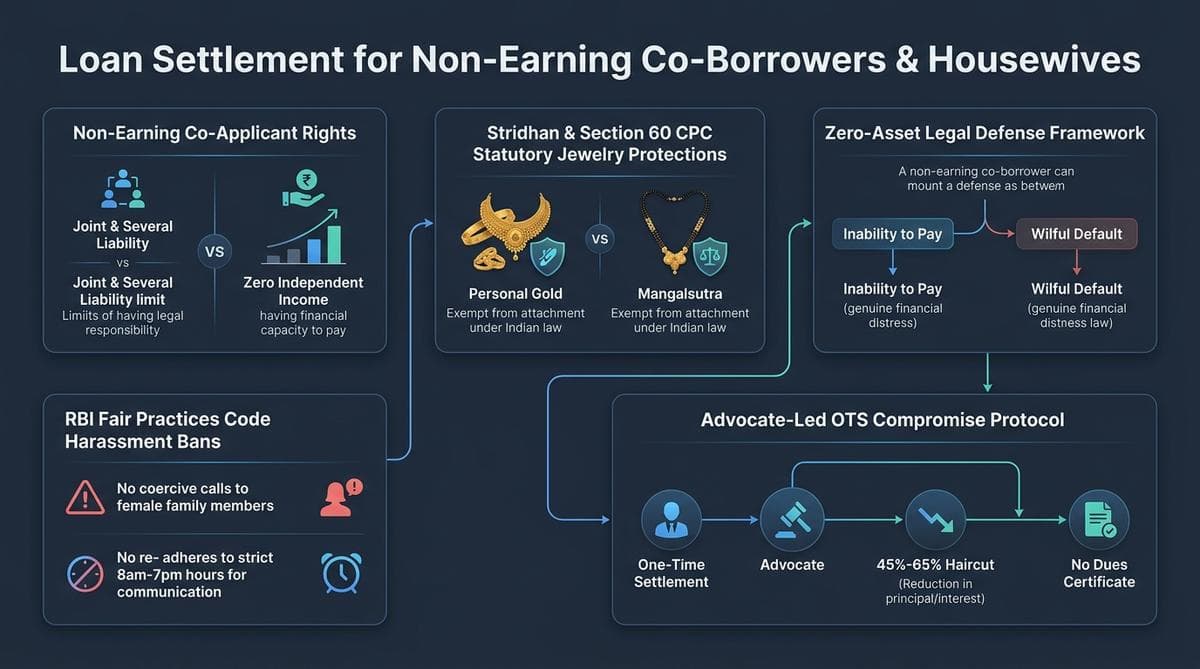
This chart outlines the 5 key pillars of co-borrower defense. It covers Stridhan rights, the Zero-Asset rule, RBI safeguards, and the steps to get an OTS waiver:
6. RBI Anti-Harassment Mandates for Women & Families
The RBI Master Direction on Fair Practices Code sets strict rules for debt recovery:
Banks cannot use abusive words or threaten female family members.
Agents can only call or visit between 8:00 AM and 7:00 PM.
Agents cannot contact neighbors or reveal your debt to others.
7. 4-Stage Advocate OTS Strategy (45%–65% Haircut)
8. Sanction Forensics & RBI ₹0 NDC Mandate
An authentic settlement letter must come on official bank letterhead. It must list both borrowers and their PAN numbers. It should state the exact settlement amount and confirm full debt closure. Always pay directly into the official bank loan account.
Under RBI Circular RBI/2023-24/60, banks must issue a No Dues Certificate (NDC) within 30 days. They must also update credit bureaus. If the bank takes longer than 30 days, it must pay you ₹5,000 per day in compensation.
9. Co-Borrower Legal Rights vs Threats Matrix
| Recovery Agent Threat | Governing Law | Legal Reality | Advocate Action |
|---|---|---|---|
| "We will seize the housewife's gold jewelry." | Section 60(1)(a) CPC & Pratibha Rani SC Ruling | Stridhan and marriage jewelry are 100% safe from court attachment. | Send a legal notice to the bank and file a police complaint if agents threaten you. |
| "Police will arrest the non-earning co-borrower." | Article 21 Constitution & Order 21 CPC | A loan default is a civil matter. Police cannot arrest you for unpaid loans. | Report unlawful threats to the Principal Nodal Officer and the RBI Ombudsman. |
| "We will auction household furniture." | Section 60(1) Proviso (a) CPC | Basic clothes, cooking pots, and beds cannot be seized by law. | Do not let agents in. Record video proof if they enter without permission. |
| "Co-borrower must pay immediately or go to jail." | Order 21 Rule 37 CPC (Zero-Asset Defense) | Courts will not detain debtors who lack the money to pay. | Submit income hardship proofs and negotiate a 45% to 65% OTS waiver. |
10. SettleLoans Homemaker Defense & Advisory
SettleLoans helps non-earning co-borrowers and homemakers across India. Our legal team stops recovery harassment and protects your Stridhan rights. We file complaints with the RBI Ombudsman when agents break rules. We also negotiate directly with bank heads to secure 45% to 65% waivers and official No Dues Certificates.

Settle Loan is India's trusted debt relief and loan settlement platform. We help borrowers overcome financial distress by negotiating with banks and NBFCs to legally settle personal loans and credit card debts. With our transparent, performance-based approach, you can achieve debt freedom and regain your financial peace of mind.
COMPUTER
11. Frequently Asked Questions
Can a bank legally seize a housewife's wedding gold or jewelry for an unpaid loan?
No. Under Section 60(1) proviso (a) of the Code of Civil Procedure (CPC), 1908, your jewelry is safe. A woman's clothes, kitchen vessels, and holy ornaments like the Mangalsutra and Stridhan cannot be seized. Banks cannot attach or auction them for personal loans. This protection holds unless you gave the gold as loan collateral.
What is the extent of legal liability for a non-earning co-borrower under Indian law?
Section 128 of the Indian Contract Act makes a co-borrower equally liable. But civil courts can only attach assets you actually own. If you have no salary, income, or property, the bank cannot seize anything. They cannot touch non-existent assets or protected Stridhan.
Can recovery agents harass, call, or intimidate a female co-borrower at home?
No. The RBI Fair Practices Code bans abuse and threats. Recovery agents can only call between 8:00 AM and 7:00 PM. Harassing women at home is a crime under Sections 503, 506, and 509 IPC (Sections 351, 356, and 79 BNS). You can report rogue agents directly to the RBI Ombudsman.
What is the Zero-Asset Defense in civil loan recovery execution petitions?
Under Order 21 Rule 37 CPC, civil courts protect borrowers without money. The court will not order detention if you have no income or property. The Zero-Asset Defense proves your hardship in court. It shows you cannot pay due to genuine distress.
Can a housewife or non-earning co-applicant be arrested or sent to jail?
No. A loan default is purely a civil dispute. Police cannot arrest you for failing to pay an unsecured loan. Arrest only applies if you signed a bounced cheque under Section 138 NI Act.
How does a One-Time Settlement (OTS) resolve liability for both borrower and co-borrower?
A bank OTS letter clears both the borrower and co-borrower. You pay an agreed sum, usually 45% to 65% of the principal. Once paid, the bank issues a joint No Dues Certificate. This cancels all remaining debt.
What should a housewife do if recovery agents show up unannounced at her doorstep?
Do not let agents inside your house. Ask for their bank ID, DRA certificate, and authority letter. Record video of their visit. Call the police if they shout or threaten you. A lawyer can also send them a legal notice to stop visits.
Does loan settlement negatively impact the CIBIL score of a non-earning co-borrower?
Yes. Credit bureaus will mark the loan account as 'Settled'. But it removes your debt burden and ends agent harassment. You can rebuild your credit score later using secured cards or fixed deposits.
What is the mandatory RBI timeline for issuing a No Dues Certificate after settlement?
Under RBI Circular RBI/2023-24/60, banks must issue a No Dues Certificate within 30 days of payment. If the bank delays beyond 30 days, it must pay you ₹5,000 for each day of delay.