- Total Prohibition on Contact Harvesting. RBI lending rules ban this practice. The DPDP Act also forbids reading phonebooks or photo galleries.
- Invalidity of Forced Consent. Forced app permissions fail legal standards. Section 6 of the DPDP Act treats them as void.
- Massive DPBI Financial Sanctions. The Data Protection Board can act swiftly. It can levy fines up to ₹250 Crores on lenders.
- Cognizable Criminal Offenses. Messaging contacts or creating shaming groups is a crime. It is punishable under Section 308 BNS and Section 66E IT Act.
- Direct Advocate Intervention. A legal Cease-and-Desist notice stops harassment at once. It also opens official bank settlement channels.
1. The Predatory Ecosystem
Instant loan apps in India pose serious privacy risks. Many apps use tracking kits during installation. They demand phone permissions under false fraud checks. The app then copies contact lists, call logs. And photos to remote servers.
When a borrower faces financial delay, rogue lenders exploit this data. Recovery agents send abusive texts, morphed photos. And fake notices to relatives. This tactic uses social stigma to extort money quickly.
People in your phonebook never gave consent. Stealing their data violates their right to privacy. This makes phonebook harvesting both illegal and criminal.
Many borrowers think clicking "Allow". waives all rights. That is not true. Under the DPDP Act 2023, forced consent cannot make data theft legal.
2. The DPDP Act 2023 Statutory Architecture
The DPDP Act 2023 protects loan borrowers across India. The law calls the borrower a "Data Principal". It calls the lender a "Data Fiduciary". The Act sets strict rules on collecting, using. And deleting data.
Section 4 requires lawful consent for data processing. Section 5 mandates clear notice before taking any data. The notice must state what data is collected. It must explain user rights and DPBI complaint steps.
Key DPDP Act 2023 Statutory Provisions Governing Loan Apps
Section 6: Forced and Bundled Consent is Void.
Consent must be free, specific. And clear. Forcing contact access for loan approval is illegal. Borrowers can withdraw consent at any time.
Section 8: Duties and Full Liability of Lenders.
Lenders must safeguard user data. Data Fiduciaries remain liable for unlawful acts by recovery agents and third-party vendors.
Section 12 &. 13: Right to Data Deletion and Grievance Desk.
Data Principals have a legal right to erase personal data. Lenders must provide a grievance desk and answer queries on time.
Section 33 &. Schedule: Heavy fines for Non-Compliance.
The DPBI can levy heavy fines. It can penalize breaches up to ₹250 Crores. It can fine consent failures up to ₹200 Crores.
Scraping an address book breaks Section 6 and Section 8. The people in the list never gave consent. Thus, the lender has no right to hold or call those numbers.
Check Your Loan Settlement Options
Answer 2 quick questions to evaluate your settlement eligibility.
1. What type of loan do you want to settle?
3. RBI Digital Lending Directives vs. Predatory Mobile App
The DPDP Act aligns with Reserve Bank of India rules. On September 2, 2022, the RBI issued its Digital Lending Guidelines (Circular RBI/2022-23/111 DOR.CRE.REC.66/21.07.001/2022-23). These rules apply to all banks, NBFCs. And lending apps.
The RBI rules set firm restrictions on app access:
Mandatory RBI Digital Lending Standards
Strict Ban on Access to Contacts and Media.
Loan apps cannot access contacts, call logs, or media files. Only one-time camera and microphone access for KYC is allowed.
Direct Fund Transfer and Loan Repayments.
Funds must move directly between bank accounts. Regulated lenders and borrowers cannot use third-party pool accounts.
Key Fact Statement (KFS) Rules.
Lenders must provide a clear KFS before signing. It must state total APR, recovery rules. And grievance contacts.
Local Data Storage and Deletion Rules.
All borrower data must stay on servers in India. Users can revoke consent and demand full data deletion.
The RBI holds licensed NBFCs strictly responsible. If a partner app abuses contacts, the NBFC faces steep fines and license cancel.
4. Penal Liabilities, Blackmail & Cyber Crime Sanctions
Threatening borrowers or sharing morphed pictures is a crime. Such conduct triggers immediate criminal liability.
Under the Bharatiya Nyaya Sanhita, 2023 (BNS) and the IT Act 2000, borrowers have strong legal remedies against rogue agents:
Section 308 BNS / Section 383 IPC: Extortion.
Demanding money by threatening family or work reputation is extortion. It carries heavy prison terms.
Section 351 BNS / Section 503 &. 506 IPC: Criminal threats.
Threatening a person's reputation or safety to cause fear is punishable with up to two years in jail.
Section 356 BNS / Section 499 &. 500 IPC: Criminal Defamation.
Sending false statements about a borrower to relatives or coworkers is criminal defamation.
Section 66E, 67 &. 72A Information Technology Act, 2000.
Section 66E bans privacy breaches. Section 67 penalizes obscene media. Section 72A punishes illegal data sharing with up to 3 years in jail.
In Justice K.S. Puttaswamy (Retd.) v. Union of India (2017) 10 SCC 1, the Supreme Court ruled privacy is a fundamental right under Article 21. Stealing contact lists directly violates this constitutional right.
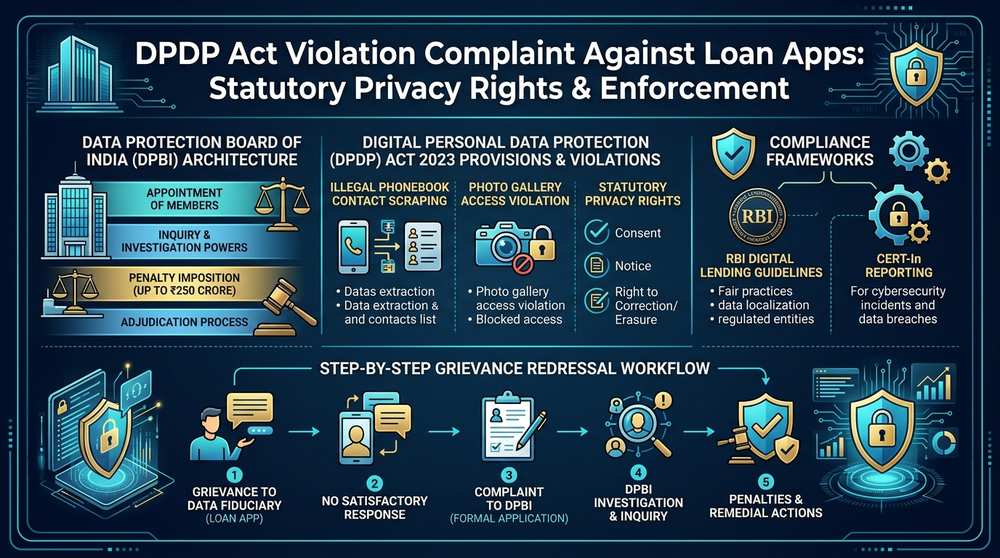
6. Step-by-Step Legal Procedure
Borrowers must follow a clear legal path under the DPDP Act. A structured four-stage plan ensures swift action:
Stage 1: Digital Proof &. Evidence Collection.
Save screenshots of permissions, threats, call logs. And receipts. Keep all agent phone numbers and message headers.
Stage 2: Legal Notice to Data Protection Officer.
Send a formal legal notice to the lender and partner NBFC. Demand an immediate halt to harassment and full data deletion under Section 12.
Stage 3: Online Petition to the Data Protection Board.
If the lender fails to respond, lodge an online complaint on the DPBI portal. List violated sections and attach proof.
Stage 4: Reporting to RBI CMS &. Cyber Portal.
File a complaint on the RBI portal (cms.rbi.org.in). Report criminal threats at cybercrime.gov.in or call 1930.
This legal approach shifts pressure to the lender. Facing DPBI fines and RBI scrutiny, regulated NBFCs stop recovery harassment quickly.
7. Fintech NPA Accounting Realities
Apps use aggressive collection because micro-loans are unsecured. Unlike home loans, digital loans carry no collateral.
Under RBI rules, overdue loans turn into Non-Performing Assets (NPAs) after 90 days. Lenders then face strict provisioning rules:
- Substandard Assets (Up to 12 Months Overdue): Mandatory 15% provisioning on unsecured debt.
- Doubtful Assets (12 to 24 Months Overdue): Mandatory 100% provisioning against overdue balances.
- Loss Portfolios / Complete Write-Offs: 100% loss deducted directly from net quarterly profits.
Civil suits are too slow and costly for small loans. Court fees and litigation delay profits. Lenders therefore evaluate recovery with this formula:
Here C_t is expected cash recovery. And r is the discount rate. Deductions include legal fees, loan provisioning, and DPDP fines up to ₹250 Crores.
A DPDP legal notice alters the risk balance. The threat of a ₹250 Crore fine exceeds the loan balance. Lenders agree to a One-Time Settlement (OTS) with 40% to 70% waivers and data deletion.
8. Cease-and-Desist Notices, Evidence Preservation
Never pay cash or UPI sums without official papers. Rogue agents pocket the money, leaving the loan active.
Borrowers should resolve their debt using a three-pillar legal plan:
1. legal Cease-and-Desist.
Send a legal notice citing DPDP Sections 6 and 8, RBI rules, and BNS provisions to stop harassment calls immediately.
2. Formal Sanction Letter.
Secure an official OTS letter on NBFC letterhead with clear waiver terms and data erasure terms.
3. Stamped NDC &. CIBIL Update.
Pay directly into the lender's bank account. Obtain a stamped No Dues Certificate and verify bureau closure.
After issuing the No Dues Certificate, the lender must delete all stored device data and contact records under DPDP rules.
9. Comparative DPDP Enforcement & Debt Matrix
The table below outlines legal mandates and fines under Indian digital lending laws:
| legal Framework. | Governing Authority. | Contact Scraping Legality. | allowed Data Scope. | fines &. Legal Remedies. |
|---|---|---|---|---|
| DPDP Act, 2023 (Sec 4, 6, 8, 33). | Data Protection Board of India (DPBI). | Strictly Illegal. (Void without specific consent). | Minimal data strictly needed for the loan. | Fines up to ₹250 Crores per breach. Mandatory data deletion orders. |
| RBI Digital Lending Guidelines (2022). | Reserve Bank of India. | Explicitly Barred. (No access to contacts or gallery). | One-time camera and mic access for KYC only. | cancel of NBFC license. App store delisting. |
| Information Technology Act, 2000. | Cyber Crime Police &. Adjudicating Officers. | Punishable Offense. (Sec 66E, 72A privacy breach). | Strict duty to protect personal data. | Up to 3 years prison. Civil damages and corporate fines. |
| Bharatiya Nyaya Sanhita, 2023. | Criminal Judicial Courts &. State Police. | Cognizable Crime. (Sec 308 Extortion, Sec 351 threats). | Zero legal right to harass third-party contacts. | Criminal warrants, police arrest. And asset seizure. |
| Consumer Protection Act, 2019. | District &. State Consumer Commissions. | Unfair Trade Practice. &. service defect. | Fair, transparent. And balanced loan terms. | Substantial payout for harassment and distress. |
10. SettleLoans Cyber-Legal Defense Framework
No borrower should face cyber threats, phonebook theft, or family harassment from loan apps. SettleLoans provides swift legal defense against predatory lenders across India. Our legal team serves Cease-and-Desist notices under the DPDP Act and RBI rules. We file complaints with the DPBI and cyber police. We negotiate 40% to 70% One-Time Settlements with official No Dues Certificates.

Settle Loan is India's trusted debt relief and loan settlement platform. We help borrowers overcome financial distress by negotiating with banks and NBFCs to legally settle personal loans and credit card debts. With our transparent, performance-based approach, you can achieve debt freedom and regain your financial peace of mind.
COMPUTER
11. FAQs: DPDP Act & Predatory Loan App Complaints
Verified legal answers regarding the Digital Personal Data Protection Act 2023, Data Protection Board complaints, contact scraping prohibitions. And debt resolution.
Can a digital loan app legally access or download my phone contacts list in India?
No. The RBI Digital Lending Guidelines strictly ban this practice. Section 6 of the DPDP Act 2023 also forbids it. Digital loan apps cannot access your phonebook, call logs, or media gallery. Any loan app demanding contact access violates Indian law.
What penalties can the Data Protection Board of India impose on loan apps violating the DPDP Act?
The Data Protection Board of India holds strong penal powers. It can levy fines up to ₹250 Crores for personal data breaches. It can also impose fines up to ₹200 Crores for failing user consent rules.
What immediate legal steps should I take if a loan app messages my phone contacts or relatives?
First, save all evidence like chat screenshots, call logs, and app links. Next, send a legal Cease-and-Desist notice to the lender. Then, file a complaint with the Data Protection Board. You can also report cyber harassment at cybercrime.gov.in.
Does giving app permission during installation count as lawful consent under the DPDP Act, 2023?
No. Section 6 of the DPDP Act requires free and specific consent. Forced permissions are not lawful consent. If an app blocks loans unless you share contacts, the agreement is legally void.
Can I file an FIR with local police against a loan app for creating WhatsApp groups with my contacts?
Yes. Creating shaming groups or sending morphed photos is a crime. You can file an FIR under Section 308 and Section 351 of the BNS. You can also cite Sections 66E and 67 of the IT Act.
How does the DPDP Act 2023 affect regulated NBFC partners funding predatory loan apps?
Regulated NBFC partners act as Data Fiduciaries under the law. The fintech app acts as a Data Processor. Under Section 8, the NBFC is fully liable for data leaks and illegal contact harvesting.
What is the procedure for filing a complaint with the Data Protection Board of India (DPBI)?
First, send a grievance notice to the lender. If they fail to fix the issue, lodge a complaint on the DPBI portal. List the violated sections, attach evidence, and request statutory action.
How does a debt settlement advocate help when dealing with an abusive fintech loan app?
A debt advocate serves legal notices under the DPDP Act and RBI rules. This stops recovery agent harassment immediately. The advocate then helps negotiate a legal One-Time Settlement with full data deletion.