- Statutory Compromise Rights: Borrowers facing genuine financial distress hold the legal right under RBI Master Directions on Compromise Settlements to negotiate a formal One-Time Settlement (OTS) with Bhanix Finance and Investment Limited.
- Eliminating Compounding Penalties: Rapidly accumulating daily late fees, bounce charges, and penal interest (reaching 36%–48% APR) can be legally audited and 100% eliminated during compromise negotiations under RBI Fair Lending Directives.
- Realistic 40%–65% Principal Waivers: When an account transitions into Non-Performing Asset (NPA) status (90+ DPD) or technical write-off, Bhanix Finance evaluates recovery via Net Present Value (NPV) mathematics, unlocking substantial debt haircuts.
- Defending Advocate Legal Notices: Demand notices issued by Mumbai or Bengaluru law firms under Section 25 PSSA or unilateral arbitration notices can be effectively answered and converted into binding compromise settlements.
- Mandatory ₹0 NDC Delivery: Under RBI Circular RBI/2023-24/60, Bhanix Finance must issue a formal No Dues Certificate and update credit bureaus within 30 days of settlement payment, backed by a ₹5,000 per day statutory delay penalty.
Understanding CASHe Apps Digital Underwriting Bhanix Finances
The CASHe mobile application, engineered by Aeries Financial Technologies Private Limited, operates as one of India's most prominent digital lending platforms tailored primarily for young salaried professionals, gig-economy workers, and tech employees seeking short-term unsecured credit lines and instant personal loans ranging from ₹10,000 to ₹4,00,000. While the consumer interacts with the sleek mobile interface of CASHe, the actual credit evaluation, capital disbursement, and regulatory reporting are legally executed by its associated Reserve Bank of India (RBI) registered Non-Banking Financial Company (NBFC), Bhanix Finance and Investment Limited.
Unlike traditional public or private sector commercial banks that underwrite loans through conservative physical verification, income-tax returns, and strict debt-to-income benchmarks, CASHe utilizes a proprietary artificial intelligence scoring algorithm known as the Social Loan Quotient (SLQ). This automated risk engine analyzes alternative digital data points—such as smartphone digital footprints, transaction SMS logs, salary credit patterns, and professional social profiles—to sanction rapid, high-frequency credit lines.
Because these digital credit lines are completely unsecured and carry high effective Annual Percentage Rates (APRs) ranging from 28% to over 48% per annum, any sudden disruption in the borrower's financial stability—such as corporate layoffs, startup downsizing, medical emergencies, or salary delays—can instantly trigger a severe debt spiral. When an Equated Monthly Installment (EMI) bounces, the NBFC's algorithmic collection systems automatically deploy high-velocity recovery actions: high-frequency automated tele-calling, rapid late payment penalty levies, and repetitive electronic National Automated Clearing House (e-NACH) debit presentations.
It is vital for distressed salaried borrowers to recognize that defaulting on an unsecured fintech loan is strictly a civil breach of contract under the Indian Contract Act, 1872, and does not constitute a criminal offense. Under the statutory framework established by the Reserve Bank of India Master Directions on Compromise Settlements and the RBI Digital Lending Guidelines, borrowers possess clear legal entitlements to halt recovery agent intimidation, demand an exhaustive audit of arbitrary penalty charges, and negotiate a legally binding One-Time Settlement (OTS) with significant principal waivers.
CASHe Delinquency Lifecycle: From DPD 1-30 to Non-Performing Asset (NPA)
Under the Reserve Bank of India Prudential Norms on Income Recognition, Asset Classification and Provisioning (IRACP) and the Indian Accounting Standard 109 (Ind AS 109) Expected Credit Loss (ECL) frameworks, Bhanix Finance systematically transitions delinquent loan accounts across standardized Days Past Due (DPD) aging buckets. Recognizing the exact operational and legal characteristics of each bucket enables borrowers to determine the optimal timing for settlement negotiations.
During the early delinquency phases (SMA-0 and SMA-1), collection efforts are heavily automated, relying on internal call centers and outsourced third-party tele-calling agencies attempting to force complete installment regularization. However, once the default crosses 90 consecutive days, the loan account is statutorily classified as a Non-Performing Asset (NPA). At this stage, Bhanix Finance is legally mandated to freeze interest income recognition and lock capital in balance-sheet provisions, shifting the lender's institutional focus from aggressive full recovery to pragmatic bad-debt loss mitigation through compromise settlements.
| Delinquency Stage | Overdue Days (DPD) | Bhanix / CASHe Recovery Actions | Legal & Statutory Exposure | Settlement Haircut Potential |
|---|---|---|---|---|
| SMA-0 (Early Default) | 1 – 30 Days | Automated IVR calls, daily SMS/WhatsApp alerts, repeated e-NACH presentation sweeps. | Zero litigation; initial credit bureau DPD reporting initiated. | Negligible (Lender demands 100% overdue EMI payment). |
| SMA-1 (Mid Delinquency) | 31 – 60 Days | Aggressive tele-calling by outsourced agencies, urgent loan acceleration warnings. | Loan recall notices issued; substantial CIBIL score drop begins. | Low (Restructuring or tenure extension occasionally offered). |
| SMA-2 (Pre-NPA Escalation) | 61 – 90 Days | Intensive recovery pressure, legal warning emails, mandate bounce notices. | Section 25 PSSA / Section 138 NI Act statutory 15-day demand notices. | Moderate (Discussions to waive penal fees can commence). |
| NPA (Substandard Asset) | 91 – 180 Days | Transferred to NBFC Stressed Assets Desk; mandatory Ind AS 109 balance-sheet provisioning. | Advocate notices from Mumbai/Bengaluru law firms; conciliation referrals. | High (40%–50% Principal Haircut). |
| Doubtful / Loss Asset | 181 – 365+ Days | Substantial capital provisioning absorbed; evaluated for internal technical write-off. | Private arbitration claims, Magistrate Court summons, Lok Adalat notices. | Maximum (50%–65% Principal Haircut). |
Once a CASHe loan enters Doubtful Asset or Loss Asset classification, Bhanix Finance recognizes that the legal and administrative costs of prolonged civil recovery far exceed the discounted recovery value. Consequently, the NBFC's internal Credit Committee becomes highly receptive to structured, lump-sum One-Time Settlement offers submitted through formal legal representation.
Check Your Loan Settlement Options
Answer 2 quick questions to evaluate your settlement eligibility.
1. What type of loan do you want to settle?
Stopping Rapid Late Fee Accumulation, Penal Interest & Repetitive NACH Bounces
One of the most distressing experiences for defaulted CASHe borrowers is the alarming speed at which ledger balances inflate. A defaulted credit line of ₹80,000 can rapidly surge beyond ₹1,40,000 within just a few months due to compounding late payment charges, daily penal fees, processing surcharges, and repeated e-mandate presentation return fees.
Bhanix Finance routinely programs automated systems to present electronic NACH mandates multiple times in a single billing cycle. When the borrower's bank account lacks sufficient funds, each failed presentation triggers a double financial penalty: the borrower's primary bank levies a dishonour fee of ₹250 to ₹590, while the CASHe ledger adds an internal bounce fee of ₹500 to ₹1,000 plus GST. This destructive cycle rapidly exhausts any remaining bank balance.
Borrowers can decisively halt this financial drainage by taking two statutory measures: First, submitting a formal mandate cancellation or suspension request to their destination bank under National Payments Corporation of India (NPCI) circulars, which legally terminates recurring automated debit sweeps. Second, invoking the Reserve Bank of India's Fair Lending Practice Circular (RBI/2023-24/53) regarding Fair Lending Practice - Penal Charges in Loan Accounts. Under these RBI directives, lenders are strictly prohibited from capitalizing penal charges or levying punitive interest masquerading as compounding interest. During professional settlement negotiations, legal counsel enforces an exhaustive forensic audit of the loan ledger, demanding the complete 100% elimination of all accumulated bounce fees, penal surcharges, and late payment penalties.
How Bhanix Finance Evaluates Compromise Settlements: The NPV Recovery Benchmark
Non-Banking Financial Companies do not grant loan settlement waivers out of charity; every compromise sanction is strictly justified through rigorous institutional accounting. Under RBI Master Directions, Bhanix Finance's Credit Committee must evaluate whether accepting an immediate discounted cash settlement yields a superior financial return compared to the uncertain Net Present Value (NPV) of pursuing protracted legal litigation against an unsecured borrower.
When an unsecured digital loan defaults, Bhanix Finance faces substantial operational frictions: recurring advocate retainers, court filing fees in distant jurisdictions, third-party collection agency commissions (often 15% to 25% of recovered amounts), and mandatory capital provisioning that prevents the NBFC from deploying funds into profitable new lending. The mathematical model governing this institutional calculation is structured as follows:
Where C_t represents estimated future cash recoveries, r denotes the NBFC discount rate, and deductions incorporate 3–5 years of judicial delays, advocate fees, collection agency commissions, and regulatory capital locked in NPA provisions.
By presenting a rigorously documented hardship dossier establishing that the borrower has zero unencumbered disposable assets and that settlement funds are being mobilized from external third-party family support, legal counsel demonstrates to Bhanix Finance that an immediate lump-sum settlement of 35% to 60% of principal delivers far greater economic value than years of futile legal recovery.
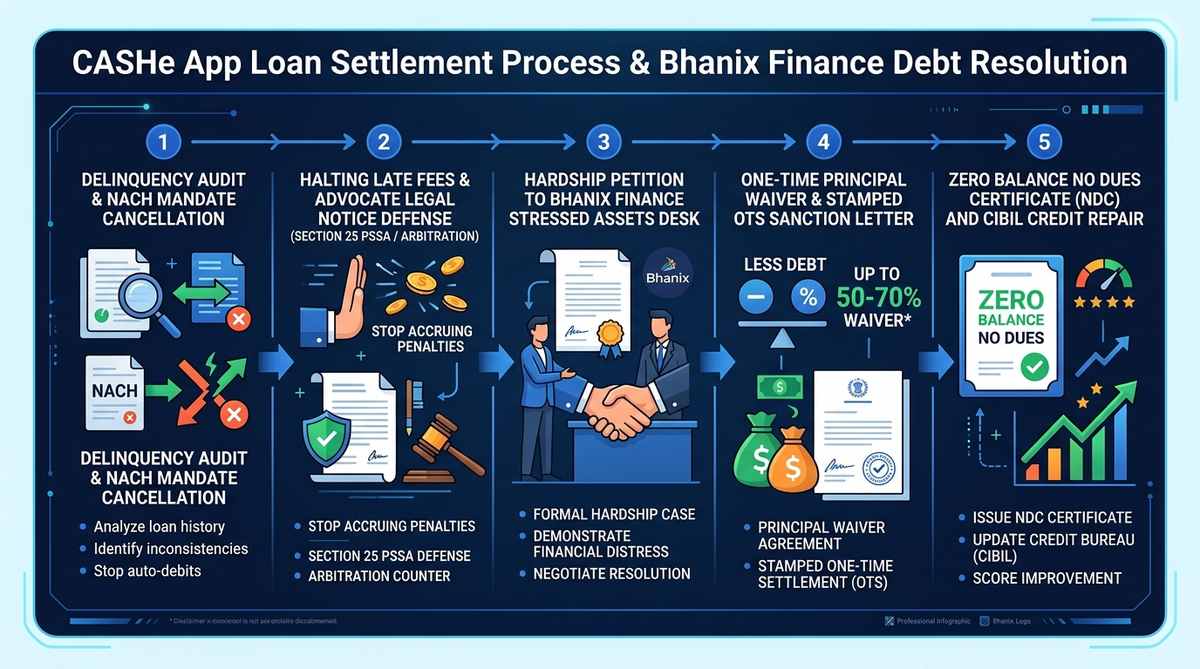
CASHe App Loan Settlement & Bhanix Finance Debt Resolution Blueprint
The visual roadmap below details the complete 5-stage institutional and legal framework required to transition a defaulted CASHe credit facility from aggressive collection harassment into a fully discharged, legally binding One-Time Settlement with a ₹0 No Dues Certificate.
Defending Against Aggressive Recovery Tactics Under RBI Digital Lending Rules
Defaulted CASHe borrowers frequently experience extreme psychological distress caused by aggressive third-party Debt Recovery Agencies (DRAs). Collection agents operate on commission incentives and frequently utilize high-pressure tactics: contacting workplace numbers, sending intimidating messages via WhatsApp, threatening to call relatives or colleagues, and threatening immediate police arrests or home seizures.
The Reserve Bank of India has established stringent, non-negotiable statutory safeguards under the RBI Digital Lending Guidelines and the Master Directions on Recovery Agents:
- Zero Contact List Access: Regulated lending apps and recovery agents are strictly prohibited from harvesting, storing, or contacting numbers from borrower smartphone contact books or photo galleries.
- Calling Hour Restrictions: Recovery personnel are legally restricted to contacting borrowers only between 08:00 AM and 07:00 PM. Calling during late night or early morning hours is a punishable regulatory offense.
- Third-Party Shaming Prohibited: Reaching out to employers, HR departments, co-workers, friends, or non-guarantor family members is strictly illegal under RBI Fair Practices Codes.
- Mandatory Identification: Every recovery agent must disclose their full identity, agency name, and official authorization letter issued by Bhanix Finance upon request.
When unlawful harassment occurs, borrowers should preserve call recordings, screenshots of threatening WhatsApp messages, and caller logs. Serving a formal legal cease-and-desist notice to Bhanix Finance's Principal Nodal Officer and filing a complaint on the RBI Integrated Ombudsman portal (CMS) triggers immediate regulatory scrutiny and forces the NBFC to halt rogue recovery operations.
Defending Advocate Legal Notices, Section 25 PSSA & Unilateral Arbitration
When a CASHe credit line reaches 60 to 120 days of non-payment, borrowers commonly receive stern legal notices sent via registered post, speed post, or email from law firms based in Mumbai (where Bhanix Finance maintains its corporate headquarters) or Bengaluru. These notices typically invoke Section 25 of the Payment and Settlement Systems Act, 2007 (PSSA) for dishonoured NACH mandates, Section 138 of the Negotiable Instruments Act, 1881, or initiate unilateral private arbitration proceedings under the Arbitration and Conciliation Act, 1996.
It is essential to understand that an advocate legal notice is a formal 15-day statutory demand, not a court decree or police warrant. Ignoring these notices is a serious mistake, as failure to respond allows the lender's counsel to establish an uncontested evidentiary record. A timely, advocate-drafted legal response setting out involuntary financial hardship, challenging excessive penal interest compounding, and formally requesting a conciliation meeting under RBI compromise guidelines effectively protects your legal rights while transferring the dispute to settlement channels.
Furthermore, regarding private arbitration notices appointing a sole arbitrator in Mumbai or Bengaluru without borrower consent, landmark Supreme Court rulings—including Perkins Eastman Architects DVM v. HSCC (India) Ltd. (2020) and TRF Ltd. v. Energo Engineering Projects Ltd. (2017)—have firmly established that unilateral arbitrator appointments by lenders are null and void in law. Experienced legal counsel can file a formal objection challenging the arbitrator's mandate under Section 12(5) and Section 14 of the Arbitration Act, compelling Bhanix Finance to withdraw the proceedings and execute a mutually agreed One-Time Settlement.
| Notice Type | Statutory Framework | Legal Impact & Risk | Strategic Defense & Countermeasure | Haircut Potential |
|---|---|---|---|---|
| Section 25 PSSA Notice | Payment & Settlement Systems Act, 2007 | Statutory 15-day demand for bounced e-NACH auto-debits. | Serve formal legal reply demonstrating lack of criminal intent and bona fide hardship. | 40% – 55% Principal Waiver |
| Sole Arbitration Notice | Arbitration & Conciliation Act, 1996 | Threat of ex-parte monetary award in distant city (Mumbai/Bengaluru). | Challenge unilateral appointment under Supreme Court Perkins Eastman precedent. | 45% – 60% Principal Waiver |
| Loan Recall Demand Notice | Indian Contract Act, 1872 | Acceleration of full loan balance and demand for total ledger sum. | Demand full ledger audit, eliminate 100% penal fees, submit formal OTS petition. | 40% – 65% Principal Waiver |
| National Lok Adalat Referral | Legal Services Authorities Act, 1987 | Pre-litigation conciliation before a judicial magistrate panel. | Participate with counsel to record binding Civil Court Decree with non-appealable finality. | 50% – 65% Principal Waiver |
Step-by-Step Roadmap: How to Negotiate a Compromise Settlement with Bhanix Finance
Executing a legally secure and financially advantageous One-Time Settlement with Bhanix Finance requires a structured, evidence-based methodology:
1Forensic Ledger Audit & Compiling the Hardship Dossier
Download complete statement logs from the CASHe mobile application and calculate exact net principal disbursed versus total repayments made. Assemble concrete documentary proof of involuntary financial distress—such as salary reduction slips, job termination letters, medical hospital bills, or bank statements showing depleted liquidity.
2Revoking e-NACH Mandates & Directing Formal Communication
Instruct your bank to revoke the automated e-NACH / UPI autopay mandate to prevent further return charges. Issue a formal notice to Bhanix Finance directing all future communication exclusively to registered email channels or designated legal counsel, establishing a verifiable written evidentiary record.
3Submitting the Formal Hardship Petition to Bhanix Stressed Assets Desk
Submit a structured compromise settlement petition addressed to Bhanix Finance's Stressed Assets Desk citing RBI Master Directions. Anchor the initial settlement offer at 25% to 35% of outstanding principal dues to create strategic bargaining room for structured counter-negotiations.
4Managing Counter-Demands & Credit Committee Approval
Bhanix Finance will initially counter with modest discounts (10%–20%). Experienced banking counsel counters by demonstrating that settlement funds are being pooled from external third-party family loans, steering the NBFC Credit Committee toward the target 40% to 65% principal waiver band.
5Forensic Verification of the Official OTS Sanction Letter
Never deposit money against verbal promises from tele-callers. Ensure Bhanix Finance issues an authentic, stamped OTS Sanction Letter on official corporate letterhead detailing the exact settlement amount, payment deadlines, loan account numbers, and explicit covenants guaranteeing full debt discharge and legal withdrawal.
6Direct Account Remittance & Enforcing ₹0 NDC Delivery
Remit the agreed settlement funds directly into your verified Bhanix Finance loan account via NEFT/RTGS. Under RBI Circular RBI/2023-24/60, Bhanix Finance is legally mandated to deliver a formal No Dues Certificate (NDC) and update credit bureaus within 30 calendar days.
Authenticating Bhanix Finance Settlement Letters & Enforcing the ₹0 NDC Mandate
A grave hazard in digital fintech loan settlement is the prevalence of unauthorized third-party collection agents issuing fabricated settlement letters or verbal discount assurances over WhatsApp to meet monthly collection targets. When an unsuspecting borrower transfers funds without authentic verification, Bhanix Finance credits the payment toward outstanding penal charges, leaving the default active and compounding.
Borrowers must verify that the OTS Sanction Letter satisfies essential forensic standards: printed on official Bhanix Finance and Investment Limited letterhead containing the Corporate Identification Number (CIN: U65910MH1996PLC300645), registered corporate office address in Mumbai, unique settlement proposal reference number, authorized signatory name, employee code, and official corporate seal.
The settlement letter must explicitly state that the agreed payment represents full and final settlement of all claims, that all pending legal or arbitration proceedings will be formally withdrawn, and that a formal No Dues Certificate (NDC) will be delivered within 30 days. Under RBI Circular RBI/2023-24/60, any failure by Bhanix Finance to issue the NDC within 30 days entitles the borrower to statutory compensation of ₹5,000 per day of delay directly from the NBFC.
CIBIL Score Trajectory Post-Settlement & 18-Month Credit Rehabilitation Plan
Upon completing a One-Time Settlement with Bhanix Finance, the lender reports the credit facility to TransUnion CIBIL, Experian, Equifax, and CRIF High Mark with the status 'Settled' or 'Post-Write-off Settled' with an outstanding balance of exactly ₹0. This reporting change causes an initial credit score drop of 70 to 120 points.
While a 'Settled' status reflects an agreed compromise rather than full original repayment, it is vastly superior to an active, compounding 'Default' status that degrades credit scores every month and invites ongoing litigation. Under RBI guidelines, a mandatory 12-month cooling-off window applies before new unsecured credit can be obtained from institutional lenders.
Borrowers can systematically rehabilitate their credit score back to 750+ within 18 to 24 months by following a proven credit repair strategy: securing a fixed-deposit-backed credit card (FD card) with a modest limit of ₹25,000 to ₹50,000, maintaining credit utilization strictly below 25%, paying 100% of statements on time, and ensuring zero subsequent loan inquiries during the rehabilitation period.
Why Distressed CASHe Borrowers Trust SettleLoans for Debt Resolution
Negotiating an optimal debt settlement with a sophisticated digital lender like Bhanix Finance / CASHe requires deep technical expertise in fintech lending algorithms, RBI digital lending guidelines, and civil litigation defense. SettleLoans provides complete legal shielding: halting recovery harassment, responding to advocate demand notices, challenging unilateral arbitration, and negotiating directly with the NBFC's senior Stressed Assets Desk to secure maximum principal waivers and authentic ₹0 No Dues Certificates.

Settle Loan is India's trusted debt relief and loan settlement platform. We help borrowers overcome financial distress by negotiating with banks and NBFCs to legally settle personal loans and credit card debts. With our transparent, performance-based approach, you can achieve debt freedom and regain your financial peace of mind.
COMPUTER
Frequently Asked Questions About CASHe App Loan Settlement
What is the CASHe app loan settlement process and which NBFC actually lends the money?
The CASHe mobile application operates as a digital lending service provider (LSP) developed by Aeries Financial Technologies, while the underlying credit facility and loan capital are disbursed by Bhanix Finance and Investment Limited, an RBI-registered Non-Banking Financial Company (NBFC). The settlement process is governed by the Reserve Bank of India Master Directions on Compromise Settlements. When an unsecured short-term loan or credit line crosses 90 days of non-payment and transitions into Non-Performing Asset (NPA) status, the borrower submits a formal financial hardship petition to Bhanix Finance's Stressed Assets Desk. Upon evaluation of the Net Present Value (NPV) of recovery, the NBFC issues an official stamped OTS Sanction Letter. Remitting the agreed settlement sum directly into the designated loan account completely discharges all legal liabilities and secures a formal No Dues Certificate (NDC).
Why do CASHe app loan balances increase so rapidly after defaulting on an EMI?
CASHe loans accumulate charges rapidly due to automated daily late payment penalties (often 0.7% to 2% per month or flat daily fee structures), compounding penal interest rates reaching up to 36% to 48% annualized APR, and repetitive e-NACH auto-debit bounce fees debited on multiple presentation sweeps. Under RBI Fair Lending Practice Circulars and Digital Lending Guidelines, excessive compounding of penal interest and disproportionate bounce charges are strictly restricted, and borrowers can legally demand a 100% waiver of these accumulated penalty add-ons during One-Time Settlement negotiations.
How should borrowers handle legal notices received from Mumbai or Bengaluru advocates representing CASHe?
Legal notices issued by advocates in Mumbai (where Bhanix Finance is registered) or Bengaluru under Section 25 of the Payment and Settlement Systems Act, 2007 (PSSA) or Section 138 of the Negotiable Instruments Act are formal 15-day statutory demands resulting from dishonoured electronic mandates. They are not court summons, arrest warrants, or police FIRs. Borrowers should promptly engage banking advocates to serve a structured legal reply demonstrating bona fide, involuntary financial hardship, citing RBI compromise directives, and initiating formal OTS settlement negotiations to resolve the dispute before any court filing occurs.
What percentage of debt waiver or principal haircut can you realistically negotiate with CASHe / Bhanix Finance?
On defaulted CASHe unsecured credit lines, borrowers can realistically negotiate debt waivers ranging between 40% and 65% of total ledger dues, alongside a 100% complete waiver of all accumulated late fees, bounce penalties, and penal interest. The achievable principal haircut depends on the aging of default (accounts overdue beyond 180 to 365 days in Doubtful or Loss Asset status qualify for maximum waivers) and the strength of the documented financial hardship dossier.
Can CASHe recovery agents access my phone contact list or call my employer and family members?
No. Under the Reserve Bank of India Digital Lending Guidelines (2022/2023) and Master Directions on Recovery Agents, regulated entities and their digital lending apps are strictly prohibited from accessing mobile contact lists, photo galleries, or social media files. Furthermore, recovery agents are legally prohibited from calling employers, colleagues, neighbors, or non-guarantor family members. Any such unauthorized contact constitutes a severe regulatory breach punishable under RBI ombudsman frameworks and consumer protection laws.
Can CASHe or Bhanix Finance file a police complaint or have a borrower arrested for loan default?
No. An unsecured personal loan or digital credit line default is strictly a civil dispute arising from contractual non-performance under the Indian Contract Act, 1872. Police stations have zero legal jurisdiction to register an FIR, initiate criminal investigations, or execute arrests for inability to repay personal loan debt. While lenders can pursue compoundable quasi-criminal proceedings under Section 25 PSSA for dishonoured mandates in Magistrate Courts, these are routinely disposed of through advocate representation and compromise settlements.
How should borrowers handle unilateral arbitration notices issued by CASHe / Bhanix Finance?
Bhanix Finance occasionally issues notices invoking private arbitration before a sole arbitrator in Mumbai. Under landmark Supreme Court rulings (Perkins Eastman Architects DVM v. HSCC (India) Ltd. and TRF Ltd. v. Energo Engineering Projects Ltd.), unilateral appointment of a sole arbitrator by a lender without mutual borrower agreement is invalid in law. Legal counsel can serve a formal objection challenging the arbitrator's jurisdiction under Section 12(5) and Section 14 of the Arbitration and Conciliation Act, 1996, effectively halting ex-parte proceedings and directing the NBFC toward compromise settlement.
How can borrowers permanently stop recurring CASHe e-NACH auto-debit bounce fees in their bank accounts?
Borrowers can stop recurring mandate bounce penalties by: (1) Logging into their bank's internet banking portal or visiting their home branch to submit a formal e-NACH / UPI autopay mandate revocation request under National Payments Corporation of India (NPCI) procedural guidelines; (2) Serving a formal written intimation to Bhanix Finance requesting an immediate freeze on automated presentation sweeps; (3) Insisting on a complete waiver of all historic bounce fees during final One-Time Settlement accounting.
How does settling a CASHe loan affect your CIBIL credit score and bureau report?
Upon receipt of the negotiated settlement payment, Bhanix Finance updates credit information companies (TransUnion CIBIL, Experian, Equifax, CRIF High Mark) with the status 'Settled' or 'Post-Write-off Settled' with an outstanding balance of ₹0. While this produces a temporary credit score drop of 70 to 120 points, it permanently halts compounding monthly DPD delinquency marks. Borrowers can systematically rebuild their CIBIL score back to 750+ within 18 to 24 months through disciplined usage of secured credit cards.
How long does Bhanix Finance take to issue the No Dues Certificate (NDC) after settlement payment?
Under Reserve Bank of India Circular RBI/2023-24/60 on Release of Movable/Immovable Property Documents and Loan Closure, Bhanix Finance and Investment Limited is legally mandated to deliver an authentic No Dues Certificate (NDC) and update credit bureaus within 30 calendar days of receiving full settlement payment. If the lender fails to deliver the closure certificate within this statutory window, it is liable to pay mandatory compensation of ₹5,000 per day of delay directly to the borrower.
Official Regulatory References & Statutory Circulars
- Reserve Bank of India (RBI): Master Direction on Compromise Settlements and Technical Write-offs (DOR.STR.REC.20/21.04.048/2023-24)
- RBI Digital Lending Guidelines: Guidelines on Digital Lending & Fair Practices Code for Non-Banking Financial Companies (NBFCs)
- Bhanix Finance and Investment Limited / CASHe: Fair Practices Code, Customer Grievance Redressal Policy & Nodal Officer Details
- Reserve Bank - Integrated Ombudsman Scheme, 2021: Online Portal for Complaints on Digital Lending Harassment & Excessive Penal Charges
- National Legal Services Authority (NALSA): Legal Services Authorities Act, 1987 — National Lok Adalat Conciliation Framework