- Zero Equipment Vulnerability on Unsecured Loans: Unsecured doctor loans, professional overdrafts, and clinic credit cards carry no lien or hypothecation over diagnostic machines, surgical tools, or clinic premises.
- NMC & State Medical Council Immunity: A commercial loan default is strictly a civil contractual breach under the Indian Contract Act, 1872. It does not affect professional medical licenses or violate NMC ethics.
- Strict Anti-Harassment Protections: RBI Fair Practices Codes strictly prohibit recovery agents from entering clinical consulting rooms, hospital OPD corridors, or contacting patient reception staff.
- Structured 40%–60% Haircut via NPV Math: Banks recognize that prolonged civil litigation against unsecured medical professionals is economically inefficient, enabling structured OTS principal reductions.
- Mandatory ₹0 No Dues Certificate: Under RBI Circular RBI/2023-24/60, lenders must issue an authentic No Dues Certificate and update bureau records within 30 days of settlement payment.
Medical Professional Debt: Expansion vs Cash-Flow
In India's healthcare sector, establishing and scaling a private medical clinic, diagnostic center, dental operatory, or surgical nursing home requires immense capital expenditure. Leading private banks and systemically important NBFCs—including HDFC Bank, ICICI Bank, Axis Bank, State Bank of India, Bajaj Finance, and Aditya Birla Finance—aggressively market specialized 'Doctor Loans' and professional credit lines with limits reaching ₹50 Lakhs to ₹1.5 Crores without demanding tangible collateral upfront.
While these credit lines enable medical practitioners to purchase advanced imaging equipment, finance interior fit-outs, and meet clinical payroll, they introduce severe balance-sheet vulnerability. Medical professionals frequently encounter severe operational cash-flow mismatches. Delayed reimbursement cycles from Third-Party Administrators (TPAs) and corporate insurance empanelments often lock operating funds for four to nine months. Concurrently, escalating biomedical waste compliance costs, high technician salaries, aggressive corporate hospital chain competition, and commercial rent inflation can rapidly compress clinical operating margins.
When an unexpected disruption occurs—such as a key associate doctor departure, local regulatory zoning disputes, personal health emergencies, or diagnostic referral declines—the medical practice faces immediate liquidity exhaustion. Unable to service monthly installments ranging from ₹1.5 Lakhs to ₹4 Lakhs, the practitioner is subjected to automated penal interest levies of 24% to 36% per annum, electronic mandate return penalties, and aggressive debt collection activities.
Classifying Medical Liabilities: Unsecured Professional Lines vs Secured Asset Finance
To design a successful debt resolution and compromise settlement strategy, a medical practitioner must clearly differentiate between the distinct categories of credit facilities extended by commercial lenders. Each loan product carries unique contractual terms, recovery mechanisms, and statutory risk parameters:
| Credit Facility Type | Underlying Collateral | Recovery Framework | Asset Seizure Risk | Settlement Haircut Window |
|---|---|---|---|---|
| Unsecured Doctor Professional Loan | Zero collateral (sanctioned on MBBS/MD/MS degrees) | Civil Suit (Order 37 CPC), Sec 25 PSSA, Arbitration | Zero (Bank cannot touch clinic assets) | 40% – 60% Principal Waiver |
| Professional Overdraft / Line of Credit | Unsecured cash-credit limit against practice turnover | Civil summary proceedings, Lok Adalat conciliation | Zero (No charge registered on clinic) | 45% – 65% Debt Reduction |
| Medical Equipment Lease / Loan | Hypothecation of specific diagnostic machine | Repossession under hypothecation deed, DRT | High (Lender holds specific asset lien) | Restructuring or Shortfall OTS (30%–50%) |
| Secured Clinic Mortgage / LAP | Commercial clinic premises or residential title deeds | SARFAESI Act, 2002 (Sec 13(2), Sec 13(4) notices) | High (Immovable property attachment) | 15% – 30% (Requires asset defense / sale) |
Most doctors facing collection pressure carry multiple high-ticket unsecured professional loans alongside business credit cards. Because these unsecured facilities carry zero underlying mortgage on clinic premises or diagnostic machinery, the lending institution holds no summary power of asset seizure. The lender's recovery options are limited to formal civil litigation, which takes several years in Indian courts, creating strong economic leverage for the doctor to negotiate an authorized One-Time Settlement (OTS).
Check Your Loan Settlement Options
Answer 2 quick questions to evaluate your settlement eligibility.
1. What type of loan do you want to settle?
Safeguarding Clinical Machinery: Section 60(1)(c) CPC & Asset Protection Doctrines
A primary anxiety among indebted healthcare professionals is whether a defaulted bank or aggressive recovery agent can enter their clinic and confiscate essential diagnostic equipment—such as ultrasonography machines, digital radiography systems, dental chairs, pathology analyzers, or endoscopic suites.
Indian jurisprudence establishes robust statutory barriers against arbitrary asset seizure. First, if the credit facility is an unsecured doctor loan, the lending institution has no contractual lien or hypothecation over any clinic equipment. Any attempt by third-party agency staff to touch, tag, or confiscate clinical property constitutes criminal trespass under Section 329 of the Bharatiya Nyaya Sanhita, 2023 (formerly Section 441 IPC) and extortion.
Second, under Section 60(1)(c) of the Code of Civil Procedure, 1908 (CPC), tools of artisans and professional instruments necessary to enable a professional to earn their livelihood are statutorily exempt from attachment or sale in the execution of any civil court decree. High Courts across India have affirmed that professional tools used personally by medical practitioners for patient diagnosis and emergency treatment enjoy broad protection against summary execution.
Even in cases involving secured medical equipment loans where a specific machine is hypothecated, the lender cannot physically seize the machine through brute force. The financial institution must strictly follow due process of law under the Securitisation and Reconstruction of Financial Assets and Enforcement of Security Interest (SARFAESI) Act, 2002, or approach the Debt Recovery Tribunal (DRT) / Civil Court, serving mandatory statutory notices under Section 13(2) and Section 13(4). This legal timeframe affords doctors ample opportunity to seek judicial protection, restructure the debt, or settle the account through a compromise agreement.
Protecting Doctor Dignity: Halting OPD Disruption & Enforcing RBI Recovery Codes
For a practicing physician, surgeon, or healthcare specialist, professional reputation is an invaluable asset built over decades of clinical dedication. Unscrupulous recovery agencies frequently exploit this sensitivity by threatening to visit hospital consultation suites during active outpatient department (OPD) hours, shouting at clinical receptionists, or making threatening phone calls in the presence of patients.
Such coercive collection conduct violates the Reserve Bank of India Master Directions on Recovery Agents and NBFC Fair Practices Codes. The statutory framework establishes clear protections for borrowers:
- Prohibition on Clinical Trespass: Recovery agents are legally forbidden from entering medical examination rooms, hospital ICUs, OT complexes, or patient waiting areas. Any harassment in a healthcare facility is a direct violation of patient privacy and medical decorum.
- Zero Third-Party Communication: Lenders and collection agents are strictly barred from disclosing financial default details to nursing staff, clinic receptionists, hospital administrators, associate doctors, or patient families.
- Time and Decorum Restrictions: Contact is legally restricted to the hours between 08:00 AM and 07:00 PM. Abusive language, intimidation, and continuous calling are strictly actionable offenses.
- Mandatory Identification: Every recovery agent must possess an official bank identity card and valid Indian Institute of Banking & Finance (IIBF) accreditation.
When a doctor experiences unlawful recovery pressure, debt advocates issue immediate statutory cease-and-desist notices to the lending institution's Managing Director and Principal Nodal Officer (PNO). Concurrently, formal complaints filed through the RBI Integrated Ombudsman portal (CMS) trigger regulatory scrutiny, compelling the lender to halt external agency intervention and redirect the account to its institutional Stressed Asset Resolution Branch (SARB) for structured settlement negotiations.
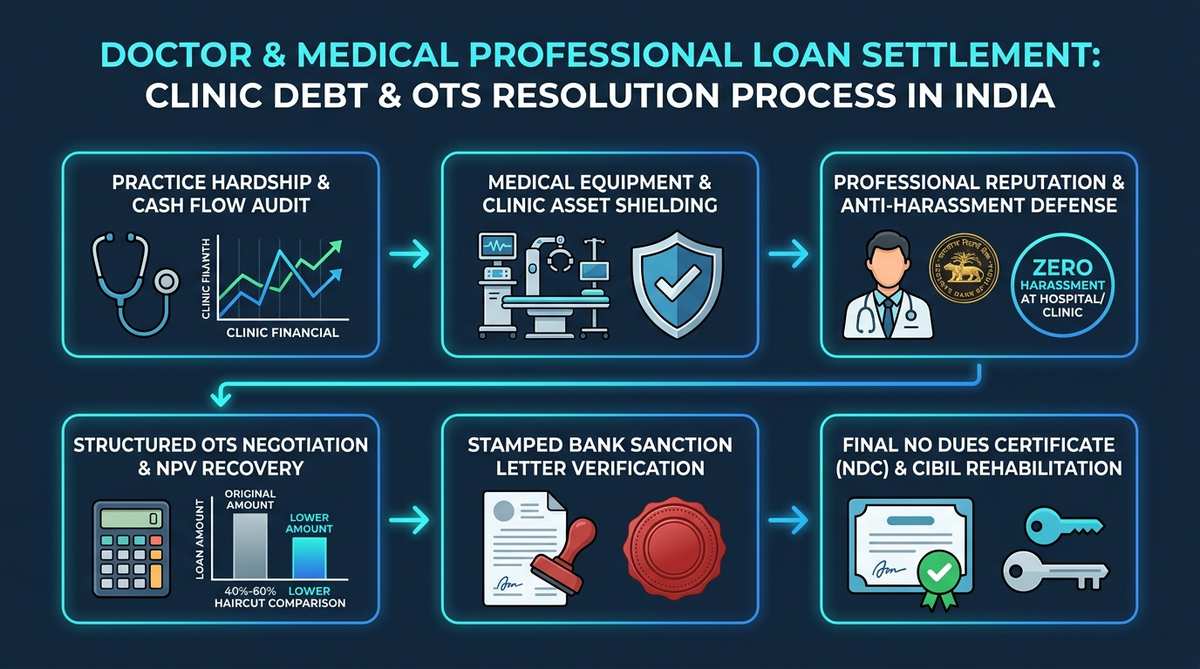
Doctor & Medical Professional Loan Settlement Process Blueprint
The Bank's Internal Math: Net Present Value (NPV) Valuation & Haircut Justification
Under the Reserve Bank of India Master Direction on Compromise Settlements and Technical Write-offs (DOR.STR.REC.20/21.04.048/2023-24), commercial banks and NBFCs are legally empowered to execute compromise settlements with borrowers facing genuine commercial insolvency. Banks do not sanction debt waivers out of goodwill; every settlement haircut is evaluated against mathematical Net Present Value (NPV) recovery benchmarks.
When an unsecured doctor loan crosses 90 days of non-payment and is classified as a Non-Performing Asset (NPA), Indian Accounting Standard 109 (Ind AS 109) mandates that the lender allocate substantial capital provisioning against its quarterly profits. If the loan defaults further into Substandard (15% provisioning) or Doubtful Asset status (25% to 100% provisioning), the bank's capital adequacy ratio is heavily strained.
Where C_t represents estimated recoveries, r is the discount rate, and deductions account for 3–5 years of court friction and capital locked in NPA provisions.
If a bank files a civil summary suit under Order 37 of the CPC or initiates arbitration against a medical practitioner, the recovery process typically spans 3 to 7 years in Indian courts. During this period, the bank incurs continuous advocate retainers, court fees, and administrative expenses, while the unsecured loan yields zero interest. Consequently, when a doctor offers an immediate, upfront lump-sum payment of 40% to 55% of the outstanding ledger, the bank's Stressed Asset Committee recognizes that the Net Present Value of the instant cash settlement significantly exceeds the discounted, uncertain future recovery of prolonged litigation.
Step-by-Step Execution: How Medical Practitioners Settle High-Ticket Debt
Successfully executing a legally sound One-Time Settlement (OTS) for medical professional debt requires a structured, multi-stage legal and financial protocol:
1Practice Financial Forensic Audit & Hardship Dossier Compilation
Compile an indisputable financial hardship dossier demonstrating that the default is non-wilful and stems from clinical cash-flow distress. Essential documentation includes audited clinic balance sheets, profit and loss statements showing reduced patient footfalls, GST returns, TPA insurance receivable aging reports, and bank statements showing depleted liquidity.
2Revoking e-NACH Mandates & Establishing Legal Representation Channels
Instruct your bank in writing under NPCI guidelines to cancel recurring e-NACH auto-debit mandates, preventing compounding bounce penalties. Concurrently, serve a formal notice to the lending bank directing all future communication exclusively to your designated legal counsel, establishing a structured evidentiary audit trail.
3Submitting Formal Compromise Proposal to Stressed Asset Desk
Submit a formal OTS petition directly addressed to the bank's Zonal Stressed Assets Resolution Branch (SARB) or Credit Committee citing the RBI Master Direction on Compromise Settlements. Anchor the initial settlement offer at 25% to 35% of total book dues to create strategic room for structured counter-negotiations.
4Negotiating the Haircut & 100% Waiver of Penal Charges
During Credit Committee reviews, experienced debt counsel establishes that settlement funds are being pooled from external family assistance or non-operating asset liquidation rather than clinical cash flow. Demand an absolute 100% cancellation of all penal interest, late fees, and bounce charges under RBI fair lending guidelines, finalizing a 40% to 60% principal waiver.
5Rigorous Forensic Audit of the Bank OTS Sanction Letter
Before making any financial transfer, verify that the bank delivers an official, stamped OTS Sanction Letter on corporate letterhead containing unique reference numbers, sanctioned settlement amount, installment schedules, and explicit covenants confirming complete debt discharge and legal withdrawal.
6Direct Account Remittance & Enforcing the ₹0 No Dues Certificate
Remit the agreed settlement funds directly into your designated loan account through RTGS/NEFT. Under RBI Circular RBI/2023-24/60, the lender is legally required to deliver your formal No Dues Certificate (NDC) and update all credit bureaus within 30 calendar days.
Authenticating Doctor Settlement Letters & Enforcing the RBI 30-Day NDC Mandate
A critical danger encountered by medical professionals in debt recovery involves rogue third-party collection callers making verbal settlement promises or issuing unauthorized PDF letters. If a doctor remits funds based on an unverified promise, the bank credits the money as partial overdue recovery, keeping the default active and compounding penal interest.
To guarantee absolute legal validity, every settlement agreement must satisfy rigorous forensic standards:
- Official Bank Letterhead: The sanction letter must be issued on official corporate stationery with full branch address, corporate identification number (CIN), and contact details of the authorizing credit officer.
- Unambiguous Full Discharge Clause: The letter must explicitly state that remittance of the agreed settlement sum represents 'full and final settlement of all claims' and completely extinguishes the borrower's financial liabilities.
- Mandatory Legal Withdrawal Covenant: If the bank has issued notices under Section 25 PSSA, Section 138 NI Act, or initiated arbitration, the sanction letter must stipulate unconditional withdrawal of all proceedings upon settlement receipt.
Under the Reserve Bank of India's directive on the release of movable and immovable property documents (Circular RBI/2023-24/60), banks and NBFCs are statutorily required to issue a formal No Dues Certificate (NDC) and update credit bureau records within 30 calendar days of full payment. Lenders failing to deliver the NDC within this timeline without lawful justification are legally mandated to pay the doctor statutory compensation of ₹5,000 per day of delay.
CIBIL Score Trajectory Post-Settlement & 18-Month Practice Financial Rehabilitation
Following the execution of an OTS, the lending institution updates credit information companies (TransUnion CIBIL, Experian, Equifax, CRIF High Mark) with the status 'Settled' or 'Post-Write-off Settled' alongside an outstanding balance of exactly ₹0. This reporting change halts compounding default reporting, removes active legal recovery flags, and establishes debt-free status.
While a 'Settled' status results in an initial credit score drop of 75 to 140 points and introduces a standard 12-month cooling-off period for fresh unsecured loans, it permanently protects the doctor from continuing judicial litigation, salary attachment, or bank account freezes.
Medical practitioners can systematically rebuild their CIBIL score back to 750+ within 18 to 24 months by adopting a structured financial rehabilitation roadmap:
- Fixed-Deposit Backed Secured Credit Card: Open a fixed deposit of ₹1 Lakh to ₹2 Lakhs with a bank like ICICI or Axis and obtain a secured credit card. Utilize 15% to 25% of the limit for regular clinical pharmacy supplies and pay 100% of the bill on time.
- Eliminating Lingering Ledger Discrepancies: Monitor monthly credit reports to ensure the bank accurately reflects the ₹0 balance and closes all associated credit lines.
- Segregating Practice Working Capital: Transition clinic accounting to dedicated current accounts with positive cash reserves, avoiding personal credit contamination.
Comparing Medical Professional Debt Resolution Avenues in India
Medical practitioners have multiple avenues to resolve defaulted loan obligations. Evaluating the advantages, legal finality, and financial haircut potential across these frameworks ensures doctors make informed decisions:
| Resolution Pathway | Legal Mechanism | Haircut Potential | Practice Disruption | Finality & Judicial Status |
|---|---|---|---|---|
| Direct Bank OTS via Advocate | Compromise settlement under RBI Master Directions | 40% – 60% Principal Waiver | Zero (Handled off-site via counsel) | Binding private settlement with ₹0 NDC. |
| National Lok Adalat Settlement | Judicial conciliation before sitting judge panel | 45% – 60% Debt Haircut | Minimal (Single session resolution) | Civil Court Decree (Zero further appeal). |
| Arbitration Defense | Challenging unilateral sole arbitrator appointments | Converts to OTS | Moderate (Requires legal replies) | Interim stay / Section 34 challenge. |
| Sec 25 PSSA / Sec 138 Defense | Magistrate Court defense on bounced auto-debits | 35% – 50% Debt Haircut | Moderate (Advocate appearance required) | Compoundable settlement and case disposal. |
Why Doctors & Medical Practitioners Choose SettleLoans
Medical debt resolution demands specialized legal acumen and deep familiarity with banking regulations, clinical asset protections, and healthcare cash-flow realities. SettleLoans provides dedicated legal advocacy for doctors, surgeons, and clinic owners across India. We halt OPD recovery harassment through immediate cease-and-desist notices, ring-fence clinical machinery under Section 60(1)(c) CPC, defend statutory legal summons, and negotiate directly with bank Credit Committees to secure maximum lawful debt waivers and authentic ₹0 No Dues Certificates.

Settle Loan is India's trusted debt relief and loan settlement platform. We help borrowers overcome financial distress by negotiating with banks and NBFCs to legally settle personal loans and credit card debts. With our transparent, performance-based approach, you can achieve debt freedom and regain your financial peace of mind.
COMPUTER
Frequently Asked Questions: Doctor & Medical Professional Loan Settlement
Can banks seize essential medical equipment or diagnostic machines if a doctor defaults on a loan?
For unsecured doctor loans and professional credit lines, banks and NBFCs possess zero mortgage or charge over clinic assets and cannot legally seize any equipment. In secured medical equipment finance, lenders can only enforce hypothecation through formal civil proceedings under the SARFAESI Act or DRT, provided strict statutory notice periods are observed. Furthermore, Section 60(1)(c) of the Code of Civil Procedure (CPC) provides fundamental protections to professional tools necessary to earn a livelihood.
Does defaulting on a professional loan impact a doctor's Medical Council or NMC registration?
No. Defaulting on a commercial bank loan or unsecured professional credit facility is strictly a civil contractual dispute governed by the Indian Contract Act, 1872. It does not constitute professional misconduct, moral turpitude, or medical negligence under National Medical Commission (NMC) regulations or State Medical Council codes. Medical registration cannot be canceled or suspended due to financial insolvency.
How can doctors stop recovery agents from harassing staff or visiting clinical consulting rooms?
Under RBI Master Directions on Recovery Agents and NBFC Fair Practices Codes, recovery personnel are strictly prohibited from visiting hospitals, OPD consultation suites, or clinics during patient hours, shouting at staff, or disclosing debt details to third parties. Doctors can serve an immediate legal cease-and-desist notice through an advocate and lodge formal complaints with the bank's Principal Nodal Officer and the RBI Integrated Ombudsman portal (CMS).
What percentage of debt waiver can doctors expect in a One-Time Settlement (OTS)?
On unsecured doctor loans, professional overdrafts, and clinic working capital lines past 90–180 days of default (NPA status), doctors typically achieve debt waivers ranging between 40% and 60% of total book dues. In addition, 100% of accumulated penal interest, NACH bounce charges, and late payment penalties are entirely waived under RBI fair lending guidelines.
What is the difference between an unsecured doctor professional loan and a secured clinic term loan?
An unsecured professional loan is sanctioned purely against the doctor's professional qualifications (MBBS, MD, MS, BDS, MDS) and historical income without any collateral. A secured clinic loan is backed by physical immovable property (clinic premises) or hypothecated medical machinery. Unsecured loans allow for substantial settlement haircuts (40%–60%) through direct OTS without asset risk, whereas secured debts require careful asset ring-fencing or restructuring.
How do banks calculate the Net Present Value (NPV) recovery formula for medical professional debts?
Banks evaluate compromise proposals by discounting expected future litigation recoveries against immediate lump-sum settlement offers. Because civil suits and DRT recovery take 3 to 7 years in Indian courts alongside heavy legal retainers and mandatory capital provisioning under Ind AS 109, a prompt upfront cash settlement represents higher economic value (NPV) to the bank than prolonged litigation against an unsecured medical borrower.
What documents are required to prove genuine clinical financial hardship during OTS negotiations?
Doctors should assemble: (1) Audited clinic balance sheets and profit & loss statements showing declining patient revenues; (2) Bank statements demonstrating depleted operating liquidity; (3) TPA/insurance delayed payment ledgers or medical equipment maintenance overhead records; (4) GST returns (if applicable); and (5) A detailed medical practice hardship narrative drafted by debt legal counsel.
How does settling a doctor loan affect personal and professional CIBIL scores in India?
Upon completion of the OTS payment, the lending institution updates credit bureaus (CIBIL, Experian, CRIF High Mark) with the status 'Settled' or 'Post-Write-off Settled' reflecting a ₹0 balance. While this results in an initial credit score dip and a standard 12-month cooling period for fresh unsecured loans, it permanently stops compounding legal actions and allows full credit score rehabilitation to 750+ within 18 to 24 months through disciplined secured credit management.
How long does a bank take to issue the No Dues Certificate (NDC) to a doctor after settlement?
Under RBI Circular RBI/2023-24/60, all regulated commercial banks and NBFCs are legally mandated to issue the formal No Dues Certificate (NDC) and release any pledged documents within 30 calendar days of receiving full settlement payment. Failure to comply makes the lender statutorily liable to pay compensation of ₹5,000 per day of delay directly to the borrower.
Official Statutory & Regulatory References
- Reserve Bank of India (RBI): Master Direction on Compromise Settlements and Technical Write-offs (DOR.STR.REC.20/21.04.048/2023-24)
- RBI Master Circular: Fair Practices Code for Lenders, Recovery Agent Conduct & Penal Charge Caps
- National Medical Commission (NMC): Registered Medical Practitioner (Professional Conduct) Regulations
- Reserve Bank - Integrated Ombudsman Scheme: Grievance Redressal Mechanism for Unlawful Recovery Harassment & NDC Non-Delivery
- National Legal Services Authority (NALSA): Legal Services Authorities Act, 1987 — Pre-Litigation Lok Adalat Conciliation