- Corporate Separation. Under the Companies Act 2013 and the Salomon rule, banks cannot freeze company accounts for personal debts.
- Doctrine of Mutuality. A bank can only set off funds between the same parties in the same legal role. Cross-account debit holds are void.
- Partnership Asset Safety. Partnership funds belong to all partners jointly. They cannot be used to pay one partner's personal loan.
- High Court Protections. Even for sole proprietors, banks cannot freeze working capital or halt GST and salary payouts without due notice.
- Advocate Relief &. OTS. A formal legal notice forces banks to remove holds. Borrowers can then settle debts at a 45% to 65% discount.
1. Demystifying Banker's Right of Set-Off vs. Right of
When a borrower defaults on a personal loan or credit card, some lenders freeze their business current accounts. If your business account is in the same bank, such as HDFC Bank, ICICI Bank, Axis Bank, SBI, or Kotak Mahindra Bank, this action creates huge trouble. It stops vendor payouts, GST tax deposits. And staff salary payments instantly.
To check if such account freezes are legal, we must understand two key banking rules under Indian law:
Under Section 171 of the Indian Contract Act 1872, a bank holds a lien on physical goods and securities in its custody. However, the Supreme Court has ruled that bank account deposits are not bailed goods. They form a simple debtor-creditor link. Therefore, Section 171 cannot be used to freeze liquid cash in a business current account.
The Right of Set-Off lets a bank combine accounts to settle a due debt. But it has strict conditions. Both accounts must belong to the exact same person in the exact same legal role. The bank must also give prior written notice before taking any funds.
When branch managers freeze a business account without fulfilling these legal conditions, they act outside the law. Banks often claim that loan forms have standard clauses allowing cross-account debits. However, court rulings confirm that standard contract terms cannot override legal company laws or constitutional rights to run a business under Article 19(1)(g).
2. The Doctrine of Mutuality
The core principle governing cross-account recovery is the Doctrine of Mutuality. Under this rule, a bank can only set off funds when the debt and the account share the same legal identity. If the legal entity or ownership role is different, the bank cannot touch the funds.
Whether a business current account is safe depends on how the business is set up:
Private Limited & Public Limited Companies (Complete Legal Immunity)
Under the Companies Act 2013 and the Salomon v. Salomon &. Co Ltd rule, a company is a separate legal person. This was upheld by the Supreme Court in Tata Engineering &. Locomotive Co Ltd v. State of Bihar. When a director defaults on a personal loan, it is an individual debt. Corporate bank funds belong to the company, shareholders. And suppliers. Freezing a company account for a director's personal debt is illegal and violates banking laws.
Partnership Firms & Limited Liability Partnerships (LLPs)
Under the Indian Partnership Act 1932 and the LLP Act 2008, firm funds belong to all partners together. A personal loan taken by one partner is not a firm debt. There is no mutuality between the partner's loan and the firm's account. A bank cannot debit or freeze a partnership account for one partner's personal loan.
Sole Proprietorships: The Dual Status & Working Capital Nuance
A sole proprietorship shares the owner's legal identity. Even so, High Courts have set clear limits. Banks cannot freeze an active business account without prior warning. Freezing working capital halts GST tax payments, employee salaries. And vendor dues. This violates the RBI Fair Practices Code for Lenders.
Because company structures differ, banks cannot treat business accounts as personal savings reserves. When banks break these legal rules, borrowers can seek quick court orders and claim damages.
Check Your Loan Settlement Options
Answer 2 quick questions to evaluate your settlement eligibility.
1. What type of loan do you want to settle?
3. High Court Precedents, Article 19(1)(g)
Indian High Courts and the Supreme Court have ruled on bank account freezes many times. The courts hold that banks cannot act as judge and jury. Lenders cannot freeze running business accounts to force unsecured loan recovery.
Key legal protections for business current accounts include:
The Indian Constitution protects the right to carry on trade and business. Freezing company cash without legal orders hurts business survival and violates this fundamental right.
Under Section 31 of the NI Act 1881, a bank must pay cheques if funds exist. Wrongful cheque bounce due to an unlawful freeze makes the bank liable to pay damages.
The Delhi, Madras, and Bombay High Courts have ruled against freezing active business accounts. Courts direct banks to use civil court recovery routes instead.
Under the Code of Civil Procedure 1908 (CPC), attaching a bank account needs a formal court hearing under Order 38 Rule 5 or Order 21 CPC. A private bank cannot bypass the judicial system by freezing accounts on its own.
If an account freeze causes business cheques to bounce, suppliers may file cases under Section 138 of the Negotiable Instruments Act. Because the bounce happened due to the bank's wrongful hold, business owners have a strong legal defense. They can also sue the bank for commercial damages.
4. Bank NPA Accounting & Current Account Freezes
Banks use current account freezes when loans turn into defaulted Assets (NPAs). Under RBI rules, an unsecured personal loan becomes an NPA after 90 days of non-payment.
As overdue loans age, banks must set aside capital reserves to cover bad debt provisions:
| default status. | Aging Timeline. | Mandatory RBI Capital Provision. | Settlement / Haircut Scope. |
|---|---|---|---|
| SMA-1 / SMA-2. | 31 – 90 Days Overdue. | 5% General Capital Provision. | Penal Interest &. Overdue Fee Waivers. |
| Substandard NPA. | 91 – 365 Days Overdue. | 25% Unsecured Capital Provision. | 35% – 45% Principal Haircut. |
| Doubtful NPA 1 (D1). | 12 – 24 Months Default. | 100% Full Capital reserves. | 45% – 55% Principal Haircut. |
| Doubtful NPA 2 / Loss Asset. | 24+ Months / Written-Off. | 100% Full Balance Sheet Write-Off. | 55% – 65% Principal Haircut. |
When a loan reaches Doubtful status, the bank writes off 100% of the capital. Freezing unrelated accounts is a fast attempt by branch teams to recover funds. When legal counsel challenges the freeze, bank committees evaluate the Net Present Value (NPV) of Recovery to choose between court fights and settlements:
C_t shows expected recovery cash flow. r is the discount rate. Deductions cover court costs, lawyer fees. And regulatory fines.
Fighting an illegal account freeze in court costs banks time and money. Lenders prefer taking 35% to 55% quick cash recovery through a One-Time Settlement rather than facing regulatory fines.
5. Business Current Account Unfreezing
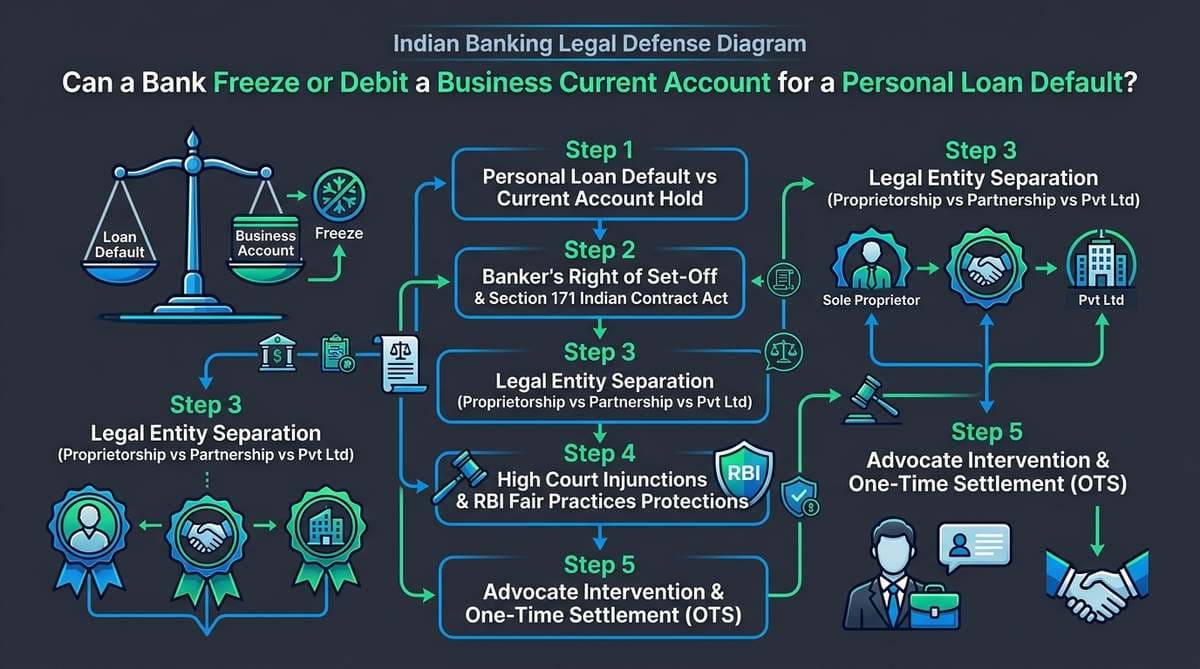
This 5-stage roadmap shows how to unfreeze a business current account. It guides you from checking illegal bank holds to serving legal notices and securing a debt settlement:
6. The Emergency 4-Stage Advocate Protocol to Unfreeze
When a business account is frozen, standard complaints to branch desks rarely work. Branch managers cannot remove risk system holds without legal clearance. Legal counsel follows this 4-stage unfreezing protocol:
Stage 1: Immediate Cash Flow Ring-Fencing & Alternate Banking
Within 24 hours, move customer wire transfers, card swipe machines, and UPI QR codes to an account at another bank. This keeps fresh sales revenue safe from wrongful freezes.
Stage 2: Serving Advocate Statutory Demand Notice
Your lawyer serves a legal notice on the bank's Zonal Head and Principal Nodal Officer. The notice proves lack of mutuality under company law, cites Section 31 NI Act. And warns of claims for damages.
Stage 3: Escalation to RBI Integrated Ombudsman Scheme
If the bank does not unfreeze the account within 48 hours, file a complaint on the RBI CMS portal (cms.rbi.org.in). The RBI Ombudsman acts strictly against illegal account freezes.
Stage 4: Emergency High Court Writ (Article 226) or Commercial Court Injunction
For PSU banks, file a Writ Petition under Article 226 in the High Court. For private banks, file an injunction application under Order 39 CPC in commercial court to unfreeze funds immediately.
This legal approach removes the bank's recovery advantage. Bank authorities quickly lift account freezes and open discussions for a discounted settlement.
7. Converting an Unlawful Account Freeze into an Affordable
An illegal account freeze shows that the bank wants a quick recovery. By exposing regulatory breaches, lawyers can turn this situation into leverage. Borrowers can then negotiate a formal One-Time Settlement (OTS) on the overdue personal loan.
Rather than paying extra fines, the settlement is structured through these key steps:
Prepare a clear file showing true cash flow drops. Document lower sales, unpaid invoices, or medical costs to prove why EMIs stopped.
Seek a complete waiver of penal charges and late fees. Aim for a 45% to 65% reduction on principal based on the loan NPA status.
Include an explicit term in the agreement. The bank must lift all debit freezes and internal liens on all accounts before receiving settlement funds.
Split the settlement payment into 2 to 4 monthly installments. This helps business cash flow remain smooth without creating new financial stress.
8. Sanction Letter Forensics & RBI ₹0 NDC
When settling a loan that triggered an account freeze, checking paperwork is critical. Never rely on verbal promises from recovery agents. Without written approval, banks may keep debit flags active.
Check your settlement documents against these four verification standards:
The settlement letter must come from the bank official email or stationery. It must be signed by an authorized Zonal Credit Manager.
The letter must show the loan number, borrower PAN, original balance, waiver amount. And final agreed settlement figure.
The letter must confirm that all account freezes, liens. And internal debit holds across all business accounts are removed permanently.
The bank must agree to withdraw all Section 138 NI Act complaints, Section 25 PSSA notices. And recovery suits once payment is complete.
Under RBI Circular RBI/2023-24/60, banks must issue a No Dues Certificate (NDC) and update credit bureaus (CIBIL, Experian, Equifax, CRIF) to ₹0 balance within 30 calendar days. If the bank delays beyond 30 days, it must pay a fine of ₹5,000 per day directly to the borrower.
Understanding Commercial CIBIL (CCR) vs. Individual CIBIL Score Rehabilitation
For Private Limited companies and LLPs, the Company Credit Report (CCR) runs under the company PAN. It remains completely safe from a director's personal debt settlement. For sole proprietors, the loan marks as "Settled" with a ₹0 balance. This stops collection calls, clears bank holds. And lets you rebuild your score to 750+ within 18 months.
9. Current Account Debt Defense Matrix
Compare the legal options available when a bank freezes a business current account:
| Resolution Mechanism. | Governing Legal Basis. | Business Entity Protection. | Typical Timeline. | Final Legal Effect. |
|---|---|---|---|---|
| one-sided Banker Set-Off. | Section 171 Contract Act. | Zero Protection. Unlawful hold on company cash flow. | Instant / Unannounced. | High risk of regulatory fines via RBI Ombudsman. |
| Civil Court Attachment. | Order 38 Rule 5 and Order 21 CPC. | Full Judicial Review. Company separation is upheld. | 2 – 4 Years. | Court decree applies only to individual personal assets. |
| High Court / Ombudsman Order. | Article 226 or RBI Ombudsman Scheme 2021. | Direct Protection. Orders unfreezing of business funds. | 30 – 45 Days. | Enforceable order unblocking account operations. |
| Advocate-Led 55% OTS. | Consensual Compromise Agreement. | 100% Protection. Accounts unblocked and debt closed. | 15 – 30 Days. | Full debt waiver, formal ₹0 NDC. And clean exit. |
10. SettleLoans Account Unfreezing Legal Relief
Protecting your business against an unlawful account freeze requires expert banking advocates. SettleLoans helps business founders, partners. And proprietors across India. We serve legal notices, halt recovery pressure, file RBI Ombudsman cases. And secure 45% to 65% principal waivers with official No Dues Certificates.

Settle Loan is India's trusted debt relief and loan settlement platform. We help borrowers overcome financial distress by negotiating with banks and NBFCs to legally settle personal loans and credit card debts. With our transparent, performance-based approach, you can achieve debt freedom and regain your financial peace of mind.
COMPUTER
11. FAQs: Current Account Freezes & Legal Remedies
Find clear answers to key questions about business current account freezes, company laws. And loan settlements in India.
Can a bank legally debit or freeze a Private Limited Company current account for a director's personal loan default?
No. Under the Companies Act 2013 and the Salomon rule, a company is a separate legal person. A bank cannot freeze or debit corporate accounts for a director's personal loan. Doing so is unlawful and violates banking service rules.
Can a bank freeze a Partnership firm current account if one partner defaults on an individual personal loan?
No. Under the Indian Partnership Act 1932, partnership funds belong to all partners jointly. Under the Doctrine of Mutuality, a bank cannot use firm funds to clear an individual partner's personal loan.
What happens if the business is a Sole Proprietorship? Can the bank freeze the current account?
A sole proprietorship shares the owner's legal identity. However, banks cannot place sudden total debit freezes without prior written notice. High Courts rule that banks must not halt active business operations, GST taxes, or employee salaries without due process.
What is the Doctrine of Mutuality under Indian banking law?
The Doctrine of Mutuality requires that debts and credit balances exist between the same parties in the same legal role. A personal loan of an individual cannot be set off against a company or partnership account.
Can a bank freeze a current account maintained at an entirely different banking institution?
No. A lending bank cannot freeze an account held at another bank on its own. It requires a formal court decree under Order 21 CPC, a DRT order, or a legal tax authority order.
What should a business owner do immediately if their current account is frozen?
Take these quick steps: First, divert incoming client payments and POS machines to an alternate bank account. Second, submit a written objection to the Branch Manager. Third, send a legal notice to the Principal Nodal Officer through legal counsel. Fourth, file an online complaint on the RBI CMS portal.
What liabilities does a bank face for wrongfully dishonoring business cheques after an illegal freeze?
Under Section 31 of the Negotiable Instruments Act 1881, a bank must clear cheques if funds exist. If an unlawful freeze causes cheques to bounce, the bank is liable for commercial damages and business losses.
Can an unlawful business current account freeze be converted into a One-Time Settlement (OTS)?
Yes. When legal counsel proves regulatory violations and lack of mutuality, banks often lift the hold. They agree to a One-Time Settlement (OTS) with a 45% to 65% principal waiver and a No Dues Certificate.
How does an individual personal loan default impact a business company's Commercial CIBIL score?
For Private Limited companies and LLPs, commercial CIBIL runs on the company PAN and stays safe. For sole proprietorships, personal and business debts share one PAN. Settling the loan marks it as Settled with ₹0 balance, protecting future credit.
What are the RBI rules regarding the release of No Dues Certificates after settling a loan?
Under RBI Circular RBI/2023-24/60, lenders must issue a No Dues Certificate within 30 days of full settlement. Delays require the bank to pay ₹5,000 per day in payout to the borrower.