- Regulated Institutional Underwriting: ZestMoney functioned as a digital lending interface, while loan liabilities reside on the balance sheets of DMI Finance Private Limited and Aditya Birla Finance Limited. Loan default remains strictly a civil dispute under the Indian Contract Act, 1872.
- Eliminating Punitive NACH Fees: Borrowers hold the statutory power to revoke e-NACH auto-debits via their home bank, stopping recurring ₹500 to ₹1,000 bounce fees. Under RBI Fair Lending Directions, all accumulated penal charges are completely waivable during formal compromise talks.
- 50% to 60% Principal Haircuts: Because consumer durable loans lack underlying collateral, accounts classified as Non-Performing Assets past 90 to 180 days qualify for major principal write-downs under institutional stressed asset resolution guidelines.
- Defense Against Automated Notices: Section 25 PSSA demand notices and unilateral online arbitration intimations can be dismantled through structured legal replies, non-wilful hardship filings, and National Lok Adalat conciliation mechanisms.
- Mandatory ₹0 No Dues Certificate: Under RBI Circular RBI/2023-24/60, settling financial institutions must issue a stamped, verified No Dues Certificate within 30 days of remittance or face a statutory penalty of ₹5,000 per calendar day of delay.
ZestMoney Post-Acquisition Credit Architecture
ZestMoney gained prominence as a checkout financing app for zero-cost EMIs on electronics and upskilling courses. Under Indian banking regulations, ZestMoney operated as a Lending Service Provider (LSP), while credit facilities were underwritten on the balance sheets of regulated NBFCs, primarily DMI Finance Private Limited (CIN: U65929DL2008PTC182749) and Aditya Birla Finance Limited.
Following RBI's 2022 Digital Lending Guidelines banning synthetic balance-sheet guarantees, DMI Finance acquired ZestMoney's assets in early 2024. Overdue consumer accounts were migrated into DMI Finance's centralized debt recovery systems, triggering automated collection calls and credit bureau flags. However, loan default remains strictly a civil dispute under the Indian Contract Act, 1872, entitling borrowers to negotiate formal compromise settlements under RBI norms.
Delinquency Lifecycle and NPA Classification
Under the RBI Prudential Framework and Ind AS 109, overdue retail loans are categorized by Days Past Due (DPD). In the early SMA-0 to SMA-2 brackets (1 to 90 days), lenders rely on telecalling and payment reminders, generally offering only minor interest relief.
Once default crosses 90 DPD, the debt is classified as a Substandard Non-Performing Asset (NPA), forcing the NBFC to allocate capital provisions. Past 180 DPD, the loan enters Doubtful Asset status and undergoes technical write-off. Because carrying provisioned bad debt depresses return on equity, the NBFC's Stressed Asset Committee becomes receptive to deep cash settlements.
| Delinquency Stage | Overdue Aging (DPD) | NBFC Action Profile | Legal Exposure | Realizable Haircut Range |
|---|---|---|---|---|
| SMA-0 (Early Overdue) | 1 – 30 Days | Automated SMS alerts, IVR reminders, daily NACH presentations. | Routine demand notices and bureau late flags. | 0% (Full overdue recovery demanded). |
| SMA-1 (Mid Delinquency) | 31 – 60 Days | Outsourced telecalling and digital demand warnings. | Legal warning intimating contract acceleration. | 10% – 20% (Overdue penal interest relief). |
| SMA-2 (Pre-NPA Alert) | 61 – 90 Days | Intensive recovery outreach and loan recall notices. | Section 25 PSSA statutory demand notices. | 25% – 35% (Penal fee waiver and minor principal cut). |
| Substandard NPA | 91 – 180 Days | Transfer to Stressed Assets Desk; capital provisioning locked. | Magistrate court filings and arbitration notices. | 40% – 50% Principal Haircut |
| Doubtful / Loss Asset | 181 – 365+ Days | Full 100% loss provisioned; technical balance-sheet write-off. | Lok Adalat referrals and civil recovery litigation. | 50% – 60% Principal Haircut |
Engaging legal representation after the 90-day NPA inflection point enables borrowers to anchor talks around the lender's provisioning realities, securing substantial principal write-downs.
Check Your Loan Settlement Options
Answer 2 quick questions to evaluate your settlement eligibility.
1. What type of loan do you want to settle?
Halting Automated NACH Bounces and Penalties
Repeated presentation of electronic NACH mandates during default causes severe financial drain. Every failed debit incurs dual penalties: the customer's bank levies an inward return charge of ₹295 to ₹590, while DMI Finance or Aditya Birla imposes an additional presentation bounce fee of ₹500 to ₹1,000. Over months, these penalties can inflate an overdue balance by 30% to 50% above original disbursements.
Under NPCI and RBI rules, borrowers possess an absolute statutory right to revoke or cancel active e-mandates directly through their retail bank without lender approval. Furthermore, the RBI Fair Lending Practices circular (RBI/2023-24/53) strictly prohibits capitalizing penal charges into principal or compounding overdue penalties. In formal OTS negotiations, SettleLoans ensures all accumulated bounce and penal charges are 100% waived.
DMI Finance OTS Haircut Policies and NPV Matrix
The Stressed Asset Resolution Committees of DMI Finance and Aditya Birla Finance evaluate compromise proposals through Net Present Value (NPV) recovery benchmarking. Because consumer durable loans lack physical collateral under the SARFAESI Act, the lender must weigh immediate cash against years of expensive civil litigation.
Where C_t represents estimated recoveries, r is the discount rate, and deductions account for 3–5 years of court friction and capital locked in NPA provisions.
Recoveries dragged across 3 to 5 years of court litigation yield a negative return when factoring in advocate fees and capital provisioning drag. Presenting a verified lump-sum offer representing 40% to 50% of the core principal provides the NBFC with a mathematically superior NPV outcome compared to prolonged litigation.
Realistic ZestMoney / DMI Finance Settlement Haircut Slabs Across Products and Aging
| Product / Facility Category | Delinquency Aging Bracket | Penal & Bounce Waiver | Principal Haircut Range | Optimal Settlement Target |
|---|---|---|---|---|
| Consumer Durable BNPL (< ₹40,000) | 90 – 180 Days (NPA) | 100% Complete Waiver | 35% – 45% Principal Waiver | Offer 45% – 55% of Net Disbursed Principal |
| Consumer Durable BNPL (< ₹40,000) | 181 – 365+ Days (Doubtful) | 100% Complete Waiver | 50% – 60% Principal Waiver | Offer 35% – 40% of Net Disbursed Principal |
| Electronics & Appliances (₹40,000 – ₹1.5L) | 90 – 180 Days (NPA) | 100% Complete Waiver | 30% – 42% Principal Waiver | Offer 48% – 58% of Outstanding Balance |
| EdTech & Upskilling Financing | 181+ Days (Written Off) | 100% Complete Waiver | 50% – 65% Principal Waiver | Offer 30% – 38% of Claimed Amount |
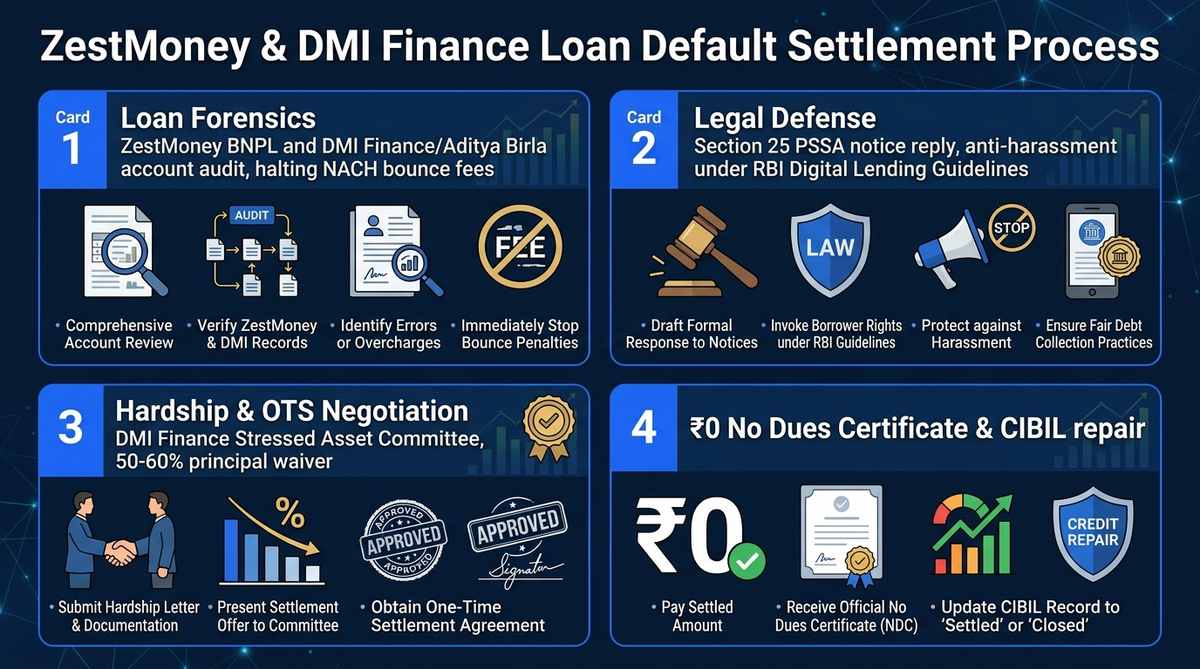
ZestMoney & DMI Finance Loan Default Settlement Process
Legal Anti-Harassment Shields Under RBI Rules
Under the RBI Guidelines on Digital Lending (RBI/2022-23/111) and NBFC Fair Practices Code, outsourced recovery agencies face strict statutory restrictions: recovery calling is barred outside 8:00 AM to 7:00 PM, accessing phone contacts or photo galleries is illegal, and calling non-guarantor relatives or colleagues constitutes an actionable breach of privacy.
As affirmed by the Supreme Court in ICICI Bank Ltd. v. Prakash Kaur (2007), coercive recovery tactics are impermissible under Indian law. SettleLoans serves formal legal representation notices to the Principal Nodal Officer (PNO) of DMI Finance or Aditya Birla Finance, reporting persistent violations to the RBI Integrated Ombudsman on the CMS portal to immediately halt unlawful harassment.
Six-Stage NBFC Debt Settlement Roadmap
Achieving maximum debt relief from DMI Finance and partner NBFCs requires a disciplined, legally verified sequence:
1Loan Portfolio Forensics & Debt Bifurcation
We audit original ZestMoney records against DMI Finance loan contracts, isolating true disbursed principal from inflated bounce fees and compounded interest.
2e-NACH Mandate Revocation & Representation Notice
We help you instruct your bank to cancel active e-mandates under NPCI rules to stop bounce fees, while issuing formal legal notices directing all communications to counsel.
3Hardship Dossier Compilation & Stressed Assets Filing
We compile documented proof of involuntary financial distress (layoffs, medical bills, business losses), submitting a formal petition establishing non-wilful default.
4Structured Counter-Negotiations & Committee Approval
Our team counters low opening offers with mathematical NPV benchmarks, steering the credit committee toward a 100% penal waiver and a 50% to 60% principal write-down.
5Forensic Verification of the Stamped OTS Sanction Letter
We perform line-by-line scrutiny of the official compromise sanction letter on DMI Finance letterhead, confirming seal authenticity, loan numbers, and closure clauses.
6Direct Account Remittance & ₹0 NDC Delivery
You remit settlement funds directly to the NBFC's verified account via RTGS/NEFT. We enforce the 30-day statutory delivery of your stamped ₹0 No Dues Certificate under RBI rules.
Defending Section 25 PSSA and Arbitration Notices
Section 25 of the Payment and Settlement Systems Act, 2007 (PSSA) penalizes dishonored electronic debits, operating similarly to Section 138 cheque bounce proceedings. However, a Section 25 notice is not an arrest warrant; it is a 15-day statutory demand. Because these offenses are compoundable, submitting an advocate-drafted reply highlighting bona fide hardship halts criminal prosecution and steers the file toward compromise settlement.
For automated online arbitration notices, Supreme Court precedents in Perkins Eastman (2019) and TRF Ltd. (2017) establish that lenders cannot unilaterally appoint a sole arbitrator. Borrowers can lawfully challenge such proceedings under Sections 12 and 14 of the Arbitration Act. Alternatively, National Lok Adalat benches offer a powerful forum where disputes are settled with 50% to 60% haircuts, producing binding awards carrying the finality of a Civil Court decree.
| Resolution Channel | Governing Statutory Framework | Realizable Haircut Range | Resolution Timeline | Legal Finality & Immunity |
|---|---|---|---|---|
| Direct Institutional OTS | RBI Compromise Settlement Framework (2023) | 45% – 60% Principal Haircut | 15 to 30 Days | Binding settlement agreement with ₹0 No Dues Certificate. |
| National Lok Adalat | Legal Services Authorities Act, 1987 | 50% – 60% Principal Haircut | Single-day conciliation bench | Civil Court Decree Status; zero appeal exposure. |
| Section 25 PSSA Defense | Payment and Settlement Systems Act, 2007 | 40% – 55% Principal Haircut | 30 to 90 Days | Formal compounding and court case dismissal. |
| Arbitration Challenge | Arbitration and Conciliation Act, 1996 | Converts to Compromise OTS | 2 to 6 Months | Neutralization of unilateral awards under Section 34. |
Sanction Letter Verification and Zero Dues Mandate
Borrowers must never remit funds based on oral promises or WhatsApp links from recovery callers. Unscrupulous agencies often credit such payments toward overdue interest, keeping the principal balance active. A valid compromise requires an official OTS Sanction Letter on DMI Finance or Aditya Birla corporate letterhead, bearing CIN registration, explicit loan IDs, fee waiver bifurcation, and payment deadlines.
The sanction letter must confirm full account closure, withdrawal of all legal notices, and issuance of a ₹0 No Dues Certificate (NDC). Under RBI Circular RBI/2023-24/60, lenders are legally mandated to deliver the NDC within 30 days of payment, subject to a statutory compensation penalty of ₹5,000 per calendar day of delay paid directly to the borrower.
Mandatory Forensic Checklist for ZestMoney / DMI Finance OTS Letters
- Printed on corporate letterhead of DMI Finance or Aditya Birla Finance with valid CIN registration.
- Explicit cross-referencing of ZestMoney digital loan ID and NBFC loan account number.
- Complete ledger breakdown confirming 100% waiver of penal interest, bounce charges, and late fees.
- Explicit statement confirming full account closure and withdrawal of any pending Section 25 or arbitration proceedings.
- Payment instructions specifying direct remittance exclusively to the NBFC's verified account, never to personal UPIs.
Resolving CIBIL Overdue Flags and Score Recovery
Following full remittance of the agreed settlement, the underwriting NBFC reports the account as 'Settled' with a ₹0 balance across all credit bureaus within the mandatory 30-day reporting cycle. While 'Settled' status causes an initial score contraction of 60 to 120 points, it halts monthly compounding default marks that paralyze credit access.
Borrowers can systematically rebuild prime credit by taking a secured credit card backed by a fixed deposit, maintaining credit utilization below 25%, and clearing billing balances promptly. Within 18 to 24 months, disciplined payment patterns restore CIBIL scores past 750, regaining eligibility for prime banking facilities.
Why Distressed Borrowers Choose SettleLoans
Navigating the complex institutional hierarchy of DMI Finance and Aditya Birla Finance following the ZestMoney transition requires dedicated legal advocacy and deep domain expertise in fintech debt resolution. SettleLoans provides complete end-to-end representation: we dismantle aggressive third-party collection harassment under RBI rules, revoke punitive e-mandates, draft formal replies to Section 25 PSSA and arbitration notices, and negotiate directly with senior credit committees to achieve maximum principal write-downs alongside official ₹0 No Dues Certificates.

Settle Loan is India's trusted debt relief and loan settlement platform. We help borrowers overcome financial distress by negotiating with banks and NBFCs to legally settle personal loans and credit card debts. With our transparent, performance-based approach, you can achieve debt freedom and regain your financial peace of mind.
COMPUTER
Frequently Asked Questions
Who actually owns and underwrites my defaulted ZestMoney loan?
ZestMoney operated as a Lending Service Provider (LSP) and Digital Lending App (DLA). The actual funds were disbursed by regulated partner NBFCs, primarily DMI Finance Private Limited and Aditya Birla Finance Limited. Following the 2024 acquisition, DMI Finance manages the servicing, collections, and legal recovery of these loan portfolios.
Can DMI Finance or ZestMoney file criminal charges or arrest a borrower?
No. Loan default on an unsecured consumer durable loan is strictly a civil contract dispute under the Indian Contract Act, 1872. Police cannot arrest borrowers for genuine loan default. While lenders issue statutory Section 25 PSSA notices for bounced electronic debits, these offenses are compoundable and resolved upon executing a formal OTS.
How can borrowers halt repeated e-NACH auto-debit bounce fees?
Borrowers have a statutory right under NPCI procedural guidelines to instruct their bank to cancel or revoke an active e-NACH mandate. This stops inward bank bounce fees. During settlement negotiations, advocates ensure all accumulated penal charges are 100% waived under the RBI Fair Lending Practices circular.
What percentage of debt waiver can you realistically negotiate with DMI Finance?
For unsecured ZestMoney consumer durable loans classified as Non-Performing Assets past 90 to 180 days, borrowers can realistically negotiate a 40% to 60% haircut on the core outstanding principal balance. All penal fees, late presentation charges, and overdue interest are completely waived.
What is a Section 25 PSSA legal notice from DMI Finance and how to respond?
A Section 25 PSSA notice is a 15-day statutory demand triggered by a bounced e-mandate under the Payment and Settlement Systems Act, 2007. It is not an arrest warrant. A formal legal reply served by an advocate explaining genuine financial hardship halts criminal prosecution and opens direct OTS negotiations.
How should borrowers handle unilateral digital arbitration notices from ZestMoney lenders?
Under Supreme Court precedents in Perkins Eastman and TRF Ltd., a lender cannot unilaterally appoint a sole arbitrator to resolve its own claims. Borrowers can formally challenge the jurisdiction and appointment under Sections 12 and 14 of the Arbitration and Conciliation Act, prompting lenders to seek compromise settlement.
Who within DMI Finance has the legal authority to sanction an OTS?
External recovery callers and field agents have zero legal authority to sanction waivers or loan closures. Legally valid compromise settlements are authorized solely by the Credit Committee or Stressed Asset Resolution Desk of DMI Finance or Aditya Birla Finance, evidenced by an official stamped sanction letter on corporate letterhead.
How does settling a ZestMoney loan impact your CIBIL score?
The underwriting NBFC reports the account to CIBIL and other credit bureaus as 'Settled' with a ₹0 balance. While this results in a temporary score dip of 60 to 120 points, it halts monthly negative default reporting. Borrowers can systematically rebuild their score past 750 within 18 to 24 months using secured credit products.
What is the statutory deadline for DMI Finance to issue the No Dues Certificate?
Under RBI Circular RBI/2023-24/60, regulated financial entities must issue the official No Dues Certificate (NDC) within 30 days of receiving full settlement remittance. Failure to issue the certificate within this timeframe mandates compensation of ₹5,000 per calendar day of delay payable to the borrower.
Why is my CIBIL report showing DMI Finance instead of ZestMoney?
Because ZestMoney was a digital distribution platform and not a banking institution, the credit facility was legally funded by DMI Finance or Aditya Birla Finance. Following DMI Finance's acquisition of ZestMoney assets, all regulatory bureau reporting reflects under the underwriting NBFC's corporate name.
Official Regulatory References & Statutory Circulars
- Reserve Bank of India (RBI): Master Direction on Compromise Settlements and Technical Write-offs (DOR.STR.REC.20/21.04.048/2023-24)
- RBI Guidelines on Digital Lending: Guidelines on Default Loss Guarantee & Fair Lending Practices for Regulated Digital Lending Apps (RBI/2022-23/111)
- DMI Finance Private Limited: Customer Grievance Redressal Policy, Fair Practices Code & Principal Nodal Officer Matrix
- Reserve Bank - Integrated Ombudsman Scheme, 2021: Online Portal for Complaints on Fintech Harassment, Illegal Auto-Debits & NDC Delays
- National Legal Services Authority (NALSA): Legal Services Authorities Act, 1987 - National Lok Adalat Settlement Framework