- Absolute Statutory Exemption: The SARFAESI Act of 2002 applies exclusively to secured loans. Unsecured personal loans and credit cards carry zero collateral and are completely outside the Act scope.
- Section 13(2) Notices Are Void: Demand notices citing Section 13(2) or 13(4) of SARFAESI for unsecured loans are legally defective, void ab initio, and unenforceable in court.
- Zero Property Seizure Power: Collection agents and bank officers possess no legal authority to enter homes or seize property for unsecured personal debt.
- Section 60 CPC Dwelling Protection: Under Section 60(1)(ccc) of the Code of Civil Procedure, a debtor sole residential dwelling is statutorily exempt from civil court attachment.
- Compromise Settlement Leverage: Because banks cannot seize property under SARFAESI for unsecured loans, lenders routinely approve One-Time Settlements with 40% to 70% principal waivers.
1. Demystifying SARFAESI: The Personal Loan Eviction Myth
When borrowers face financial distress from job loss, medical emergencies, or business downturns and default on personal loan EMIs, recovery agents often deploy intense psychological pressure. Among the most common threats is the false claim that the lender will invoke the SARFAESI Act of 2002 to attach, seal, and auction the borrower home within sixty days.
This threat creates widespread panic among salaried borrowers across India. Many take high-interest informal loans or liquidate family savings believing bank officers and police can evict them without court hearings.
Under established Indian financial jurisprudence and statutory banking legislation, the SARFAESI Act does not apply to personal loans, credit card balances, consumer durables credit, or education loans. The legislative intent and statutory architecture of the Act restrict summary repossession powers strictly to credit facilities backed by registered collateral. Citing SARFAESI against an unsecured borrower constitutes an unlawful recovery bluff designed to bypass ordinary civil courts through fear.
2. Statutory Architecture: Section 13(2) & Security Interest Defined
To understand why personal loans are exempt from SARFAESI proceedings, one must review Section 2 and Section 13 of the SARFAESI Act, 2002. Extra-judicial enforcement under the Act requires the existence of a valid Security Interest.
The Act defines security interest as any mortgage, charge, hypothecation, or pledge created on property by a borrower in favor of a secured creditor. Without a registered mortgage deed recorded with CERSAI, zero security interest exists.
Section 13(2) permits a secured creditor to issue a 60-day demand notice to enforce security on a secured asset. Section 13(4) permits taking possession of that asset. Because personal loans have no pledged collateral or mortgage, Section 13 enforcement is legally impossible.
In landmark constitutional rulings including Transcore v. Union of India and Mardia Chemicals v. Union of India, the Supreme Court authoritatively held that extraordinary SARFAESI remedies require a prior, registered, and perfected security interest over identifiable property. Because personal loan borrowers execute clean promissory loan contracts without depositing title deeds or registering charges with the Sub-Registrar, commercial lenders remain unsecured creditors with zero SARFAESI enforcement rights.
Check Your Loan Settlement Options
Answer 2 quick questions to evaluate your settlement eligibility.
1. What type of loan do you want to settle?
3. Recovery Agent Harassment Forensics & Criminal Intimidation
Despite clear statutory law, recovery agencies frequently send notices titled Final Notice under Section 13(2) SARFAESI Act for personal loans.
Lenders outsource delinquent unsecured debt to third-party collection agencies operating on commission. Agents use standardized legal intimidation, referencing SARFAESI, Debt Recovery Tribunals (DRT), and Section 138 of the Negotiable Instruments Act to create fear of arrest and home auction.
Sending fraudulent statutory notices to extort debt violates the Indian Penal Code and BNS. Offenses include Extortion (IPC 383 / BNS 308), Cheating by Personation (IPC 416 / BNS 319), and Criminal Intimidation (IPC 503/506 / BNS 351). It also violates the RBI Master Direction on Fair Practices Code.
Under RBI Master Directions (Circular DOR.ORG.REC.65/21.04.158/2022-23), recovery agents face strict prohibitions. They cannot contact borrowers before 8:00 AM or after 7:00 PM. Harassing family members, using abusive language, and misrepresenting statutory authority are strictly barred. Borrowers can file police complaints for criminal intimidation and initiate regulatory proceedings before the RBI Banking Ombudsman.
4. Bank NPA Accounting & Net Present Value Settlement Formula
Banks manage delinquent personal loans under RBI Prudential Norms on Income Recognition, Asset Classification and Provisioning (IRACP). Defaulted unsecured loans progress through standard delinquency buckets:
- Special Mention Account 0 (SMA-0): Overdue 1 to 30 days. Standard monitoring.
- Special Mention Account 1 (SMA-1): Overdue 31 to 60 days. Early recovery alerts.
- Special Mention Account 2 (SMA-2): Overdue 61 to 90 days. Pre-NPA resolution review.
- Non-Performing Asset (NPA): Past 90 days of default, the account becomes an NPA and interest recognition freezes.
Unlike secured home loans where property collateral reduces provisioning, unsecured personal loans require heavy reserves: 15% to 25% provisions for sub-standard assets and 100% provisioning once doubtful after 12 months.
Because commercial lenders cannot auction assets under summary SARFAESI mechanisms, holding non-performing unsecured assets severely suppresses bank return on assets (RoA) and degrades Tier-1 capital adequacy ratios. Consequently, financial institutions face a stark strategic choice between protracted civil court litigation or sanctioning an immediate compromised One-Time Settlement (OTS). This institutional calculation is evaluated using the Net Present Value recovery benchmark:
Where C_t represents expected court recoveries, r is the discount rate (12%-14%), and deductions account for litigation delays, legal fees, and locked capital. A structured OTS provides banks higher net recovery than prolonged court battles.
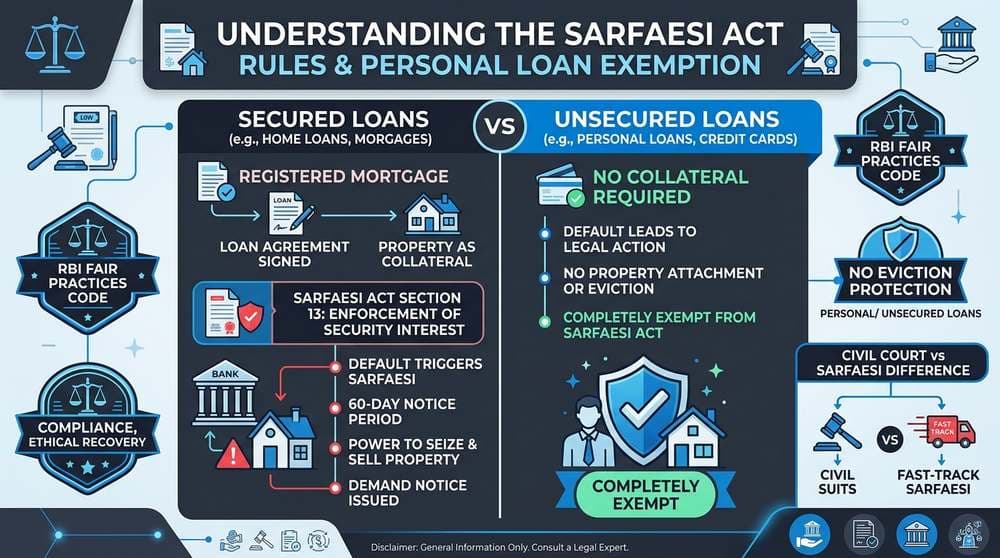
Figure 1.0: Statutory comparison between secured debts under SARFAESI Section 13 and unsecured personal loans. Personal loan borrowers enjoy complete statutory immunity from summary repossession and home eviction.
6. Actual Legal Recovery Channels: Summary Suits & Section 60 CPC
Since SARFAESI is inapplicable, banks and NBFCs must rely on regular civil and statutory recovery channels for personal loans:
Order 37 CPC Summary Civil Suit
Lenders can file a summary suit in Civil Court. However, banks must pay court fees (3% to 7%) and serve summons. Borrowers can apply for Leave to Defend. When advocates show triable issues like improper interest compounding, courts grant leave to defend, converting the case into a regular trial.
Section 138 NI Act & Section 25 PASSA
If NACH or ECS auto-debits bounce, lenders may issue notices under Section 25 of the Payment and Settlement Systems Act or Section 138 NI Act. These bailable proceedings require strict 30-day notice compliance and are routinely resolved through Lok Adalat or compromise settlement.
Institutional Arbitration Proceedings
Lenders may invoke loan arbitration clauses. However, under Supreme Court rulings in TRF Ltd and Perkins Eastman, unilateral sole arbitrator appointments by banks are void under Section 12(5) of the Arbitration Act. Legal challenges routinely redirect banks toward settlement.
The Section 60(1)(ccc) CPC Shield: Suppose a lender obtains an executable civil money decree after years of trial. Even then, executing that decree against the borrower's home is prohibited. Under Section 60(1)(ccc) CPC, a debtor's sole residential house is immune from attachment or sale for unsecured debt. This rule preserves the fundamental constitutional right to shelter.
7. Converting Recovery Pressure into a Bank-Sanctioned OTS
Recognizing that lending institutions lack SARFAESI enforcement powers and confront extensive procedural barriers in civil recovery rebalances negotiating leverage in favor of the distressed borrower. An advocate-managed One-Time Settlement (OTS) converts high-pressure collection tactics into an institutional compromise through four disciplined milestones:
Advocates review collection notices, expose false SARFAESI threats, and issue formal replies demanding compliance with RBI Fair Practices Codes.
Gathering financial hardship records (job termination, medical bills, business losses) proving genuine inability to sustain original EMI terms.
Escalating discussions past collection agents to the bank Zonal Stressed Asset Management Branch for penal charge waivers and 40% to 70% principal haircuts.
Auditing the formal OTS sanction letter to verify authorized signatures, loan numbers, installment dates, and explicit zero-balance discharge terms.
Never remit settlement payments to recovery agent UPI IDs or personal accounts. Pay only directly into the designated bank loan account via RTGS, NEFT, or Account Payee Demand Draft drawn in favor of "[Bank Name] A/C [Your Loan Account Number]".
8. Loan Closure Protocols: RBI NDC Mandate & CIBIL Rehabilitation
Settlement completion requires formal legal closure. Under RBI Circular RBI/2023-24/60, banks and NBFCs must issue a formal No Dues Certificate (NDC) / Loan Closure Letter and update credit bureaus within 30 calendar days of final payment.
If a lender fails to issue the NDC or update bureau records within 30 days without justification, it must pay the borrower statutory compensation of ₹5,000 per day of delay under RBI mandates.
Understanding CIBIL Bureau Trajectory & Credit Rehabilitation
Borrowers must understand credit reporting following compromise settlement:
- Account Status Remark: The bank updates bureau status to "Settled" with a ₹0 balance.
- Immediate Halting of Default Compounding: This stops delinquency compounding and legal recovery action.
- 12-Month Cooling Period: Borrowers observe a standard 12-month cooling period before new unsecured credit.
- Structured CIBIL Score Recovery: Borrowers rebuild their CIBIL score above 750 within 18 to 24 months using secured credit cards and punctual repayments.
9. Dispute Resolution Comparative Matrix: SARFAESI vs Civil Suit vs OTS
Evaluating resolution channels clarifies borrower protections:
| Resolution Channel | Applicable Debt Category | Statutory Basis / Power | Home Seizure Risk | Average Settlement Haircut |
|---|---|---|---|---|
| SARFAESI Act Section 13 | Secured debts only (Home loans, Mortgages) | Extra-judicial possession power | High (Auction of mortgaged property) | 10% – 25% (Asset backed) |
| Order 37 CPC Summary Suit | Unsecured personal loans and cards | Civil court trial with Leave to Defend | Zero (Protected under Sec 60 CPC) | 30% – 50% (High legal friction) |
| Unilateral Bank Arbitration | Personal loans with arbitration clauses | Void under Section 12(5) Arbitration Act | Zero (Requires civil execution) | 40% – 60% (Challenged panel) |
| Advocate-Led Bank OTS | Defaulted personal loans and cards | RBI Compromise Settlement Framework | Zero (Complete debt extinguishment) | 45% – 70% Principal Waiver |
| National Lok Adalat | Pre-litigation and pending civil disputes | Consensual award under NALSA Act | Zero (Non-appealable consent decree) | 40% – 65% Principal Waiver |
10. SettleLoans Legal Defense & Professional Advisory
Navigating recovery harassment, fake SARFAESI notices, and unmanageable debt requires specialized advocacy. SettleLoans provides comprehensive defense. We issue legal notices to halt harassment and challenge defective claims in civil forums. Furthermore, we negotiate directly with bank authorities to secure verified One-Time Settlements with deep principal waivers and authentic No Dues Certificates.

Settle Loan is India's trusted debt relief and loan settlement platform. We help borrowers overcome financial distress by negotiating with banks and NBFCs to legally settle personal loans and credit card debts. With our transparent, performance-based approach, you can achieve debt freedom and regain your financial peace of mind.
COMPUTER
11. Frequently Asked Questions: SARFAESI Act Rules & Personal Loan Rights
Direct, legally verified answers to common questions regarding the SARFAESI Act, property attachment myths, and unsecured debt settlement in India.
Does the SARFAESI Act apply to unsecured personal loans in India?
No. SARFAESI applies only to secured debts with registered mortgages. Personal loans have no collateral and are completely exempt.
Can a bank issue a Section 13(2) SARFAESI notice for an overdue personal loan?
No. Section 13(2) demand notices require a valid security interest. Issuing them for unsecured debt is legally void and violates RBI rules.
Can bank recovery agents seize my residential house or car for personal loan default?
No. Recovery agents have zero authority to enter premises or seize assets. Property attachment requires a civil decree, which excludes primary residences under Section 60 CPC.
Why do collection agents send notices mentioning Section 13(2) or Section 13(4) of SARFAESI?
Third-party collection agents use fraudulent notices to induce fear of immediate eviction and force quick repayments.
What is a 'Security Interest' under Section 2(1)(zf) of the SARFAESI Act?
Security interest refers to a mortgage, charge, or pledge on property to secure debt. Without collateral, personal loans have no security interest.
What legal action can a bank actually take for an unsecured personal loan default?
Lenders can file Order 37 CPC summary suits, initiate arbitration, issue Section 138 NI Act notices for bounced auto-debits, or settle via Lok Adalat.
Does Section 60 of the CPC protect my home from being attached for personal debt?
Section 60(1)(ccc) of the CPC strictly exempts a debtor sole residential dwelling from civil court attachment or execution auction.
What should I do if a bank sends a fake SARFAESI notice for a personal loan?
Engage debt defense advocates to issue a formal legal reply challenging the notice, demanding proof of security interest, and filing RBI complaints.
Can an unsecured personal loan in default be legally settled through an OTS?
Yes. Banks regularly approve One-Time Settlements with 40% to 70% principal waivers due to high litigation costs and heavy RBI provisioning.
What is the penalty for recovery agents who threaten illegal property seizure?
Under RBI Master Directions, lenders face severe regulatory fines and criminal liability for recovery agent harassment and false legal representations.