- Different Legal Rules: Restructuring modifies loan terms under the RBI Prudential Framework and requires 100% repayment. Settlement executes a debt compromise that wipes out remaining debt at a discount.
- Viability vs Permanent Hardship: Pick restructuring when your cash shortage is temporary and future earnings are steady. Pick an OTS when income loss is permanent and debt payments are impossible.
- Bank Provisioning and NPV Math: Banks assess restructuring using Net Present Value (NPV) and set aside 5% to 15% provisions. For OTS decisions, banks compare instant cash against 3 to 6 years of DRT and SARFAESI court delays.
- CIBIL Bureau Reporting Differences: Restructuring gives a "Restructured". tag in credit bureaus while keeping the loan active. An OTS gives a "Settled". tag with a ₹0 balance. Both require distinct credit repair steps.
- Complete Legal Safety with OTS: If a borrower misses restructured EMIs, banks can start SARFAESI or Section 138 NI Act cases. An OTS backed by an official RBI No Dues Certificate ends all legal risk and frees property.
1. The Core Strategic Dilemma
When a borrower faces cash trouble, default risks rise fast. This affects personal loans, credit cards, SME credit. And home loans across banks. Major banks include SBI, HDFC, ICICI, Axis, and PNB. Borrowers have two choices. They can apply for loan restructuring under the Reserve Bank of India (RBI) Prudential Framework for Resolution of Stressed Assets. Or they can seek a One-Time Settlement (OTS).
Many borrowers mix up loan restructuring and loan settlement. That mistake is costly. Borrowers often think both are the same. In reality, they work differently. They follow different RBI rules, accounting norms. And credit score effects.
Loan restructuring updates your loan terms. It fits viable borrowers with short-term cash gaps. The bank can extend loan tenure or pause monthly EMIs. It can lower EMI amounts or turn unpaid interest into a term loan. But you must pay 100% of the principal and interest. Your loan continues. And the bank keeps your pledged assets.
A One-Time Settlement is an exit plan for deep financial distress. When income stops, full loan repayment is not possible. Through lawyer talks, the bank takes a lower lump sum. The bank often waives 50% to 75% of the total debt. It closes the loan contract, frees property liens. And gives an official RBI No Dues Certificate. Choosing the wrong path can trap you in rising debt.
2. Statutory & Regulatory Framework
Stressed debt resolution in India follows clear statutory laws and RBI Master Directions. Banks cannot change loan terms or grant OTS settlements on a whim. They must follow strict regulatory rules set by the Reserve Bank of India and commercial statutes.
The main rulebook is the RBI Prudential Framework for Resolution of Stressed Assets (June 7, 2019 Master Directions, updated through 2026). Under these rules, banks and NBFCs must track early stress. They classify accounts into Special Mention Account stages (SMA-0, SMA-1, SMA-2). Lenders get a 30-day review period to evaluate a Resolution Plan (RP). For example, loan restructuring or ownership change.
Governed by RBI Master Directions on Stressed Assets. Requires formal viability studies, Inter-Creditor Agreements (ICAs) for joint loans, credit committee sanctions. And post-restructuring checks.
Governed by Section 63 of the Indian Contract Act, 1872 (remission of performance), RBI OTS circulars. And consent orders before National Lok Adalats or Debt Recovery Tribunals (DRT).
Under RBI rules, stressed standard accounts that are restructured move to Non-Performing Assets (Sub-Standard). If already NPA, they keep that status. They upgrade to Standard only after a clean repayment record over a set monitoring period.
RBI Board-Approved Settlement Policies allow bank committees to waive unrecovered debt. This happens when legal recovery costs, court delays. And security shortfalls make an instant cash compromise the better financial choice.
The Supreme Court of India and High Courts protect borrower rights. When you file a restructuring or OTS request under RBI Master Directions, banks must review it fairly. They must follow their board policy. Lenders cannot reject claims without clear reasons. Using recovery agents to harass borrowers violates the RBI Fair Practices Code.
Check Your Loan Settlement Options
Answer 2 quick questions to evaluate your settlement eligibility.
1. What type of loan do you want to settle?
3. Anatomy of Restructuring
When a bank approves an RBI Debt Resolution Framework restructuring plan, it adjusts key loan terms. This aligns debt payments with your expected cash flow. Restructuring is not a debt waiver. It is a financial adjustment that reschedules your debt over more time.
Standard commercial and retail restructuring plans use several main tools:
1. Repayment Tenure Extension & EMI Recalibration
The bank extends the loan tenure by 2 to 5 years. Spreading the principal across more years cuts your monthly EMI by 25% to 45%. This provides immediate relief for household or business budgets.
2. Principal and Interest Payment Moratorium
The lender may grant an EMI payment pause of 3 to 12 months. In severe economic crises, this can last up to 24 months. You do not pay EMIs during this window. However, interest still accrues and gets added to your total loan balance.
3. Conversion of Accrued Interest into Funded Interest Term Loans (FITL)
When unpaid interest builds up during default, the bank splits the debt. It moves the unpaid interest into a separate Funded Interest Term Loan (FITL). The principal becomes a standard term loan. This lets you resume regular operations without instant penalty pressure.
4. Interest Rate Margin Concessions & Penal Charge Reversal
The bank committee may lower the interest margin over benchmark rates (MCLR/EBLR). It can also waive past penal interest and bounce fees. This cuts down compound interest growth on your balance.
To qualify for restructuring, you must show verifiable cash flow viability. You need audited accounts, GST filings, or salary slips. These records must prove your income drop is temporary and you can service revised EMIs. If your cash flow fails the bank's Debt Service Coverage Ratio (DSCR) rules, the bank will reject your application.
4. Bank Balance Sheet Economics, Provisioning Burdens
Banks review debt relief under clear accounting rules. Under RBI prudential norms, lenders do not look only at loan balance. They track provisioning rules, capital ratios. And the Net Present Value (NPV) of cash flow.
When a loan becomes an NPA, the bank sets aside 15% to 100% funds as provisioning. Restructuring a stressed loan needs a 5% to 15% provision. The bank also takes a fair value loss (NPV loss) from lower rates or longer loan life.
In an OTS review, the bank compares upfront cash against the NPV of long litigation. This includes DRT suits, civil court claims, and SARFAESI property auctions:
| Resolution Pathway. | Gross Face Claim. | Institutional Friction &. Timeline. | Net Present Value (Realized Recovery). |
|---|---|---|---|
| Litigation &. SARFAESI Enforcement. | ₹40.0 Lakhs Claim. | 4–7 Years Court Delays, DRT Stay Appeals, 100% Capital Provisioning Drag. | ₹16.2 Lakhs (Heavy NPV Diminution). |
| RBI Framework Restructuring. | ₹40.0 Lakhs Full Debt. | Tenure Extended by 4 Years, 10% Diminution Provision, Risk of Re-Default. | ₹32.5 Lakhs (NPV Discounted at 12%). |
| Advocate-Negotiated OTS Settlement. | ₹40.0 Lakhs Gross Claim. | Immediate Cash within 30–60 Days, Zero Future Provisioning. | ₹18.0 Lakhs (Immediate Liquid Capital). |
To decide whether to accept an OTS offer or proceed with recovery, the bank calculates recovery value using the NPV formula:
Here, C_t is estimated cash recovered in year t. The discount rate r reflects the bank's cost of funds. Deductions include 3 to 6 years of DRT court delays, lawyer fees, auction price cuts. And frozen capital in NPA provisions.
Court litigation in Indian tribunals is slow and expensive. Therefore, the present value of future legal recovery is often lower than an immediate cash settlement. This mathematical rule allows lawyers to secure 50% to 75% principal haircuts for insolvent borrowers.
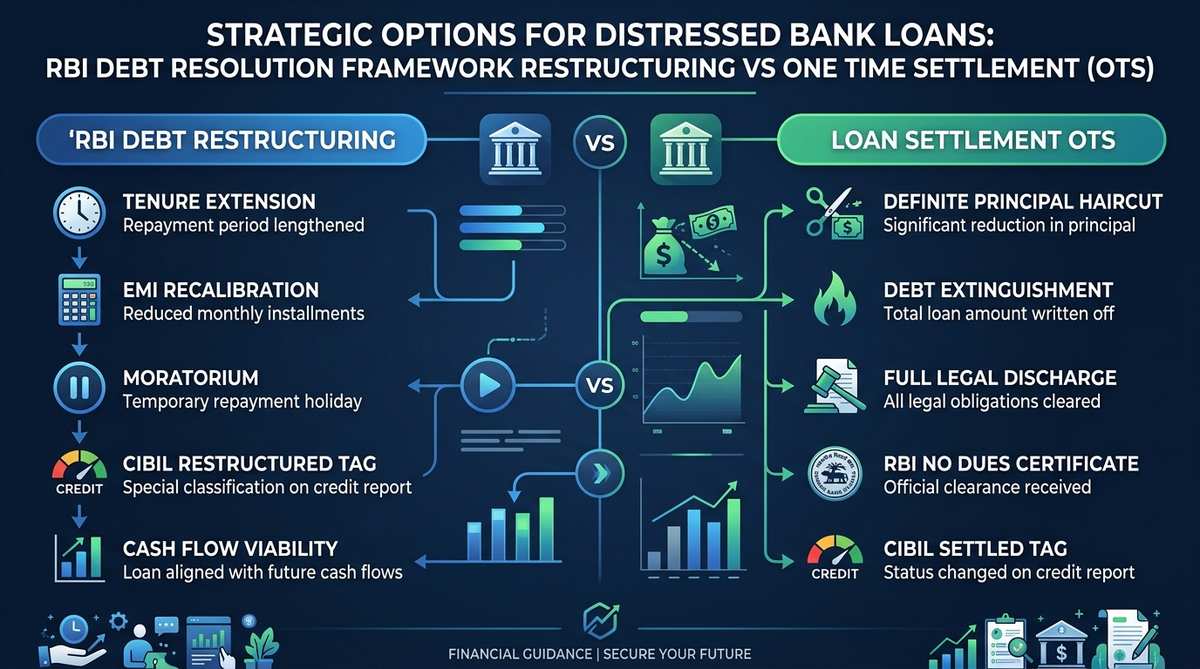
5. RBI Restructuring vs. Loan Settlement Visual Roadmap
The graphic below outlines the path between the RBI Debt Resolution Framework and a One-Time Settlement (OTS). It highlights differences in eligibility, payment terms, credit reporting. And legal finality.
6. Strategic Decision Framework
Choosing between RBI loan restructuring and a One-Time Settlement depends on three factors: permanence of income loss, pledged assets. And long-term credit needs.
Here is the strategic framework used by banking advocates to guide distressed borrowers:
When to Opt for RBI Restructuring
- •Temporary Cash Flow Drop: You faced a short-term income shock (job switch, delayed payments, or illness) that should clear within 6 to 12 months.
- •Viable Business or Job: Your firm has active client orders, or you have salary credentials to pay smaller EMIs over extra time.
- •Secured Mortgage Protection: You have valuable property pledged to the bank and want to avoid SARFAESI Section 13(4) possession notices and auctions.
- •Corporate Directorships: You hold corporate roles where keeping an active, non-default credit profile is vital.
When to Opt for One-Time Settlement (OTS)
- •Permanent Financial Hardship: You suffered total business shutdown, serious illness, or permanent job loss, making regular payments impossible.
- •Inability to Pay EMIs: Even with a 50% EMI cut through tenure extension, your income cannot meet the revised schedule.
- •High-Interest Unsecured Debt: Credit card balances and personal loans have spiraled with interest. Where a 50% to 75% waiver is essential.
- •Clean Debt Exit: You have access to one-time family or third-party funds and need immediate legal release from all creditor claims.
Applying for restructuring without steady cash flow is risky. It only delays default while adding compounded interest to your loan. If servicing debt is impossible, a structured OTS compromise is the sensible choice.
7. RBI Compromise Sanction Forensic Checklist
Signing a restructuring addendum or an OTS sanction letter carries real legal risks if the paperwork has errors. Banks and recovery teams often include strict clauses or vague terms that leave you exposed to future court claims.
Our banking advocates examine every settlement agreement against four mandatory legal checks:
Check that the addendum clearly states the revised tenure, new EMI amount, exact moratorium dates. And interest capitalization rules. It must bar retroactive penal interest hikes.
Ensure the OTS letter comes on official bank letterhead. It must be signed by an authorized manager (Chief Manager or AGM). It must state that your debt is fully cleared upon payment.
The letter must bind the bank to withdraw all pending legal notices. This includes Section 138 NI Act cheque bounce cases, Section 25 PSS Act complaints, DRT claims, and SARFAESI actions within 30 days.
Under RBI Circular RBI/2023-24/60, the bank must return all original property title deeds and guarantee discharges. It must deliver your No Dues Certificate within 30 days of final payment.
Never deposit token money into your account based on verbal promises from recovery agents. Without an official signed and stamped OTS letter from the bank, any paid funds go toward interest and penal fees. Your loan stays open to legal action.
8. Long-Term CIBIL Credit Bureau Impact
Credit bureaus track how loans are closed under the Credit Information Companies (Regulation) Act, 2005 and RBI Master Directions. Lenders must report exact resolution codes to CIBIL, Experian, Equifax, and CRIF High Mark.
The credit impact of each option works differently:
The bank marks the account in CIBIL as "Restructured". Your balance reflects the modified loan amount. Your score drops 30 to 70 points. Because the loan stays open and you pay on time, your score rebuilds steadily. Once the loan ends, the status changes to "Closed".
After you pay the OTS amount, the bank marks the account as "Settled" with a ₹0 balance. This brings a sharp score drop of 70 to 150 points. However, it stops monthly overdue default tags and ends legal risk. You can rebuild your score back to 750+ over 18 to 24 months.
The 18-to-24 Month Credit Score Rehabilitation Roadmap
You can restore your credit eligibility by following four clear steps:
- Step 1: Get a Fixed-Deposit Credit Card: Open a fixed deposit (₹25,000 to ₹50,000) with a bank and get a secured card. This starts fresh, positive monthly credit reporting.
- Step 2: Keep Credit Use Below 30%: Spend under 30% of your total credit limit each month to show good financial control.
- Step 3: Pay Bills on Time in Full: Set up auto-pay for all monthly card statements at least 5 days before the due date. Avoid late payments.
- Step 4: Audit Bureau Records and Dispute Errors: Check all four bureaus (CIBIL, Experian, Equifax, CRIF) quarterly. Verify that settled accounts show a ₹0 balance. Raise online disputes for any errors.
9. RBI Debt Restructuring vs. Loan Settlement Comprehensive
The table below highlights key differences between RBI Debt Restructuring and a One-Time Settlement (OTS):
| Strategic Parameter. | RBI Debt Restructuring Framework. | One-Time Settlement (OTS Compromise). |
|---|---|---|
| Core Objective. | Tenure modification &. EMI relief for viable borrowers. | Permanent debt clearance and exit for insolvent borrowers. |
| Principal Repayment Obligation. | 100% of loan principal must be repaid. | 50% to 75% Principal Haircut waiver sanctioned. |
| Contractual Continuity. | Loan contract continues via written addendum. | Loan contract ends and is fully cancelled. |
| Prerequisite Condition. | Demonstrable future cash flows &. DSCR viability. | Verifiable financial hardship and permanent income loss. |
| Payment Timeline. | Monthly EMIs spread across 2 to 5 extra years. | Lump sum or 2–4 parts paid within 30–90 days. |
| Credit Bureau Status. | Reported as "Restructured". with active balance. | Reported as "Settled". with strict ₹0 balance. |
| CIBIL Score Impact. | Moderate drop (30 to 70 points). | Initial drop (70 to 150 points). 18–24 month recovery. |
| Collateral / Lien Release. | Security stays pledged until final EMI payment. | Full lien release &. title deeds returned in 30 days. |
| Legal Risk of Re-Default. | High. missed payments trigger fresh SARFAESI/DRT claims. | Zero. absolute judicial finality backed by RBI NDC. |
10. SettleLoans Resolution Defense & Advisory
Picking between loan restructuring and an OTS settlement needs sound legal help. SettleLoans assists borrowers across India. We check your repayment ability. We stop illegal recovery calls under RBI rules. We audit loan statements to remove wrongful charges. Our legal team negotiates directly with bank committees. We help you get an RBI loan restructuring plan or a 50% to 75% OTS waiver with an official No Dues Certificate.

Settle Loan is India's trusted debt relief and loan settlement platform. We help borrowers overcome financial distress by negotiating with banks and NBFCs to legally settle personal loans and credit card debts. With our transparent, performance-based approach, you can achieve debt freedom and regain your financial peace of mind.
COMPUTER
11. FAQs: RBI Restructuring vs. Loan Settlement
Here are clear legal answers to common questions on RBI loan restructuring, One-Time Settlements. And borrower rights in India.
What is the primary difference between loan restructuring and loan settlement?
The main difference is the repayment duty and loan life. Under the RBI Prudential Framework, restructuring changes loan terms. It can extend tenure, cut monthly EMIs, or give an interest pause. But you must repay 100% of the loan and interest. In contrast, a One-Time Settlement (OTS) is a debt compromise. The bank takes a lump sum, often 30% to 50% of the balance. The bank writes off the rest. It closes your debt forever.
When should a borrower choose loan restructuring over loan settlement?
Choose loan restructuring when your cash trouble is short term. Your job or business must remain steady. You must have clear future income to pay smaller EMIs over extra time. Restructuring gives quick cash relief through longer tenure or an EMI pause. It keeps your credit active and avoids legal default.
When is a One-Time Settlement (OTS) the only practical option?
An OTS is best when you suffer permanent income loss. This includes job loss, business closure, or serious illness. Paying even reduced EMIs is impossible. Restructuring will only delay default and add heavy interest. An OTS allows a 50% to 75% waiver. It clears the debt forever with an official RBI No Dues Certificate.
How does loan restructuring affect CIBIL and credit bureau scores compared to settlement?
Both options affect credit bureau records differently under RBI rules. Restructured accounts get a 'Restructured' tag in CIBIL, Experian, Equifax, and CRIF High Mark. Your credit score drops 30 to 70 points. But the account stays active and standard. Scores recover as you pay on time. A settled loan gets a 'Settled' tag with zero balance. The score drops 70 to 150 points. You need 18 to 24 months of steady credit steps to rebuild.
Can a borrower get a loan settlement after their loan has already been restructured?
Yes. If you enter an RBI restructuring plan and face a new financial shock, you may miss new EMIs. The loan then becomes a Non-Performing Asset (NPA). At that stage, you can start fresh OTS talks with the bank or Debt Recovery Tribunal. You can use your verified hardship to get a final settlement waiver.
Does loan restructuring involve any principal or interest waiver?
Standard retail and SME loan restructuring under RBI rules does not waive principal debt. Banks may lower the interest rate or drop late fees. They may convert unpaid interest into a Funded Interest Term Loan (FITL). Full debt waivers and principal cuts happen only through One-Time Settlements (OTS) or NCLT plans under the Insolvency and Bankruptcy Code (IBC).
What is the Net Present Value (NPV) test used by banks during debt resolution?
Under RBI Master Directions, banks must run an NPV test for debt resolution. In restructuring, the bank calculates the present value of future cash flows. It compares this against the original loan value. In an OTS, the credit committee compares the cash offer with the net value of long legal recovery under DRT or SARFAESI. They deduct legal fees, court delays. And capital provisioning costs.
How does advocate representation assist borrowers during restructuring vs settlement?
Specialist debt defense lawyers protect your rights. In restructuring, lawyers check bank rules, prepare cash flow reports. And negotiate lower rates. They ensure addendum terms do not add unfair personal guarantees. In an OTS, lawyers issue notices to stop recovery harassment. They audit loans to remove illegal fees. They negotiate with zonal committees to get formal OTS sanction letters and RBI No Dues Certificates.
Can a bank initiate SARFAESI or Section 138 proceedings during the RBI restructuring evaluation window?
Under RBI Prudential Framework rules. When a lender reviews a stressed asset plan, a review period begins. During this evaluation window, lenders usually pause recovery actions. But if restructuring fails or you miss restructured payments, the bank can act. It can issue Section 13(2) SARFAESI notices, file Section 138 NI Act cheque bounce cases, or start DRT claims.