- Gateway Payout Firewall: Payment aggregators are strictly barred under RBI rules from freezing or withholding customer checkout proceeds to recover defaulted credit owed to partner NBFCs.
- Halting Compounding NACH Penalties: Merchants possess absolute statutory rights under NPCI circulars to revoke electronic mandates, stopping daily bank return fees and high penalty interest.
- Realistic 45%–65% OTS Haircuts: Because merchant cash advances lack collateral, lenders balance Net Present Value recovery math, approving substantial principal write-offs for insolvent sellers.
- Challenging Unilateral Arbitration: Digital arbitration notices issued without mutual written consent are legally invalid under Supreme Court precedents and can be successfully stayed.
- Statutory ₹0 NDC Protection: Under RBI Circular RBI/2023-24/60, lenders must deliver a final No Dues Certificate and clear bureau default tags within 30 days under a ₹5,000 daily penalty rule.
Understanding Fintech Merchant Cash Advances & Risk Engines
Indian e-commerce sellers and Direct-to-Consumer (D2C) brands increasingly rely on algorithmic credit lines known as Merchant Cash Advances (MCAs) and Revenue-Based Financing (RBF). Facilitated by payment platforms like Razorpay Capital and underwritten by partner NBFCs (including LiquiLoans, Northern Arc, Vivriti, and InCred), these unsecured facilities bypass traditional mortgage security. Instead, lenders deploy Thirdwatch AI fraud scoring, Shopify sales data, and daily gateway turnover to sanction limits up to ₹1 Crore.
Unlike standard monthly EMI term loans, advances are recovered through automated daily or weekly e-NACH sweeps and direct gateway holdbacks. When sales drop due to rising advertising acquisition costs, seasonal demand shifts, or high return-to-origin (RTO) rates, automated daily sweeps continue unabated. Draining working capital needed for inventory and vendor invoices, this rigid mechanism forces solvent merchants into sudden default.
Gateway Payout Freezes vs. RBI Payment Aggregator Rules
When a merchant defaults on an advance, fintech lenders frequently threaten to freeze payment gateway settlement accounts, withholding customer sales proceeds to coerce repayment. This practice violates Reserve Bank of India regulations. Under RBI Guidelines on Regulation of Payment Aggregators and Payment Gateways (DPSS.CO.PD.No.1810/02.14.008/2019-20), checkout funds must be credited to escrow accounts held strictly in trust to settle merchant transactions.
A payment aggregator cannot act as an extralegal recovery arm for a partner lending NBFC. Withholding operational checkout funds to offset an unpaid loan without an explicit Civil Court attachment order under Order 38 Rule 5 CPC is unlawful. Furthermore, RBI Digital Lending Guidelines (2022) require strict firewalls between payment aggregators and lenders, mandating that loan recovery occur directly through bank accounts without gateway diversion.
Check Your Loan Settlement Options
Answer 2 quick questions to evaluate your settlement eligibility.
1. What type of loan do you want to settle?
Halting Daily NACH Sweeps & Stopping Gateway Deductions
Defaulting merchants face relentless compounding of electronic mandate bounce fees. Algorithmic collection engines present failed e-NACH mandates daily. Each failed debit incurs bank return penalties of ₹250 to ₹500 plus GST, while NBFCs levy dishonour fees of ₹500 to ₹1,000 and 24% to 36% penal interest. Over two months, these automated sweeps generate over ₹1 Lakh in artificial penalties, violating RBI Fair Lending Practice directives (2023) prohibiting penalty capitalization.
Founders can stop this drain by directing their bank under NPCI guidelines to cancel or suspend the e-mandate, preventing future return charges. Simultaneously, legal counsel issues formal notice to the NBFC declaring commercial hardship, confirming mandate cancellation, and insisting on a 100% waiver of accumulated bounce fees during compromise settlement discussions.
Fintech OTS Haircut Policies & Mathematical Valuation
Fintech NBFCs operate under board-approved Compromise Settlement and Technical Write-off policies mandated by Reserve Bank of India circular DOR.STR.REC.20/21.04.048/2023-24. Under Indian Accounting Standard 109 (Ind AS 109), financial institutions must follow Expected Credit Loss (ECL) frameworks, requiring mandatory balance sheet provisioning as delinquent loans age across 30, 60, and 90 Days Past Due (DPD) thresholds.
Because merchant cash advances and revenue-based lines are completely unsecured—possessing zero underlying mortgage real estate, hypothecated plant machinery, or liquid pledges—the lender faces acute downside risk upon borrower default. The NBFC's Stressed Assets Committee must mathematically evaluate any compromise settlement offer against the projected Net Present Value (NPV) of prolonged legal litigation.
Where C_t represents estimated recoveries, r is the discount rate, and deductions account for 3–5 years of court friction and capital locked in NPA provisions.
When legal counsel submits a well-documented commercial hardship petition demonstrating severe revenue contraction, depleted cash reserves, and unviable unit economics, the NBFC recognizes that pursuing civil execution across multi-year court timelines will yield negligible returns after accounting for legal retainers and capital provisioning costs. Under these financial constraints, an upfront lump-sum settlement offers the lender immediate balance-sheet recovery and capital write-back, unlocking substantial debt haircuts.
Fintech Merchant Loan Settlement Slabs by Facility Category & Aging
| Fintech Facility Category | Delinquency Aging | Penal & Bounce Waiver | Principal Haircut Range | Target Settlement Offer |
|---|---|---|---|---|
| Razorpay Capital Line of Credit | 90 – 180 Days (NPA) | 100% Full Waiver | 35% – 50% Principal Waiver | Offer 40%–50% of Core Dues |
| Razorpay Capital Line of Credit | 180+ Days (Doubtful / Loss) | 100% Full Waiver | 50% – 65% Principal Waiver | Offer 30%–40% of Core Dues |
| E-Commerce Revenue-Based Advance | 90 – 150 Days (NPA) | 100% Full Waiver | 40% – 55% Principal Waiver | Offer 35%–45% of Outstanding |
| POS Swipe Terminal Term Loan | 180+ Days (Written Off) | 100% All Penal Charges | 55% – 70% Principal Waiver | Offer 25%–35% of Book Dues |
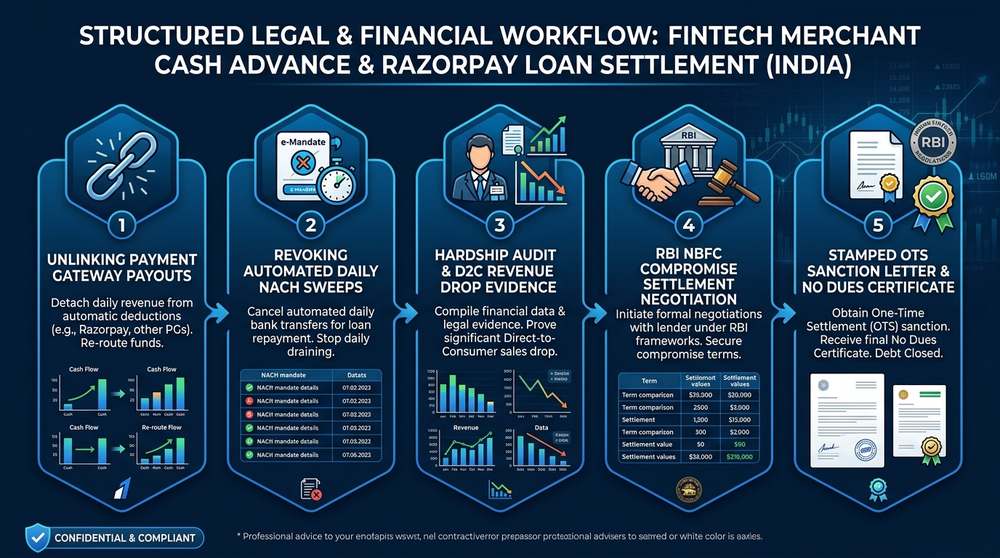
Fintech Merchant Loan Resolution Action Blueprint
Defending Against Aggressive Fintech Debt Recovery Tactics
Fintech collection agencies often deploy aggressive recovery tactics upon loan default, including incessant calls, unannounced visits to retail premises during business hours, and unauthorized outreach to suppliers, logistics vendors, or investors. These actions directly breach the RBI Master Direction on Recovery Agents and NBFC Fair Practices Code, which restricts borrower contacts strictly between 08:00 AM and 07:00 PM and explicitly prohibits contacting third parties, non-guarantor family members, or business associates.
Founders should preserve call audio records, WhatsApp messages, and CCTV recordings. When legal advocates serve a formal statutory cease-and-desist notice on the NBFC's Principal Nodal Officer and file an escalation on the RBI Integrated Ombudsman portal (CMS), regulated entities are mandated to restrain third-party collection agencies within 48 hours.
Step-by-Step Roadmap to Settle Merchant Cash Advances
Executing an advantageous compromise settlement on defaulted merchant advances requires a disciplined legal strategy:
1Decoupling Payment Gateway Settlement Accounts
Segregate operational checkout revenues from the distressed loan relationship by re-routing customer payment processing through independent merchant accounts, protecting daily trading cash flows from extralegal holdbacks.
2Revoking Automated Daily NACH Electronic Mandates
Issue an e-mandate cancellation notice to your bank under NPCI guidelines. This immediately stops repeated failed presentations, halting the compounding accumulation of bank return fees and NBFC dishonour charges.
3Compiling an Exhaustive Hardship Evidence Dossier
Compile documentary evidence demonstrating business distress, including monthly GST filings showing turnover decline, Shopify analytics, ad spend receipts proving negative unit economics, and bank liquidity statements.
4Submitting Formal Hardship Petition to NBFC Stressed Assets Desk
Submit a formal OTS petition directly to the partner NBFC's Stressed Assets Desk under RBI Compromise Settlement Directions, anchoring opening offers at 25% to 35% of core dues to preserve negotiation leeway.
5Conducting Credit Committee Negotiations for Maximum Haircut
Counter modest NBFC discount offers by demonstrating that settlement funds represent third-party distress pooling, steering the Credit Committee toward the target 45% to 65% principal waiver band alongside 100% penal cancellation.
6Forensic Sanction Letter Audit & Remittance for ₹0 NDC
Audit the OTS Sanction Letter on official NBFC letterhead. Remit payment directly into the designated loan account and enforce delivery of the final stamped No Dues Certificate within 30 days under RBI rules.
Section 25 PSSA Defense, Digital Arbitration & Lok Adalat
At 60 to 90 days delinquency, lenders issue statutory notices under Section 25 of the Payment and Settlement Systems Act, 2007 (PSSA) for bounced electronic debits, alongside Section 138 NI Act notices if security cheques were deposited.
A Section 25 PSSA notice is a 15-day demand notice, not an arrest warrant. A timely legal reply detailing genuine commercial adversity and lack of fraudulent intent protects the founder while directing the dispute toward compromise settlement.
Fintech lenders also invoke online dispute resolution (ODR) platforms like CADRE or Presolv360. Under Supreme Court precedents (Perkins Eastman and TRF Ltd.), unilateral arbitrator appointments without mutual consent are void ab initio, allowing counsel to challenge jurisdiction under Section 12 and 14 of the Arbitration Act. Furthermore, quarterly National Lok Adalats offer pre-approved 50%–65% haircuts backed by non-appealable Civil Court Decrees.
| Resolution Avenue | Legal Mechanism | Haircut Potential | Typical Timeline | Judicial Finality |
|---|---|---|---|---|
| Direct NBFC OTS | Compromise settlement under RBI Master Directions. | 45% – 65% Debt Haircut | 15 to 30 Days | Binding private settlement contract with ₹0 NDC. |
| National Lok Adalat | Judicial conciliation before sitting judge and bench. | 50% – 65% Debt Haircut | Single-day session | Civil Court Decree (Permanent finality, no appeal). |
| Digital ADR Defense | Challenging unilateral sole arbitrator jurisdiction. | Variable (Converts to OTS) | 2 to 5 Months | Subject to Section 34 / 14 challenges. |
| Section 25 / 138 Defense | Magistrate Court compoundable defense and settlement. | 40% – 55% Debt Haircut | 2 to 6 Months | Formal withdrawal and case dismissal. |
Forensic Audit of Sanction Letters & ₹0 NDC Mandate
Borrowers must beware of collection agents issuing unauthorized settlement letters. Funds paid against unverified offers are often credited toward penal interest rather than core principal.
An authentic OTS letter must be issued on official NBFC letterhead, stating the Corporate Identification Number (CIN), specific loan accounts, sanctioned settlement amount, payment deadlines, and unambiguous covenants of full debt discharge.
Under RBI Circular RBI/2023-24/60, lenders must deliver a formal No Dues Certificate (NDC) and update credit bureaus within 30 days of payment, subject to statutory compensation of ₹5,000 per day of delay payable to the borrower.
Comparative Resolution Matrix & Founder Credit Recovery
An OTS settlement updates credit bureaus (CIBIL, Experian, Equifax, CRIF High Mark) to 'Settled' or 'Post-Write-off Settled' with an outstanding balance of ₹0.
While a settled tag causes an initial score adjustment of 75 to 140 points, it permanently halts compounding default tags. Founders can systematically restore their credit score to 750+ within 18 to 24 months by utilizing fixed-deposit-backed credit cards and maintaining disciplined repayment records.
Why Distressed D2C & Retail Founders Trust SettleLoans
Resolving defaulted merchant cash advances and revenue-based lines requires sophisticated financial restructuring combined with aggressive legal advocacy. SettleLoans insulates business operations by halting illegal payment gateway freezes, canceling unauthorized automated NACH debit sweeps, defending against Section 25 PSSA and online arbitration summons, and negotiating directly with NBFC Stressed Assets Committees to achieve maximum debt waivers and certified ₹0 No Dues Certificates.

Settle Loan is India's trusted debt relief and loan settlement platform. We help borrowers overcome financial distress by negotiating with banks and NBFCs to legally settle personal loans and credit card debts. With our transparent, performance-based approach, you can achieve debt freedom and regain your financial peace of mind.
COMPUTER
Frequently Asked Questions on Merchant Loan Settlement
Can Razorpay legally freeze my payment gateway payouts if I default on a merchant cash advance?
No. Under the Reserve Bank of India Guidelines on Regulation of Payment Aggregators and Payment Gateways (DPSS.CO.PD.No.1810/02.14.008/2019-20), payment aggregator escrow accounts are held strictly in trust to settle customer merchant transactions. A payment aggregator cannot unilaterally freeze, withhold, or divert unrelated operational sales turnover to satisfy a defaulted loan owed to an external partnered NBFC without an explicit judicial attachment order issued by a competent Civil Court under Order 38 Rule 5 of the Code of Civil Procedure.
What is a fintech merchant cash advance and how does it differ from a traditional bank loan?
A fintech merchant cash advance (MCA) or revenue-based financing facility is an unsecured short-term credit line underwritten using algorithmic risk engines, store sales volumes, and historical payment gateway transactions. Instead of traditional monthly equated installments, repayments are automatically extracted via daily or weekly electronic NACH debits or revenue-split sweeps directly from incoming settlement batches. The facility carries no physical collateral but often imposes severe penal fees upon default.
How can merchants stop automated daily e-NACH debits and prevent mounting bounce charges?
Under National Payments Corporation of India (NPCI) procedural guidelines and RBI Fair Lending Practice circulars, a borrower maintains the absolute statutory right to instruct their destination bank in writing or via digital net-banking channels to cancel or suspend an e-mandate. Concurrently, legal counsel issues a formal hardship notice to the fintech lender demanding an immediate pause on electronic presentations and a complete waiver of all capitalized bounce penalties during settlement negotiations.
What percentage of debt haircut can online sellers realistically negotiate on fintech loans?
On unsecured merchant cash advances and revenue-based facilities crossing 90 to 180 days of non-payment (Non-Performing Asset or Doubtful status), fintech NBFCs routinely approve principal debt waivers ranging from 45% to 65% of outstanding book dues. Additionally, RBI fair lending guidelines mandate an absolute 100% waiver of all accumulated bounce penalties, late fees, and compounding default interest.
Can a fintech lender file a criminal police case or arrest a merchant for defaulting on a business loan?
No. A default on an unsecured commercial credit line or merchant advance is strictly a civil breach of contract under the Indian Contract Act, 1872. Local police authorities have zero jurisdiction to register an FIR or make an arrest for business insolvency or revenue collapse. While lenders may issue demand notices under Section 25 of the Payment and Settlement Systems Act (PSSA) for dishonoured NACH debits, these are bailable, compoundable quasi-criminal proceedings handled in Magistrate Courts that are routinely resolved through advocate representation and compromise settlements.
How should a merchant respond to a Section 25 PSSA legal notice sent by a fintech NBFC?
A Section 25 PSSA notice is a statutory 15-day demand notice, not a court warrant or conviction. Borrowers must promptly engage specialized banking counsel to draft a comprehensive formal reply within the 15-day window. The reply must detail bona fide business distress, challenge unauthorized multiple daily debit sweeps, demonstrate the absence of fraudulent intent, and propose a structured One-Time Settlement under RBI compromise frameworks.
Are unilateral online arbitration notices issued on platforms like CADRE or Presolv360 legally enforceable?
No. Landmark Supreme Court rulings, including Perkins Eastman Architects DVM v. HSCC (India) Ltd. and TRF Ltd. v. Energo Engineering Projects Ltd., have established that unilateral appointments of sole arbitrators by lenders without mutual, express post-dispute consent are void ab initio. Legal advocates can formally challenge the arbitrator's jurisdiction under Section 12 and Section 14 of the Arbitration and Conciliation Act, 1996, effectively staying ex-parte proceedings.
How does settling a fintech merchant cash advance impact the founder's CIBIL score?
Following an approved compromise settlement, the partner NBFC reports the account to credit bureaus (CIBIL, Experian, Equifax, CRIF High Mark) with the status 'Settled' or 'Post-Write-off Settled' with a ₹0 balance. While this results in an immediate credit score adjustment of 75 to 140 points, it halts continuous compounding negative delinquency marks and legal default flags, allowing founders to rebuild their credit profile to 750+ within 18 to 24 months.
Who within a fintech lending company holds the legal authority to approve an OTS proposal?
External recovery agents, outsourced tele-calling agencies, and frontend loan collection officers possess zero delegated legal authority to grant loan waivers. Substantive debt haircuts (45% to 65%) must be formally sanctioned by the partner NBFC's internal Stressed Assets Committee, Zonal Credit Committee, or Chief Risk Officer, and documented on official corporate letterhead bearing valid seals and signatory credentials.
How long does a fintech NBFC take to issue the No Dues Certificate (NDC) following settlement payment?
Under Reserve Bank of India Circular RBI/2023-24/60, regulated financial entities are statutorily mandated to deliver a formal No Dues Certificate (NDC) and update credit bureau records within 30 calendar days of receiving full settlement remittance. Any unjustified delay beyond 30 days entitles the borrower to mandatory statutory compensation of ₹5,000 per calendar day of delay directly from the lender.
Official Regulatory References & Statutory Frameworks
- Reserve Bank of India (RBI): Master Direction on Compromise Settlements and Technical Write-offs (DOR.STR.REC.20/21.04.048/2023-24)
- RBI Guidelines: Regulation of Payment Aggregators and Payment Gateways (DPSS.CO.PD.No.1810/02.14.008/2019-20)
- RBI Circular: Fair Lending Practice – Penal Charges in Loan Accounts & NBFC Recovery Directives
- Reserve Bank - Integrated Ombudsman Scheme, 2021: Online CMS Portal for Harassment, Unauthorized Freezes & Penalty Disputes
- National Legal Services Authority (NALSA): Legal Services Authorities Act, 1987 — National Lok Adalat Conciliation Framework