- Proactive Borrower Initiation: Defaulters do not have to wait to be sued; any borrower can file a free Pre-Litigation Mediation petition before their local District Legal Services Authority (DLSA).
- Immediate Harassment Shield: Once registered with the DLSA registry, the dispute becomes subject to judicial conciliation, forcing lenders to cease aggressive recovery agency visits and abusive calls.
- Statutory Force of Civil Court Decree: Settlements executed through DLSA mediation are converted into National Lok Adalat awards under Section 21 of the Legal Services Authorities Act, possessing non-appealable civil court decree finality.
- Substantial Principal Haircuts (40%–65%): Neutral court-appointed mediators evaluate real hardship evidence, prompting bank nodal officers to approve deep principal discounts alongside 100% penal interest waivers.
- RBI-Mandated ₹0 NDC Delivery: Lenders must deliver an official No Dues Certificate and update credit bureaus within 30 days under RBI Circular RBI/2023-24/60, subject to a ₹5,000 per day statutory delay penalty.
1. Pre-Litigation Mediation: Dispute Resolution Guide
When a borrower defaults on an unsecured personal loan, business line of credit, or credit card facility due to severe financial adversity—such as sudden job loss, catastrophic medical emergencies, or commercial business insolvency—the conventional banking recovery machinery immediately swings into punitive action. Commercial lenders and Non-Banking Financial Companies (NBFCs) deploy aggressive third-party collection agencies, flood borrowers with automated legal notices, and initiate adversarial proceedings under the Negotiable Instruments Act (Section 138 cheque bounce) or the Payment and Settlement Systems Act (Section 25 NACH bounce).
Faced with mounting pressure, most distressed borrowers remain completely unaware that Indian civil jurisprudence provides an extraordinarily powerful, cost-free, and legally recognized shield: Pre-Litigation Mediation. Instead of waiting defenselessly for a bank to file a summary recovery suit under Order 37 CPC or initiate unilateral arbitration proceedings, the borrower can seize the legal initiative by proactively bringing the lending institution before a neutral judicial conciliation forum.
Pre-Litigation Mediation operates under the statutory patronage of the Legal Services Authorities Act, 1987, Section 89 of the Code of Civil Procedure (CPC), and the newly enacted Mediation Act, 2023. Managed through the District Legal Services Authority (DLSA) established in every district court complex across India, this process provides an institutional bridge where borrowers and authorized senior bank officers negotiate realistic debt settlement terms under the guidance of trained, court-appointed mediators. By shifting the venue from stressful phone confrontations to a formal judicial forum, borrowers eliminate coercive harassment and create the necessary leverage to secure formal One-Time Settlements (OTS) with substantial debt relief.
2. Statutory Legal Grounding: Legal Services Authorities Act, 1987, Section 89 CPC & The Mediation Act, 2023
To maximize the strategic impact of pre-litigation mediation, borrowers must grasp the statutory architecture that compels commercial banks and financial institutions to participate in good-faith settlement negotiations. The legal validity and institutional authority of pre-litigation mediation rest upon three foundational pillars of Indian civil jurisprudence:
Under Sections 19, 20, and 22 of the Act, District Legal Services Authorities (DLSAs) and Taluk Legal Services Committees are mandated to organize Lok Adalats and pre-litigation conciliation desks to resolve civil and commercial disputes before regular suits are filed in civil courts.
Section 89 CPC mandates judicial courts to refer civil disputes to Alternative Dispute Resolution (ADR) channels, including arbitration, conciliation, judicial settlement through Lok Adalat, or mediation, recognizing that negotiated compromise serves public interest far better than protracted litigation.
The Mediation Act, 2023 gives statutory formalization to pre-litigation mediation, establishing a strict 180-day resolution timeline, establishing confidentiality standards, and ensuring mediated settlement agreements are enforceable directly as court decrees under the law.
Under Section 21 of the Legal Services Authorities Act, every award passed by a Lok Adalat bench on the basis of a DLSA mediated settlement is deemed a final decree of a Civil Court, binding upon both borrower and lender with zero right of appeal.
Unlike a contested courtroom trial where a judge imposes an adversarial verdict, pre-litigation mediation is an entirely non-adversarial, consensus-driven process. The mediator cannot force any settlement upon you. No compromise is executed unless both the borrower and the bank agree to every specific clause, repayment figure, and instalment timeline in writing.
Check Your Loan Settlement Options
Answer 2 quick questions to evaluate your settlement eligibility.
1. What type of loan do you want to settle?
3. Halting Coercive Recovery Tactics: How DLSA Registration Neutralizes Aggressive Harassment
One of the most immediate benefits of filing an application for pre-litigation mediation is the neutralization of third-party debt collection harassment. When a borrower defaults, commercial banks often outsource collection portfolios to third-party recovery agencies whose personnel employ aggressive and unlawful collection tactics—including persistent calling at unsociable hours, unauthorized visits to workplaces, contacting distant family members, and threatening unconstitutional criminal actions.
The moment your DLSA pre-litigation mediation application is registered and formal court notices are served on the bank's Zonal Stressed Assets Resolution Desk, the legal landscape changes fundamentally:
- Establishment of Sub-Judice Conciliation: The debt dispute officially enters a court-administered resolution framework. Banks maintain strict internal compliance protocols requiring their collection teams to halt external recovery efforts while formal mediation is actively pending before a judicial authority.
- Enforcement of RBI Fair Practices Code: Under the RBI Master Direction – Recovery Agents and Conduct Rules, lenders are strictly prohibited from intimidating borrowers, invading privacy, or contacting relatives. Raising recovery misconduct before a DLSA judicial mediator exposes the bank to direct judicial reprimand and severe regulatory penalties.
- Transition to Authorized Zonal Legal Counsel: Instead of dealing with commission-driven agency callers, the borrower engages directly with the bank's internal legal managers and empowered recovery officers who hold formal delegation of power to write off bad debt and execute haircuts.
- Preemption of Unilateral Arbitration: Filing for pre-litigation mediation before the DLSA prevents the bank from initiating biased unilateral arbitration proceedings or rushing into ex-parte summary suits under Order 37 CPC without facing immediate jurisdictional objections.
Inability to repay an unsecured personal loan or credit card debt due to genuine economic distress is strictly a civil contractual dispute, not a criminal offense. The Supreme Court of India has repeatedly held that commercial banks cannot weaponize police complaints or criminal charges for loan default. Appearing before a DLSA mediator ensures that the civil character of the dispute is firmly preserved.
4. Bank Balance Sheet Accounting, NPA Provisioning & The Net Present Value (NPV) Equation
Securing a deep 40% to 65% principal haircut during DLSA mediation requires a clear understanding of the financial pressures governing commercial bank balance sheets. Indian commercial banks and NBFCs are strictly regulated by the Reserve Bank of India's Prudential Norms on Income Recognition, Asset Classification, and Provisioning (IRACP). When a borrower fails to service interest or principal instalments for 90 days, the loan is formally classified as a Non-Performing Asset (NPA).
As an NPA account ages, the bank must set aside substantial capital provisions out of its operating profits, creating severe balance sheet drag:
| NPA Classification Stage | Overdue Aging Horizon | RBI Mandatory Capital Provision | Settlement Haircut Window |
|---|---|---|---|
| SMA-2 (Pre-NPA Alert) | 61 to 90 Days Overdue | 5% General Reserve | Penal Interest & Late Fee Waivers Only |
| Sub-Standard Asset (Early NPA) | 91 to 365 Days Overdue | 25% Unsecured Provisioning | 25% to 40% Principal Haircut Scope |
| Doubtful Asset 1 (D1) | 12 to 24 Months Default | 100% Full Capital Provisioning | 40% to 55% Principal Haircut Scope |
| Doubtful Asset 2 / Written-Off | 24+ Months Default / Write-Off | 100% Balance Sheet Charge-Off | 55% to 65% Maximum Haircut Window |
When a bank receives a pre-litigation mediation notice from the DLSA, its Stressed Asset Committee performs an internal financial calculation comparing the immediate cash recovery under mediation against the net yield of litigating through civil courts or Debt Recovery Tribunals (DRT). The bank evaluates the Net Present Value (NPV) of Litigation Recovery:
Where C_t represents estimated future cash recoveries, r is the bank's cost of capital discount rate, and deductions incorporate 3–5 years of judicial court delays, senior advocate retainers, execution petition friction, and capital locked in non-earning NPA reserves.
Because pursuing an unsecured debtor through civil litigation takes several years with substantial legal expenditure and uncertain realization, receiving a structured cash payment of 40% to 55% through a single DLSA session delivers a far higher financial return for the bank than dragging out adversarial lawsuits.
5. DLSA Pre-Litigation Mediation & Loan Settlement Visual Roadmap
The visual roadmap below details the complete 5-stage institutional trajectory of resolving bank loan default through District Legal Services Authority (DLSA) pre-litigation mediation—from filing the initial application to conciliation hearings, sanction letter execution, and receiving an unappealable Lok Adalat decree with a zero-balance No Dues Certificate.
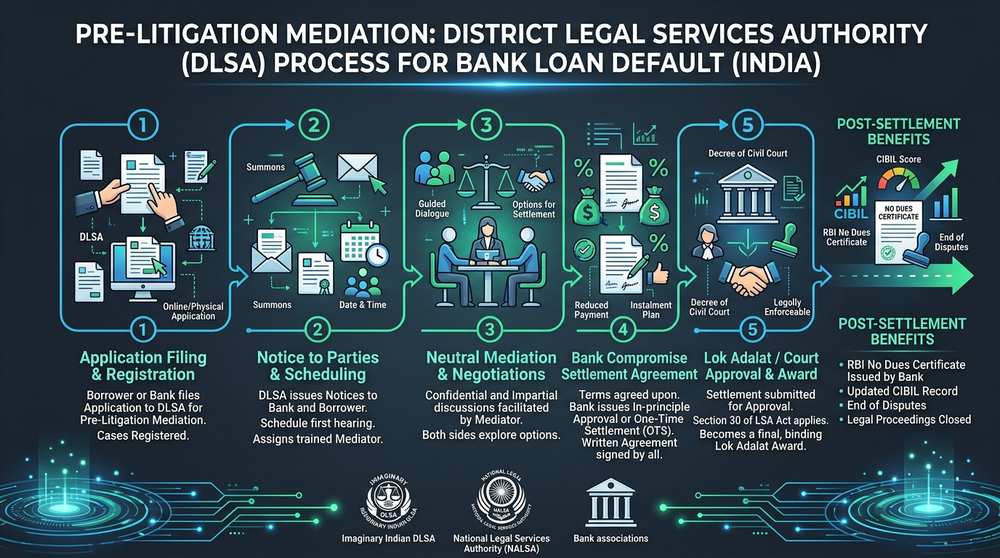
6. Step-by-Step Advocate Strategy: How to Proactively Initiate DLSA Pre-Litigation Mediation
Initiating pre-litigation mediation requires careful procedural precision and tactical preparation. While any citizen can theoretically submit a basic letter to the DLSA, engaging specialized debt defense advocates ensures your application is fortified with unassailable financial documentation, statutory citations, and negotiation strategy.
Our legal team executes a structured 4-phase protocol to maximize borrower leverage:
Phase 1: Drafting the Formal DLSA Pre-Litigation Petition
Your advocate drafts a comprehensive pre-litigation application addressed to the Member Secretary of your territorial District Legal Services Authority. The petition details: (1) Full loan account specifications, sanction dates, and total principal disbursed; (2) Detailed accounting of total repayments made to date; (3) Clear identification of unapplied penal interest, bounce charges, and usurious late fees; (4) A comprehensive financial hardship statement articulating the specific trigger events (job loss, business downturn, medical crisis) that impaired servicing capacity.
Phase 2: Compiling the Unassailable Hardship Dossier
Banks routinely reject direct customer settlement requests because collection agents report that the borrower possesses hidden capacity to pay. We dismantle this assumption by appending certified documentary proof: income tax return (ITR) reductions, termination letters, medical treatment records, GST sales decline filings, or insolvency declarations that prove bona fide inability to service the full ledger balance.
Phase 3: Formal Service & Halting Parallel Recovery Measures
Upon registration, the DLSA registry issues formal summons to the designated Nodal Officer and Zonal Legal Head of the lending bank. Your advocate immediately serves a copy of the DLSA case registration on the bank's collection department, establishing an official record that prohibits further coercive recovery visits or third-party agent intimidation.
Phase 4: Representation During Mediation Hearings
During the mediation sessions held at the District Court ADR center, your legal counsel presents the settlement proposal directly to the bank's authorized representative in the presence of the judicial mediator. Counsel emphasizes the bank's litigation risks, highlighting that rejecting the proposed compromise will result in years of zero-recovery civil litigation while the loan remains fully provisioned on their books.
This advocate-managed process ensures the borrower never negotiates from a position of vulnerability, forcing the bank to treat the compromise request as a serious commercial resolution.
7. Mediation Settlement Agreement, Lok Adalat Consent Decrees & Sanction Letter Forensics
Once the bank and borrower agree on a compromise settlement figure during mediation, the final documentation must be executed with absolute legal rigor. Thousands of borrowers fall into predatory traps each year by paying money based on verbal promises from recovery agents or unofficial email confirmations, only to discover that the bank credited their payment as partial interest and continued legal recovery for the remaining balance.
A legally watertight resolution originating from DLSA pre-litigation mediation involves two critical legal instruments:
The bank must issue a formal One-Time Settlement (OTS) sanction letter on official corporate letterhead, signed by an authorized signatory with a registered employee code and official zonal seal.
The letter must explicitly recite your exact loan account numbers, full legal name, PAN, agreed settlement sum, structured payment due dates, and specific DLSA mediation case number.
The document must state unequivocally that remittance of the agreed settlement sum constitutes complete satisfaction of all outstanding claims, with the bank waiving all residual principal, interest, and legal costs.
The signed settlement terms are placed before the National Lok Adalat or Civil Judge Bench to pass a formal Lok Adalat Award under Section 21 of the Legal Services Authorities Act, permanently barring future litigation.
Never remit settlement funds in cash, to third-party agency bank accounts, or via individual UPI IDs. All settlement payments must be deposited directly into your designated bank loan account via RTGS, NEFT, or an Account Payee Demand Draft drawn in favor of "[Bank Name] A/C [Your Exact Loan Account Number]".
8. Loan Remittance, RBI ₹0 No Dues Certificate Mandate & CIBIL Bureau Trajectory
Completing your settlement payments on or before the agreed milestone dates initiates the final stage of total debt discharge: obtaining your official No Dues Certificate (NDC) and rehabilitating your credit profile. Under RBI Circular RBI/2023-24/60 (Responsible Lending Conduct – Release of Movable/Immovable Property Documents and Issuance of NDC), all regulated commercial banks and NBFCs are statutorily required to issue an official NDC and update credit information bureaus within 30 calendar days of receiving full settlement funds.
If the lending bank fails to deliver your No Dues Certificate or delays updating credit bureau closure records beyond 30 calendar days without lawful justification, the lender is statutorily liable to pay compensation of ₹5,000 for each day of delay directly to the borrower under RBI regulatory mandates.
Understanding CIBIL Bureau Reporting & Score Rehabilitation
Borrowers must understand the precise mechanism of credit bureau reporting following a compromise settlement:
- Account Status Remark: The bank will update the account status in CIBIL, Experian, Equifax, and CRIF as "Settled" or "Post-Write-off Settled", reflecting a current outstanding balance of ₹0.
- Halting Default Compounding: Although the "Settled" remark reflects a partial waiver, it immediately stops compounding 90+ DPD default accumulation and permanently terminates collection activities.
- 12-Month RBI Cooling Period: Regulated commercial banks observe a standard 12-month cooling period before evaluating settled borrowers for new unsecured credit products.
- Systematic Credit Rebuilding: By securing a fixed-deposit backed credit card, maintaining credit utilization strictly below 30%, and ensuring 100% on-time payment history, borrowers systematically rebuild their credit score above 750 within 18 to 24 months.
9. Dispute Resolution Comparative Matrix: DLSA Mediation vs Civil Court vs Arbitration vs Direct OTS
Evaluating the different dispute resolution pathways demonstrates why proactive DLSA Pre-Litigation Mediation provides the most advantageous balance of legal protection, cost savings, and speed for borrowers:
| Resolution Channel | Borrower Cost | Harassment Shield | Haircut Scope | Legal Finality & Binding Power |
|---|---|---|---|---|
| DLSA Pre-Litigation Mediation | 100% Free Court Process | Immediate Court Intervention | 40% to 65% Principal Haircut | Final Civil Court Decree (Non-Appealable) |
| Direct Bank OTS Request | Zero Direct Court Fee | None (Agents Continue Calls) | 15% to 30% (Limited Haircut) | Bank Sanction Letter Only (No Judicial Decree) |
| Unilateral Bank Arbitration | High (Arbitrator Fees & Travel) | None (Adversarial Process) | 0% (Full Claim Demanded) | Ex-Parte Money Award Risk |
| Order 37 CPC Summary Suit | Extensive (Court Fees & Litigation) | Court Appearance Required | 0% to 20% (Contested Trial) | Civil Court Decree after 3–5 Years |
10. SettleLoans Legal Defense & Strategic Mediation Advisory
Navigating pre-litigation mediation against well-funded institutional lenders requires experienced banking litigation advocates who understand the intersection of the Legal Services Authorities Act, the Mediation Act, 2023, and RBI debt resolution circulars. SettleLoans provides end-to-end legal protection: evaluating your financial hardship dossier, filing your formal DLSA mediation petition, halting unlawful recovery agent harassment, and negotiating directly with bank zonal authorities to secure the deepest possible principal haircuts backed by official, bank-stamped No Dues Certificates.

Settle Loan is India's trusted debt relief and loan settlement platform. We help borrowers overcome financial distress by negotiating with banks and NBFCs to legally settle personal loans and credit card debts. With our transparent, performance-based approach, you can achieve debt freedom and regain your financial peace of mind.
COMPUTER
11. Frequently Asked Questions: Pre-Litigation Mediation for Loan Default
Direct, legally verified answers to critical questions regarding DLSA pre-litigation mediation, halting recovery harassment, and securing court-decreed bank loan settlements.
What is Pre-Litigation Mediation for a bank loan default in India?
Pre-Litigation Mediation is a formal Alternative Dispute Resolution (ADR) mechanism institutionalized under Section 19 and 20 of the Legal Services Authorities Act, 1987 and the Mediation Act, 2023. It allows a defaulting borrower to proactively file an application before the District Legal Services Authority (DLSA) attached to their local district court to resolve loan default disputes before the bank institutes coercive civil suits, arbitration, or criminal cheque bounce proceedings.
Is filing for Pre-Litigation Mediation through DLSA free of cost?
Yes. Pre-litigation mediation conducted under the auspices of the District Legal Services Authority (DLSA), State Legal Services Authority (SLSA), or National Legal Services Authority (NALSA) is entirely free of court fees for citizens. There are zero institution fees, registry charges, or administrative costs levied on the borrower.
Can a borrower proactively initiate DLSA mediation, or must we wait for the bank?
A borrower has the full statutory right to proactively initiate pre-litigation mediation. You do not need to wait for the bank to issue legal notices or file recovery suits. Distressed borrowers can submit a formal application to the Member Secretary of their local DLSA setting out their genuine financial distress and requesting court-facilitated conciliation.
Does filing a DLSA mediation application stop recovery agent harassment?
Yes. Once DLSA registers the pre-litigation dispute and issues formal summons to the bank's zonal office, the dispute becomes sub-judice under judicial supervision. Bank legal departments instruct outsourced recovery agencies to immediately suspend phone calls, unannounced home visits, and coercive collection tactics, redirecting all communication to the institutional mediation forum.
Can a bank refuse to attend Pre-Litigation Mediation at DLSA?
While mediation is voluntary in principle, commercial banks and NBFCs regulated by the RBI almost invariably attend DLSA hearings. Refusing a judicial body's summons creates an adverse record that severely undermines the bank's future recovery litigation. Furthermore, RBI Master Directions actively encourage regulated lenders to resolve stressed assets through Lok Adalat and institutional mediation forums.
What is the legal enforceability of a DLSA mediation settlement?
When both parties execute a mediation settlement agreement, it is referred to the National Lok Adalat or Civil Court Bench to pass a formal Lok Adalat Award under Section 21 of the Legal Services Authorities Act, 1987. Under Section 21(2), this award has the exact same legal status as a decree of a Civil Court. It is final, binding on both the bank and the borrower, and cannot be appealed in any court.
What percentage of loan waiver or haircut can be secured in DLSA mediation?
Depending on the age of delinquency (NPA bucket) and documented financial hardship (job loss, illness, business insolvency), borrowers routinely achieve 100% waiver of unapplied penal interest, compound charges, and legal fees, along with a 40% to 65% principal haircut on unsecured personal loans and credit cards.
Can secured home loans or vehicle loans be settled through DLSA mediation?
Yes. While banks hold underlying asset collateral on secured debts, DLSA mediation provides a formal platform to negotiate loan restructuring, EMI moratoriums, tenure extensions, or amicable private asset sale without the punitive auction distress associated with Section 13(4) of the SARFAESI Act.
How is a DLSA loan settlement reported to CIBIL and credit bureaus?
Upon fulfillment of the settlement sum agreed before the mediator, the bank is legally required to update credit information companies (CIBIL, Experian, Equifax, CRIF) with an account status of 'Settled' and an outstanding balance of ₹0. This stops ongoing 90+ DPD default reporting and enables structured credit score recovery back above 750 over 18 to 24 months.
What happens if the bank delays issuing the No Dues Certificate after DLSA settlement?
Under RBI Circular RBI/2023-24/60, all commercial banks and NBFCs must release original documents and issue a formal No Dues Certificate within 30 calendar days of settlement payment. Any unjustified delay mandates the bank to pay statutory compensation of ₹5,000 per day of delay directly to the borrower.