- Civil Nature of Default: Unsecured business loan and personal loan defaults represent pure civil contractual breaches under the Indian Contract Act, 1872. Police stations across Ahmedabad have zero legal authority to initiate arrests or recover unpaid loans.
- Statutory Mirzapur Court Defense: Receiving a Section 138 Negotiable Instruments Act or Section 25 PSSA court summons requires prompt advocate appearance for bail and jurisdictional defense, preventing coercive non-bailable warrants.
- GSLSA Lok Adalat Compromise Decrees: Referring disputes to the Gujarat State Legal Services Authority yields final, unappealable Section 21 consent awards that eliminate pending criminal complaints and secure 45% to 65% debt waivers.
- Workplace & Market Harassment Injunction: RBI Master Directions strictly prohibit recovery agents from entering textile trading markets, GIDC factory premises, or corporate offices without explicit consent.
- Bank Provisioning Leverage: RBI Prudential Norms mandate escalating capital reserves on non-performing assets, compelling bank zonal committees on Ashram Road and CG Road to accept discounted One-Time Settlements.
1. Commercial Debt Landscape in Ahmedabad: The Dilemma of
Ahmedabad represents the formidable economic powerhouse of western India, driven by deep-rooted mercantile traditions, thriving textile trading hubs across the historic Maskati Market and New Cloth Market, engineering clusters in Naroda, Changodar, and Vatva GIDCs, alongside modern financial corridors across SG Highway, CG Road, and Prahlad Nagar. In this high-velocity commercial ecosystem, liquidity is the lifeblood of everyday commerce. However, prolonged credit cycles, deferred payments from inter-state buyers, post-pandemic demand shocks, and global export contractions in diamond processing hubs across Surat have combined to create severe liquidity crunches for thousands of Gujarati entrepreneurs and salaried professionals.
To maintain working capital, sustain raw material purchases, or fulfill immediate domestic payrolls, business owners in Ahmedabad frequently rely on unsecured business loans, fintech revolving lines of credit, high-interest overdrafts, and personal loans taken under individual guarantees. When debtor turnover falters, a domino effect ensues: working capital dries up, cheques bounce, and private banks along with Non-Banking Financial Companies (NBFCs) unleash aggressive recovery mechanisms. Borrowers suddenly face simultaneous legal notices, relentless phone harassment, invasive visits to commercial trade establishments, and formal summons from local magistrates.
Navigating this intense operational crisis requires seasoned legal advocacy rather than panic. A specialized loan settlement lawyer in Ahmedabad evaluates the entire exposure profile, insulates the entrepreneur from extrajudicial coercion, and uses statutory banking provisions to negotiate an orderly, discounted One-Time Settlement (OTS) that permanently retires distressed debt without sacrificing business solvency.
2. Statutory Protections, Civil Laws, and RBI Master Directions Against Harassment
Many borrowers in Gujarat operate under the mistaken belief that defaulting on an unsecured loan gives lenders immediate powers to initiate criminal proceedings or seize personal property. Under Indian jurisprudence, an unsecured loan is an uncollateralized commercial agreement governed by the Indian Contract Act, 1872. Defaulting on debt obligations due to genuine financial distress constitutes a civil breach of contract, not a criminal offense.
The Reserve Bank of India has enacted rigorous regulatory safeguards under the RBI Master Direction on Fair Practices Code for Lenders and circulars on Managing Risks in Outsourcing Financial Services. These binding regulatory standards establish clear borrower protections:
Recovery agents are strictly prohibited from contacting borrowers before 8:00 AM or after 7:00 PM. Calling trade suppliers, business partners, employees, or relatives violates RBI privacy guidelines and constitutes actionable civil torts.
Agents cannot enter private business premises, retail stores in textile markets, or manufacturing sheds in GIDC industrial estates without prior written appointment and verified borrower consent.
Verbal abuse, intimidation, public shaming, or threatening physical asset confiscation violates Section 503 and Section 506 of the Indian Penal Code (now Bharatiya Nyaya Sanhita) and leads to institutional penalties from the RBI.
When an advocate serves a formal Cease-and-Desist notice to the bank's Principal Nodal Officer and Zonal Head, direct agent interactions must cease, shifting all communication to formal legal channels.
Furthermore, the Supreme Court of India in landmark precedents—including ICICI Bank Ltd. v. Prakash Kaur and Arnesh Kumar v. State of Bihar—has unequivocally declared that banks cannot employ musclemen or extrajudicial recovery agents to threaten debtors, affirming that recovery must adhere strictly to established rule of law.
Check Your Loan Settlement Options
Answer 2 quick questions to evaluate your settlement eligibility.
1. What type of loan do you want to settle?
3. Local Judicial Mechanics: Mirzapur, Gheekanta, Bhadra City Civil, and GSLSA Lok Adalat
When loan defaults cross 90 to 180 days, financial institutions in Gujarat initiate formal judicial mechanisms to pressure borrowers. Understanding the specific jurisdiction and operating procedures of local Ahmedabad courts is essential for mounting a robust legal defense:
Metropolitan Magistrate Courts at Mirzapur & Gheekanta (Section 138 & Section 25)
Private lenders (such as HDFC Bank, ICICI Bank, Axis Bank, Kotak Mahindra Bank, and Bajaj Finance) routinely deposit post-dated security cheques or trigger NACH electronic clearing mandates after default. When these bounce, they file criminal complaints under Section 138 of the Negotiable Instruments Act, 1881 or Section 25 of the Payment and Settlement Systems Act, 2007 before the Additional Chief Metropolitan Magistrate (ACMM) courts at Mirzapur or Gheekanta. A seasoned Ahmedabad advocate files a Vakalatnama, appears on the summons date, secures regular bail without custody, scrutinizes statutory notice delivery timelines under Section 142 NI Act, and moves an application under Section 147 NI Act to refer the dispute for pre-trial conciliation.
Ahmedabad City Civil Court at Bhadra (Summary Civil Suits & Injunctions)
For high-value unsecured exposures, lenders file summary recovery suits under Order 37 of the Code of Civil Procedure (CPC) before the City Civil and Sessions Court at Bhadra, Ahmedabad. Summary suits demand an immediate "Leave to Defend" application within 10 days of summons service. Your legal counsel prepares a detailed affidavit highlighting triable issues—including unadjusted penal charges, unilateral interest rate hikes, and disputed ledger balances—compelling the court to grant unconditional leave to defend, which neutralizes the bank's summary recovery advantage.
Gujarat State Legal Services Authority (GSLSA) Lok Adalat Settlement
Constituted under the Legal Services Authorities Act, 1987, the GSLSA conducts National Lok Adalats across the Gujarat High Court complex, Ahmedabad City Civil Court, and District Courts in Gandhinagar and Surat. Lok Adalat provides the ultimate statutory vehicle for debt resolution. When a compromised settlement is executed before a Lok Adalat bench, it passes a binding award under Section 21 that possesses the force of a final civil court decree, refunding court fees to the lender and permanently extinguishing all underlying civil, criminal, and arbitration claims.
4. Bank NPA Accounting, Prudential Norms, and the Net Present Value (NPV) Formula
Why do commercial banks agree to write off 45% to 65% of legitimate loan balances? The answer lies in the stringent accounting mandates established by the RBI Master Direction on Prudential Norms on Income Recognition, Asset Classification and Provisioning Pertaining to Advances (IRACP).
When a loan account in Gujarat remains delinquent past 90 days, it is classified as a Non-Performing Asset (NPA). Under RBI guidelines, banks must classify NPAs across three progressive aging categories: Substandard Assets (up to 12 months), Doubtful Assets (1 to 3 years), and Loss Assets. For every stage of delinquency, the bank is legally required to lock away liquid capital as statutory provisioning—ranging from 15% on substandard unsecured debt up to 100% on doubtful and loss assets. Capital tied up in provisions cannot be lent out at profitable interest margins, degrading the bank's Return on Assets (RoA) and capital adequacy ratios.
Where C_t represents estimated future cash recoveries, r is the bank's discount rate, and deductions account for 4–6 years of trial court delay in Gujarat, escalating counsel fees, and locked capital provisions under RBI Basel-III norms.
When a skilled loan settlement lawyer presents a structured lump-sum OTS proposal, the bank's Stressed Asset Management Branch (SAMB) on Ashram Road compares the immediate cash recovery against the discounted Net Present Value of prolonged litigation. Because protracted civil litigation in Ahmedabad courts entails substantial counsel expenses and court friction, accepting an immediate 40% to 55% cash settlement generates a mathematically superior NPV for the bank, enabling them to release locked capital reserves and clean their balance sheet.
5. Strategic Resolution Roadmap: From Default Notice to Permanent Debt Discharge
The lifecycle of commercial and personal debt resolution follows a rigorous statutory continuum. The infographic below illustrates the end-to-end framework deployed by SettleLoans advocates across Ahmedabad and Gujarat—bridging legal defense, GSLSA conciliation, and RBI Fair Practices compliance:
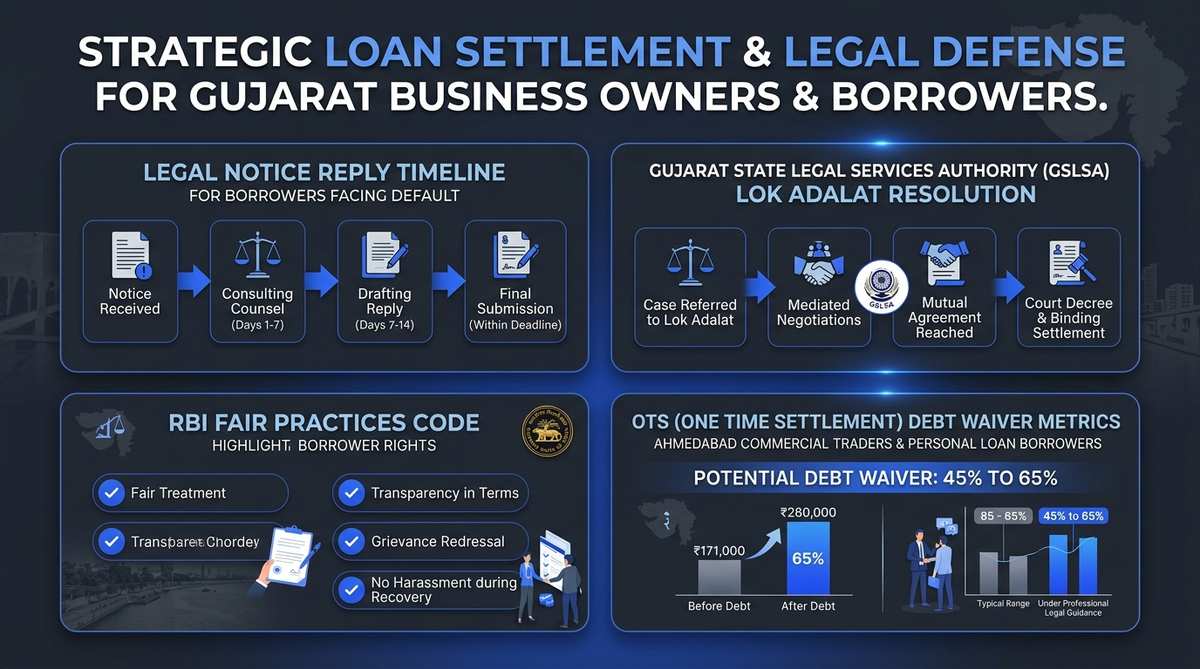
By formalizing each milestone—from drafting the initial legal reply to appearing before the GSLSA Lok Adalat bench—borrowers convert aggressive unilateral bank recovery into an orderly, bilateral negotiation grounded in statutory authority.
6. Commercial Negotiation Blueprint for Gujarat Traders, GIDC MSMEs, and Individuals
Achieving a favorable loan settlement requires a meticulous strategy tailored to the specific financial realities of Gujarat's business communities. SettleLoans advocates deploy a proven four-pillar negotiation framework:
Pillar 1: Financial Hardship Dossier Preparation
Advocates compile comprehensive documentary proof of genuine hardship—including GST turnover reductions, audited balance sheets showing commercial contraction, cancellation of trade orders, medical records, or proof of outstanding trade receivables locked in client defaults. This eliminates any arbitrary allegation of "willful default."
Pillar 2: Forensic Ledger Audit & Penal Charge Invalidation
Lenders routinely inflate outstanding balances by capitalizing overdue interest, compounding late fees, and attaching exorbitant legal recovery charges. Our legal team recalculates the actual net principal disbursed minus all repayments made, demanding the total reversal of unapproved compounding under RBI Fair Practices guidelines.
Pillar 3: Zonal Stressed Assets Committee Representation
Local branch managers have virtually zero discretion to sanction significant debt waivers. SettleLoans escalates settlement negotiations directly to the Zonal Stressed Assets Management Branches (SAMB) located along Ashram Road and CG Road in Ahmedabad, engaging directly with Assistant General Managers (AGMs) and Zonal Settlement Committees possessing requisite delegated financial authority.
Pillar 4: Structured Tranche Structuring
For business owners managing tight cash flows, advocates negotiate staggered settlement schedules—typically dividing the discounted compromise amount across two to three manageable monthly tranches without re-triggering default clauses.
7. Forensic Scrutiny of the OTS Sanction Letter: Protecting Against Recovery Traps
One of the most dangerous hazards in debt settlement is falling victim to unauthorized verbal promises made by third-party recovery agents. Borrowers frequently pay token amounts under the impression that their loan is settled, only to discover that the bank credited the funds as routine overdue interest while keeping the principal fully active.
To guarantee absolute legal finality, every One-Time Settlement must be backed by a formal OTS Sanction Letter subjected to rigorous legal verification:
Mandatory Legal Checklist for an Authentic OTS Sanction Letter
- Official Institutional Letterhead: Must be generated on official bank or NBFC letterhead, complete with verified corporate identification, zonal dispatch numbers, and official contact credentials.
- Explicit Compromise Figure: The letter must explicitly mention the exact negotiated settlement sum as full and final payment, leaving zero residual balance liability.
- Direct Loan Account Deposit: Payment instructions must strictly mandate deposit directly into the borrower's designated loan account number via NEFT/RTGS or demand draft payable to the bank, never to third-party collection agency accounts.
- Litigation Withdrawal Covenant: The sanction letter must incorporate an unambiguous undertaking that the bank will unconditionally withdraw all pending Section 138 NI Act complaints, Section 25 PSSA petitions, and arbitration proceedings within 30 days of payment fulfillment.
- Guaranteed No Dues Certificate Delivery: Must commit to issuing an unencumbered ₹0 No Dues Certificate (NDC) and updating credit information companies (CIBIL, Experian, CRIF) within statutory timelines.
8. Post-Settlement Credit Bureau Reporting (CIBIL) & Mandatory No Dues Certificate Delivery
Executing the financial settlement is only the first phase of complete debt resolution. The second phase involves securing complete institutional release through the issuance of a No Dues Certificate (NDC) or No Objection Certificate (NOC) and managing credit bureau reporting.
Under the RBI Master Direction on Release of Movable and Immovable Property Documents / NDC upon Loan Closure, regulated entities are legally obligated to issue the final NDC and release all original security documentation within 30 calendar days of full settlement realization. If a bank in Gujarat defaults or delays beyond this 30-day statutory window without valid cause, the RBI framework mandates compensation to the borrower at the rate of ₹5,000 per day of delay.
Regarding credit scores, fulfilling an OTS will update the loan status to "Settled" or "Post-Settlement Closed" in CIBIL, Experian, and CRIF High Mark records. While this temporary classification reflects the negotiated principal write-off, it permanently halts delinquency aging, eliminates mounting overdue penalties, and provides a clean foundation. By following disciplined credit rebuilding protocols—such as securing a small fixed-deposit backed credit card or gold loan and maintaining 100% on-time repayments—business owners and professionals in Ahmedabad typically rebuild their credit score back to 750+ within 12 to 24 months.
9. Comparative Resolution Matrix: Evaluating Debt Relief Pathways in Gujarat
To assist business owners, traders, and salaried borrowers in evaluating their strategic options, the comparative matrix below outlines key debt resolution pathways available under Indian law:
| Resolution Pathway | Legal Mechanism | Expected Debt Relief | Resolution Timeline | Legal Finality & Risk |
|---|---|---|---|---|
| Advocate-Led OTS Negotiation | Bilateral settlement with Zonal Stressed Assets Wing under RBI IRACP guidelines | 45% to 65% total ledger waiver | 30 to 60 days | Complete closure with official Sanction Letter, ₹0 NDC, and court withdrawals |
| GSLSA Lok Adalat Consent Award | Section 21 Legal Services Authorities Act conciliation decree | 40% to 60% compromise waiver | 1 to 3 Lok Adalat cycles | Final, unappealable civil court decree with automatic refund of court fees |
| Summary Civil Litigation (Order 37 CPC) | Trial defense before Ahmedabad City Civil Court, Bhadra | Zero principal waiver; litigation defense | 3 to 6 years | High legal expenditure, prolonged judicial exposure, risk of asset execution |
| Ignoring Notices / Defaulting Passively | Unilateral bank recovery and coercive legal proceedings | Zero waiver; compounding penal interest | Indefinite compounding | Ex-parte decrees, Non-Bailable Warrants (NBW), and severe market harassment |
10. Why Professional Advocate Representation Is Essential for Commercial Debt Defense
Handling bank recovery without dedicated legal representation places borrowers at a severe disadvantage. Commercial lenders deploy sophisticated institutional legal wings and empanelled law firms whose sole objective is maximizing recovery yields through aggressive procedural pressure.
Engaging a specialized loan settlement lawyer in Ahmedabad restores the balance of power. At SettleLoans, our network of experienced banking advocates and debt resolution specialists provides end-to-end legal protection:
Formal legal intervention establishes an immediate shield, terminating unauthorized visits to trading markets and GIDC industrial estates.
Immediate appearance before Mirzapur ACMM courts and Bhadra City Civil Court, securing bail and quashing frivolous petitions.
Leveraging RBI NPA accounting mechanics to negotiate 45% to 65% principal haircuts backed by airtight Sanction Letters.

Settle Loan is India's trusted debt relief and loan settlement platform. We help borrowers overcome financial distress by negotiating with banks and NBFCs to legally settle personal loans and credit card debts. With our transparent, performance-based approach, you can achieve debt freedom and regain your financial peace of mind.
COMPUTER
11. Frequently Asked Questions: Ahmedabad Loan Settlement & Legal Defense
Detailed legal and procedural answers to the most critical questions asked by Ahmedabad business owners, traders, and individual borrowers.
Why do Ahmedabad business owners and traders need a specialized loan settlement lawyer?
Commercial traders and entrepreneurs in Ahmedabad and Surat operate within interconnected trade credit cycles. When liquidity locks up in textile markets or industrial GIDCs, lenders frequently deploy aggressive recovery tactics, filing Section 138 NI Act and Section 25 PSSA criminal complaints in Mirzapur or Gheekanta courts. A specialized loan settlement lawyer in Ahmedabad provides immediate court appearance representation, secures prompt bail, halts extrajudicial harassment through statutory Cease-and-Desist notices, and leverages RBI NPA provisioning rules to negotiate 45% to 65% principal haircuts.
How does GSLSA Lok Adalat facilitate loan settlement in Ahmedabad?
The Gujarat State Legal Services Authority (GSLSA) organizes regular National and State Lok Adalats across Ahmedabad City Civil & Sessions Courts at Bhadra, the Metropolitan Magistrate Courts at Mirzapur, and District Courts in Gandhinagar and Surat. A Lok Adalat award passed under Section 21 of the Legal Services Authorities Act, 1987, functions as a conclusive, non-appealable civil decree. It refunds full court fees to the lender and completely extinguishes all pending civil and Section 138 complaints without ongoing judicial exposure.
What should I do if I receive a Section 138 summons from the Mirzapur or Gheekanta Court?
Never ignore a judicial summons from the Ahmedabad Metropolitan Magistrate Courts. You must engage a local advocate to file a Vakalatnama on the designated returnable date and obtain formal bail. Your advocate will scrutinize statutory compliance—such as whether the bank sent the demand notice within 30 days of memo receipt and filed the complaint within the 1-month statutory window under Section 142 NI Act. Simultaneously, the advocate moves an application under Section 147 NI Act to refer the dispute to mediation or Lok Adalat for a negotiated compromise.
Can Ahmedabad or Gujarat Police arrest me for defaulting on an unsecured business or personal loan?
No. Defaulting on an unsecured personal loan or commercial credit facility is purely a civil dispute governed by the Indian Contract Act, 1872. The Ahmedabad City Police, Surat Police Commissionerate, and Gujarat CID have zero statutory authority to arrest, detain, or interrogate borrowers for unpaid loan dues. If collection agencies attempt to file frivolous Section 420 (cheating) or Section 406 (criminal breach of trust) complaints, your advocate will rely on Supreme Court rulings (such as Arnesh Kumar v. State of Bihar and Lalita Kumari) to quash improper police interference.
What percentage of loan waiver is achievable through One-Time Settlement in Ahmedabad?
For unsecured personal loans, credit card balances, and unsecured business credit lines aged past 90 to 180 days (NPA status), seasoned Ahmedabad advocates typically achieve 45% to 65% waivers on the total outstanding ledger balance. This resolution involves a 100% complete waiver of accumulated late payment penalties, penal compounding interest, and simulated legal fees, leaving a consolidated lump sum or 2 to 3 structured installments.
How does the Net Present Value (NPV) calculation motivate banks to settle with Gujarat traders?
Commercial banks evaluate OTS offers by comparing immediate settlement proceeds against the Net Present Value of prolonged recovery litigation. In Gujarat civil courts, recovering debts through summary suits or execution proceedings typically consumes 4 to 6 years, incurring heavy court fees, advocate expenses, and escalating mandatory capital provisioning under RBI Basel-III norms. An immediate lump sum of 35% to 50% yields a demonstrably higher NPV for the bank's zonal stressed asset committee than uncertain recovery half a decade later.
How do legal advocates protect commercial borrowers from workplace and market harassment?
Under the RBI Master Direction on Fair Practices Code and Section 35A of the Banking Regulation Act, recovery agencies are strictly prohibited from visiting trade shops, factories in industrial GIDCs, or corporate offices without prior borrower consent, nor can they harass business partners, trade suppliers, or family members. Advocates serve formal Cease-and-Desist notices to the bank's Zonal Manager and Principal Nodal Officer, warning of criminal defamation, trespass litigation, and formal complaints before the RBI Integrated Ombudsman.
What essential clauses must be verified in an OTS Sanction Letter before paying the bank?
An OTS Sanction Letter must be issued on official bank letterhead with a verifiable digital barcode, reference number, and signature of the authorized Zonal Officer. It must explicitly specify the exact compromise sum, clear payment due dates, account numbers, and unequivocally state that upon receipt of the agreed amount, all civil suits, Section 138/25 proceedings, and arbitration awards will be withdrawn, followed by the delivery of an unencumbered No Dues Certificate within 30 days.
How long after an Ahmedabad loan settlement can I rebuild my CIBIL score?
Upon complete settlement fulfillment, the bank updates the credit bureaus (CIBIL, Experian, CRIF High Mark) with the status 'Settled' or 'Post-Settlement Closed' within 30 to 45 days. While this initial status lowers the composite score, borrowers can restore their score to 750+ within 12 to 24 months by maintaining pristine repayment on small collateralized credit products, disciplined gold loans, or secured credit cards.