- Statutory IBC Architecture (Part III): The Insolvency and Bankruptcy Code, 2016 codified individual debt relief under Part III, replacing obsolete colonial bankruptcy statutes with modern, court-supervised restructuring.
- Automatic Section 96 Interim Moratorium: Filing an application under Section 94 (by the debtor) or Section 95 (by a creditor) grants an instant statutory stay on all pending court cases, execution petitions, and recovery agent visits.
- The Chapter II Fresh Start Window: Low-income individuals with gross annual income up to ₹60,000, qualifying unsecured debt up to ₹35,000, and minimal assets can obtain a complete 100% debt write-off via DRT discharge orders.
- 75% Majority Creditor Repayment Plan: Under Section 105 and Section 111, the Resolution Professional tables a structured repayment plan which, when approved by a 75% creditor majority, legally binds all lenders to deep principal waivers.
- Personal Guarantor Liability & Supreme Court Precedent: Following the landmark Lalit Kumar Jain ruling, personal guarantors to corporate entities face simultaneous insolvency proceedings before the NCLT or DRT, making advocate-led settlements indispensable.
1. Demystifying Personal Insolvency Bankruptcy in India:
For over a century, personal debt distress in India was governed by antiquated colonial legislation: the Presidency Towns Insolvency Act, 1909 (applicable to Mumbai, Kolkata, and Chennai) and the Provincial Insolvency Act, 1920 (applicable across the rest of India). These historical statutes were inherently punitive, cumbersome, and rarely offered honest but unfortunate borrowers a viable economic restart. Debtors who suffered severe business loss, debilitating medical emergencies, or systemic economic crises faced lifelong civil litigation, continuous asset attachment, and acute societal stigmatization without ever achieving legal debt finality.
The enactment of the Insolvency and Bankruptcy Code, 2016 (IBC) fundamentally transformed Indian insolvency jurisprudence. By enacting Part III (Insolvency Resolution and Bankruptcy for Individuals and Partnerships), the Indian Parliament established an institutional, time-bound, and rehabilitative statutory framework. The modern philosophy shifts the objective of the law from punitive retribution to economic rehabilitation, offering stressed individuals, commercial proprietors, and personal guarantors an orderly, transparent legal exit from unsustainable debt traps.
In legal terminology, a vital distinction exists between insolvency and bankruptcy. Insolvency is a financial condition where an individual's liquid assets and cash flows are insufficient to discharge outstanding financial obligations as they fall due. In contrast, bankruptcy is a formal judicial declaration pronounced by a competent Adjudicating Authority (the Debt Recovery Tribunal or National Company Law Tribunal) establishing that the individual is legally insolvent and directing the liquidation of non-exempt assets followed by a binding Discharge Order.
2. Statutory Architecture of IBC Part III: Section 94 Debtor Petitions & The Section 96 Statutory Interim Moratorium
Part III of the IBC operates through an organized statutory hierarchy designed to protect the debtor while balancing legitimate creditor rights under constitutional law. The procedural mechanics begin when an eligible debtor or creditor initiates legal proceedings before the designated Adjudicating Authority:
A debtor who has defaulted on qualifying debts can voluntarily file an application for initiating an Individual Insolvency Resolution Process (IIRP). The petition includes full disclosures of financial statements, list of creditors, encumbered properties, and proposed repayment structures.
A financial or operational creditor can file a petition against a defaulting individual or personal guarantor after serving a mandatory 14-day statutory demand notice in Form B, establishing the existence of unpaid debt exceeding the threshold limit.
Operating as an immediate statutory shield, the interim moratorium takes effect automatically on the exact date of filing. All pending legal actions, civil suits, arbitration claims, and coercive recovery measures in respect of the debtor's liabilities are instantly stayed.
Upon formal admission of the insolvency petition under Section 100, the DRT issues a full Moratorium order under Section 101 lasting for 180 days, completely prohibiting creditors from initiating any security enforcement, asset sale, or transfer during plan negotiations.
The automatic inception of the Section 96 interim moratorium provides unprecedented legal relief for distressed individuals. Unscrupulous recovery agencies, continuous telephonic intimidation, and multiple parallel recovery litigations are legally rendered non-executable during the pendency of the petition. Any creditor taking coercive action during this statutory freeze is subject to contempt proceedings before the tribunal.
Check Your Loan Settlement Options
Answer 2 quick questions to evaluate your settlement eligibility.
1. What type of loan do you want to settle?
3. The "Fresh Start" Process (Chapter II, Sections 79–93): Eligibility, Limitations & Realities
Under Chapter II of Part III of the IBC (Sections 79 through 93), the legislature introduced the revolutionary Fresh Start Process. This unique statutory instrument is specifically designed as a social welfare mechanism to relieve impoverished, low-income citizens from unpayable micro-debts without the heavy administrative costs of full-blown insolvency litigation.
To prevent misuse and ensure that only genuinely destitute debtors access this route, Section 80 imposes strict cumulative qualifying criteria:
| Statutory Parameter | IBC Section 80 Legal Threshold | Legal Impact on Debtor Eligibility |
|---|---|---|
| Gross Annual Income | Must not exceed ₹60,000 per annum | Average monthly earning must be under ₹5,000 |
| Aggregate Qualifying Debt | Must not exceed ₹35,000 in total | Calculated across all unsecured micro-loans & hand loans |
| Total Unencumbered Assets | Must not exceed ₹20,000 in total value | Excludes basic tools of trade, essential clothing & utensils |
| Dwelling Ownership | Applicant must NOT own a dwelling unit | Cannot possess legal title to any residential house or land |
| Prior Insolvency History | No fresh start or bankruptcy in last 12 months | Must have clean bona fide record with no pending fraud cases |
Upon application by the debtor, the Adjudicating Authority appoints a Resolution Professional (RP) to examine the claim under Section 83. If the RP verifies compliance, the DRT issues an unconditional Fresh Start Order under Section 92. This order operates as a complete legal discharge: the debtor is permanently absolved from all listed qualifying debts, and all civil liabilities are expunged from creditor ledgers without any remaining financial obligation.
4. Individual Insolvency Resolution Process (IIRP) in the DRT: Resolution Professionals, Repayment Plans & NPV Valuation
For mid-to-high ticket individual borrowers, business entrepreneurs, and personal guarantors whose financial liabilities exceed the Fresh Start thresholds, the statutory route is the Individual Insolvency Resolution Process (IIRP) under Chapter III (Sections 94–120).
The primary objective of the IIRP is not to liquidate the individual, but to formulate a consensual, legally binding Repayment Plan under Section 105. The process follows a structured statutory timeline:
Step 1: Appointment & Report of the Resolution Professional (Section 97 & 99)
The DRT directs the IBBI to nominate an independent Resolution Professional (RP). The RP audits the debtor's financial records, verifies default authenticity, and submits a comprehensive Section 99 report recommending admission or rejection of the insolvency petition.
Step 2: Formulation of the Section 105 Repayment Plan
The debtor, assisted by specialized debt defense advocates and the RP, prepares a comprehensive Repayment Plan. The plan outlines restructuring terms, proposed debt haircuts (35%–60%), liquidation of non-core secondary assets, and a realistic tranche repayment schedule over 12 to 36 months.
Step 3: Creditor Voting & The 75% Majority Requirement (Section 111)
The RP convenes a formal meeting of all participating creditors. Under Section 111, for the repayment plan to succeed, it must secure approval by a majority of more than 75% in total value of the voting creditors.
Step 4: DRT Judicial Sanction Order (Section 114)
Upon approval by the requisite creditor majority, the Presiding Officer of the DRT passes a judicial sanction order under Section 114, making the compromise plan legally binding on the debtor, all secured and unsecured creditors, and guarantors.
To evaluate the economic feasibility of a repayment plan versus protracted litigation, bank credit committees and Resolution Professionals utilize the Net Present Value (NPV) Recovery Benchmark:
Where R_t represents scheduled recovery installments under the repayment plan, k is the bank's discount rate, and deductions account for 3–5 years of judicial execution delays, auction shortfalls, advocate fees, and capital tied in 100% NPA provisioning.
When advocates demonstrate that a structured repayment plan provides higher present-value economic recovery than distress asset liquidation, institutional creditors routinely vote to approve substantial principal write-downs.
5. Personal Insolvency & Bankruptcy Process: Statutory Visual Roadmap
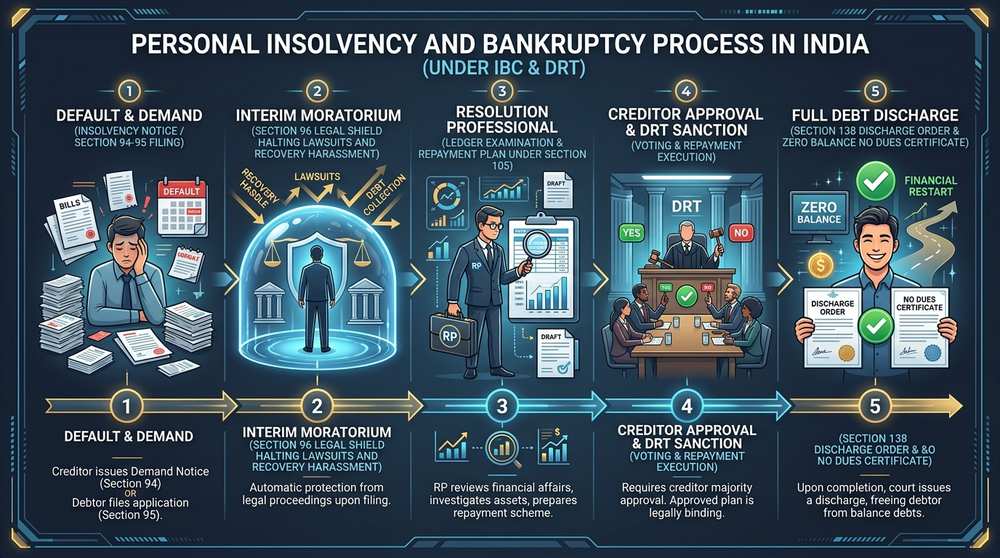
The visual roadmap below details the complete 5-stage statutory lifecycle under the Insolvency and Bankruptcy Code (IBC) and Debt Recovery Tribunal (DRT): from initial default and Section 94/95 filings to the Section 96 interim moratorium shield, Resolution Professional investigation, creditor voting, and full judicial debt discharge.
6. Chapter IV Formal Bankruptcy: Asset Liquidation, Section 138 Discharge Orders & Disqualifications
When an Individual Insolvency Resolution Process fails—either because creditors reject the proposed repayment plan or the debtor is genuinely unable to offer any settlement terms—the statutory machinery shifts into Chapter IV (Bankruptcy for Individuals and Partnership Firms, Sections 121–148).
Upon application by the debtor or creditor, the DRT passes a formal Bankruptcy Order under Section 126. Key legal consequences unfold:
The tribunal appoints an IBBI-registered Bankruptcy Trustee. The entire divisible estate of the bankrupt vests in the trustee, who is empowered to take custody, administer, and liquidate non-exempt assets.
The law strictly protects essential personal assets: basic household tools of trade, essential wearing apparel, furniture, utensils, and personal pension funds are statutorily exempt from seizure and liquidation.
An undischarged bankrupt is legally disqualified from acting as a director of any company, standing for parliamentary/assembly election, serving as a trustee, or taking fresh credit without disclosing their bankruptcy status.
Upon completion of the liquidation and distribution process, the DRT issues a definitive Discharge Order under Section 138. The debtor is completely freed from all bankruptcy debts, permanently lifting all statutory disqualifications.
Under Section 79(15) of the IBC, a bankruptcy discharge order does NOT extinguish court-mandated criminal fines, maintenance/alimony payments ordered by family courts, personal liability for fraud or breach of trust, or unliquidated damages for negligence causing bodily harm.
7. Personal Guarantors to Corporate Debtors: Supreme Court Precedents & Parallel DRT / NCLT Jurisdictions
The most litigated and commercially active dimension of Part III of the IBC in India involves Personal Guarantors to Corporate Debtors. By a landmark central government notification dated November 15, 2019, the Ministry of Corporate Affairs operationalized the personal insolvency provisions specifically for personal guarantors.
In the historic ruling of Lalit Kumar Jain v. Union of India (2021) 9 SCC 321, the Supreme Court of India unanimously upheld the constitutional validity of this framework, laying down critical legal doctrines:
- Co-Extensive Liability under Indian Contract Act: Under Section 128 of the Indian Contract Act, 1872, the liability of a personal guarantor is co-extensive with that of the principal corporate debtor. Lenders are not obligated to exhaust remedies against the corporate entity before proceeding against personal guarantors.
- No Automatic Discharge via Corporate Resolution: The Supreme Court clarified that approval of a Corporate Insolvency Resolution Plan (CIRP) under Section 31 does NOT automatically discharge personal guarantors, unless explicitly stipulated and accepted by the Committee of Creditors (CoC).
- Forum Jurisdiction Rule (Section 60(2)): If a Corporate Debtor is already undergoing CIRP or liquidation before the National Company Law Tribunal (NCLT), all insolvency applications against its personal guarantors must be filed before the same NCLT bench, rather than the DRT.
For personal guarantors facing high-exposure insolvency demand notices, engaging specialized banking advocates to challenge Section 95 filings, expose unverified interest compounding, and structure tripartite compromise settlements is essential to safeguard personal estates from attachment.
8. Loan Remittance, RBI ₹0 No Dues Certificate Mandate & Long-Term Credit Bureau Rehabilitation
Whether a borrower achieves debt resolution through a judicially confirmed IBC Repayment Plan (Section 114), a formal Discharge Order (Section 138), or an advocate-negotiated Bank One-Time Settlement (OTS), securing unassailable closure documentation is vital.
Under RBI Circular RBI/2023-24/60 (Responsible Lending Conduct – Release of Movable/Immovable Property Documents and Issuance of NDC), all commercial banks and NBFCs are bound by strict post-settlement regulatory obligations:
Lenders must return all original movable and immovable property title deeds, vacate registry charge liens, and issue an unambiguous zero-balance No Dues Certificate (NDC) within 30 calendar days of receiving the full settlement remittance. Any unjustified delay mandates the lender to pay compensation at ₹5,000 per calendar day of default to the borrower.
Credit Information Bureau (CIBIL) Trajectory & Score Rehabilitation
Borrowers must understand the precise mechanism of credit bureau reporting after resolving insolvency or debt default:
- Bureau Status Reporting: Following discharge or OTS remittance, the bank updates credit bureaus (CIBIL, Experian, Equifax, CRIF) with the official status remark "Discharged", "Settled", or "Post-Write-off Settled", reflecting a current outstanding balance of ₹0.
- Cessation of Delinquency Compounding: While a settled remark triggers a temporary credit score drop, it permanently terminates compounding default records (90+ DPD) and eliminates legal litigation flags.
- 12-Month Institutional Cooling Period: Under RBI guidelines, commercial lenders observe a 12-month cooling window before considering fresh unsecured commercial credit lines for settled individuals.
- Rebuilding a 750+ CIBIL Score: By utilizing secured credit cards backed by fixed deposits, maintaining credit utilization below 25%, and recording immaculate monthly payment discipline, settled debtors systematically restore their credit score above 750 within 18 to 24 months.
9. Dispute Resolution Comparative Matrix: IBC Personal Insolvency vs DRT OA vs Bank OTS vs Civil Suit
Evaluating the strategic parameters across major Indian debt resolution mechanisms illustrates the comparative advantages of judicial discharge, tribunal defense, and advocate-led compromise settlements:
| Resolution Mechanism | Statutory Governing Law | Typical Haircut Potential | Resolution Timeline | Key Legal Benefit & Debtor Shield |
|---|---|---|---|---|
| IBC Personal Insolvency (IIRP) | IBC 2016 (Part III, Sections 94–120) | 40% – 70% Restructuring Waiver | 6 – 12 Months | Instant Section 96 interim moratorium; binding 75% creditor sanction |
| IBC Fresh Start Process | IBC 2016 (Chapter II, Sections 79–93) | 100% Complete Write-Off | 3 – 6 Months | Unconditional statutory debt discharge for low-income debtors |
| Bank Compromise OTS Settlement | RBI Compromise Settlement Framework | 35% – 60% Principal Haircut | 2 – 4 Months | Fast out-of-court closure; zero court attendance; official ₹0 NDC |
| DRT Section 19 OA Defense | RDB Act, 1993 | 30% – 50% Compromise Haircut | 18 – 36 Months | Defends claims > ₹20L; prevents ex-parte Recovery Certificates |
| Civil Court Recovery Suit | Code of Civil Procedure, 1908 | 15% – 30% Waiver | 4 – 7 Years | Lengthy trial; heavy court fees; defended via Leave to Defend |
10. SettleLoans Personal Insolvency Defense & Institutional Debt Advisory
Navigating personal insolvency petitions, Debt Recovery Tribunal litigation, and complex bank compromise negotiations requires seasoned legal advocates who possess deep mastery of the Insolvency and Bankruptcy Code, banking regulations, and civil recovery laws. SettleLoans provides comprehensive legal defense for borrowers, corporate guarantors, and stressed individuals across India: invoking Section 96 interim moratoriums, auditing loan ledgers for illegal penal interest, representing clients before the DRT, and negotiating directly with bank Zonal Committees to deliver massive principal haircuts backed by authentic No Dues Certificates.

Settle Loan is India's trusted debt relief and loan settlement platform. We help borrowers overcome financial distress by negotiating with banks and NBFCs to legally settle personal loans and credit card debts. With our transparent, performance-based approach, you can achieve debt freedom and regain your financial peace of mind.
COMPUTER
11. Frequently Asked Questions: Personal Insolvency & Bankruptcy in India
Direct, legally verified answers to critical questions regarding personal insolvency petitions, Section 96 interim moratoriums, DRT procedures, Fresh Start eligibility, and debt discharge orders in India.
What is the statutory framework governing personal insolvency and bankruptcy in India?
Personal insolvency and individual bankruptcy in India are governed by Part III of the Insolvency and Bankruptcy Code, 2016 (IBC). Part III provides for three distinct statutory mechanisms: the Fresh Start Process (Sections 79–93) for low-income qualifying debtors, the Individual Insolvency Resolution Process (Sections 94–120) for restructuring liabilities via repayment plans, and formal Bankruptcy (Sections 121–148) for liquidating assets and issuing judicial debt discharge orders.
Which judicial forum has jurisdiction over personal insolvency petitions in India?
Under Section 179 of the IBC, the Debt Recovery Tribunal (DRT) is the designated Adjudicating Authority for individual debtors, proprietorships, and partnership firms. However, under Section 60(2) of the IBC, if an individual is a Personal Guarantor to a Corporate Debtor undergoing Corporate Insolvency Resolution Process (CIRP) or liquidation, the National Company Law Tribunal (NCLT) holds exclusive territorial jurisdiction over that guarantor's insolvency proceedings.
What is the Section 96 Interim Moratorium and how does it protect debtors?
Under Section 96 of the IBC, the moment an application for personal insolvency is filed under Section 94 (by the debtor) or Section 95 (by a creditor), an automatic statutory 'Interim Moratorium' immediately commences. This interim moratorium statutorily stays all ongoing legal proceedings in respect of any debt, prohibits creditors from initiating fresh recovery suits, and halts coercive recovery agent contact until the petition is formally admitted or rejected by the Adjudicating Authority.
What is the 'Fresh Start' process under Chapter II of the IBC and who is eligible?
The Fresh Start Process under Sections 79 to 93 of the IBC is a statutory debt-relief mechanism designed for economically vulnerable individuals. To qualify, an applicant must have a gross annual income not exceeding ₹60,000, aggregate qualifying debts not exceeding ₹35,000, total unencumbered assets not exceeding ₹20,000, and must not own a dwelling unit. If approved, the DRT issues an unconditional discharge order wiping out 100% of the qualifying liabilities.
What is the role of a Resolution Professional (RP) in individual insolvency?
A Resolution Professional (RP) is an independent insolvency practitioner registered with the Insolvency and Bankruptcy Board of India (IBBI). In personal insolvency, the RP examines the debtor's application, submits a recommendation report to the DRT under Section 99, facilitates the preparation of a structured Repayment Plan under Section 105, convenes the meeting of creditors, supervises voting, and monitors plan implementation.
What percentage of creditor voting is required to approve a personal repayment plan?
Under Section 111 of the IBC, a repayment plan submitted in an individual insolvency proceeding must be approved by a majority of more than three-fourths (75% or higher) in value of the creditors present and voting. If approved and sanctioned by the DRT under Section 114, the repayment plan becomes legally binding on the debtor and all listed creditors.
What happens if an individual insolvency resolution process fails?
If creditors reject the repayment plan or if the debtor defaults on the sanctioned plan terms, the Resolution Professional or any creditor can file a report before the DRT. The debtor or creditor may then file an application for formal Bankruptcy under Section 121 of the IBC. The DRT appoints a Bankruptcy Trustee to take possession of the bankrupt's estate, liquidate non-exempt assets, distribute proceeds, and subsequently issue a formal Discharge Order under Section 138.
Can an individual file for personal insolvency for credit card and personal loan debts?
While Part III of the IBC has been officially notified and operationalized by the Ministry of Corporate Affairs for Personal Guarantors to Corporate Debtors, individual insolvency provisions for non-guarantor retail individuals (pure credit card and personal loan borrowers) await final phased central notification. In the interim, retail borrowers facing unmanageable unsecured debt resolve their liabilities through advocate-led RBI Compromise One-Time Settlements (OTS) or Lok Adalat conciliation.
What are the legal disqualifications imposed on an undischarged bankrupt individual in India?
Under Section 141 of the IBC, an undischarged bankrupt is disqualified from being appointed or acting as a director of any company, being elected to public office (including Parliament or State Legislatures), acting as a trustee of a trust, and from obtaining fresh credit exceeding statutory limits without disclosing their undischarged bankruptcy status to prospective lenders.
How does a formal discharge order or OTS settlement impact future CIBIL bureau scores?
Upon receiving a judicial discharge order under Section 138 of the IBC or executing a bank OTS settlement, the lender updates credit bureaus with a status remark of 'Discharged' or 'Settled' with an outstanding balance of ₹0. While this temporarily impacts credit scores, it halts delinquent interest compounding. Borrowers can systematically rebuild their CIBIL score to 750+ within 18 to 24 months using secured credit cards backed by fixed deposits.