- Statutory Compromise Rights: Defaulting on a LazyPay credit line is strictly a civil contract breach under the Indian Contract Act, 1872. Borrowers hold rights under RBI Master Directions to request a compromise One-Time Settlement (OTS).
- Halting Auto-Debits: Cancelling e-NACH mandates through destination banks stops recurring bounce charges. Legal counsel demands a 100% waiver of penal interest under RBI Fair Lending Practice rules.
- Realistic Principal Haircuts: Past 90 to 180 days default, PayU Finance absorbs Ind AS 109 balance-sheet provisioning, allowing compromise settlements between 40% and 60% of core dues.
- Anti-Harassment Protections: RBI Digital Lending Guidelines prohibit collection callers from accessing contacts, messaging third parties, or contacting borrowers outside 08:00 AM to 07:00 PM.
- Mandatory ₹0 NDC Delivery: Under RBI Circular RBI/2023-24/60, PayU Finance must issue a formal No Dues Certificate and update credit bureaus within 30 days of settlement payment.
PayU Finance Architecture & Digital Credit Line Mechanics
LazyPay operates as a prominent digital credit platform delivering revolving lines and personal loans up to ₹5 Lakhs. Credit facilities are underwritten by PayU Finance India Private Limited, an RBI-regulated Non-Banking Financial Company (NBFC).
During financial emergencies, revolving credit triggers rapid compounding. Interest rates between 28% and 42% are magnified by late fees and repeated e-NACH bounce penalties. Defaulting on an unsecured digital credit line is strictly a civil dispute under the Indian Contract Act, 1872. Borrowers hold statutory rights to halt automated sweeps, challenge excessive penalties, and petition PayU Finance for a formal One-Time Settlement (OTS).
Delinquency Lifecycle: From Overdue DPD to NPA Write-Off
Under RBI Prudential Norms (IRACP) and Ind AS 109, PayU Finance classifies overdue accounts across strict Days Past Due (DPD) aging buckets. Early delinquency (1 to 60 DPD) triggers automated reminders. Once non-payment crosses 90 days, the debt becomes a Non-Performing Asset (NPA), freezing interest recognition and requiring capital provisioning.
| Delinquency Stage | Overdue Days | PayU Finance Protocols | Legal Exposure | Compromise Haircut |
|---|---|---|---|---|
| SMA-0 (Initial Default) | 1 – 30 Days | Automated reminders, IVR calls, e-NACH sweeps. | Zero litigation risk; initial bureau reporting. | Negligible (Overdue clearance demanded). |
| SMA-1 (Secondary Stage) | 31 – 60 Days | Agency calling, loan recall warnings. | Credit score drops; acceleration warnings. | Minimal (Short-term tenure relief). |
| SMA-2 (Pre-NPA Alert) | 61 – 90 Days | Agency escalation, legal demand notices. | Section 25 PSSA notices dispatched. | Moderate (Penal fee waivers discussed). |
| NPA (Substandard Asset) | 91 – 180 Days | Stressed Assets assignment; Ind AS 109 provisioning. | Magistrate court complaints drafted. | High (35%–50% Principal Haircut). |
| Doubtful / Written Off | 181 – 365+ Days | Full provisioning; balance sheet write-off. | Arbitration notices, Lok Adalat referrals. | Maximum (50%–65% Total Haircut). |
Past 180 DPD, PayU Finance absorbs write-offs against balance-sheet reserves. A lump-sum compromise settlement provides immediate liquidity recovery, justifying substantial debt waivers by Credit Committees.
Check Your Loan Settlement Options
Answer 2 quick questions to evaluate your settlement eligibility.
1. What type of loan do you want to settle?
Halting Penal Interest, Hidden Fees & e-NACH Presentations
Automated e-NACH mandate sweeps represent a severe financial burden. PayU Finance's gateway often resubmits debits multiple times monthly. Each failed sweep triggers bank return penalties of ₹250 to ₹590 alongside internal NBFC late charges.
Under RBI Fair Lending Practice directives (August 2023), lenders cannot capitalize penal charges or charge compounded penalties. Borrowers can instruct their bank to cancel the e-NACH mandate under NPCI guidelines. During OTS negotiations, legal counsel demands a 100% waiver of accumulated bounce charges, calculating haircuts exclusively on core principal.
LazyPay OTS Haircut Framework & Mathematical Recovery NPV
PayU Finance assesses compromise proposals using Net Present Value (NPV) recovery modeling under RBI Master Directions. Because unsecured credit lines lack physical collateral, the lender weighs immediate cash settlement against protracted civil litigation over three to five years, deducting advocate costs and provisioning drag.
Where C_t represents estimated recoveries, r is the discount rate, and deductions account for 3–5 years of court friction and capital locked in NPA provisions.
Realistic PayU LazyPay Settlement Haircut Slabs by Product & Aging
| Product Facility | Delinquency Aging | Penal Waiver | Principal Haircut | Optimal Settlement Target |
|---|---|---|---|---|
| LazyPay Credit Line | 90 – 180 Days (NPA) | 100% Full Waiver | 35% – 50% Principal Waiver | Offer 40%–50% of Utilized Limit |
| LazyPay Credit Line | 181 – 365+ Days (Doubtful) | 100% Full Waiver | 50% – 65% Principal Waiver | Offer 35%–40% of Utilized Limit |
| PayU Personal Loan | 90 – 180 Days (NPA) | 100% Full Waiver | 30% – 45% Principal Waiver | Offer 45%–55% of Outstanding Book |
| PayU Personal Loan | 180+ Days (Written Off) | 100% All Penal Charges | 50% – 60% Principal Waiver | Offer 35%–45% of Outstanding Book |
Defending Against Third-Party Recovery Agents & Digital Calls
Fintech defaults frequently trigger aggressive recovery from outsourced agencies. Under the RBI Guidelines on Digital Lending (September 2022) and NBFC Fair Practices Code, lenders and recovery agents cannot access borrower contact lists, photos, or call logs. Calling is strictly restricted between 08:00 AM and 07:00 PM. Contacting third parties, friends, or employers is illegal.
Borrowers must document unlawful communications. Serving a legal cease-and-desist notice to PayU Finance's Principal Nodal Officer and escalating complaints to the RBI Integrated Ombudsman portal halts harassment, redirecting files to formal settlement desks.
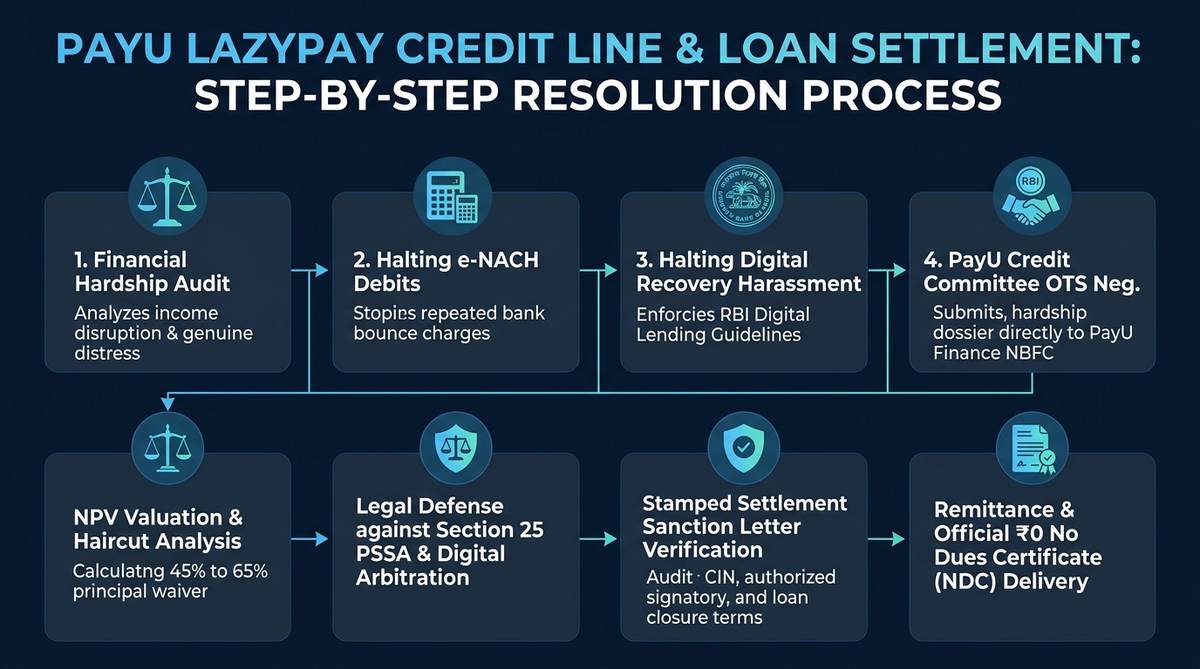
Step-by-Step Roadmap to Negotiate LazyPay Debt Compromise
Achieving an authentic One-Time Settlement with PayU Finance requires a structured legal methodology:
1Hardship Dossier Compilation
Assemble verified evidence of distress, such as termination letters, salary reductions, or medical summaries, establishing non-willful default under RBI rules.
2Mandate Cancellation
Cancel electronic auto-debits through your bank to eliminate return charges. Direct PayU Finance to communicate strictly in writing via legal counsel.
3Formal OTS Petition
Submit an official compromise settlement petition to PayU Finance's Stressed Assets Desk, anchoring opening offers at 25% to 35% of core principal dues.
4Managing Counter-Offers
Counter modest lender offers by demonstrating settlement funds stem from family financial aid, guiding reviews toward 40% to 60% principal waivers.
5Forensic Sanction Audit
Verify that the formal settlement letter is issued on official PayU Finance letterhead, confirming loan numbers, payment milestones, and full discharge terms.
6Direct Remittance & NDC Delivery
Remit settlement funds directly into your verified PayU Finance loan account via RTGS/NEFT. Enforce delivery of the ₹0 No Dues Certificate within 30 days.
Navigating Section 25 PSSA Legal Notices & Online Arbitration
When a LazyPay loan remains unpaid past 60 to 90 days, PayU Finance regularly issues statutory demand notices under Section 25 of the Payment and Settlement Systems Act, 2007 (PSSA) for dishonoured e-mandates, alongside online arbitration notices.
A Section 25 PSSA notice is a 15-day statutory demand, not an arrest warrant. Serving an advocate reply detailing bona fide hardship and challenging unauthorized multiple sweeps preserves legal standing while opening settlement channels. Under Supreme Court rulings (Perkins Eastman and TRF Ltd.), unilateral arbitrator appointments without borrower consent are void ab initio. Furthermore, quarterly National Lok Adalats under DLSA provide structured 45% to 60% waivers, producing a non-appealable Civil Court Decree.
| Resolution Channel | Legal Framework | Haircut Potential | Typical Timeline | Legal Finality |
|---|---|---|---|---|
| Direct PayU Finance OTS | RBI Compromise Master Directions | 40% – 60% Debt Haircut | 15 to 30 Days | Binding contract with ₹0 NDC |
| National Lok Adalat | Judicial conciliation under NALSA | 45% – 60% Debt Haircut | Single-day session | Non-appealable Court Decree |
| Online Arbitration Defense | Challenging unilateral appointments | Converts to OTS | 2 to 6 Months | Section 34 challenge grounds |
| Section 25 PSSA Defense | Magistrate court compoundable reply | 35% – 50% Debt Haircut | 2 to 5 Months | Case withdrawal on settlement |
Sanction Letter Verification & Enforcing the ₹0 NDC Mandate
A major risk in fintech debt recovery is fraudulent settlement documents issued by third-party agency callers. Unverified payments made without an authentic letter are credited toward penal fees, leaving the default active.
Borrowers must confirm that the OTS sanction letter is printed on official PayU Finance India Private Limited letterhead displaying the Corporate Identification Number (CIN: U65993MH2011PTC218698), registered address, and authorized corporate signatures. Under RBI Circular RBI/2023-24/60, PayU Finance must deliver an official ₹0 No Dues Certificate within 30 days, or pay statutory compensation of ₹5,000 per day of delay.
CIBIL Score Trajectory Post-Settlement & Credit Recovery
Following settlement payment, PayU Finance reports the loan to TransUnion CIBIL, Experian, Equifax, and CRIF High Mark as 'Settled' with a ₹0 balance, ending monthly default additions.
While settlement causes an initial credit score drop of 75 to 140 points, it prevents ongoing default tags. A mandatory 12-month cooling window applies before fresh unsecured loans can be approved. Borrowers can restore credit back to 750+ within 18 to 24 months using a secured fixed-deposit credit card and maintaining 100% on-time payments.
Why Distressed Borrowers Choose SettleLoans for PayU Relief
Resolving defaulted digital credit facilities with PayU Finance requires seasoned legal advocacy. SettleLoans halts collection harassment under RBI Digital Lending Guidelines, cancels e-NACH auto-debits, defends Section 25 PSSA notices, and negotiates directly with PayU Finance Credit Committees to secure maximum lawful debt waivers and authentic stamped ₹0 No Dues Certificates.

Settle Loan is India's trusted debt relief and loan settlement platform. We help borrowers overcome financial distress by negotiating with banks and NBFCs to legally settle personal loans and credit card debts. With our transparent, performance-based approach, you can achieve debt freedom and regain your financial peace of mind.
COMPUTER
Frequently Asked Questions About LazyPay Loan Settlement
What is the PayU LazyPay loan settlement process and how does an OTS work?
The LazyPay settlement process is an RBI-sanctioned compromise. Defaulted accounts past 90 days submit a hardship petition to PayU Finance. Upon approval, PayU issues an official OTS sanction letter. Remitting the agreed sum directly extinguishes all liability with a formal ₹0 No Dues Certificate.
Can PayU LazyPay recovery agents call my friends, family, or employer contacts?
No. Under RBI Digital Lending Guidelines, lending apps and collection agencies cannot access phone contacts or call logs. Recovery personnel are legally forbidden from contacting relatives, friends, or employers. Documented violations can be escalated to the RBI Ombudsman.
How can I stop automated e-NACH bounce charges from PayU Finance?
Borrowers can cancel e-NACH mandates through their destination bank under NPCI rules. Furthermore, legal counsel requests an immediate presentation pause and negotiates a 100% waiver of accumulated bounce charges under RBI Fair Lending Practice rules.
What percentage of debt waiver can be negotiated on a LazyPay credit line?
Because LazyPay facilities are unsecured without collateral, PayU Finance routinely sanctions principal waivers between 40% and 60% of book dues for accounts past 90 to 180 days default, alongside a 100% waiver of accrued late fees and penal interest.
Can PayU Finance file a police FIR or arrest me for defaulting on LazyPay?
No. Defaulting on a digital credit line or personal loan is strictly a civil contract breach under the Indian Contract Act, 1872. Police cannot arrest borrowers for genuine financial default. Section 25 PSSA proceedings are compoundable and settled via compromise.
How do I respond to a Section 25 PSSA legal notice from PayU Finance?
A Section 25 PSSA notice is a 15-day statutory demand, not an arrest warrant. Borrowers should promptly engage legal counsel to reply within 15 days, stating verified financial hardship, challenging unauthorized debit sweeps, and opening formal settlement channels.
Are digital arbitration notices sent by LazyPay on platforms like CADRE binding?
Fintech lenders often issue online arbitration notices, but under Supreme Court precedents (Perkins Eastman and TRF Ltd.), unilateral arbitrator appointments without mutual borrower consent are void. Legal counsel can challenge jurisdiction under Section 12 and 14.
How does settling a LazyPay account affect my CIBIL credit score?
PayU Finance reports settled accounts to credit bureaus as 'Settled' with a ₹0 balance. While this causes an initial credit score drop of 75 to 140 points, it halts compounding default tags. Borrowers can rebuild their score to 750+ within 18 to 24 months.
How long does PayU Finance take to issue the No Dues Certificate (NDC)?
Under RBI Circular RBI/2023-24/60, PayU Finance must deliver the official No Dues Certificate and update credit bureau records within 30 calendar days of payment, failing which the lender is liable to pay statutory compensation of ₹5,000 per day of delay.
Official Regulatory References & Statutory Circulars
- Reserve Bank of India (RBI): Master Direction on Compromise Settlements and Technical Write-offs (DOR.STR.REC.20/21.04.048/2023-24)
- RBI Guidelines on Digital Lending: Regulatory Framework for Orderly Growth of Digital Lending Ecosystem (September 2, 2022)
- PayU Finance India Private Limited: Fair Practices Code, Customer Grievance Redressal Policy & Nodal Officer Matrix
- Reserve Bank - Integrated Ombudsman Scheme, 2021: Online Redressal Portal for Lending App & NBFC Recovery Violations
- National Legal Services Authority (NALSA): Legal Services Authorities Act, 1987 - National Lok Adalat Settlement Framework