- RBI Microfinance Master Directions (2022): All microfinance loans (collateral-free credit to low-income households) are governed by strict RBI consumer protection rules, mandating that total household debt service cannot exceed 50% of monthly income.
- Absolute Ban on Coercive Recovery & Shaming: Recovery agents and branch staff from Bandhan, Fusion, Spandana, or CreditAccess Grameen are strictly prohibited from staging group protests, instigating social boycotts, visiting homes outside 8 AM–7 PM, or using verbal abuse.
- Realistic 40% to 65% OTS Haircut: Unsecured microfinance loans past 90 days past due (NPA classification) carry heavy Expected Credit Loss (ECL) provisioning. Lenders readily accept 40% to 65% debt waivers under RBI compromise settlement frameworks.
- Civil Dispute vs False Criminal Claims: Inability to pay microfinance installments due to business distress or medical illness is purely a civil matter under the Indian Contract Act, 1872. Police cannot arrest borrowers or register FIRs for genuine loan default.
- Mandatory ₹0 No Dues Certificate: Under RBI Circular RBI/2023-24/60, the lending institution must issue a formal No Dues Certificate and update credit bureau records (CIBIL/CRIF) within 30 days, backed by a ₹5,000 daily penalty for lender delay.
Understanding Joint Liability Group Structure in India
The Indian microfinance sector has expanded rapidly across semi-urban and rural landscapes, driven by Non-Banking Financial Company Microfinance Institutions (NBFC-MFIs), Small Finance Banks (SFBs), and commercial banking entities such as Bandhan Bank, CreditAccess Grameen, Fusion Micro Finance, Spandana Sphoorty Financial, Muthoot Microfin, Satin Creditcare Network, and Annapurna Finance. The foundation of this lending architecture rests upon the Joint Liability Group (JLG) and Self-Help Group (SHG) credit delivery mechanisms, wherein small cohorts of four to ten borrowers—predominantly women entrepreneurs—assume mutual social responsibility for uncollateralized credit disbursements.
While the JLG architecture was engineered to extend collateral-free working capital to underbanked households, it creates profound systemic vulnerabilities when macroeconomic shocks, agricultural distress, localized inflation, or catastrophic medical crises occur. When an individual borrower suffers genuine cash-flow destruction, the group mechanism frequently transforms into an engine of coercive social pressure. Center leaders, field collection officers, and recovery agents exploit peer dynamics to orchestrate community ostracization, public humiliation at weekly center meetings, and unlawful demands that solvent group members liquidate personal assets to service a defaulting peer's installment.
Under Indian jurisprudence and regulatory doctrines established by the Reserve Bank of India, collective social underwriting does not strip vulnerable citizens of their constitutional protections under Article 21 of the Constitution of India, nor does it supersede statutory contract laws. An unpaid microfinance facility represents a civil debt governed by the Indian Contract Act, 1872. When over-indebtedness paralyzes a borrower's household economy, the statutory pathway forward is an institutional One-Time Settlement (OTS) rather than submission to predatory recovery practices or unauthorized community tribunals.
Statutory Safeguards Under the RBI Regulatory Framework for Microfinance Loans (2022)
In March 2022, the Reserve Bank of India enacted the comprehensive Master Direction – Reserve Bank of India (Regulatory Framework for Microfinance Loans) Directions, 2022 (RBI/DOR/2021-22/89). This landmark regulatory framework unified microfinance regulations across all commercial banks, NBFC-MFIs, SFBs, and cooperative banks, introducing stringent statutory safeguards designed to eliminate predatory over-leveraging and protect vulnerable consumer groups:
The RBI Master Directions explicitly mandate that no regulated lender shall sanction a microfinance loan if the borrower's total monthly loan repayment obligations (across all existing formal lenders) exceed 50% of the total monthly household income. If an MFI disbursed credit without verifying household income or in excess of the 50% ceiling, the institution committed a direct regulatory violation. This non-compliance serves as critical leverage during legal compromise negotiations to demand substantial debt waivers.
Under Paragraph 6 of the Master Directions, microfinance loans cannot carry any prepayment penalties or foreclosure charges. Furthermore, lenders are barred from levying arbitrary center meeting fines, excessive documentation surcharges, or hidden processing fees. In an OTS audit, all accumulated unlawful fees must be reversed and credited against the core principal balance.
Regulated entities must ensure that recovery staff adhere strictly to board-approved codes of conduct. Field staff cannot use threatening language, cannot visit residences before 08:00 AM or after 07:00 PM, cannot intrude into workplaces, and cannot disclose default details to neighbors, village panchayats, or extended family members who are not co-borrowers.
Check Your Loan Settlement Options
Answer 2 quick questions to evaluate your settlement eligibility.
1. What type of loan do you want to settle?
MFI Delinquency Lifecycle: From Center Meeting Misses to Balance-Sheet NPA Write-Offs
To negotiate an advantageous microfinance debt compromise, borrowers and their legal representatives must grasp the financial mechanics of microfinance delinquency classification under RBI Prudential Norms and Indian Accounting Standards (Ind AS 109):
During the initial 60 days of missed weekly or monthly installments, recovery pressure is concentrated at the local center meeting level. Branch loan officers and field recovery agents attempt to enforce peer collection. MFI systems register high bounce charges and penal interest. At this operational stage, branch managers lack financial authority to approve debt discounts, focusing solely on curing delinquency.
Between 61 and 90 days past due, the account escalates to the regional collections desk. Formal pre-legal notices are dispatched via speed post and SMS. Third-party collection agencies are assigned to conduct home visits. The lender begins preparing for asset reclassification, recognizing that prolonged delinquency indicates structural distress.
Upon crossing 90 DPD, the microfinance exposure is formally classified as a Non-Performing Asset (NPA). Under Ind AS 109 Expected Credit Loss (ECL) provisioning guidelines, NBFC-MFIs must set aside substantial capital provisions (often escalating to 70%–100% within 180 days). Because microfinance loans lack underlying physical collateral (unlike mortgages or auto loans), the lender recognizes that the cost of prolonged recovery exceeds potential recovery yields, opening the gateway for massive 40% to 65% OTS debt haircuts.
How NBFC-MFIs Calculate Compromise Settlements Using Net Present Value (NPV)
Institutional compromise settlements in the microfinance domain are not arbitrary concessions; they are mathematically determined under the RBI Master Direction on Compromise Settlements and Technical Write-offs (2023). When an MFI Stressed Asset Management Committee evaluates a hardship petition, it compares immediate cash recovery against the Net Present Value (NPV) of protracted recovery litigation:
Where C_t represents estimated future field collections, r is the institution's cost of capital, and deductions account for 3 to 5 years of legal enforcement costs against collateral-free borrowers and capital frozen in 100% bad-debt provisions.
Because microfinance exposures typically range between ₹25,000 and ₹1,50,000 per borrower, pursuing contested civil court litigation across rural jurisdictions is economically unviable for lending institutions. Filing civil suits under Order 37 of the Code of Civil Procedure (CPC) or initiating arbitration requires court fees, advocate retainers, and prolonged hearings that quickly exceed the total loan value. Consequently, when presented with a robust legal hardship dossier, NBFC-MFIs prioritize immediate compromise settlements that release capital provisions and eliminate balance-sheet drag.
Visual Blueprint: Microfinance Loan Settlement & Vulnerable Borrower Protection
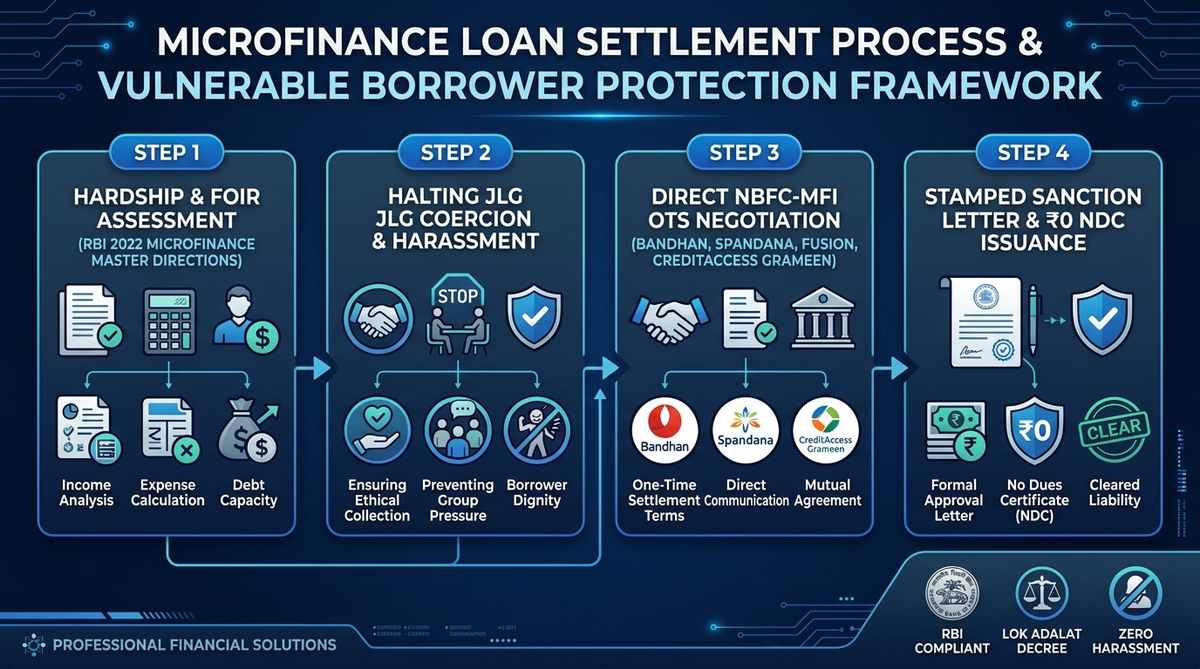
Step-by-Step Strategic Roadmap: Negotiating an Enforceable Microfinance Settlement
Executing a legally sound, discounted One-Time Settlement with major microfinance lenders (Bandhan Bank, Fusion, Spandana, CreditAccess Grameen, Muthoot Microfin, Satin Creditcare) requires a systematic six-stage process:
1Compiling Bona Fide Hardship Documentation
Assemble comprehensive documentary proof evidencing genuine, non-wilful financial distress. Critical documentation includes medical hospitalization discharge summaries, death certificates of primary earners, crop damage certificates from local revenue authorities, business trade closure records, or bank statements showing depleted liquidity.
2Isolating the Account & Establishing Written Communication
Serve a formal written representation to the NBFC-MFI branch and regional headquarters directing that all future communication be conducted exclusively in writing or through designated legal counsel. This halts unannounced center-meeting disruptions and establishes an auditable legal trail.
3Submitting the Formal Hardship OTS Proposal
Bypass local field collection agents who lack settlement discretion. Submit a formal One-Time Settlement petition directly to the MFI Stressed Asset Department and Principal Nodal Officer, proposing a realistic compromise figure (typically 35% to 50% of the core principal outstanding) backed by the hardship dossier.
4Negotiating the Debt Haircut & Demanding 100% Penalty Waivers
Conduct structured negotiations with MFI regional credit authorities. Insist on a complete 100% waiver of all accumulated bounce charges, late payment fees, and penal interest under the RBI Fair Lending Practice framework, arriving at an agreed, discounted lump-sum or structured 2-to-3 installment settlement.
5Forensic Verification of the Official OTS Sanction Letter
Prior to transferring any settlement funds, conduct a forensic audit on the OTS Sanction Letter. Ensure it is issued on official NBFC-MFI corporate letterhead, citing your correct loan account number, exact compromise figure, payment due dates, and explicit covenants confirming complete liability extinguishment and withdrawal of legal notices.
6Direct Bank Remittance & Enforcing ₹0 NDC Delivery
Remit the agreed settlement funds directly into your designated MFI loan account via NEFT/RTGS or official branch counter receipt. Under RBI Circular RBI/2023-24/60, the institution must deliver the formal No Dues Certificate and update credit bureau records within 30 calendar days.
Navigating Section 25 PSSA Notices, Arbitration & National Lok Adalat Decrees
As microfinance defaults mature beyond 90 to 180 days, lending institutions routinely deploy formal legal procedures to accelerate recoveries. Understanding how to handle legal notices transforms procedural pressure into an opportunity for structured compromise:
Section 25 PSSA & Section 138 NI Act Notices: When e-NACH mandates or post-dated cheques bounce due to insufficient funds, MFI legal counsels issue statutory 15-day demand notices. These notices are statutory procedural requirements, not immediate arrest warrants. A comprehensive legal reply served within 15 days detailing bona fide hardship and raising any violations of the RBI 50% household FOIR rule creates legal defense and initiates settlement conciliation.
National Lok Adalat Resolution: National Lok Adalats organized quarterly across all states by District Legal Services Authorities (DLSA) under the Legal Services Authorities Act, 1987 represent the premier dispute resolution forum for microfinance debts. Sitting judicial officers facilitate compromise settlements with pre-approved MFI discounts (typically 45% to 65%). The resulting Lok Adalat Award carries the statutory weight of a non-appealable Civil Court Decree, permanently closing all legal disputes.
| Resolution Mechanism | Statutory Framework | Haircut Potential | Resolution Timeframe | Enforceability & Finality |
|---|---|---|---|---|
| Direct NBFC-MFI OTS Petition | RBI Master Direction on Compromise Settlements (2023) | 40% – 65% Debt Haircut | 15 to 30 Days | Binding private contract with ₹0 NDC. |
| National Lok Adalat | Legal Services Authorities Act, 1987 (NALSA) | 45% – 65% Debt Haircut | Single Session | Civil Court Decree (Non-appealable finality). |
| Legal Notice Formal Reply | Payment and Settlement Systems Act (Sec 25) | 35% – 50% Debt Haircut | 1 to 2 Months | Compounds dispute into formal OTS. |
| RBI Ombudsman Escalation | Reserve Bank Integrated Ombudsman Scheme, 2021 | Penal Fee Reversal | 30 to 45 Days | Enforces Fair Lending compliance. |
Authenticating Microfinance Settlement Letters & Enforcing the ₹0 NDC Mandate
A grave danger in rural and semi-urban microfinance recovery involves field collection agents or unauthorized third-party agencies issuing fake or verbal settlement assurances to collect partial payments. When a borrower deposits money without an authentic stamped sanction letter, the MFI core banking system automatically credits the funds toward overdue penal interest and bounce charges, leaving the principal balance active, compounding, and in default.
Before making any settlement payment, verify that the OTS sanction letter satisfies essential legal criteria:
- Official Corporate Letterhead: The letter must be printed on official corporate letterhead of the lending institution (e.g., Bandhan Bank, CreditAccess Grameen, Fusion Micro Finance, Spandana Sphoorty) containing its Corporate Identification Number (CIN) and registered office address.
- Detailed Account Particulars: The sanction document must explicitly mention the borrower's full name, registered mobile number, unique loan account number, total outstanding ledger balance, agreed settlement amount, and exact payment deadline.
- Discharge & Legal Withdrawal Covenants: The document must unambiguously affirm that remittance of the agreed compromise sum constitutes full and final satisfaction of all claims, extinguishing all remaining debt and mandating the withdrawal of any pending legal or Section 25 notices.
- Direct Institutional Remittance: Payments must be made exclusively to the official loan account through authorized banking channels (NEFT/RTGS/IMPS) or an official branch counter receipt. Never transfer funds to personal UPI IDs or cash without a formal computerized receipt.
Under Reserve Bank of India Circular RBI/2023-24/60, all regulated lenders are statutorily required to issue a formal No Dues Certificate (NDC) and update credit bureau records within 30 calendar days of settlement receipt. Any failure to deliver the closure certificate within this statutory window entitles the borrower to mandatory compensation of ₹5,000 per day of delay directly from the lender.
Credit Bureau Trajectory Post-Settlement & 18-Month Financial Rehabilitation Plan
Following the execution of an OTS, the microfinance institution reports the updated account status to all four authorized credit bureaus in India—TransUnion CIBIL, Experian, Equifax, and CRIF High Mark. The loan status transitions from active 'Default' or 'Written-Off' to 'Settled' or 'Post-Write-Off Settled', with the outstanding ledger balance reduced to exactly ₹0.
While a 'Settled' remark leads to an initial credit score drop of 75 to 120 points and requires a 12-month cooling period under RBI rules before new unsecured credit lines can be approved, it is vastly superior to an unresolved 'Default' status that degrades your score every 30 days and invites ongoing legal friction.
Borrowers can systematically restore their credit profile to 750+ within 18 to 24 months through a disciplined rehabilitation strategy:
Avail a fixed-deposit-backed credit card (e.g., ₹20,000 to ₹30,000 FD). Use it for small routine expenses and ensure 100% on-time full repayment every billing cycle.
Keep credit utilization strictly below 20% to 25% of the secured credit limit. Avoid exhausting the credit line, signaling responsible credit management to scoring algorithms.
Review your CIBIL and CRIF High Mark reports 45 days post-settlement. Verify that the outstanding balance shows ₹0. If errors persist, file an online bureau dispute attaching your ₹0 NDC.
Why Vulnerable Microfinance & JLG Borrowers Choose SettleLoans
Resolving defaulted microfinance and Joint Liability Group loans requires specialized regulatory expertise, aggressive anti-harassment legal advocacy, and direct access to NBFC-MFI Stressed Asset Management committees. SettleLoans shields vulnerable borrowers from coercive recovery tactics, halts community shaming, defends against Section 25 notices and arbitration summons, and negotiates authentic stamped One-Time Settlements with maximum principal waivers and guaranteed ₹0 No Dues Certificates.

Settle Loan is India's trusted debt relief and loan settlement platform. We help borrowers overcome financial distress by negotiating with banks and NBFCs to legally settle personal loans and credit card debts. With our transparent, performance-based approach, you can achieve debt freedom and regain your financial peace of mind.
COMPUTER
Frequently Asked Questions About Microfinance & JLG Loan Settlement
What are the latest RBI Master Directions (2022) regarding microfinance loan settlement and recovery?
The Reserve Bank of India (Regulatory Framework for Microfinance Loans) Directions, 2022 establish comprehensive protections for collateral-free microfinance borrowers. Key mandates include: (1) A mandatory cap ensuring that total monthly loan repayment obligations (Fixed Obligation to Income Ratio or FOIR) do not exceed 50% of monthly household income; (2) An absolute ban on harsh recovery methods, intimidation, verbal abuse, and social shaming; (3) Strict calling and visiting hours between 08:00 AM and 07:00 PM; (4) Explicit prohibition against contacting non-borrowers or creating group pressure; and (5) A board-approved framework for genuine hardship compromise settlements under the RBI Master Direction on Compromise Settlements (2023).
How does a Joint Liability Group (JLG) loan work, and can other group members be legally forced to pay my defaulted EMI?
In a Joint Liability Group (JLG) model, 4 to 10 individuals form a peer group to access collateral-free credit, providing mutual social guarantees. However, under Indian civil jurisprudence and RBI Fair Practices Codes, recovery agents cannot harass, socially boycott, or intimidate co-members, nor can they use physical force or public humiliation to coerce group payments. While the group agreement technically carries peer accountability, when an individual borrower experiences catastrophic financial insolvency (such as job loss, critical illness, or business failure), the lender must evaluate the borrower individually under RBI compromise settlement norms rather than orchestrating community boycotts.
How can I stop microfinance recovery agents from harassing me, visiting outside permitted hours, or creating scenes in my village/neighborhood?
Under the RBI 2022 Directions and the NBFC Fair Practices Code, you have statutory rights against harassment. You can stop coercive tactics by: (1) Serving a formal legal representation through counsel to the NBFC-MFI Principal Nodal Officer documenting specific violations; (2) Explicitly demanding that agents adhere to statutory visiting hours (08:00 AM to 07:00 PM) and meet exclusively at designated branch locations or pre-agreed places; (3) Documenting and recording abusive behavior, unannounced home visits, or threats; and (4) Lodging an immediate formal complaint on the RBI Integrated Ombudsman portal (cms.rbi.org.in), which mandates time-bound regulatory scrutiny and penalties for the lending institution.
What percentage of debt waiver or haircut can you negotiate on defaulted microfinance loans?
Because microfinance loans are 100% unsecured and collateral-free, lenders face severe legal friction in executing recovery through civil courts. When an account crosses 90 to 180 days past due (NPA classification) and carries mandatory Expected Credit Loss (ECL) provisions, NBFC-MFIs (such as Bandhan, Fusion, Spandana, CreditAccess Grameen, and Muthoot Microfin) routinely approve One-Time Settlement (OTS) haircuts ranging between 40% and 65% of the total ledger balance, alongside a 100% waiver of all accumulated overdue penalties, penal interest, and center meeting bounce charges.
Can microfinance institutions file police complaints or send borrowers to jail for unpaid JLG loans?
No. Under the Indian Contract Act, 1872 and settled Supreme Court jurisprudence, defaulting on an unsecured microfinance or JLG loan is purely a civil contractual dispute. Inability to repay due to financial hardship does not constitute a criminal offense, cheating, or fraud. Police authorities have zero legal jurisdiction to intervene in loan recovery, register FIRs, summon borrowers to police stations, or effect arrests for unpaid microfinance installments. Any threat of police arrest made by recovery agents is unlawful and actionable under civil and criminal law.
What should I do if an MFI issues a Section 25 PSSA notice or Section 138 cheque bounce notice?
If an NBFC-MFI issues a statutory 15-day demand notice under Section 25 of the Payment and Settlement Systems Act, 2007 (PSSA) for NACH dishonour or Section 138 of the Negotiable Instruments Act for cheque return, engage specialized banking legal counsel immediately. A comprehensive legal reply must be served within the statutory 15-day window demonstrating genuine commercial hardship, highlighting any lender violations of the 50% household FOIR cap under RBI 2022 guidelines, and submitting a formal proposal for an amicable compromise settlement.
Can microfinance loan defaults be settled through National Lok Adalat?
Yes. National Lok Adalats organized quarterly across India by District Legal Services Authorities (DLSA) under the Legal Services Authorities Act, 1987 are among the most effective forums for settling microfinance debts. Microfinance institutions regularly submit delinquent accounts to Lok Adalat benches where pre-negotiated settlements with 45% to 65% discounts are formalized before judicial officers. The Lok Adalat Award operates as a final, non-appealable Civil Court Decree, barring any further claims or recovery proceedings.
How do I verify the authenticity of a microfinance OTS Sanction Letter before paying?
An authentic microfinance OTS sanction letter must be printed on official NBFC-MFI or bank corporate letterhead featuring its Corporate Identification Number (CIN), registered office address, borrower name, unique loan account number, sanctioned settlement figure, strict payment schedule, authorized signatory seal, and explicit legal covenants confirming that the payment constitutes full and final discharge of all liabilities with complete withdrawal of legal notices.
How long does it take to receive the No Dues Certificate (NDC) and update CIBIL after microfinance settlement?
Under RBI Circular RBI/2023-24/60, all regulated lenders—including NBFC-MFIs, Small Finance Banks, and commercial banks—are legally required to issue an official stamped No Dues Certificate (NDC) and submit updated loan records to credit bureaus (CIBIL, Experian, Equifax, CRIF High Mark) within 30 calendar days of receiving full settlement payment. If the lender fails to deliver the NDC within 30 days, it is liable to pay statutory compensation of ₹5,000 per day of delay directly to the borrower.
Official Regulatory References & Statutory Circulars
- Reserve Bank of India (RBI): Master Direction – Reserve Bank of India (Regulatory Framework for Microfinance Loans) Directions, 2022 (RBI/DOR/2021-22/89)
- RBI Master Direction on Compromise Settlements: Guidelines on Compromise Settlements and Technical Write-offs (DOR.STR.REC.20/21.04.048/2023-24)
- Microfinance Institutions Network (MFIN): Code of Conduct Enforcement Guidelines & Customer Grievance Redressal Mechanism
- Reserve Bank - Integrated Ombudsman Scheme (2021): Official CMS Portal for Complaints Against MFI Harassment & Excessive Penalties
- National Legal Services Authority (NALSA): Legal Services Authorities Act, 1987 — National Lok Adalat Dispute Settlement Framework