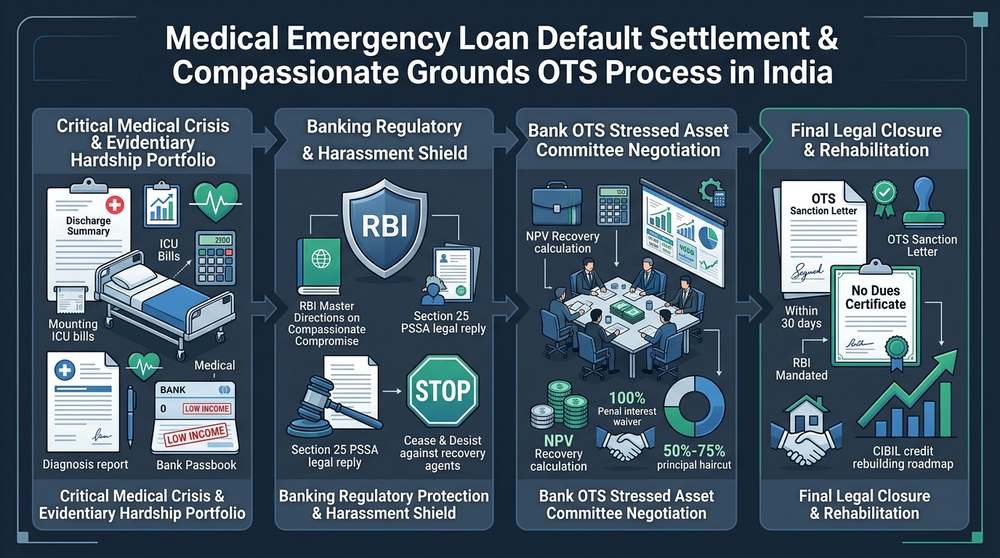
- Compassionate Grounds Recognition: Critical illness, emergency surgeries, cancer treatments, and severe accidents are legally recognized by the Reserve Bank of India (RBI) as non-wilful distress events, entitling borrowers to structured compromise debt relief.
- Irrefutable Evidentiary Portfolio: Hospital discharge summaries, operation theatre notes, inpatient invoices, and zero-balance bank statements legally defeat wilful default allegations and force credit committees to authorize deep waivers.
- 50%–75% Haircut Potential: In Non-Performing Asset (NPA) accounts past 90 to 180 days, banks eliminate 100% of penal interest and late fees while discounting core principal balances by 50% to 75% through Net Present Value (NPV) modeling.
- Hospital & Family Harassment Shield: RBI Master Directions strictly ban recovery agents from contacting recovering patients, visiting hospital premises, or intimidating family members under threat of severe regulatory fines.
- Mandatory ₹0 No Dues Certificate: Under RBI Circular RBI/2023-24/60, lenders must issue an authentic stamped No Dues Certificate (NDC) within 30 days of settlement payment under a statutory delay penalty of ₹5,000 per day.
Healthcare Debt Trap: Medical Distress vs Wilful Default
In India, out-of-pocket healthcare expenditure is a leading cause of sudden household insolvency. Catastrophic medical emergencies—such as cardiac surgeries, oncology chemotherapy, neurosurgery, or chronic organ failure—liquidate savings and provident funds within days. Even with health insurance coverage, strict sub-limits, non-payable consumables, and TPA deductions force families to absorb immense direct hospital bills.
When cash flows are diverted toward medical bills, personal loan EMIs and credit card balances inevitably default. In Indian banking law, this scenario represents an involuntary default. Under the RBI Master Circular on Wilful Defaulters, a borrower is categorized as wilful only if they possess liquid funds but refuse repayment, siphon money, or fraudulently dispose of assets.
A salaried professional or self-employed borrower who maintained an unblemished repayment track record for years and defaulted solely due to verified critical illness or prolonged inpatient hospitalization stands completely protected against wilful default classifications. Unsecured retail loans represent civil contractual debts governed by the Indian Contract Act, 1872. Under the doctrine of objective financial frustration and the RBI Master Directions on Compromise Settlements (DOR.STR.REC.20/21.04.048/2023-24), regulated banking entities are legally mandated to entertain compassionate grounds compromise petitions and negotiate realistic debt closures.
Compiling Medical Records as Irrefutable Evidence
Bank Zonal Stressed Assets Committees and Chief Risk Officers do not grant multi-lakh debt waivers based on verbal emotional appeals or casual medical prescriptions. Internal bank auditors, statutory credit controllers, and RBI inspection teams require comprehensive, verifiable documentary trails to justify every single rupee written off under a compromise settlement. Submitting an airtight Medical Hardship Dossier transforms a subjective personal crisis into an indisputable legal reality, compelling bank credit committees to authorize maximum compromise concessions.
A legally watertight medical hardship portfolio consists of five foundational documentary components that establish medical gravity, total savings exhaustion, and genuine financial incapacity:
| Document Category | Primary Evidentiary Records | Strategic Evidentiary Purpose | Credit Committee Weightage |
|---|---|---|---|
| 1. Hospital Discharge Summaries | Official multi-page discharge summary from accredited hospital (NABH/JCI), operation theatre (OT) notes, and ICU charts. | Establishes exact diagnosis (e.g., malignancy, acute myocardial infarction, trauma), surgery dates, and critical condition. | Critical (Non-Negotiable) |
| 2. Itemized Inpatient Hospital Invoices | Stamped final hospital billing statements, pharmacy receipts, diagnostic imaging bills (MRI/CT), and surgeon fee vouchers. | Provides quantitative mathematical proof of catastrophic capital drain directly linked to medical treatment. | Critical (Non-Negotiable) |
| 3. Insurance Settlement / Rejection Slips | TPA settlement advice showing severe claim deductions or formal claim rejection letters detailing non-payable clauses. | Proves that the borrower was forced to absorb massive out-of-pocket healthcare liabilities from liquid personal savings. | Critical (Non-Negotiable) |
| 4. Bank Account Liquidity Statements | Last 6 to 12 months of stamped bank account statements across all savings, salary, and current accounts. | Verifies direct fund transfers to hospital billing accounts and proves absolute exhaustion of household liquid reserves. | High Supporting Value |
| 5. Medical Prognosis & Incapacity Letters | Treating physician / Medical Superintendent certificate detailing ongoing recovery, bed rest, or permanent disability. | shows severe temporary or permanent loss of professional earning capacity, destroying future EMI servicing ability. | High Supporting Value |
When these verified records are indexed chronologically into a formal legal submission, the bank's legal team cannot dispute the authenticity of the financial catastrophe. The dossier legally shifts the borrower from a standard collection target into a protected compassionate-grounds category.
Check Your Loan Settlement Options
Answer 2 quick questions to evaluate your settlement eligibility.
1. What type of loan do you want to settle?
NPA Provisioning Timeline for Medical Debt Waivers
Achieving a favorable loan settlement requires an in-depth understanding of bank accounting cycles and the regulatory lifecycle of delinquent assets. In commercial banking, default resolution is governed by strict provisioning mandates imposed by the Reserve Bank of India. The internal authority of bank credit managers to sanction significant debt write-offs changes drastically across the delinquency timeline:
| Delinquency Phase | Overdue Days (DPD) | Bank Accounting Status | Mandatory Bank Provisioning | OTS Haircut Authorization |
|---|---|---|---|---|
| Special Mention Account (SMA-0) | 1 – 30 Days | Standard Performing Asset | 0.4% Standard Provision | 0% Haircut (Penalties only) |
| Special Mention Account (SMA-1) | 31 – 60 Days | Early Delinquency Pool | 5% Regulatory Reserve | Minimal (Restructuring focus) |
| Special Mention Account (SMA-2) | 61 – 90 Days | Critical Pre-NPA Warning | 10% Regulatory Reserve | 10% – 25% (Fee waivers only) |
| Sub-Standard NPA Phase | 91 – 180 Days | Classified Non-Performing Asset | 15% – 25% Mandatory Capital Lock | 50% – 65% Principal Haircut |
| Doubtful NPA / Written-off | 181+ Days | Doubtful Asset / Technical Write-off | 50% – 100% Capital Provisioned | 60% – 75% Principal Haircut |
During early SMA stages (Days 1 to 90), frontline collection callers operate on rigid commission scripts. They possess zero authority to sanction principal discounts and routinely dismiss medical emergencies. However, once the loan crosses Day 91 and becomes a Non-Performing Asset (NPA), files shift to authorized verticals. Management moves to the Zonal Stressed Assets Resolution Cell (SARC) or Settlement Committee.
Between Day 120 and Day 180, the bank faces mandatory quarterly provisioning allocations under RBI prudential accounting norms. Because capital is locked without generating interest, bank credit committees are actively incentivized to approve one-time cash recoveries to clean their balance sheets, making this the prime strategic window to submit the Medical Hardship Dossier.
NPV Modeling: Why Banks Accept 50%–75% Medical Haircuts
Borrowers often wonder why commercial banks voluntarily waive 50% to 75% of an outstanding loan balance. The decision is rooted in institutional economics and Net Present Value (NPV) Recovery Modeling. Under RBI Master Directions, credit committees must determine whether an immediate cash settlement yields higher net returns than litigating against a medically incapacitated borrower.
Here, C_t represents estimated future recoveries, and r is the institutional discount rate (12%–15%). Deductions account for 3–5 years of court delays and advocate retainers. They also factor in execution friction and 100% capital frozen in NPA provisioning reserves.
Consider an unsecured personal loan with an outstanding ledger balance of ₹12,00,000 defaulted due to critical surgery and prolonged recovery:
- Litigation Path (High Friction & Uncertainty): The bank files a civil summary suit under Order 37 CPC or starts commercial arbitration. The bank spends ₹75,000 in court fees, ₹90,000 in advocate fees, and waits 4 to 7 years in Indian civil courts. Because the borrower has depleted all liquid savings on hospital bills and owns no unencumbered commercial real estate, executing a money decree yields negligible cash. Meanwhile, the bank must freeze ₹12,00,000 in mandatory capital reserves. The discounted NPV of this route yields barely ₹2.5 Lakhs to ₹3.2 Lakhs.
- Compassionate Hardship OTS (Immediate Certainty): The borrower, represented by experienced debt settlement advocates, submits the complete medical dossier and offers an immediate lump-sum settlement of ₹3.6 Lakhs to ₹4.5 Lakhs (a 62% to 70% haircut) mobilized with help from extended family members. The bank receives immediate liquid cash, completely releases ₹12,00,000 from frozen capital reserves, eliminates all legal costs, and closes the delinquent ledger permanently.
Because the compassionate settlement delivers superior NPV and eliminates balance-sheet risk, the bank's Zonal Stressed Assets Committee has a fiduciary and economic obligation to approve the settlement.
Resolution Blueprint: Medical Default to ₹0 NDC
The comprehensive infographic below illustrates the 4-stage institutional lifecycle of resolving defaulted retail loans following catastrophic medical emergencies. It outlines how verified hospital records and statutory protections transform unmanageable debt into an authorized 50% to 75% compromise waiver under Reserve Bank of India frameworks.
Halting Recovery Harassment for Medical Patients
The most distressing aspect of defaulting during illness is aggressive recovery agent harassment. Lenders often outsource delinquent accounts to commission-driven third-party agencies. In violation of statutory regulations, agents sometimes call patients in hospitals or visit during strict bed rest. They intimidate family members and issue unlawful threats of police action.
Such coercive tactics represent severe violations of the RBI Master Directions on Recovery Agents (2022) and the statutory Charter of Customer Rights. Under binding directives issued to all scheduled commercial banks, non-banking financial companies (NBFCs), and digital lending apps, borrowers enjoy comprehensive statutory protections:
- Absolute Prohibition of Hospital / Sickbed Contact: Recovery agents are legally prohibited from calling patients undergoing active medical treatment or visiting hospitals, nursing homes, or recovery centers.
- Strict Calling Windows: Debt collectors can only contact borrowers between 08:00 AM and 07:00 PM. Calls at night or early morning constitute illegal harassment.
- Zero Contact with Non-Guarantor Family Members: Contacting spouses, elderly parents, children, or attending doctors to demand debt repayment is explicitly prohibited under RBI privacy mandates.
- Mandatory Identification Credentials: Any field agent visiting a residence must present an official bank authorization letter, photo identity card, and an Indian Institute of Banking & Finance (IIBF) Debt Recovery Agent (DRA) certificate.
- Zero Tolerance for Coercion & Threats: Using abusive language, threatening physical harm, or falsely claiming that police officers will arrest the patient constitutes punishable criminal intimidation under the Bharatiya Nyaya Sanhita.
Enforcement & Ombudsman Escalation Mechanism
When collection agencies violate these statutory safeguards, specialized legal advocates issue a formal Legal Cease-and-Desist Notice to the bank's Managing Director and Principal Nodal Officer (PNO), attaching hospital admission records. If the harassment continues, a formal complaint is escalated to the RBI Integrated Ombudsman Portal (cms.rbi.org.in). Under the Ombudsman scheme, banks face mandatory regulatory reprimands, institutional fines, and monetary relief orders awarded directly to the distressed borrower.
Defending Notices: Section 25 PSSA & Section 138 NI Act
As medical expenditures exhaust bank balances, automated electronic National Automated Clearing House (e-NACH) mandates and post-dated cheques bounce due to insufficient funds. Lenders use these automated bounce events to issue intimidating statutory legal notices under Section 25 of the Payment and Settlement Systems Act (PSSA), 2007 or Section 138 of the Negotiable Instruments (NI) Act, 1881.
Receiving a 15-day statutory demand notice while dealing with serious illness causes immense psychological stress. However, borrowers must understand that a statutory notice is merely a formal demand letter, not an arrest warrant or court judgment. Both Section 25 PSSA and Section 138 NI Act represent quasi-criminal, bailable, and compoundable legal mechanisms designed to help debt conciliation rather than penalize genuine medical emergencies.
To build an unassailable legal defense, legal counsel drafts a comprehensive formal reply within the statutory 15-day window establishing the following core legal arguments:
- Absence of Mens Rea (Criminal Intent): Placing the complete Medical Hardship Dossier on official court record, proving that payment failure arose from sudden catastrophic medical expenditure and life-saving hospitalizations rather than deliberate financial deception.
- Forensic Challenge to Unlawful Bounce Penalties: Demanding an immediate forensic audit of the loan account to eliminate predatory bounce fees added through multiple unauthorized repeated e-NACH presentations.
- Revocation of Electronic Mandates: Serving formal notice of mandate cancellation under National Payments Corporation of India (NPCI) procedural guidelines to halt further debit return charges.
- Formal Invitation for Pre-Litigation Conciliation: Submitting a formal offer for compromise conciliation through National Lok Adalat benches or bank settlement committees under the Legal Services Authorities Act, 1987.
Filing an authoritative legal reply through an advocate completely prevents the bank from securing an ex-parte court summons and firmly shifts the entire dispute into structured compromise settlement talks.
5-Step Compassionate Settlement Protocol for Zonal Approval
Executing a legally binding, heavily discounted loan settlement requires bypassing frontline collection tele-callers and engaging directly with authorized bank decision-makers. The following five-stage roadmap governs professional medical debt resolution:
1Audit & Medical Dossier Assembly
Collate all hospital discharge summaries, inpatient invoices, TPA claim vouchers, treating physician prognosis certificates, and 12-month stamped bank account statements establishing total savings exhaustion.
2Legal Representation & Harassment Injunction
Formal Letters of Authority (LoA) are served on the lender's Nodal Officers. Legal cease-and-desist notices immediately halt collection agent harassment at home, office, and hospital premises under RBI directives.
3Direct Submission to Zonal Stressed Assets Cell
The structured compassionate hardship petition is submitted directly to the bank's Zonal Settlement Committee, bypassing retail branch personnel and presenting detailed NPV recovery mathematics.
4Multi-Round Haircut talks
Advocates negotiate aggressively to eliminate 100% of accumulated penal interest and bounce charges, securing a 50% to 75% haircut on the core principal balance based on verified healthcare costs.
5Sanction Letter Audit & Stamped ₹0 NDC Closure
The official OTS Sanction Letter is forensically audited for mandatory legal clauses before payment is disbursed. Stamped No Dues Certificates (NDC) and credit bureau updates are tracked until final delivery.
OTS Sanction Letters: 5 Key Clauses & ₹0 NDC Mandate
A dangerous trap facing medically distressed borrowers is relying on verbal settlement promises or WhatsApp messages. Tele-callers trick borrowers into depositing token payments of ₹25,000 to ₹50,000, promising account closure. The bank then credits this token against penal interest, leaving the principal balance active and compounding.
To guarantee absolute legal closure, borrowers must ensure that their OTS Sanction Letter satisfies five mandatory forensic parameters before paying any settlement consideration:
- Authentic Corporate Stationery & Signatures: The sanction letter must be issued on official bank letterhead, bearing the physical signature, employee identification number, designation, and official seal of an authorized Credit Manager, Assistant General Manager (AGM), or Zonal Recovery Head.
- Accurate Borrower & Loan Details: The letter must correctly state the borrower's full legal name, registered PAN card number, and exact loan account number.
- Clear Settlement Figures & Payment Schedule: The approved compromise sum must be specified in clear numbers and words, along with exact due dates. Any installment schedule must be clearly defined without ambiguous penal clawback clauses.
- Complete Extinguishment of Residual Liabilities: The letter must contain a definitive legal clause confirming that upon receipt of the agreed settlement sum, all residual principal balances, accumulated interest, and legal expenses stand fully and irrevocably waived, with zero further claims enforceable.
- Guaranteed Delivery of Zero-Balance No Dues Certificate: The sanction letter must stipulate that a formal, stamped No Dues Certificate (NDC) and closure statement will be delivered within 30 calendar days of payment.
Comparative Debt Resolution Matrix & Credit Repair
Distressed borrowers often evaluate whether a One-Time Settlement (OTS) is superior to alternative relief mechanisms such as loan tenure restructuring, medical moratoriums, or conciliation through National Lok Adalat. The comparative matrix below details the strategic trade-offs of each avenue following a healthcare crisis:
| Resolution Avenue | Core Financial Mechanism | Debt Haircut Potential | Legal Enforceability | CIBIL Bureau Reporting Status |
|---|---|---|---|---|
| One-Time Settlement (OTS) | Lump-sum or short-installment compromise closing the loan permanently. | 50% – 75% Principal Haircut + 100% Fee Waiver | Binding Civil Contract & Complete Legal Immunity | Reported as 'Settled' with ₹0 Outstanding Balance |
| National Lok Adalat | Statutory conciliation bench presided over by retired judges and judicial members. | 45% – 65% Debt Haircut | Final Civil Court Decree (Non-Appealable under LSA Act) | Reported as 'Settled through Lok Adalat' (₹0 Balance) |
| Tenure Restructuring | Extending loan tenure (e.g., from 3 to 7 years) to reduce monthly EMI burden. | 0% Haircut (Total interest paid over time increases) | Modified Loan Agreement | Reported as 'Restructured' (Temporary CIBIL Dip) |
| Medical Moratorium | 3 to 6 months pause on EMI payments during active medical treatment. | 0% Haircut (Interest continues to capitalize monthly) | Internal Bank Concession | Standard / Overdue depending on bank approval |
Rebuilding Your CIBIL Score from 'Settled' to 750+ Post-Recovery
Executing a loan settlement updates your credit bureau status to 'Settled' with an outstanding balance of ₹0. While this causes an initial score dip of 75 to 150 points and a 12-month cooling period, it permanently stops compounding default marks, halts legal notices, and eliminates harassment.
Once physical health and regular professional income stabilize, borrowers can systematically rehabilitate their credit profile back to prime status (750+) within 18 to 24 months through a disciplined 3-step credit rebuilding roadmap:
- Secured Credit Card Foundation: Open a Fixed Deposit (FD) of ₹30,000 to ₹50,000 with a scheduled commercial bank and obtain an instant secured credit card backed by the deposit (80%–90% credit limit).
- Strict Credit use Discipline: use no more than 20% to 30% of the card limit for regular household expenditures and ensure 100% automated full payment on or before the due date every month.
- Bureau Score Re-indexing: As 12 to 18 months of spotless, on-time repayments are reported to CIBIL, Experian, Equifax, and CRIF, the credit scoring algorithm re-indexes your financial reliability, unlocking prime commercial credit eligibility.

Settle Loan is India's trusted debt relief and loan settlement platform. We help borrowers overcome financial distress by negotiating with banks and NBFCs to legally settle personal loans and credit card debts. With our transparent, performance-based approach, you can achieve debt freedom and regain your financial peace of mind.
COMPUTER
FAQs: Loan Settlement Due to Medical Emergency
Is a medical emergency recognized as a valid legal ground for loan settlement in India?
Yes. Under Reserve Bank of India (RBI) Master Directions on Compromise Settlements and Technical Write-offs, catastrophic medical emergencies, critical illness of the borrower or primary dependents, permanent disability, and sudden loss of earning capacity are explicitly recognized as genuine, non-wilful hardship grounds. When backed by verified hospital discharge summaries, surgical notes, and depleted bank records, bank credit committees are authorized to sanction deep compromise settlements with 50% to 75% debt haircuts.
What hospital records and medical documents are needed to prove financial hardship to a bank?
A comprehensive medical hardship dossier requires: (1) Official hospital discharge summaries detailing diagnosis, admission/discharge dates, and surgical procedures; (2) Itemized inpatient hospital invoices, pharmacy bills, and diagnostic test receipts; (3) Treating physician prognosis certificates attesting to ongoing medical incapacity or temporary loss of earning ability; (4) Health insurance claim settlement or rejection vouchers showing out-of-pocket capital exhaustion; and (5) Stamped bank account statements showing liquidity drain caused by hospital transfers.
How do medical discharge summaries protect borrowers from being labeled wilful defaulters?
Under RBI Master Circulars on Wilful Defaulters, a borrower can only be declared a wilful defaulter if they have the financial capacity to pay but intentionally refuse, or if they divert funds fraudulently. A formal medical discharge summary combined with hospital expenditure proofs provides conclusive legal evidence that loan default was entirely involuntary and driven by an uncontrollable medical calamity, completely shielding the borrower from wilful default penal classifications.
What percentage of debt waiver or haircut can you get for medical emergency loan default?
For unsecured personal loans and credit cards that have transitioned into Non-Performing Assets (NPAs past 90 to 180 days), verified medical emergency hardship typically commands debt haircuts between 50% and 75% of total ledger dues. In addition, 100% of accumulated penal interest, overdue late fees, and bounce charges are waived outright under RBI Fair Lending Practices.
How can you stop recovery agents from harassing a patient or family during hospitalization?
Under the RBI Master Directions on Recovery Agents (2022), debt collectors are strictly prohibited from using abusive language, visiting hospitals, contacting recovering patients, or calling non-guarantor family members. Borrowers or their legal agents can serve an immediate Legal Cease-and-Desist Notice attaching hospital admission proofs, submit a complaint to the bank's Principal Nodal Officer (PNO), and escalate violations to the RBI Integrated Ombudsman portal (cms.rbi.org.in).
What should you do if a bank sends a Section 25 PSSA or Section 138 notice during medical treatment?
Do not ignore the statutory notice. Have a banking advocate draft a formal legal reply within the mandated 15-day statutory window. The reply must place the complete medical hardship portfolio on legal record, establish the absence of mens rea (criminal intent), demand an immediate stop to automated e-mandate presentation fees, and propose structured conciliation or compromise settlement under the Legal Services Authorities Act, 1987.
Can health insurance claim rejections or partial payouts be used as evidence for bank OTS?
Yes. Formal claim rejection letters or deduction statements from health insurance Third Party Administrators (TPAs) serve as powerful secondary evidence. They prove to the bank's Stressed Assets Committee that the borrower was forced to absorb catastrophic out-of-pocket medical liabilities directly from personal savings and salary earnings, reinforcing the necessity of a deep compromise settlement.
How does the bank's Zonal Stressed Assets Committee evaluate medical hardship petitions?
The committee applies Net Present Value (NPV) recovery modeling. They compare the immediate lump-sum cash offered through medical OTS against the discounted present value of protracted civil litigation against an incapacitated borrower with depleted liquid assets. Because civil lawsuits take 3 to 7 years and yield highly uncertain returns while locking up regulatory capital reserves, credit committees mathematically favor approving compassionate OTS proposals.
What key clauses must be verified in the bank's medical OTS sanction letter before paying?
Before disbursing any payment, verify that the sanction letter: (1) Is issued on authentic bank letterhead with an authorized officer's signature and branch seal; (2) Accurately lists your loan account number and borrower name; (3) Explicitly states the agreed settlement amount and payment due dates; (4) Affirms that full payment completely extinguishes all residual claims and penal charges; and (5) Guarantees issuance of a ₹0 No Dues Certificate within 30 days under RBI Circular RBI/2023-24/60.
How does settling a loan due to medical emergency affect your CIBIL score and how can you rebuild it?
Executing an OTS updates the credit bureau status to 'Settled' with an outstanding balance of ₹0. While this produces a temporary credit score reduction and triggers an initial 12-month cooling period, it permanently eliminates active default marks and legal liabilities. Once health and income stabilize, borrowers can rebuild their credit score back to 750+ within 18 to 24 months by using a secured credit card backed by a fixed deposit and maintaining spotless repayment discipline.
Official Regulatory References & Statutory Circulars
- Reserve Bank of India (RBI): Master Direction on Compromise Settlements and Technical Write-offs (DOR.STR.REC.20/21.04.048/2023-24)
- RBI Master Circular: Responsible Lending Conduct – Release of Movable / Immovable Property Documents / NDC on Repayment (RBI/2023-24/60)
- RBI Master Direction on Recovery Agents: Fair Practices Code for Scheduled Commercial Banks and NBFCs (2022)
- Reserve Bank - Integrated Ombudsman Scheme, 2021: Online Grievance Redressal for Coercive Recovery & Hardship Disputes
- National Legal Services Authority (NALSA): Legal Services Authorities Act, 1987 — National Lok Adalat Settlement Guidelines