- Genuine Hardship Recognition: Involuntary unemployment is categorized as a bona fide financial calamity under RBI Master Directions, distinguishing distress defaults from intentional wilful non-payment.
- Evidentiary Hardship Dossier: Submitting official corporate layoff notices, severance calculations, zero-credit bank records, and PF withdrawal proofs compels bank credit committees to authorize maximum compromise waivers.
- 50%–70% Haircut Dynamics: During the Non-Performing Asset (NPA) window (120–180 days past due), banks optimize Net Present Value (NPV) recovery by eliminating 100% of penal charges and heavily discounting core principal.
- Complete Civil Immunity: Defaulting on unsecured loans due to income disruption is strictly a civil matter under the Indian Contract Act, 1872. Police intervention and criminal arrests are legally impossible for non-fraudulent defaults.
- Statutory ₹0 NDC Delivery: Under RBI Circular RBI/2023-24/60, lending institutions must deliver an authentic stamped No Dues Certificate and update all credit bureaus within 30 days of receiving settlement consideration.
The Unemployment Retail Debt Crisis
Corporate restructuring, macroeconomic contraction, technological automation, and sudden organizational downsizing across IT, fintech, e-commerce, and manufacturing sectors have precipitated an unprecedented wave of retail loan defaults in India. For salaried professionals servicing equated monthly installments (EMIs) across personal loans, credit card balances, and consumer durable lines, sudden job loss instantly destroys the debt-to-income equilibrium. What was once a manageable 35% debt service ratio transforms overnight into total insolvency, as recurring monthly debts collide with zero ongoing cash inflows.
Indian banking jurisprudence draws a clear line between distressed borrowers and financial delinquents. This distinction rests on involuntary default versus wilful default. Under the RBI Master Circular on Wilful Defaulters, a borrower is branded wilful only if they intentionally withhold repayment despite having liquid capacity, siphon funds, or fraudulently dispose of collateral. A salaried professional who defaulted due to corporate retrenchment or company liquidation stands entirely outside the ambit of wilful default.
Unsecured personal loans and credit cards represent bilateral civil contracts governed exclusively by the Indian Contract Act, 1872. When an unexpected loss of employment renders performance impossible due to objective financial incapacity, the legal relationship transitions from active servicing into dispute conciliation. Distressed borrowers hold explicit statutory protections under the RBI Master Directions on Compromise Settlements and Technical Write-offs (DOR.STR.REC.20/21.04.048/2023-24). Regulated financial institutions cannot coerce unpayable installments through extrajudicial threats and are mandated by prudential accounting standards to evaluate genuine hardship petitions for structured compromise settlements.
Compiling the Evidentiary Hardship Dossier
Bank credit committees do not sanction debt waivers based on verbal explanations. Under internal auditing standards and RBI supervisory guidelines, every rupee of debt haircut must be justified by evidentiary records. A borrower who submits a documented Hardship Portfolio shifts the balance of power during talks. It proves that full liquid recovery is impossible, making a discounted One-Time Settlement (OTS) the bank's sole viable option.
A legally robust hardship dossier comprises five primary documentary pillars that substantiate total income cessation, depletion of emergency liquidity, and genuine insolvency:
| Document Category | Primary Evidentiary Records | Strategic Evidentiary Purpose | Credit Committee Weightage |
|---|---|---|---|
| 1. Employment Separation Records | Official termination letter, corporate layoff notice, company closure circular, or severance agreement. | Proves the exact date of involuntary employment termination and absence of misconduct. | Critical (Non-Negotiable) |
| 2. Full & Final (FnF) Statement | Corporate FnF settlement slip detailing severance pay, gratuity, leave encashment, and notice pay deductions. | shows total terminal relief received and confirms complete cessation of corporate benefits. | Critical (Non-Negotiable) |
| 3. Primary Bank Account Ledgers | Last 6 to 12 months of stamped bank account statements across all operational savings and salary accounts. | Provides mathematical proof of zero incoming salary credits and verifies exhaustive depletion of savings. | Critical (Non-Negotiable) |
| 4. Statutory Tax & PF Records | Form 26AS, Income Tax Returns (ITR-1/ITR-2) showing income collapse, and EPFO non-contribution / withdrawal slips. | Substantiates long-term income destruction under statutory government records, defeating wilful default claims. | High Supporting Value |
| 5. Ancillary Hardship Disclosures | Medical treatment bills, dependent care expenses, residential rental agreements, and active job rejection emails. | Establishes mandatory subsistence living expenses that legally supersede unsecured debt repayment. | High Supporting Value |
When presenting this dossier through legal counsel, each exhibit is cross-referenced with a formal Hardship Affidavit executed on non-judicial stamp paper. This formalization shows absolute transparency, disarms aggressive recovery litigation, and provides the branch credit officer with the internal audit compliance necessary to recommend a 50% to 70% principal waiver to the Zonal Stressed Assets Committee.
Check Your Loan Settlement Options
Answer 2 quick questions to evaluate your settlement eligibility.
1. What type of loan do you want to settle?
NPA Delinquency Lifecycle & Bank Provisioning Windows
To negotiate a maximum debt waiver following job loss, understand the bank's accounting mechanics. Under RBI IRACP norms and Ind AS 109 Expected Credit Loss frameworks, lenders face strict regulatory provisioning schedules. These aging schedules dictate when and why credit committees are willing to compromise.
During the initial 90 days of missed payments, the account progresses through Special Mention Account stages (SMA-0 from Days 1–30, SMA-1 from Days 31–60, and SMA-2 from Days 61–90). In this phase, the bank categorizes the loan as a standard asset with temporary distress and expends massive operational energy trying to collect regular installments. Negotiating an OTS during early SMA stages is notoriously difficult because branch managers face punitive scrutiny for writing off loans that have not yet crossed the Non-Performing Asset threshold.
The strategic inflection point occurs at Day 91, when the loan becomes a Non-Performing Asset (NPA). Once an account enters NPA status, the bank must halt income recognition. It must also allocate mandatory capital reserves to cover potential loan losses (15% for Substandard, 25%–40% for Doubtful, and 100% for Loss Assets).
SMA-0 to SMA-2 Stage
Automated collection calls, repeated NACH sweeps, and agency pressure. Bank insists on full EMI regularization; settlement discounts are minimal.
Substandard NPA Stage
Account transferred to Zonal Stressed Assets Desk. Bank absorbs mandatory capital provisioning. Optimal window for negotiating 50%–65% principal waivers.
Doubtful & Loss Asset
Provisioning reaches 40%–100%. Bank prioritizes offloading bad ledger entries before fiscal year-end audits. Haircuts can reach 65%–70%+.
The primary talks sweet spot occurs between Day 120 and Day 180. At this stage, recovery agency commissions have peaked. In addition, internal records have established bona fide hardship. Credit committees actively seek cash recoveries to clean balance sheets before audits without incurring multi-year litigation costs.
Net Present Value (NPV) Recovery Modeling
Borrowers often wonder why a commercial bank would willingly forfeit 50% to 70% of an outstanding debt. The answer lies in risk management and Net Present Value (NPV) Recovery Valuation. Under RBI Master Directions, credit committees must compare immediate OTS cash against the discounted present value of litigating against an unemployed borrower with no attachable assets.
Where C_t represents estimated future cash recoveries, r is the institutional discount rate (12%–15%), and large deductions account for 3–5 years of court friction, advocate fees, and locked provisioning capital under RBI prudential norms.
Consider an unsecured personal loan with an outstanding principal balance of ₹10,00,000 defaulted due to job loss:
- Scenario A (Litigation Route): The bank files a civil summary suit under Order 37 of the Code of Civil Procedure (CPC) or starts arbitration. Court fees (₹50,000–₹80,000), advocate retainers (₹60,000–₹1,00,000), and 4 to 7 years of court delays yield an uncertain decree against an person with zero liquid assets. Meanwhile, 100% of the loan (₹10 Lakhs) remains frozen in capital reserves. The discounted NPV of this route yields barely ₹2.2 Lakhs to ₹2.8 Lakhs.
- Scenario B (Immediate Hardship OTS): The borrower, represented by specialized debt settlement advocates, offers an immediate lump-sum settlement of ₹3.8 Lakhs to ₹4.5 Lakhs (a 55% to 62% haircut) funded through family help. The bank receives immediate liquid cash, completely releases ₹10 Lakhs in locked regulatory provisioning, eliminates legal expenditures, and closes the bad loan ledger permanently.
Because Scenario B delivers higher economic value and zero ongoing risk, the bank's Zonal Stressed Assets Committee has a fiduciary and institutional incentive to approve the compromise settlement.
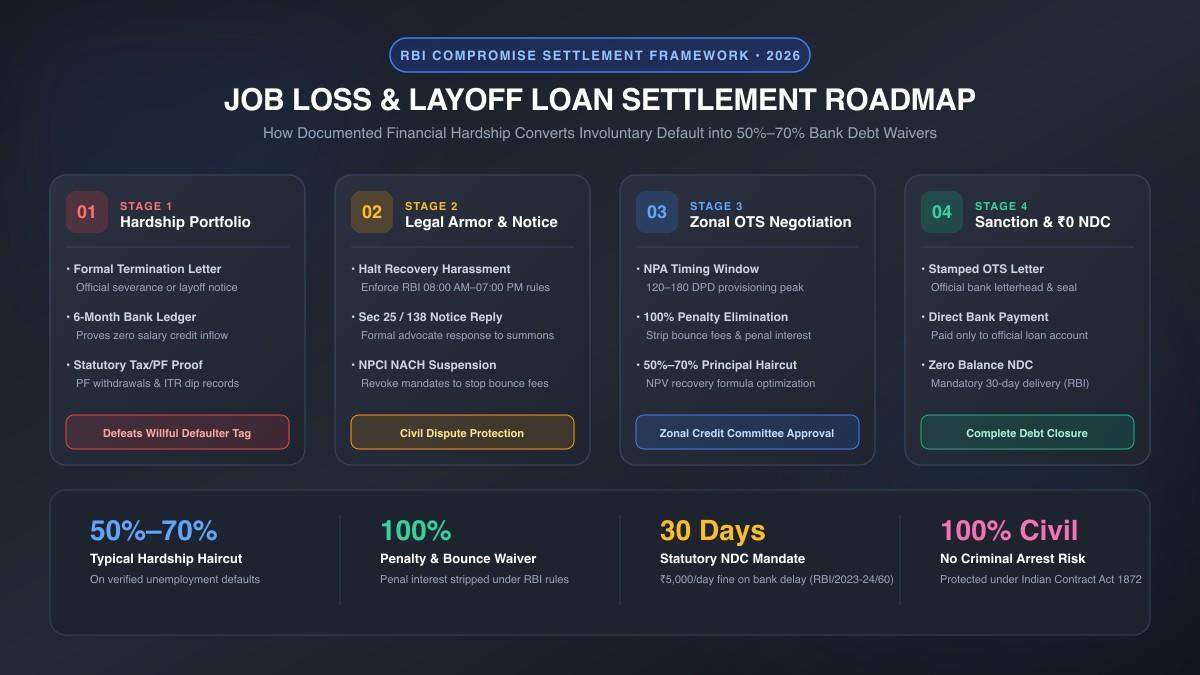
Visual Resolution Blueprint: Job Loss Default to ₹0 NDC
The comprehensive infographic below illustrates the 4-stage institutional lifecycle of settling defaulted retail loans following involuntary unemployment. It details how an evidentiary hardship dossier transforms unserviceable debt into an authorized 50% to 70% compromise waiver under Reserve Bank of India frameworks.
Stopping Recovery Agent Harassment
The most traumatic consequence of defaulting after job loss is the aggressive onslaught of third-party recovery agencies. Lenders frequently outsource delinquent accounts to external collection agencies operating on aggressive commission structures (earning 10% to 20% of recovered cash). These agents routinely resort to unlawful tactics: non-stop phone calls from multiple virtual numbers, threatening former colleagues or HR managers, contacting non-guarantor family members, and making unannounced visits to residential premises.
Such coercive practices constitute a direct violation of the RBI Master Directions on Recovery Agents (2022) and the statutory Fair Practices Code. Under binding regulatory circulars issued to all commercial banks and NBFCs, borrowers enjoy concrete statutory rights:
- Strict Calling Hours: Recovery agents are legally prohibited from calling borrowers before 08:00 AM or after 07:00 PM. Any notice outside this statutory window is illegal.
- Zero Contact with Third Parties: Reaching out to employers, former colleagues, HR personnel, friends, or non-guarantor family members is explicitly forbidden under RBI privacy mandates.
- Prohibition of Workplace Visits: Agents cannot show up at a borrower's former office or present workplace unless explicitly authorized in writing by the borrower.
- Mandatory Identification: Any field agent visiting a residential address must possess an official identity card, a valid Indian Institute of Banking & Finance (IIBF) DRA certificate, and a stamped bank authorization letter.
- Prohibition of Threatening Language: Intimidation, verbal abuse, public humiliation, and false threats of police arrest or asset seizure constitute punishable offenses under Indian criminal law.
Enforcement Protocol for Harassment Violations
When recovery agents violate these statutory norms, legal counsel issues a formal Legal Cease-and-Desist Notice to the bank's Managing Director and Principal Nodal Officer (PNO). If the lender fails to halt collection harassment within 30 days, a formal regulatory complaint is lodged on the RBI Integrated Ombudsman portal (cms.rbi.org.in). Under RBI guidelines, lending institutions face severe financial penalties and regulatory sanctions for third-party agency misconduct.
Defending Notices: Section 25 PSSA & Section 138 NI Act
When salary credits cease, automated electronic National Automated Clearing House (e-NACH) mandates and post-dated cheques inevitably bounce due to insufficient funds. Lenders use these payment failures to issue statutory legal notices under Section 25 of the Payment and Settlement Systems Act (PSSA), 2007 or Section 138 of the Negotiable Instruments (NI) Act, 1881.
Receiving a statutory 15-day or 30-day legal notice generates immense psychological anxiety, but borrowers must understand that a legal notice is simply a formal demand for payment, not an arrest warrant or court decree. Both Section 25 PSSA and Section 138 NI Act represent quasi-criminal, bailable, and compoundable statutory provisions designed to enforce debt recovery rather than punish genuine insolvency.
To build an unassailable legal defense, legal counsel drafts a comprehensive formal reply within the statutory notice period establishing the following core legal pillars:
- Establishment of Bona Fide Hardship: Attaching the complete Hardship Portfolio (termination letter, severance slip, zero-inflow statements) to establish that mandate failure arose from genuine involuntary insolvency rather than fraudulent intent.
- Challenging Predatory Penalty Inflation: Demanding an immediate forensic audit of the loan ledger to strip out unlawful bounce penalties debited by multiple repeated electronic mandate presentations without consent.
- Revocation of Electronic Mandates: Submitting a formal mandate cancellation under National Payments Corporation of India (NPCI) procedural guidelines to legally halt continuous debit return fees.
- Formal Offer for Conciliation & OTS: Expressing continuous willingness to resolve the civil dispute through compromise settlement or National Lok Adalat conciliation benches under the Legal Services Authorities Act, 1987.
By responding formally through an advocate, the borrower prevents the lender from obtaining an uncontested ex-parte court order and firmly directs the dispute into structured compromise settlement talks.
The 5-Step Unemployment Loan Settlement Protocol
Executing a legally secure, heavily discounted loan settlement requires bypassing frontline branch tele-callers and negotiating directly with authorized bank decision-makers. The following five-stage roadmap governs professional debt settlement:
1Comprehensive Delinquency & Ledger Audit
Obtain the complete Statement of Account (SOA) from the lender. Reconcile all historical EMI payments, isolate the core unamortized principal balance, and demand 100% elimination of all accumulated late fees, cheque bounce surcharges, and penal interest compounded post-default.
2Submission of Formal Hardship Petition
Submit a formal, advocate-drafted OTS Hardship Petition directly to the bank's Zonal Stressed Assets Recovery Branch (SARB) or Credit Committee. Accompany the petition with the verified Hardship Portfolio, explicitly citing RBI Master Directions on Compromise Settlements.
3Mathematical NPV Haircut talks
Anchor the settlement offer between 30% and 40% of the core principal. Structure the talks using the Net Present Value recovery formula, showing that an immediate lump-sum settlement delivers higher economic recovery than multi-year civil litigation.
4Forensic Sanction Letter Verification
Before releasing a single rupee of settlement funds, conduct a forensic legal audit of the bank's written OTS Sanction Letter. Ensure the letter contains authorized branch seals, explicit waiver clauses, and guaranteed No Dues Certificate delivery timelines.
5Direct Account Disbursal & Stamped ₹0 NDC Mandate
Disburse the agreed settlement sum strictly via traceable banking channels (NEFT/RTGS/Cheque) directly into the specified loan account. Track the mandatory 30-day delivery of the stamped No Dues Certificate and verify zero-balance credit bureau updates under RBI Circular RBI/2023-24/60.
OTS Sanction Letters: 5 Key Clauses & ₹0 NDC Mandate
The greatest risk facing distressed borrowers is fake oral promises made by rogue collection agents. Tele-callers frequently induce borrowers to deposit token amounts like ₹50,000 on a ₹5 Lakh loan. The bank then treats this token as overdue interest rather than a settlement. This leaves the full debt active and compounding.
To guarantee absolute legal closure, borrowers must verify that their OTS Sanction Letter contains five mandatory verification parameters before disbursing settlement consideration:
- Official Corporate Letterhead & Branch Stamp: The letter must be printed on official bank stationery, bearing the physical signature, employee designation, and official seal of an authorized Credit Manager, Assistant General Manager (AGM), or Zonal Recovery Head. Letters sent via plain email text or WhatsApp images are legally invalid.
- Precise Loan Identification: The letter must accurately specify the borrower's full legal name, registered PAN card number, and exact loan account number.
- Unambiguous Settlement Breakdown: The agreed compromise sum and payment due dates must be explicitly stated. Any installment plan must define exact milestone deadlines without ambiguous penal clawback clauses.
- Full Extinguishment of Residual Liabilities: The letter must contain a definitive legal clause confirming that upon receipt of the agreed settlement sum, all residual principal balances, penal charges, and legal expenses stand fully and irrevocably waived, with zero further claims enforceable against the borrower.
- Guaranteed Delivery of Zero-Balance No Dues Certificate: The sanction letter must stipulate that a formal, stamped No Dues Certificate (NDC) and closure statement will be delivered within 30 calendar days of payment.
Comparative Debt Resolution Matrix & Credit Repair
Distressed borrowers often struggle to evaluate whether a One-Time Settlement (OTS) is superior to alternative relief mechanisms such as loan restructuring, emergency moratoriums, or conciliation through National Lok Adalat. The comparative matrix below details the strategic trade-offs of each avenue following employment termination:
| Resolution Avenue | Core Financial Mechanism | Debt Haircut Potential | Legal Enforceability | CIBIL Bureau Reporting Status |
|---|---|---|---|---|
| One-Time Settlement (OTS) | Lump-sum or short-installment compromise closing the loan permanently. | 50% – 70% Principal Haircut + 100% Fee Waiver | Binding Civil Contract & Complete Legal Immunity | Reported as 'Settled' with ₹0 Outstanding Balance |
| National Lok Adalat | Statutory conciliation bench presided over by retired judges and judicial members. | 45% – 65% Debt Haircut | Final Civil Court Decree (Non-Appealable under LSA Act) | Reported as 'Settled through Lok Adalat' (₹0 Balance) |
| Tenure Restructuring | Extending loan tenure (e.g., from 3 to 7 years) to reduce monthly EMI burden. | 0% Haircut (Total interest paid over time increases) | Modified Loan Agreement | Reported as 'Restructured' (Temporary CIBIL Dip) |
| Temporary Moratorium | 3 to 6 months pause on EMI payments during active job hunting. | 0% Haircut (Interest continues to capitalize monthly) | Internal Bank Concession | Standard / Overdue depending on bank approval |
Rebuilding Your CIBIL Score from 'Settled' to 750+ Post-Re-employment
Executing a loan settlement updates your credit bureau status to 'Settled' with an outstanding balance of ₹0. This entry leads to an initial score dip of 75 to 150 points and a 12-month cooling period. However, it permanently ends compounding default marks, quashes legal notices, and eliminates harassment.
Once new employment is secured, borrowers can systematically rehabilitate their credit profile back to prime status (750+) within 18 to 24 months through a disciplined 3-step credit rebuilding roadmap:
- Secured Credit Card Foundation: Open a Fixed Deposit (FD) of ₹30,000 to ₹50,000 with a scheduled commercial bank and obtain an instant secured credit card backed by the deposit (80%–90% credit limit).
- Strict Credit use Discipline: use no more than 20% to 30% of the card limit for regular household expenditures and ensure 100% automated full payment on or before the due date every month.
- Bureau Score Re-indexing: As 12 to 18 months of spotless, on-time repayments are reported to CIBIL, Experian, Equifax, and CRIF, the credit scoring algorithm re-indexes your financial reliability, unlocking prime commercial credit eligibility.

Settle Loan is India's trusted debt relief and loan settlement platform. We help borrowers overcome financial distress by negotiating with banks and NBFCs to legally settle personal loans and credit card debts. With our transparent, performance-based approach, you can achieve debt freedom and regain your financial peace of mind.
COMPUTER
FAQs: Loan Settlement After Job Loss & Layoffs
Is job loss considered a legally valid ground for loan settlement in India?
Yes. Under Reserve Bank of India (RBI) Master Directions on Compromise Settlements, involuntary unemployment, corporate layoffs, and sudden loss of earning capacity are explicitly recognized as genuine, non-wilful hardship grounds. When backed by verified records such as formal termination letters and zero-salary bank statements, credit committees are authorized to sanction deep compromise settlements with 50% to 70% debt haircuts.
What documents are required to compile an unassailable hardship portfolio after job loss?
A robust financial hardship portfolio must contain: (1) Official corporate termination or layoff letter stating the release date; (2) Final severance calculation and full & final settlement (FnF) statement; (3) Last 6 to 12 months of bank account statements establishing the complete cessation of regular salary credits; (4) Proof of PF advance withdrawals or medical expenditures incurred during unemployment; and (5) Income Tax Returns (ITR) showing the sharp decline in annual taxable income.
Can a bank start criminal cases or arrest me if I default on loans due to job loss?
No. Involuntary loan default arising from genuine financial insolvency is strictly a civil dispute governed by the Indian Contract Act, 1872. Police authorities have zero legal jurisdiction to register an FIR, summon you, or make an arrest for unpaid unsecured personal loans. While lenders may issue statutory notices under Section 138 of the Negotiable Instruments Act or Section 25 of the PSSA for dishonoured cheques or NACH mandates, these are compoundable quasi-criminal matters that are routinely resolved through advocate representation and compromise OTS.
What percentage of debt waiver can you negotiate after losing your job?
For unsecured personal loans and credit card debts past 90 to 180 days of delinquency, verified job loss typically yields debt waivers between 50% and 70% of total ledger dues. In all RBI-compliant compromise settlements, 100% of accumulated penal interest, late payment charges, and NACH bounce fees are waived outright before discounting the core principal balance.
How can you stop repeated NACH bounce fees when there is no salary credit in your bank account?
Repeated electronic NACH mandate sweeps can trigger hundreds of rupees in debit return fees from both the lending bank and destination bank. Borrowers can stop this financial drain by: (1) Submitting a written mandate revocation request to their destination bank under NPCI procedural guidelines; (2) Serving a formal hardship notice to the lending institution requesting an immediate freeze on automated electronic clearing; and (3) Demanding complete waiver of all bounce charges during OTS talks under RBI Fair Lending Practices.
How do you handle aggressive recovery agent harassment at home or former office after a layoff?
Under the RBI Master Directions on Recovery Agents (2022), debt collectors are strictly prohibited from contacting borrowers before 08:00 AM or after 07:00 PM, calling former employers or colleagues, visiting workplaces without consent, or using threatening language. Borrowers should document all violations, demand the agent's DRA certificate and bank authorization letter, serve a legal cease-and-desist notice through an advocate, and lodge complaints on the RBI Integrated Ombudsman portal (cms.rbi.org.in).
Should I use my Provident Fund (PF) or severance pay to keep paying monthly EMIs while unemployed?
No. Financial and legal experts strongly advise against burning through essential retirement funds or limited severance packages to service unsecured debt interest. Severance capital should be preserved for basic family survival and medical emergencies. Once re-employment or alternative income stabilizes, remaining funds can be strategically deployed to fund a heavily discounted, lump-sum One-Time Settlement.
What is the optimal timing window to start settlement talks after job loss?
The optimal window for negotiating maximum debt waivers occurs between Day 120 and Day 180 following the first missed EMI (the Substandard NPA phase). At this stage, banks have classified the loan as a Non-Performing Asset and absorbed mandatory balance-sheet provisioning allocations under Ind AS 109, giving Zonal Stressed Assets Committees maximum internal authority to sanction 50% to 70% haircuts.
What must be verified in the bank's OTS Sanction Letter before paying the settlement amount?
Before disbursing any funds, verify five non-negotiable clauses: (1) The letter must be on authentic bank letterhead with an authorized officer's signature and branch stamp; (2) Your exact loan account number and borrower name must match; (3) The agreed settlement figure and payment schedule must be explicitly stated; (4) The letter must affirm that full payment completely extinguishes all residual claims; and (5) It must guarantee issuance of a ₹0 No Dues Certificate within 30 days under RBI Circular RBI/2023-24/60.
How does loan settlement affect my CIBIL score after job loss, and how can I rebuild it?
Settling a defaulted loan updates credit bureaus to 'Settled' with an outstanding balance of ₹0. While this leads to an initial credit score reduction of 75 to 150 points and a temporary 12-month cooling period, it permanently ends default compounding and legal risk. Once new employment is secured, borrowers can rebuild their credit score back to 750+ within 18 to 24 months by using a secured credit card backed by a fixed deposit and maintaining flawless payment discipline.
Official Regulatory References & Statutory Circulars
- Reserve Bank of India (RBI): Master Direction on Compromise Settlements and Technical Write-offs (DOR.STR.REC.20/21.04.048/2023-24)
- RBI Master Circular: Responsible Lending Conduct – Release of Movable / Immovable Property Documents / NDC on Repayment (RBI/2023-24/60)
- RBI Master Direction on Recovery Agents: Fair Practices Code for Scheduled Commercial Banks and NBFCs (2022)
- Reserve Bank - Integrated Ombudsman Scheme, 2021: Online Grievance Redressal for Recovery Harassment & Excessive Penal Charges
- National Legal Services Authority (NALSA): Legal Services Authorities Act, 1987 — National Lok Adalat Settlement Guidelines