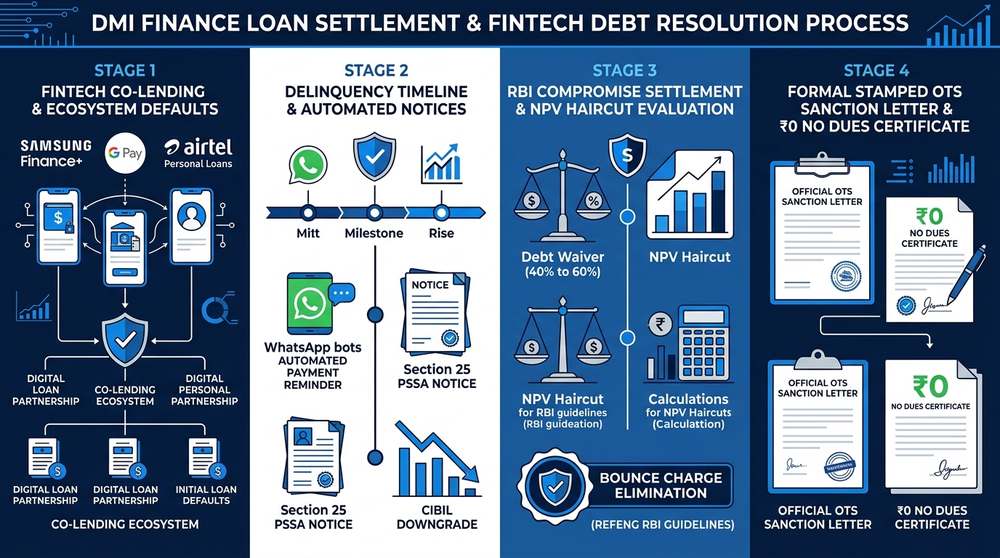
- The Institutional Underwriter: DMI Finance Private Limited is the registered NBFC behind consumer credit disbursed through Samsung Finance+, Google Pay, and Airtel Finance. Resolving these loans requires direct negotiation with DMI Finance's Stressed Assets division.
- Halting Automated Debit Bounces: Revoking e-NACH mandates under NPCI rules eliminates recurring debit failure fees. Formal legal notices demand a 100% waiver of accumulated bounce penalties and penal interest under RBI Fair Lending Practice circulars.
- Realistic 40% to 60% Haircut: When an account transitions into Non-Performing Asset (NPA) status (90+ DPD) or written-off status under Ind AS 109, DMI Finance applies Net Present Value recovery math, sanctioning substantial principal debt waivers.
- Statutory Digital Harassment Shield: Under the RBI Digital Lending Guidelines (2022), collection agencies are strictly barred from accessing borrower contact lists, sending coercive WhatsApp messages, or contacting employers and relatives.
- Mandatory ₹0 NDC Guarantee: Under RBI Circular RBI/2023-24/60, DMI Finance must deliver an official No Dues Certificate and update credit information companies (CIBIL) within 30 days of settlement payment, backed by a ₹5,000 daily delay compensation mandate.
Understanding DMI Finances Digital Balance-Sheet Engine
DMI Finance Private Limited (CIN: U65929DL2008PTC182749) represents one of India's most prominent technology-driven systemically important Non-Banking Financial Companies (NBFC-ND-SI) regulated by the Reserve Bank of India. While retail consumers frequently apply for credit through household digital interfaces—such as Samsung Finance+ device financing kiosks, Google Pay Personal Loans, or Airtel Finance embedded credit—the underlying capital, risk underwriting, regulatory reporting, and legal loan agreements originate directly from DMI Finance.
In modern digital lending ecosystems, customer-facing applications operate as Lending Service Providers (LSPs) or digital distribution conduits under the Reserve Bank of India's Regulatory Framework for Digital Lending (2022). When a borrower accepts loan terms on an app, DMI Finance disburses the principal directly to the borrower's verified bank account or merchant escrow. Consequently, when cash-flow interruptions occur due to job termination, medical emergencies, or micro-enterprise business failure, all legal demand notices, automated WhatsApp reminders, CIBIL default reporting, and recovery assignments are executed by DMI Finance.
Because DMI Finance deploys high-volume algorithmic underwriting with automated risk triggers, defaults are initially processed by computerized collection engines. These automated workflows bombard distressed borrowers with high-frequency IVR calls, AI-driven WhatsApp warnings, and aggressive electronic mandate presentations. However, under Indian jurisprudence, an unsecured consumer loan default is purely a civil contractual dispute governed by the Indian Contract Act, 1872. Distressed borrowers possess statutory rights under Reserve Bank of India compromise settlement regulations to halt collection abuse, eliminate predatory penalty charges, and negotiate an enforceable One-Time Settlement (OTS).
DMI Finance Delinquency Lifecycle: From Days Past Due (DPD) to Non-Performing Asset (NPA)
Navigating an effective settlement with DMI Finance requires understanding how the NBFC classifies delinquency under the RBI Prudential Framework for Asset Classification. The resolution dynamic shifts dramatically across distinct delinquency buckets:
During the initial 60 days following a missed EMI, automated digital communication dominates. DMI Finance initiates daily auto-dialer calls, AI bot WhatsApp reminders, and multiple e-NACH presentation attempts. Accounts in this bucket are handled by early-stage tele-calling vendors whose sole mandate is collecting regular installments with full penal interest and bounce charges. OTS discounts are not sanctioned at this operational stage.
As delinquency reaches 61 to 90 days, DMI Finance issues pre-legal demand notices via email and registered post. For Samsung Finance+ loans, automated Knox Guard system warnings appear on the mobile device interface, restricting non-essential phone features. Third-party Debt Recovery Agencies (DRAs) are assigned to the file, and field visits may be scheduled.
Upon crossing the 90-day threshold without payment, the account is classified as a Non-Performing Asset (NPA) under RBI guidelines. Under Indian Accounting Standards (Ind AS 109), DMI Finance must create mandatory Expected Credit Loss (ECL) balance-sheet provisions. The account transfers from collection vendors to DMI Finance's internal Stressed Asset Desk, opening the window for meaningful One-Time Settlement (OTS) negotiations with 40% to 60% debt haircuts.
Accounts overdue beyond 180 to 365 days are technically written off for accounting purposes, carrying 100% provision coverage. DMI Finance frequently issues formal legal notices under Section 25 of the Payment and Settlement Systems Act, 2007 (PSSA) or initiates online conciliation. At this juncture, the lender prioritizes immediate capital recovery over litigation, enabling maximum principal waivers during structured advocate-led negotiations.
Check Your Loan Settlement Options
Answer 2 quick questions to evaluate your settlement eligibility.
1. What type of loan do you want to settle?
Stopping Recurring e-NACH Bounce Charges & Predatory Penalty Accumulation
One of the most damaging financial traps for defaulting borrowers is the compounding spiral of electronic National Automated Clearing House (e-NACH) return charges. When an EMI mandate fails, DMI Finance levies internal bounce penalties of ₹500 plus GST, while the borrower's home savings bank simultaneously debits an inward return fee of ₹300 to ₹500 plus GST. When DMI Finance's automated treasury systems re-present the mandate 2 to 4 times within a single billing cycle, the borrower loses ₹2,000 to ₹4,000 per month purely in banking friction.
Distressed borrowers can dismantle this compounding penalty cycle through decisive statutory actions:
- Mandate Revocation Under NPCI Rules: Under National Payments Corporation of India (NPCI) procedural guidelines and RBI regulations, every account holder has an unconditional right to revoke, cancel, or suspend any standing NACH/e-Mandate directly through their destination bank's internet banking portal or by submitting a physical cancellation request at the home branch.
- Statutory Notice to Halt Presentations: Serving a formal legal representation to DMI Finance's collections desk putting the lender on notice regarding your insolvency or severe financial distress, demanding an immediate freeze on automated mandate presentations during compromise discussions.
- Enforcing RBI Fair Lending Practice Circular (2023): Under the Reserve Bank of India's Circular on Fair Lending Practice - Penal Charges in Loan Accounts, regulated entities are prohibited from capitalizing penal charges or charging compound interest on overdue fees. During OTS negotiations, legal counsel demands a 100% complete waiver of all accumulated bounce penalties and penal interest.
DMI Finance Compromise Settlement Policies & Net Present Value (NPV) Recovery Math
Compromise settlements in non-banking financial institutions are strictly evaluated through economic risk algorithms rather than emotional sympathy. Under the Reserve Bank of India's Master Direction on Compromise Settlements and Technical Write-offs (June 2023), regulated lenders are authorized to sanction substantial debt waivers to resolve non-performing retail portfolios where continued recovery efforts yield negative returns.
DMI Finance's Stressed Asset Committee evaluates settlement proposals using a mathematical Net Present Value (NPV) recovery benchmark. If prolonged legal recovery over 3 to 5 years incurs high advocate retainers, court filing expenses, recovery agency commissions, and balance-sheet capital locking, an upfront cash settlement yields higher economic value for the institution.
Where C_t represents estimated future recoveries across time period t, r is the NBFC cost-of-capital discount rate, and deductions account for 3–5 years of court friction, third-party recovery commissions, and capital locked under RBI ECL provisioning rules.
The achievable settlement percentage (debt haircut) is dictated by delinquency aging, loan type, and documentation quality. The comparative matrix below outlines typical OTS benchmarks across DMI Finance facilities:
| DMI Finance Credit Facility | Delinquency Aging | Penal Fee Waiver | Principal Haircut Range | Target Settlement Offer |
|---|---|---|---|---|
| Google Pay Personal Loan (Unsecured) | 90 – 180 Days (NPA) | 100% Full Waiver | 35% – 50% Principal Waiver | Offer 50%–60% of Principal |
| Google Pay Personal Loan (Unsecured) | 180+ Days (Written Off) | 100% All Penal Charges | 50% – 65% Principal Waiver | Offer 35%–45% of Principal |
| Samsung Finance+ Device Loan | 90 – 180 Days (NPA) | 100% Full Waiver | 30% – 45% Principal Waiver | Offer 55%–65% + Device Unlock |
| Samsung Finance+ Device Loan | 180+ Days (Written Off) | 100% All Penal Charges | 45% – 60% Principal Waiver | Offer 40%–50% + Knox Release |
| Airtel Finance / Digital Line of Credit | 90 – 180 Days (NPA) | 100% Full Waiver | 40% – 50% Principal Waiver | Offer 50%–55% of Outstanding |
| Airtel Finance / Digital Line of Credit | 180+ Days (Written Off) | 100% All Penal Charges | 55% – 70% Principal Waiver | Offer 30%–40% of Outstanding |
DMI Finance Loan Settlement & Legal Defense Blueprint
Defending Against Aggressive Recovery Tactics Under RBI Digital Lending Directives
To manage millions of micro-loans, DMI Finance contracts third-party Debt Recovery Agencies (DRAs) and deploys automated communications. In many default scenarios, external collection agents overstep statutory boundaries by using unauthorized WhatsApp threats, making high-velocity phone calls outside prescribed hours, attempting to access phone contact lists, or contacting references and family members who have no legal obligation as guarantors.
The Reserve Bank of India's Guidelines on Digital Lending (2022) and Master Directions on Outsourcing of Financial Services establish unequivocal borrower protections:
- Strict Permitted Calling Hours: Recovery agents and automated dialers are legally restricted to contacting borrowers only between 08:00 AM and 07:00 PM. Calls before 8:00 AM or after 7:00 PM constitute regulatory violations.
- Prohibition on Contact Harvesting & Shaming: Digital lenders and collection agents are strictly barred from accessing borrower contact lists, social media profiles, photo galleries, or contacting non-guarantor family members, friends, or employers.
- Mandatory Agent Certification: Field recovery agents must carry official DMI Finance authorization identity cards and have completed Indian Institute of Banking & Finance (IIBF) Debt Recovery Agent certification.
- Protection Against Verbal Intimidation: Using profane language, creating public scenes at residential or workplace locations, or threatening false police actions is punishable under civil and criminal law.
When collection agencies violate these statutory standards, borrowers should systematically record phone conversations, archive WhatsApp chat logs, and serve a formal legal cease-and-desist notice to DMI Finance's Principal Nodal Officer (PNO). Escalating unaddressed harassment to the RBI Integrated Ombudsman (CMS portal) triggers immediate regulatory inquiry, halting third-party aggression and compelling the NBFC to engage in formal compromise discussions.
Step-by-Step Guide: How to Negotiate a Legally Binding Settlement with DMI Finance
Executing a legally secure, cost-effective One-Time Settlement with DMI Finance requires a disciplined, evidence-backed strategy:
1Documenting Genuine Financial Hardship
Compile comprehensive documentary proof demonstrating bona fide, non-wilful financial incapacity. Essential records include salary slips showing pay cuts or termination letters, medical treatment discharge summaries, GST returns showing business revenue declines, or bank statements evidencing depleted liquidity. This establishes non-wilful default status under RBI guidelines.
2Revoking e-NACH Mandates & Directing Formal Communication
Instruct your bank to suspend or cancel the active e-NACH mandate to halt recurring debit bounce fees. Serve a formal written communication to DMI Finance directing that all future correspondence be conducted exclusively via registered email or through designated legal counsel, establishing a verifiable audit trail.
3Submitting a Formal OTS Hardship Petition
Bypass third-party recovery tele-callers who lack financial delegation powers. Submit a formal settlement proposal directly to DMI Finance's Stressed Asset Management division and Principal Nodal Officer, proposing a realistic settlement figure (typically 35% to 50% of the core principal outstanding) backed by the hardship dossier.
4Negotiating the Haircut & Demanding 100% Penalty Waiver
Conduct structured negotiations with DMI Finance credit officers. Insist on a complete 100% waiver of all accumulated bounce charges, late payment fees, and penal interest under the RBI Fair Lending Practice framework, arriving at an agreed, discounted lump-sum or structured 2-to-3 installment settlement.
5Forensic Verification of the Official OTS Sanction Letter
Prior to transferring any settlement funds, conduct a forensic check on the OTS Sanction Letter. Ensure it is issued on official DMI Finance Private Limited corporate letterhead, citing your correct loan account number, exact settlement amount, payment due dates, and explicit covenants confirming complete liability extinguishment, withdrawal of legal notices, and Knox device release (for Samsung Finance+).
6Direct Account Remittance & Enforcing ₹0 NDC Delivery
Remit the agreed settlement funds directly into your designated DMI Finance loan account via NEFT/RTGS or official DMI payment portal. Under RBI Circular RBI/2023-24/60, DMI Finance must deliver the formal No Dues Certificate and update credit bureaus within 30 calendar days.
Navigating Section 25 PSSA Notices, Online Arbitration & National Lok Adalat
As unsecured fintech loan defaults cross 60 to 90 days, DMI Finance routinely initiates statutory legal steps. Understanding the precise legal mechanics prevents panic and empowers borrowers to utilize legal notices as strategic gateways to compromise settlements:
Section 25 PSSA Demand Notices: When an e-NACH mandate returns unpaid, DMI Finance's legal empanelled advocates issue a statutory 15-day demand notice under Section 25 of the Payment and Settlement Systems Act, 2007 (PSSA). This notice is analogous to a Section 138 Negotiable Instruments Act notice for cheque dishonour. It is not an immediate summons or arrest warrant. Serving a timely, well-reasoned legal reply through counsel detailing genuine hardship and challenging unauthorized multiple presentations protects the borrower and opens formal conciliation.
Unilateral Online Arbitration & ODR Platforms: Fintech lenders frequently trigger private Online Dispute Resolution (ODR) or sole arbitrator proceedings based out of New Delhi. Under binding Supreme Court precedents (Perkins Eastman Architects DVM v. HSCC (India) Ltd. and TRF Ltd. v. Energo Engineering Projects Ltd.), unilateral arbitrator appointments made by lenders without mutual written consent are legally invalid. Legal counsel can challenge the arbitrator's jurisdiction under Section 12 and 14 of the Arbitration and Conciliation Act, 1996, effectively halting biased ex-parte awards.
National Lok Adalat Settlement: DMI Finance regularly participates in quarterly National Lok Adalats organized by District Legal Services Authorities (DLSA) under the Legal Services Authorities Act, 1987. In Lok Adalat sessions, sitting judicial officers facilitate compromise settlements with pre-approved NBFC discounts (typically 45% to 60%). The resulting Lok Adalat Award carries the statutory weight of a non-appealable Civil Court Decree, permanently closing all legal disputes.
| Resolution Mechanism | Statutory Framework | Haircut Potential | Resolution Timeframe | Enforceability & Finality |
|---|---|---|---|---|
| Direct NBFC OTS Petition | RBI Master Direction on Compromise Settlements (2023) | 40% – 60% Debt Haircut | 15 to 30 Days | Binding private contract with ₹0 NDC. |
| National Lok Adalat | Legal Services Authorities Act, 1987 (NALSA) | 45% – 60% Debt Haircut | Single Session | Civil Court Decree (Non-appealable finality). |
| Arbitration Challenge & Defense | Arbitration & Conciliation Act, 1996 (Sec 12/14/34) | Converts to OTS | 2 to 6 Months | Halts unilateral ex-parte awards. |
| Section 25 PSSA Legal Defense | Payment and Settlement Systems Act, 2007 | 35% – 50% Debt Haircut | 1 to 3 Months | Formal compounding and case dismissal. |
Authenticating DMI Finance Settlement Letters & Enforcing the ₹0 NDC Mandate
A grave hazard in digital lending recovery involves unauthorized tele-callers or third-party collection agents issuing fraudulent or verbal settlement promises to secure partial collections. If a borrower deposits money without an authentic stamped sanction letter, DMI Finance's core banking system automatically applies the funds toward outstanding penal interest and overdue bounce charges, leaving the principal balance active, compounding, and in default.
Before remitting any settlement sum, verify that the OTS sanction letter satisfies rigorous legal criteria:
- Official Corporate Letterhead: The letter must be generated on official DMI Finance Private Limited letterhead bearing its Corporate Identification Number (CIN: U65929DL2008PTC182749) and registered office address: Express Building, 9-10, Bahadur Shah Zafar Marg, New Delhi 110002.
- Precise Facility & Amount Identification: The sanction document must explicitly mention the borrower's full name, registered mobile number, unique loan account number, total outstanding ledger balance, sanctioned compromise amount, and exact payment deadline.
- Discharge & Legal Withdrawal Covenants: The document must unambiguously state that payment of the agreed settlement sum constitutes full and final satisfaction of all claims, extinguishing all remaining debt, revoking security mandates, and mandating the withdrawal of any pending legal or Section 25 notices.
- Direct Bank Remittance Only: Payments must be made exclusively to the official DMI Finance loan account through authorized banking channels (NEFT/RTGS/IMPS) or the official DMI customer portal. Never transfer funds to personal UPI IDs or collection agency accounts.
Under Reserve Bank of India Circular RBI/2023-24/60, DMI Finance is statutorily required to issue a formal No Dues Certificate (NDC) and update credit bureau records within 30 calendar days of settlement receipt. Any failure to deliver the closure certificate within this statutory window entitles the borrower to mandatory compensation of ₹5,000 per day of delay directly from the lender.
CIBIL Score Trajectory Post-Settlement & Strategic 18-Month Recovery Plan
Following the execution of an OTS, DMI Finance reports the updated account status to all four authorized credit bureaus in India—TransUnion CIBIL, Experian, Equifax, and CRIF High Mark. The loan status transitions from active 'Default' or 'Written-Off' to 'Settled' or 'Post-Write-Off Settled', with the outstanding ledger balance reduced to exactly ₹0.
A settlement record results in an immediate initial credit score adjustment of 75 to 120 points, and RBI compromise guidelines stipulate a 12-month cooling-off window before fresh unsecured credit lines can be approved. However, a 'Settled' status with ₹0 balance is vastly superior to an unresolved 'Default' status that degrades your score every 30 days and invites ongoing litigation.
Borrowers can systematically restore their credit profile to 750+ within 18 to 24 months through a disciplined rehabilitation strategy:
Avail a fixed-deposit-backed credit card (e.g., ₹25,000 to ₹50,000 FD). Use it for routine utility payments and ensure 100% on-time full repayment every billing cycle.
Keep credit utilization strictly below 20% to 25% of the secured credit limit. Avoid exhausting the credit line, signaling responsible credit management to scoring algorithms.
Review your CIBIL report 45 days post-settlement. Verify that the outstanding balance shows ₹0. If errors persist, file an online CIBIL dispute attaching your ₹0 NDC.
Why Distressed DMI Finance Borrowers Trust SettleLoans
Navigating a high-stakes loan settlement with a major digital underwriter like DMI Finance requires deep financial knowledge, algorithmic insight, and seasoned legal advocacy. SettleLoans stops aggressive recovery tele-calling through immediate cease-and-desist notices, defends against Section 25 PSSA summons and digital arbitration notices, and negotiates directly with DMI Finance's Stressed Asset Desks to achieve maximum debt haircuts and authentic ₹0 No Dues Certificates.

Settle Loan is India's trusted debt relief and loan settlement platform. We help borrowers overcome financial distress by negotiating with banks and NBFCs to legally settle personal loans and credit card debts. With our transparent, performance-based approach, you can achieve debt freedom and regain your financial peace of mind.
COMPUTER
Frequently Asked Questions About DMI Finance Loan Settlement
What is DMI Finance and why are they contacting me for Samsung Finance, Google Pay, or Airtel loans?
DMI Finance Private Limited is a major systemically important Non-Banking Financial Company (NBFC) registered with the Reserve Bank of India. It functions as the primary balance-sheet lending partner and institutional underwriter behind major digital distribution platforms including Samsung Finance+, Google Pay Personal Loans, Airtel Finance, and various retail fintech applications. When you borrow through these consumer platforms, DMI Finance is the actual regulated creditor holding your debt, presenting NACH mandates, reporting to credit bureaus (CIBIL), and managing default resolution.
How does the DMI Finance loan settlement process work under RBI guidelines?
The DMI Finance loan settlement process is an institutional debt compromise mechanism governed by the RBI Master Direction on Compromise Settlements and Technical Write-offs. When an unsecured personal or digital consumer loan crosses 90 days past due (NPA classification), the borrower or their legal representative submits a formal hardship petition demonstrating genuine financial incapacity. DMI Finance's Stressed Asset Committee evaluates the proposal against recovery Net Present Value (NPV), waives accumulated bounce penalties and penal interest, and issues an official stamped OTS Sanction Letter with a discounted closure figure.
How can I stop automated WhatsApp notices, high-frequency bot calls, and agent harassment from DMI Finance?
Borrowers are protected by the RBI Digital Lending Guidelines (2022) and NBFC Fair Practices Code. You can halt aggressive recovery by: (1) Serving a formal legal representation to DMI Finance's Principal Nodal Officer directing all communication exclusively to formal email or legal counsel; (2) Demanding that recovery agents adhere strictly to permitted calling hours (08:00 AM to 07:00 PM); (3) Prohibiting any contact with non-guarantor family members, employers, or phonebook contacts; and (4) Filing an immediate complaint on the RBI Integrated Ombudsman portal (CMS) if harassment persists.
Can DMI Finance remotely lock my Samsung phone if I default on a Samsung Finance+ loan?
Samsung Finance+ utilizes Knox Guard firmware integration that allows automated device locking upon consecutive EMI defaults as stipulated in the initial digital loan agreement. However, once an account enters structured settlement negotiations or an OTS proposal is submitted, legal counsel can negotiate the unlock protocol alongside the debt compromise. Upon remitting the agreed OTS amount, DMI Finance transmits an automated release signal to the Knox server, permanently unlocking the device and terminating administrative restrictions.
What percentage of debt waiver or haircut can you realistically negotiate with DMI Finance?
On unsecured personal loans (Google Pay, Airtel, direct retail lines) and consumer durable facilities, DMI Finance typically sanctions debt haircuts ranging between 40% and 60% of total ledger balance. For accounts categorized under Doubtful or Loss Asset buckets (overdue beyond 180 to 365 days with 100% ECL balance-sheet provisioning), principal waivers can reach 50% to 60%, alongside a mandatory 100% cancellation of all penal interest, late fees, and NACH bounce penalties.
How do I stop DMI Finance from repeatedly presenting e-NACH mandates and charging bounce fees?
Under National Payments Corporation of India (NPCI) procedural guidelines, borrowers hold an absolute legal right to revoke or suspend electronic NACH/e-Mandates through their home bank's net banking portal or by submitting a written mandate cancellation form. Concurrently, a formal written notice must be served to DMI Finance's collections desk demanding an immediate suspension of electronic sweeps during active settlement discussions. In the final OTS, 100% of accrued bounce charges must be waived under RBI Fair Lending Directions.
What is a Section 25 PSSA notice from DMI Finance advocates and what should I do?
A Section 25 notice under the Payment and Settlement Systems Act, 2007 (PSSA) is a statutory 15-day demand notice issued following an e-NACH mandate dishonour due to insufficient funds. It is not an arrest warrant or court judgment. You should engage banking legal counsel to draft a comprehensive reply within 15 days, explaining bona fide financial hardship, challenging unauthorized multiple mandate debit sweeps, and formalizing a proposal for an amicable One-Time Settlement.
Can DMI Finance initiate unilateral online arbitration or file criminal police cases?
No. Genuine loan default is strictly a civil dispute under the Indian Contract Act, 1872, and police authorities have no legal jurisdiction to register FIRs or make arrests for unpaid unsecured debt. Furthermore, unilateral sole arbitrator appointments initiated through private Online Dispute Resolution (ODR) platforms without mutual consent violate Supreme Court precedents (Perkins Eastman and TRF Limited rulings) and can be legally challenged and halted under Section 12 and 14 of the Arbitration Act.
How do I verify the authenticity of a DMI Finance OTS Sanction Letter?
An authentic DMI Finance settlement letter must be issued on official DMI Finance Private Limited corporate letterhead containing its Corporate Identification Number (CIN: U65929DL2008PTC182749), registered office address in New Delhi, unique loan agreement number, borrower name, agreed settlement amount, strict payment timeline, authorized signatory signature, and clear covenants confirming complete liability discharge and withdrawal of all legal actions upon payment.
How long does DMI Finance take to issue the No Dues Certificate (NDC) and update CIBIL after settlement?
Under RBI Circular RBI/2023-24/60 on the release of movable/immovable assets and loan closure documents, DMI Finance is statutorily mandated to issue a formal No Dues Certificate (NDC) and update credit information companies (CIBIL, Experian, Equifax, CRIF High Mark) within 30 calendar days of receiving full settlement payment. If DMI Finance fails to deliver the NDC within 30 days without lawful justification, it is liable to pay statutory compensation of ₹5,000 per day of delay directly to the borrower.
Official Regulatory References & Statutory Circulars
- Reserve Bank of India (RBI): Master Direction on Compromise Settlements and Technical Write-offs (DOR.STR.REC.20/21.04.048/2023-24)
- RBI Digital Lending Guidelines: Regulatory Framework for Digital Lending and Lending Service Providers (DOR.CRE.REC.66/21.07.001/2022-23)
- DMI Finance Private Limited: Fair Practices Code, Customer Grievance Redressal Policy & Principal Nodal Officer Matrix
- Reserve Bank - Integrated Ombudsman Scheme (2021): Official CMS Portal for Online Complaints Against NBFC Harassment & Excessive Penalties
- National Legal Services Authority (NALSA): Legal Services Authorities Act, 1987 — National Lok Adalat Dispute Settlement Framework