- Civil Contract Protection: Defaulting on an unsecured business loan from FlexiLoans (Epimoney Private Limited) is strictly a civil contractual breach governed by the Indian Contract Act, 1872. Police cannot register an FIR, arrest store owners, or seal commercial premises for loan default.
- NACH Return Shield: Recurring electronic debit attempts can be halted by instructing your destination bank to revoke e-mandates under NPCI guidelines. Legal representation demands a 100% waiver of accumulated bounce charges under RBI fair lending practice rules.
- Substantive 40%–60% Haircut: When retail business cash flows collapse and accounts cross 90 days past due into Non-Performing Asset (NPA) status, FlexiLoans evaluates recovery under Net Present Value (NPV) criteria, sanctioning substantial principal waivers.
- Section 25 PSSA & Arbitration Defense: Demand notices under Section 25 of the Payment and Settlement Systems Act and unilateral sole arbitration notices in Mumbai can be contested and redirected into mutual compromise conciliation.
- Enforceable Zero-Balance NDC: Under Reserve Bank of India Circular RBI/2023-24/60, FlexiLoans must issue a formal No Dues Certificate and update credit bureaus within 30 calendar days of settlement remittance, subject to a statutory ₹5,000 daily penalty for non-compliance.
Understanding FlexiLoans Underwriting & Merchant Default Mechanics
FlexiLoans operates through Epimoney Private Limited, an RBI-regulated non-banking financial company, alongside institutional co-lending partners. The platform provides collateral-free working capital, merchant cash advances, POS term facilities, and distributor financing to retail store owners, kirana proprietors, and commercial distributors.
Instead of requiring physical collateral or audited balance sheets, underwriting relies on algorithmic scoring of GST filings, POS terminal swipes, UPI cash flow velocity, and current account statements. While enabling rapid disbursement, this automated credit model creates acute financial vulnerability when retail revenues fluctuate.
When sales dip or supplier receivables get delayed, automated electronic NACH presentations fail repeatedly. Rather than accommodating business distress, automated systems levy compounding bounce penalties and penal interest of 24% to 36% annually. Defaulting on an unsecured business loan remains strictly a civil contractual matter under the Indian Contract Act, 1872, entitling merchants to statutory debt compromise protections under RBI regulations.
FlexiLoans Delinquency Timeline: DPD Stages to Non-Performing Asset
Defaulted FlexiLoans facilities follow the RBI Prudential Norms on Asset Classification and Ind AS 109 Expected Credit Loss frameworks. Lenders group overdue accounts into Days Past Due (DPD) aging buckets, which directly determine settlement haircut thresholds.
During SMA-0 (1–30 DPD), automated reminder bots and IVR calls dominate. In SMA-1 (31–60 DPD) and SMA-2 (61–90 DPD), files shift to external tele-collection agencies, accompanied by loan acceleration and statutory pre-litigation notices.
| Delinquency Stage | Overdue Days (DPD) | FlexiLoans Collection Behavior | Legal & Judicial Exposure | Settlement Haircut Potential |
|---|---|---|---|---|
| SMA-0 (Early Delinquency) | 1 – 30 Days | Automated reminder bots, daily IVR calling, recurring NACH clearing presentations. | No formal litigation; initial DPD reported to TransUnion CIBIL and Experian. | Negligible (Lender demands immediate clearance of full overdue EMI). |
| SMA-1 (Mid Delinquency) | 31 – 60 Days | Outsourced call center assignment, aggressive daily tele-calling, loan acceleration warnings. | Pre-litigation demand notices; credit scores decline significantly. | Low (Tenure extension or temporary penal interest freeze considered). |
| SMA-2 (Pre-NPA Escalation) | 61 – 90 Days | Field visits by outsourced agency agents, loan recall demand notices issued. | Section 25 PSSA statutory legal demand notices issued for bounced NACH. | Moderate (Discussions for penal fee waivers can commence). |
| NPA (Substandard Asset) | 91 – 180 Days | Transferred to Stressed Assets Desk; mandatory balance-sheet provisioning under Ind AS 109. | Magistrate court summons under Section 25 PSSA; conciliation summons. | High (35%–50% Haircut achievable). |
| Doubtful / Loss Asset | 181 – 365+ Days | Heavy balance-sheet provisioning absorbed; internal technical write-off evaluation. | Unilateral private arbitration notices; Lok Adalat referral notices. | Maximum (50%–65% Haircut achievable). |
Past 90 days, the loan transitions into Non-Performing Asset (NPA) status, requiring Epimoney to freeze interest recognition and allocate mandatory balance-sheet capital provisions. Once an account exceeds 180 DPD into Doubtful Asset or technical write-off status, an upfront cash settlement provides an immediate accounting write-back to operational profits, enabling credit committees to sanction 40% to 60% principal haircuts.
Check Your Loan Settlement Options
Answer 2 quick questions to evaluate your settlement eligibility.
1. What type of loan do you want to settle?
Halting Repeated FlexiLoans NACH Bounce Charges & Penalties
FlexiLoans automated clearing systems frequently present electronic mandates multiple times per billing cycle. Each failed auto-debit triggers bank return charges of ₹295 to ₹590, while the lender adds internal dishonour penalties of ₹500 to ₹1,000 plus 24%–36% penal interest, compounding ledger arrears beyond feasible recovery.
Under RBI Fair Lending Practice directives (2023), regulated lenders cannot capitalize penal charges or levy compounded default interest. Furthermore, NPCI procedural rules and RBI consumer guidelines empower account holders to instruct their bank to revoke or cancel active e-NACH mandates, instantly terminating recurring debit penalties.
Mandate cancellation preserves essential operating cash flow. During formal OTS compromise negotiations, legal advocates enforce a 100% waiver of all accrued bounce fees and penal interest, ensuring debt discounts apply strictly to legitimate principal balances.
FlexiLoans OTS Haircut Policies & Recovery Valuation Math
Under the RBI Master Direction on Compromise Settlements (DOR.STR.REC.20/21.04.048/2023-24), NBFCs assess compromise offers using Net Present Value (NPV) recovery calculations. Because FlexiLoans facilities are unsecured without mortgages or inventory hypothecation, SARFAESI asset seizure laws are entirely inapplicable.
Litigation through Order 37 CPC summary suits or arbitration demands 3 to 5 years of court friction, legal retainers, and heavy provisioning. Under financial NPV modeling, an immediate compromise cash payment provides higher economic value to Epimoney than prolonged civil litigation.
Where C_t represents estimated recoveries, r is the discount rate, and deductions account for 3–5 years of court friction and capital locked in NPA provisions.
Realistic FlexiLoans Settlement Haircut Slabs by Product & Aging
| Product Facility Category | Delinquency Aging | Penal & Bounce Waiver | Principal Haircut Range | Target Settlement Offer |
|---|---|---|---|---|
| Merchant Term / Kirana Working Capital Loan | 90 – 180 Days (NPA) | 100% Full Waiver | 30% – 45% Principal Waiver | Offer 45%–55% of Ledger Dues |
| Distributor Unsecured Business Credit Line | 181 – 365 Days (Doubtful) | 100% Full Waiver | 45% – 60% Principal Waiver | Offer 35%–45% of Core Balance |
| POS Swipe / Digital Cash Advance Facility | 180+ Days (Written Off) | 100% All Penal Charges | 50% – 65% Principal Waiver | Offer 30%–40% of Book Balance |
| E-Commerce Seller Unsecured Term Facility | 365+ Days (Loss Asset) | 100% All Penal Charges | 55% – 70% Principal Waiver | Offer 25%–35% of Principal |
FlexiLoans Business Loan Settlement & Legal Action Blueprint
Defending Against Automated Collection Calls & Recovery Tactics
Defaulted accounts trigger automated predictive dialers, AI voice bots, and third-party recovery agencies contacting merchants repeatedly. In unlawful cases, recovery agents contact shop employees, commercial suppliers, or family members whose numbers were obtained during app-based onboarding.
Under the RBI Master Directions on Recovery Agents and NBFC Fair Practices Code: calling before 08:00 AM or after 07:00 PM is strictly prohibited; reaching out to third-party suppliers, staff, or non-guarantor relatives is illegal; and intimidating store staff or threatening premises closure constitutes an actionable offence. Recovery agents must hold IIBF Debt Recovery Agent certifications.
Merchants should log calls, retain message transcripts, and serve a formal legal cease-and-desist notice on Epimoney Principal Nodal Officer. Escalating violations to the RBI Integrated Ombudsman (CMS) stops third-party harassment and transfers the dispute to structured advocate negotiations.
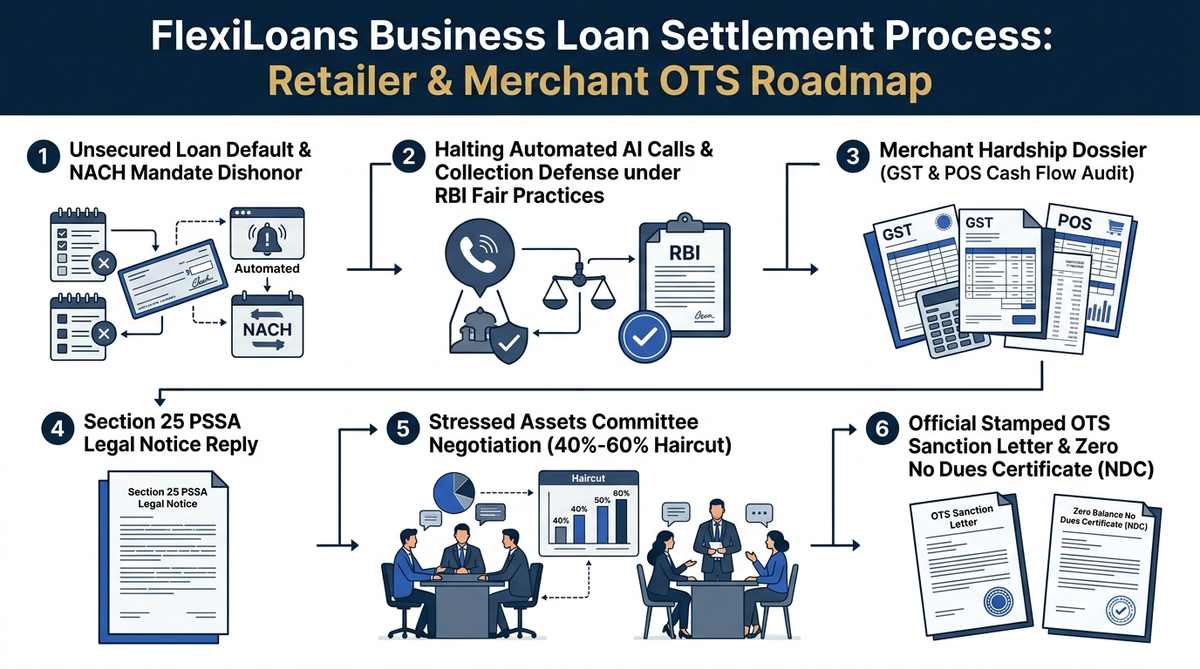
Step-by-Step Merchant Roadmap to Settle a FlexiLoans Default
Navigating an institutional compromise settlement with a technology-driven NBFC like FlexiLoans requires a disciplined, evidence-based strategy designed to engage senior credit committees directly while insulating the merchant from unlawful recovery pressure:
1Merchant Hardship Dossier Compilation & Financial Forensics
Assemble filed GST returns (GSTR-3B and GSTR-1), bank statements showing liquidity depletion, supplier debit notes, and medical records if health issues impacted store operations. This documentation proves the default is non-wilful and qualifies for compromise relief under RBI rules.
2Electronic Mandate Cancellation & Communication Containment
Submit written instructions to your destination bank revoking active e-NACH auto-debit mandates to stop recurring return penalties. Simultaneously issue a formal legal directive requiring FlexiLoans to channel all communications exclusively through registered email or designated legal counsel.
3Drafting & Submitting the Formal Compromise Petition
Legal advocates prepare a structured One-Time Settlement petition addressed directly to Epimoney Stressed Assets Committee, citing commercial distress and RBI compromise directives, with an opening proposal at 25% to 35% of total book dues.
4Navigating Counter-Demands & Structuring Committee Approvals
When the lender counters with token 10%–20% concessions, legal counsel demonstrates third-party family funding limitations and cash constraints, steering credit committee approvals toward the targeted 40% to 60% principal waiver band.
5Forensic Legal Audit of the OTS Sanction Letter
Before releasing funds, advocates verify the official sanction letter issued on Epimoney Private Limited letterhead, confirming exact loan account numbers, settlement amount, payment deadlines, and covenants releasing the borrower from further liabilities.
6Direct Account Remittance & Enforcing Zero Balance NDC Delivery
Remit the agreed sum directly into the designated FlexiLoans account via RTGS/NEFT. Under RBI Circular RBI/2023-24/60, the NBFC must deliver a zero-balance No Dues Certificate and update credit bureaus within 30 calendar days.
Navigating Section 25 PSSA Summons, Arbitration & Lok Adalat
Past 60 to 90 days default, FlexiLoans routinely issues demand notices under Section 25 of the Payment and Settlement Systems Act, 2007 (PSSA) for bounced NACH mandates, Section 138 NI Act notices if security cheques were collected, or notices invoking sole arbitration in Mumbai.
A Section 25 PSSA notice is a 15-day statutory demand, not an arrest warrant. Responding through legal counsel citing genuine commercial downturn, challenging unauthorized repetitive mandate presentations, and proposing compromise conciliation protects the proprietor from ex-parte action.
Regarding unilateral arbitration, Supreme Court rulings (Perkins Eastman Architects DVM v. HSCC and TRF Ltd. v. Energo Engineering) establish that unilateral sole arbitrator appointments without mutual consent are void. Advocates challenge the arbitrator jurisdiction under Section 12 and 14 of the Arbitration Act, halting ex-parte proceedings.
Additionally, FlexiLoans regularly participates in National Lok Adalats organized by District Legal Services Authorities (DLSA). Lok Adalats offer pre-approved settlement mandates with 40% to 60% haircuts, passing awards that hold the non-appealable force of a Civil Court Decree.
| Resolution Avenue | Legal Mechanism | Haircut Potential | Typical Timeline | Judicial Finality |
|---|---|---|---|---|
| Direct NBFC OTS | Mutual compromise agreement under RBI Master Directions. | 40% – 60% Principal Waiver | 15 to 30 Days | Binding private contract with ₹0 NDC. |
| National Lok Adalat | Judicial conciliation before sitting judge and panel. | 45% – 60% Principal Waiver | Single-day session | Civil Court Decree (Zero appeal). |
| Arbitration Defense | Contesting unilateral sole arbitration under Section 12/14. | Variable (Converts to OTS) | 3 to 6 Months | Neutralizes biased ex-parte awards. |
| Section 25 PSSA Defense | Magistrate court compoundable proceedings defense. | 35% – 50% Principal Waiver | 2 to 4 Months | Complete complaint withdrawal & disposal. |
Sanction Letter Verification & Enforcing the Zero Balance NDC
Merchants must avoid unverified settlement promises from collection agents. If funds are remitted against verbal or unverified communications, FlexiLoans credits the money entirely toward accrued penal charges and late fees, leaving the account active and defaulting.
Ensure the settlement is documented through an authentic OTS Sanction Letter on official Epimoney Private Limited letterhead (CIN: U65923MH2008PTC184494), specifying the registered Mumbai corporate office, loan account numbers, sanctioned compromise amount, payment schedule, and authorized signatory credentials.
The letter must confirm that payment discharges all liabilities. Under RBI Circular RBI/2023-24/60, lenders must deliver a formal No Dues Certificate within 30 calendar days of payment clearance, subject to a statutory compensation penalty of ₹5,000 per day of delay payable to the borrower.
CIBIL Score Trajectory Post-Settlement & Credit Rehabilitation
Following settlement payment, FlexiLoans reports the loan to TransUnion CIBIL, Experian, Equifax, and CRIF High Mark as 'Settled' with an outstanding balance of ₹0.
While this brings an initial score reduction of 75 to 130 points and a 12-month cooling-off window for unsecured credit, a 'Settled' record with zero balance permanently terminates ongoing default reporting and civil litigation exposure.
Merchants can restore credit scores to 750+ within 18 to 24 months by using a fixed-deposit-backed credit card, keeping credit utilization below 25%, and maintaining an unblemished on-time payment track record on all operating utilities and commercial expenses.
Why Distressed Retail Merchants Choose SettleLoans Defense
Navigating an unsecured loan settlement with a fast-paced fintech lender like FlexiLoans requires experienced financial auditing and decisive legal advocacy. SettleLoans provides complete end-to-end merchant defense: halting automated IVR and tele-caller harassment through statutory cease-and-desist notices, defending against Section 25 PSSA and arbitration notices, revoking predatory NACH mandates, and negotiating directly with Epimoney Private Limited Credit Committees to secure authorized 40% to 60% debt haircuts and authentic ₹0 No Dues Certificates.

Settle Loan is India's trusted debt relief and loan settlement platform. We help borrowers overcome financial distress by negotiating with banks and NBFCs to legally settle personal loans and credit card debts. With our transparent, performance-based approach, you can achieve debt freedom and regain your financial peace of mind.
COMPUTER
Frequently Asked Questions on FlexiLoans Business Loan Settlement
What is the FlexiLoans business loan settlement process and how does an OTS compromise work?
The FlexiLoans business loan settlement process is a formal compromise mechanism governed by Reserve Bank of India Master Directions on Compromise Settlements. When an unsecured merchant cash advance, POS-linked term loan, or distributor credit facility crosses 90 days past due into Non-Performing Asset (NPA) status, the merchant or their legal counsel submits a commercial hardship dossier to Epimoney Private Limited (FlexiLoans). Upon evaluating business cash flows against the Net Present Value (NPV) of recovery, the lender issues a stamped OTS Sanction Letter. Remitting the negotiated sum directly into the loan account extinguishes all financial liabilities and entitles the borrower to a zero-balance No Dues Certificate.
Can FlexiLoans or its recovery agents arrest a shop owner or seal retail premises for loan default?
No. Defaulting on an unsecured business loan is strictly a civil contractual breach governed by the Indian Contract Act, 1872. Police authorities have zero legal jurisdiction to register an FIR, arrest store owners, or seal commercial premises for genuine financial default. Unsecured business loans do not involve mortgaged real estate or hypothecated physical assets, rendering the SARFAESI Act completely inapplicable. While FlexiLoans may issue notices under Section 25 of the Payment and Settlement Systems Act (PSSA) for bounced NACH mandates, these are bailable, compoundable proceedings that are routinely resolved through advocate representation and compromise settlements.
How can retail store owners stop repeated FlexiLoans NACH bounce charges and debit attempts?
Distressed retailers can stop recurring NACH bounce penalties through a two-step legal procedure: (1) Submit a written mandate revocation or stop-payment instruction to their destination bank under National Payments Corporation of India (NPCI) procedural guidelines and RBI consumer directives, which legally prevents further electronic presentations; (2) Require their legal advocate to enforce a 100% waiver of all accrued bounce penalties, late fees, and penal interest during One-Time Settlement negotiations under RBI fair lending practice circulars.
What percentage of debt waiver or haircut can you realistically negotiate with FlexiLoans?
On unsecured retail and merchant loans, FlexiLoans typically sanctions principal debt waivers between 40% and 60% of total book dues. The achievable haircut depends on loan aging, delinquency classification, and balance-sheet provisioning. Accounts overdue beyond 180 to 365 days (Doubtful or Loss Asset status) qualify for maximum principal haircuts (50% to 65%), accompanied by a complete 100% waiver of all accumulated bounce fees, late charges, and penal interest.
How do you stop aggressive automated AI collection calls and recovery harassment from FlexiLoans?
Under RBI Master Directions on Recovery Agents and the NBFC Fair Practices Code, lenders and their outsourced agencies are strictly prohibited from: calling before 08:00 AM or after 07:00 PM; contacting shop employees, suppliers, customers, or non-guarantor family members; and using intimidating language or making unauthorized premises visits. Distressed merchants should record unauthorized calls, serve a formal legal cease-and-desist notice to Epimoney Private Limited Principal Nodal Officer, and lodge an immediate complaint on the RBI Integrated Ombudsman (CMS) portal.
What is a Section 25 PSSA notice issued by FlexiLoans and how should an advocate respond?
A Section 25 PSSA notice is a statutory 15-day demand notice issued when an automated NACH mandate dishonours due to insufficient funds. It is not an arrest warrant or court summons. Legal counsel drafts a comprehensive reply detailing bona fide commercial hardship, citing retail revenue contraction, challenging unauthorized multiple mandate presentations, and formally proposing a compromise One-Time Settlement directly to the lender.
Can FlexiLoans enforce private arbitration in Mumbai against an outstation merchant?
While FlexiLoans loan agreements often include arbitration clauses specifying Mumbai as the seat of arbitration, landmark Supreme Court rulings (Perkins Eastman Architects DVM v. HSCC and TRF Ltd. v. Energo Engineering) establish that unilateral appointment of a sole arbitrator by a lender without mutual consent is legally void. Legal counsel can challenge the arbitrator jurisdiction under Section 12 and Section 14 of the Arbitration and Conciliation Act, staying ex-parte proceedings and redirecting the dispute toward mutual settlement.
Who within FlexiLoans (Epimoney Private Limited) has the legal authority to approve a loan settlement?
Under Epimoney Private Limited internal Delegation of Financial Powers, third-party tele-callers and agency field personnel possess zero legal authority to sanction debt discounts. Substantive loan haircuts (40% to 60%) must be formally reviewed and approved by FlexiLoans Stressed Assets Committee or Credit Risk Division, documented exclusively through an authentic stamped sanction letter on corporate letterhead.
How does settling a FlexiLoans business loan impact the proprietor CIBIL score?
Upon receipt of the settlement payment, FlexiLoans updates credit bureaus (CIBIL, Experian, Equifax, CRIF High Mark) with the status Settled or Post-Write-off Settled with an outstanding balance of ₹0. While this results in an initial credit score drop of 75 to 130 points, it permanently stops compounding overdue marks and legal flags. Proprietors can systematically rebuild their score back to 750+ within 18 to 24 months through secured credit instruments.
How long does FlexiLoans take to issue the No Dues Certificate (NDC) following settlement payment?
Under Reserve Bank of India Circular RBI/2023-24/60, FlexiLoans (Epimoney Private Limited) is legally mandated to deliver a formal No Dues Certificate (NDC) and update credit bureau records within 30 calendar days of receiving full settlement payment. Any unjustified delay beyond 30 days entitles the borrower to mandatory statutory compensation of ₹5,000 per day payable directly by the lender.
Official Regulatory References & Statutory Circulars
- Reserve Bank of India (RBI): Master Direction on Compromise Settlements and Technical Write-offs (DOR.STR.REC.20/21.04.048/2023-24)
- RBI Master Circular: Fair Practices Code for Non-Banking Financial Companies (NBFCs) & Digital Lending Guidelines
- Epimoney Private Limited (FlexiLoans): Fair Practices Code, Customer Grievance Redressal Policy & Principal Nodal Officer Escalations
- Reserve Bank - Integrated Ombudsman Scheme, 2021: CMS Portal for NBFC Harassment, Excessive Bounce Fees & NDC Delay Penalties
- National Legal Services Authority (NALSA): Legal Services Authorities Act, 1987 — National Lok Adalat Conciliation Framework