- The ₹0 Balance Mandate. After an OTS, lenders must mark accounts as 'Settled&apos. with a ₹0 balance on CRIF High Mark and Equifax.
- Fintech &. Microfinance Exposure. Digital apps and microfinance firms report heavily to CRIF and Equifax. Checking all bureaus is essential.
- Mandatory 30-Day Resolution Window. Under CICRA 2005, lenders have 21 days and bureaus have 9 days to correct disputed records.
- legal ₹100/Day Delay payout. Under RBI Circular RBI/2023-24/72, lenders must pay ₹100 per day for dispute delays over 30 days.
- Key Documents Needed. Bureau disputes succeed quickly with your OTS letter, bank payment receipts, and No Dues Certificate.
The Microfinance & Retail Credit Bureau Landscape
India has four licensed Credit Information Companies under CICRA 2005: TransUnion CIBIL, Experian India, CRIF High Mark, and Equifax India. Most people focus only on CIBIL scores. However, fintech apps, small finance banks. And microfinance lenders rely heavily on CRIF High Mark and Equifax.
CRIF High Mark holds India's largest database for microfinance and rural group loans. It uses special scoring models for micro-loans. Equifax offers quick data connections for fintechs, consumer lenders, and BNPL apps.
When a borrower settles a loan, a common problem occurs. Lenders often update CIBIL but forget CRIF High Mark or Equifax. This leaves overdue balances and high DPD markers on those reports. New loan apps then reject the borrower automatically.
Post-Settlement Reporting Failures
In a One-Time Settlement, the borrower and lender agree on a discounted payment. The borrower pays the agreed amount. The lender waives the rest of the principal, interest. And fines.
After payment, the lender must do two things. First, close the loan in its internal records. Second, report the account as 'Settled&apos. with a ₹0 balance to all credit bureaus.
In practice, lenders often write off the loan internally without updating external bureaus. Data format errors can also block updates to CRIF or Equifax, leaving false defaults on record.
| Reporting Field. | Incorrect Unrectified State. | legal Lawful State (Post-OTS). | Impact on Borrower Underwriting. | Governing Legal Standard. |
|---|---|---|---|---|
| Account Status. | Active Default / Written Off. | Settled / Post-Write-off Settled. | Active default causes loan rejections. Settled status allows review. | RBI CIC Master Direction. |
| Current Balance. | Phantom Overdue Debt. | ₹0 (Zero Balance). | Phantom debt harms debt ratios and blocks new loans. | CICRA 2005 Sec 21 &. Contract Act Sec 63. |
| Amount Overdue. | Old Unpaid Amounts. | ₹0 (Zero Overdue). | Overdue amounts signal active default to loan apps. | RBI Fair Practices Code. |
| Days Past Due (DPD). | adding DPD (90+, 180+). | Frozen / Null / 000 Post-Settlement. | Monthly DPD damage stops once balance is ₹0. | RBI Credit Bureau Circular. |
Showing an active balance on a settled loan violates the law. Under Section 63 of the Indian Contract Act 1872, accepting a settlement discharges the debt completely. The lender cannot claim that money anymore.
Check Your Loan Settlement Options
Answer 2 quick questions to evaluate your settlement eligibility.
1. What type of loan do you want to settle?
3. CICRA 2005 & Statutory Bureau Protections
Borrower rights for credit report accuracy are protected under CICRA 2005 and its 2006 Rules. These laws give borrowers legal power to fix wrong records.
Section 21 of CICRA 2005 gives every citizen the right to dispute inaccurate or outdated credit data. Lenders and bureaus must review and correct errors.
Sections 14 and 15 of CICRA 2005 require lenders and bureaus to keep accurate data. Lenders cannot send false or outdated information to credit bureaus.
Failing to update a settled loan is also a Deficiency in Service under the Consumer Protection Act 2019. Courts have awarded heavy damages to consumers for wrong credit reporting.
Lender Accounting & Bureau Update Delays
Credit bureau updates often stall due to internal bank processes. Under RBI IRACP norms and Ind AS 109 rules, bad loans require heavy financial reserves.
When an OTS is completed, the recovery team writes off the waived balance. However, the recovery team is separate from the reporting team that sends monthly bureau files.
This model tracks internal accounting delays, batch data mismatches. And regulatory penalty risks under RBI directives (₹100 per day).
Many digital lenders run bureau updates quarterly instead of monthly for secondary bureaus. Filing a formal dispute forces the lender to fix the record immediately.
CRIF High Mark & Equifax Loan Settlement Dispute Resolution Workflow
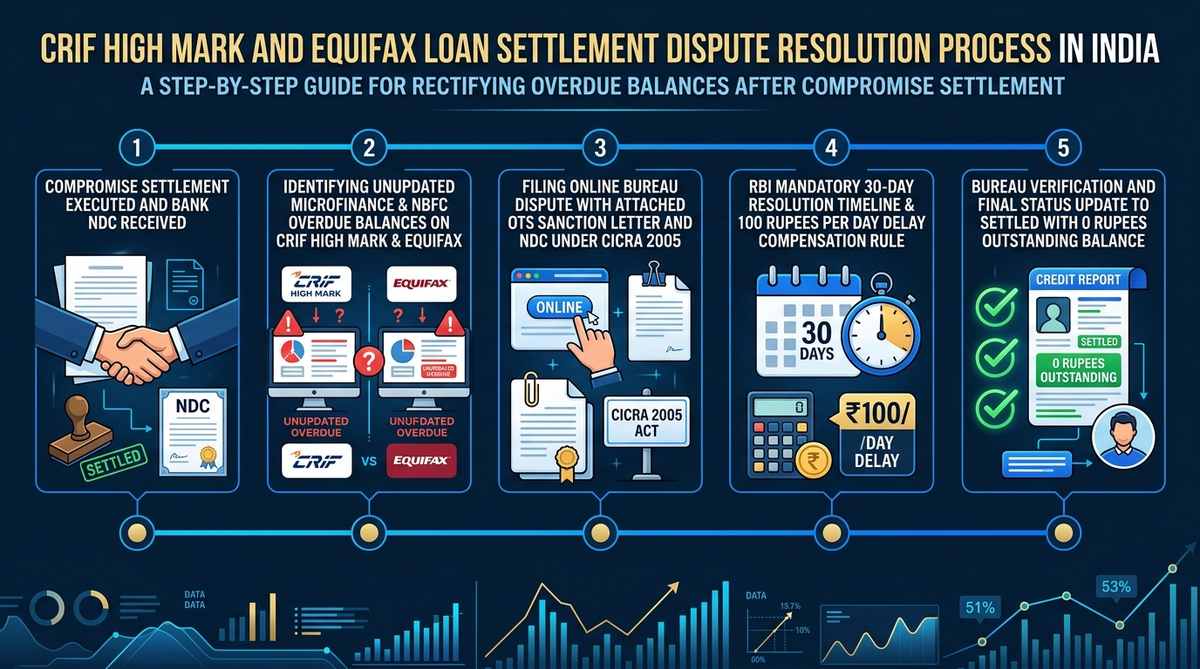
How to File an Online Dispute with CRIF High Mark and
Filing a credit bureau dispute requires clear proof and following official steps. Follow this six-step guide:
1Getting Bureau Reports and ID Numbers.
First, get fresh credit reports from both bureaus. Note the Report ID for CRIF High Mark. Note the 9-digit CRN for Equifax. You need these numbers to open a dispute.
2Gathering Settlement Proof.
Save clear PDF scans of three documents: your official OTS Sanction Letter, bank payment receipts with UTR numbers. And your formal No Dues Certificate.
3Submitting on the CRIF High Mark Portal.
Go to the CRIF High Mark dispute portal (crifhighmark.com). Enter your details and Report ID. Choose the settled account, select the balance error option, upload your PDFs. And save the Service Request number.
4Submitting on the Equifax India Portal.
Visit the Equifax India dispute portal (equifax.co.in). Enter your CRN, PAN. And loan details. Upload your settlement letter and NDC. You can also email a copy to ecissupport@equifax.com.
5Sending Notice to the Lender's Nodal Officer.
Bureaus send disputes to lenders for checks. Send a formal notice to the lender's Principal Nodal Officer under CICRA Section 21. Mention your ticket numbers to trigger the 21-day timeline.
6Getting Free Updated Credit Reports.
After 30 days, download fresh reports from CRIF and Equifax. Under RBI rules, bureaus must give you a free report showing ₹0 balance and 'Settled&apos. status.
Mandatory 30-Day Resolution Window
In the past, lenders and bureaus blamed each other for delays. To solve this, the RBI issued Circular RBI/2023-24/72 (DOR.MCS.REC.48/01.01.001/2023-24) to enforce strict dispute timelines.
The RBI rules set a total resolution window of 30 calendar days from the date of the complaint.
The lender gets 21 calendar days to verify its records. The credit bureau then gets 9 calendar days to update its database and inform the customer.
If the lender or bureau delays beyond 30 days, it must pay payout of ₹100 per day of delay directly into your bank account.
| Resolution Milestone. | legal Time Allotment. | Responsible Entity. | Legal Liability for Delay. |
|---|---|---|---|
| Dispute Receipt &. Ingestion. | Day 1 – Day 2. | CRIF High Mark / Equifax. | Must forward grievance to lender via API. |
| Credit Institution Verification. | Day 3 – Day 21 (Max 21 Days). | Lending Bank / NBFC. | Liable for ₹100/day penalty after Day 21. |
| Bureau Database Updation. | Day 22 – Day 30 (Max 9 Days). | CRIF High Mark / Equifax. | Liable for ₹100/day penalty if database update takes over 9 days. |
| Total legal Resolution Window. | 30 Calendar Days. | Composite Legal Mandate. | ₹100/day penalty plus RBI Ombudsman escalation. |
If a lender ignores your dispute, file a complaint on the RBI Integrated Ombudsman portal (cms.rbi.org.in). The Ombudsman can order penalty payments and award up to ₹20,00,000 in damages.
Sanction Letter & No Dues Certificate (NDC) Forensic Audit
Submitting incomplete settlement papers can stall a dispute. Unofficial receipts from collection agents are not accepted by credit bureaus.
Check your settlement documents against these legal standards before filing a dispute:
The OTS Sanction Letter must be on official corporate letterhead. It must show the company CIN, proposal number, agreed amount, payment schedule. And full liability discharge clause.
The No Dues Certificate (NDC) must state your loan account number. It must confirm that all dues were paid, the balance is ₹0. And the lender holds no further claims.
Under RBI Circular RBI/2023-24/60, lenders must issue the NDC and update credit bureaus within 30 days. Delays entitle borrowers to ₹5,000 per day penalty.
CRIF High Mark & Equifax Score Trajectory Post-Settlement &
Fixing a bureau dispute will not jump your score to 800 overnight. Changing the status to 'Settled&apos. with a ₹0 balance stops monthly damage and begins credit recovery.
A 'Settled&apos. status ends continuous DPD default hits. With the balance at ₹0, your credit utilization improves immediately.
Follow these steps to rebuild your credit score to 750+ over 12 to 18 months:
First, get a secured credit card against a fixed deposit. Use it for small recurring bills, keeping credit usage below 25% of the limit.
Second, pay every bill on time. Avoid applying for multiple loan apps in short periods. Over 18 months of disciplined payments, your score will qualify for prime loans.
Why Borrowers Trust SettleLoans for Bureau Disputes
Dealing with credit bureaus and lenders requires legal precision. SettleLoans audits loan ledgers, files CICRA Section 21 disputes. And escalates cases to the RBI Ombudsman. We ensure your CRIF and Equifax reports reflect a ₹0 balance.

Settle Loan is India's trusted debt relief and loan settlement platform. We help borrowers overcome financial distress by negotiating with banks and NBFCs to legally settle personal loans and credit card debts. With our transparent, performance-based approach, you can achieve debt freedom and regain your financial peace of mind.
COMPUTER
FAQs: CRIF High Mark & Equifax Settlement Disputes
Why do CRIF High Mark and Equifax show an overdue balance after I settled my loan?
Lenders must send monthly updates to all four credit bureaus. Often, lenders update CIBIL but forget CRIF High Mark or Equifax. This happens due to data upload errors or manual oversight. You must file a dispute to correct the record.
What is the legal difference between 'Settled' and 'Written Off' on CRIF High Mark and Equifax?
'Settled' means you paid an agreed compromise amount, and the lender waived the rest. The balance becomes ₹0. 'Written Off' means the lender marked the loan as a loss, but you still owe the money on their books.
How do I file an online dispute for loan settlement with CRIF High Mark?
Get your latest CRIF report and note the Report ID. Go to the CRIF High Mark dispute portal. Choose the settled account and select the balance error option. Upload your OTS letter and No Dues Certificate. Submit and save your Service Request number.
How do I file an online dispute for loan settlement with Equifax India?
Get your Equifax report and find the 9-digit Credit Report Number. Visit the Equifax dispute page. Fill in the form with your loan details and upload your No Dues Certificate. You can also email the papers to ecissupport@equifax.com.
What is the mandatory timeline for resolving credit bureau disputes under RBI regulations?
Under CICRA 2005 and RBI Circular RBI/2023-24/72, disputes must be resolved in 30 days. The lender has 21 days to verify the records. The credit bureau has 9 days to update its database.
What is the RBI ₹100 per day delay compensation rule for credit bureau disputes?
Under RBI Circular DOR.MCS.REC.48/01.01.001/2023-24, lenders and bureaus must finish disputes in 30 days. If they delay beyond 30 days, they must pay you ₹100 for each day of delay.
Why are CRIF High Mark and Equifax heavily checked by fintech loan apps and microfinance institutions?
CRIF High Mark is the main bureau for microfinance and small loans. Equifax is widely used by fintech apps. If these bureaus show an overdue balance, loan apps will reject your application automatically.
What documents are essential to successfully clear an unupdated settlement on CRIF and Equifax?
You need three documents: your official OTS Sanction Letter, bank payment receipts or UTR numbers, and a formal No Dues Certificate showing a ₹0 balance.
What should I do if the lender refuses or ignores the bureau's verification request?
Send a formal notice to the lender's Principal Nodal Officer under CICRA Section 21. If they still ignore it, file a complaint on the RBI Ombudsman portal (CMS) and claim ₹100 per day delay penalty.
How quickly does a credit score improve after CRIF High Mark and Equifax update the balance to ₹0?
Once the balance updates to ₹0, monthly default penalties stop immediately. Scores usually stabilize within 30 to 60 days. With steady financial discipline, your score can rise by 75 to 150 points over 12 to 18 months.
Official Regulatory References & Statutory Circulars
- Reserve Bank of India (RBI): Framework for payout to Customers for Delayed Updation/Rectification of Credit Information (Circular RBI/2023-24/72)
- Credit Information Companies (Regulation) Act, 2005 (CICRA): legal Framework for Credit Bureau Operations &. Dispute Resolution (Section 21)
- CRIF High Mark Credit Information Services: Consumer Online Dispute Redressal Portal &. Microfinance Reporting Guidelines
- Equifax Credit Information Services India: Consumer Dispute Resolution Portal &. Retail Credit Data Correction Protocols
- Reserve Bank - Integrated Ombudsman Scheme, 2021: Online CMS Grievance Redressal for Deficient Credit Reporting &. payout Enforcement