- Dual Regulatory Jurisdiction: Primary Urban Co-operative Banks (UCBs) and DCCBs are governed by RBI prudential guidelines for banking operations and by State Co-operative Societies Acts for recovery and administration.
- Section 101 Summary Recovery Certificates: Co-operative banks obtain direct execution warrants from the Registrar without full civil trials; legal revision before the Divisional Joint Registrar is vital to stay auctions.
- Board of Directors (BoD) OTS Authority: Settlement sanction letters require a formal resolution passed by the bank's Board of Directors and adherence to state Registrar compromise thresholds.
- 35% to 55% Principal Compromise: Under RBI's 100% unsecured NPA provisioning rules for doubtful assets, co-operative banks routinely write off accumulated penal interest and accept negotiated principal settlements.
- Mandatory Share Capital Recovery & NDC: Borrowers are entitled to adjust or refund their mandatory member share capital (2.5%–5%) and receive an official ₹0 No Dues Certificate within 30 days under RBI mandates.
1. Cooperative Bank Loans: Distinct Regional Mechanics
Co-operative banking in India occupies a unique institutional space within the national financial architecture. Unlike Scheduled Commercial Banks (such as HDFC Bank, ICICI Bank, State Bank of India, or Axis Bank) that operate under unified corporate mandates and centralized credit management software, co-operative institutions are structured on democratic, member-driven principles. These institutions include Primary Urban Co-operative Banks (UCBs), District Central Co-operative Banks (DCCBs), State Co-operative Banks (StCBs), and Multi-State Co-operative Banks operating across state borders.
A fundamental difference between a commercial bank loan and a co-operative bank credit facility lies in the legal relationship between the borrower and the lender. Under State Co-operative Societies Acts across Maharashtra, Gujarat, Karnataka, Tamil Nadu, Uttar Pradesh, and other states, an individual or business enterprise seeking credit must first become a nominal or regular shareholder-member of the co-operative society. Borrowers are required to purchase equity share certificates equal to 2.5% to 5% of the total loan amount sanctioned. This makes the borrower both a debtor and a voting or non-voting stakeholder in the institutional capital of the bank.
When financial hardship arises—such as regional economic slowdowns, post-pandemic business disruptions, inventory depreciation, or sudden loss of primary household income—defaulting on a co-operative bank loan triggers a localized, intense recovery mechanism. Because co-operative banks are deeply integrated into district-level commerce and municipal social circles, default is rarely handled through anonymous call centers. Instead, borrowers face immediate social friction, local recovery committees, public property notices in regional vernacular newspapers, and swift legal mobilization before state administrative authorities.
Understanding the legal architecture governing co-operative bank recovery, the interplay between state co-operative statutes and Reserve Bank of India (RBI) prudential guidelines, and the formal procedures for securing a Board-approved One-Time Settlement (OTS) is essential for any borrower seeking to permanently resolve stressed co-operative debt.
2. Dual Regulatory Architecture: The Interplay Between RBI Prudential Guidelines and the Registrar of Co-operative Societies
The most complex aspect of resolving a delinquent co-operative bank loan is navigating the Dual Regulatory Framework. For decades, co-operative banks functioned under bifurcated supervision, which frequently led to jurisdictional confusion during debt recovery and compromise negotiations. Following the enactment of the Banking Regulation (Amendment) Act, 2020, the regulatory powers of the Reserve Bank of India over Urban and Multi-State Co-operative Banks were substantially strengthened, while administrative governance remained under state jurisdiction.
Today, co-operative bank loan recovery and settlement operate under two distinct regulatory pillars:
Governs banking licenses, CRAR capital adequacy, Non-Performing Asset (NPA) classification, provisioning mandates, income recognition norms, and the RBI Master Direction on Compromise Settlements and Technical Write-offs (June 8, 2023), which applies directly to all Primary Urban Co-operative Banks.
Operates under State Co-operative Societies Acts (or the Multi-State Co-operative Societies Act, 2002). Governs society registration, election of the Board of Directors, administrative audits, state OTS circulars, and the issuance of statutory recovery certificates under summary recovery provisions.
Empowered under State Land Revenue Codes and Co-operative Rules to execute recovery certificates directly. They possess executive powers to attach movable assets, freeze local bank accounts, and conduct property auctions without approaching a civil court.
Under RBI Fair Lending Conduct rules, co-operative banks are prohibited from capitalizing penal interest into the principal balance. Penalties must be charged solely as non-compounded penal charges, preventing the artificial ballooning of delinquent ledgers.
In the landmark Constitution Bench judgment Pandurang Ganpati Chaugule v. Vishwasrao Patil Murgud Sahakari Bank Ltd. (2020), the Supreme Court of India held that co-operative banks established under state legislation are fully covered under the definition of 'Banking Company' under the Banking Regulation Act, 1949 and are entitled to invoke the SARFAESI Act, 2002 for mortgaged collateral. Consequently, co-operative banks wield a dual recovery sword: summary Section 101 recovery under State Acts and SARFAESI enforcement under Central banking law.
Check Your Loan Settlement Options
Answer 2 quick questions to evaluate your settlement eligibility.
1. What type of loan do you want to settle?
3. The Threat of Section 101 Recovery Certificates, Attachment Orders & Co-operative Court Disputes
When a borrower defaults on a co-operative bank loan past 90 days, the bank rarely initiates protracted civil suits under Order 37 of the Civil Procedure Code (CPC) or files applications before the Debt Recovery Tribunal (DRT) unless the debt exceeds ₹20 Lakhs. Instead, co-operative banks rely on the extraordinary statutory mechanism provided under state legislation, most notably Section 101 of the Maharashtra Co-operative Societies Act, 1960 (and analogous sections in other state statutes such as Section 70 of the Karnataka Act or Section 100 of the Gujarat Act).
Under Section 101, the co-operative bank files an application directly before the Assistant Registrar or Deputy Registrar of Co-operative Societies. The Registrar conducts a summary inquiry to verify the loan disbursement, executed mortgage or pledge documents, and statement of accounts. If satisfied, the Registrar issues a Recovery Certificate certifying the outstanding sum due.
Once a Section 101 Certificate is granted, it is treated as a final decree of a Civil Court. The consequences are immediate and severe:
- Warrant of Attachment of Movable Property: Special Recovery Officers (SRO) or Recovery Sales Officers issue attachment notices against inventory, business machinery, commercial vehicles, and personal bank accounts.
- Attachment and Public Auction of Immovable Real Estate: Under Rule 107 of the State Co-operative Societies Rules, the SRO issues Demand Notices, draws up Panchnamas, takes symbolic or physical possession of mortgaged properties, and schedules public auctions.
- Salary Attachment Warrants for Salaried Guarantors: Co-operative banks routinely issue direct employer attachment orders under Section 49 of the State Acts, deducting up to 50% of the disposable salary of borrower guarantors.
- Section 91 Dispute Proceedings in Co-operative Courts: If there are complex allegations of fraud, misrepresentation, unauthorized account debits, or disputed loan documentation, disputes are referred to the specialized Co-operative Court having exclusive jurisdiction.
Borrowers are not defenseless against Section 101 recovery certificates. Under Section 154 of the State Co-operative Societies Act, a borrower can file a statutory Revision Application before the Divisional Joint Registrar (DJR) or the State Co-operative Appellate Court. Legal counsel can challenge the certificate on grounds of violation of the principles of natural justice (failure to serve show-cause notice), illegal compounding of penal interest in violation of RBI directives, failure to account for paid-up share capital, or flawed accounting statements. Securing an interim stay order from the DJR halts SRO auction proceedings and creates a powerful legal window to negotiate a formal One-Time Settlement.
4. Bank Balance Sheet Accounting, UCB NPA Provisioning & The Net Present Value (NPV) Equation
Securing a substantial 35% to 55% principal haircut on a delinquent co-operative bank loan requires understanding the balance sheet economics governing Urban Co-operative Banks and DCCBs. Co-operative banks operate under strict capital adequacy ratios (Capital to Risk-Weighted Assets Ratio - CRAR) enforced by the Reserve Bank of India. When a loan defaults, the bank must set aside substantial capital provisions from its operational profits:
| UCB Asset Classification | Overdue Aging Timeline | RBI Mandatory Provision (Secured) | RBI Mandatory Provision (Unsecured) | Target OTS Haircut Scope |
|---|---|---|---|---|
| Standard / SMA-0 to SMA-2 | 1 – 90 Days Overdue | 0.25% – 0.40% | 0.40% – 5.0% | Penal charge waivers only |
| Sub-Standard Asset | 91 Days – 12 Months NPA | 10% – 15% Core Provision | 25% Capital Provision | 20% – 35% Principal Haircut |
| Doubtful-1 (D1 Asset) | 12 – 24 Months Default | 20% Capital Provision | 100% Full Provision | 35% – 45% Principal Haircut |
| Doubtful-2 / Doubtful-3 | 24 – 48+ Months Default | 30% – 100% Provision | 100% Full Provision | 45% – 55% Principal Haircut |
| Loss Asset | Identified Uncollectible | 100% Balance Sheet Write-off | 100% Balance Sheet Write-off | 50% – 65% Principal Haircut |
For co-operative banks, high Non-Performing Assets (NPAs) create catastrophic balance sheet pressure. If a UCB's Gross NPA ratio exceeds 7% or its CRAR falls below regulatory thresholds, the Reserve Bank of India places the institution under the stringent Supervisory Action Framework (SAF). Under SAF, the bank is prohibited from declaring member dividends, opening new branches, sanctioning fresh loans, or increasing executive compensation.
To liberate locked provisioning capital, improve audit classifications, and avoid RBI punitive actions, the bank's Board of Directors evaluates recovery proposals using the Net Present Value (NPV) Valuation Benchmark:
Where C_t represents expected recovery cash flows over time, r is the bank's opportunity cost of capital, and deductions incorporate 3–7 years of Registrar recovery litigation, Special Recovery Officer execution friction, and 100% capital provisioning burden under RBI Primary Urban Co-operative Bank prudential norms.
When legal advocates demonstrate that litigating through disputed Section 101 executions or DRT proceedings will consume 4 to 6 years with uncertain auction realizations, the bank's financial model clearly demonstrates that accepting an immediate One-Time Settlement yields a significantly superior financial outcome for the institution and its depositor base.
5. Cooperative Bank Loan Settlement Visual Roadmap
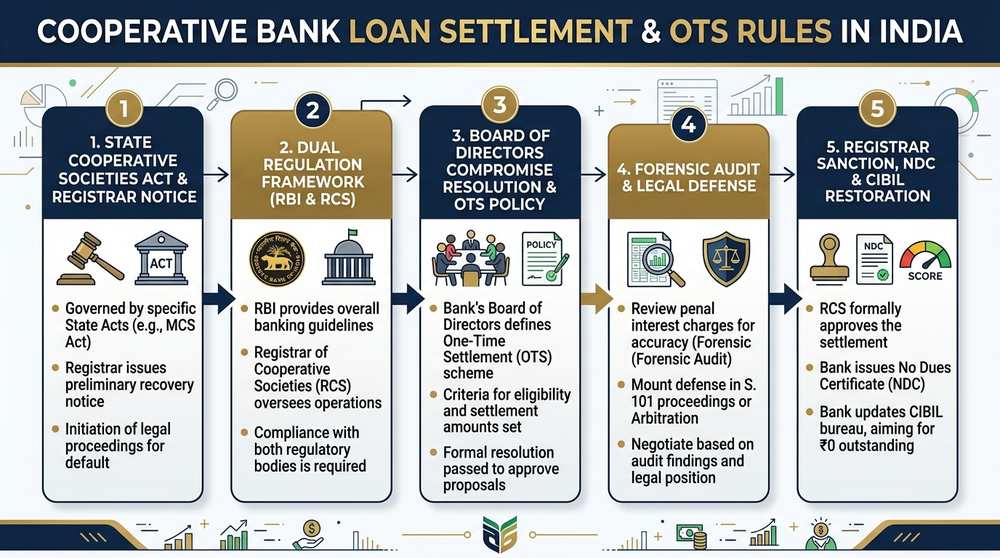
The visual roadmap below illustrates the structured 5-stage institutional progression required to settle a delinquent cooperative bank loan—from navigating state-level recovery notices and dual regulatory compliance to securing Board resolutions, Registrar concurrence, and obtaining an official RBI-mandated No Dues Certificate.
6. The Anatomy of Cooperative Bank OTS: Board Resolutions, Registrar Sanctions & Advocate Strategy
Settling a loan with an Urban or District Co-operative Bank requires an entirely different tactical approach than dealing with a commercial bank. In commercial banks, branch managers or zonal credit officers operate under fixed delegated discretionary lending powers (DLP). In co-operative banks, however, all debt compromise policies and major write-offs must be approved by the Board of Directors (BoD) during scheduled monthly board meetings.
Furthermore, under state co-operative governance rules, if the proposed waiver exceeds prescribed statutory thresholds (such as waivers exceeding ₹10 Lakhs or 50% of the loan ledger), the proposal requires prior sanction or post-facto reporting to the Registrar of Co-operative Societies (RCS) to prevent allegations of favoritism or administrative irregularities.
Professional debt resolution advocates execute a structured 5-phase institutional protocol to successfully navigate this process:
Phase 1: Comprehensive Forensic Ledger Audit
Legal advocates conduct a detailed audit of the co-operative loan ledger from the date of sanction. We isolate the true core principal disbursed, identify and eliminate unauthorized penal compounding, audit share capital deductions, and calculate the actual unrecovered baseline debt.
Phase 2: Formal Notice of Representation & SRO Cease-and-Desist
We serve a formal Notice of Representation on the Chairman, Managing Director, and Chief Executive Officer (CEO) of the co-operative bank, with copies marked to the District Registrar. This notice halts coercive recovery harassment, prevents illegal public defaming, and stays unilateral SRO auction steps.
Phase 3: Hardship Dossier Submission Under RBI June 2023 Framework
We draft a comprehensive One-Time Settlement proposal invoking the RBI Master Direction on Compromise Settlements (June 8, 2023) and applicable State OTS schemes. The dossier includes audited financial statements, tax filings, medical records, or business closure affidavits substantiating a permanent reduction in debt servicing capacity.
Phase 4: Board Agenda Tabling & Registrar Clearance
The OTS proposal is formally placed on the agenda of the bank's Board of Directors. Advocates engage with the Executive Recovery Sub-Committee, ensuring that the approved compromise is codified in an official Board Resolution complete with meeting minute numbers and necessary Registrar clearances.
Phase 5: National Lok Adalat or Co-operative Court Consent Terms
Where Section 101 or Section 91 dispute proceedings are pending, advocates record the compromise terms before the National Lok Adalat or Co-operative Court. This converts the OTS agreement into a binding, non-appealable judicial award that permanently extinguishes the lender's claims.
By grounding negotiations in RBI compliance and institutional balance sheet needs rather than emotional appeals, borrowers secure the maximum permissible legal waiver while maintaining full statutory protection.
7. Forensic Checklist for Watertight Cooperative Bank OTS Sanction Letters
A common and dangerous pitfall in co-operative bank debt resolution is relying on informal verbal assurances from local bank directors, branch managers, or recovery agents. In co-operative institutions, informal promises carry zero legal validity. If a borrower deposits settlement funds without an authentic, Board-ratified sanction letter, the bank can appropriate the money toward accumulated penal interest and continue recovery for the remaining balance.
Before remitting a single rupee, our legal team subjects the settlement sanction letter to five mandatory forensic validation checkpoints:
The sanction letter must be issued on official bank stationery and explicitly cite the specific Board Meeting Number, Resolution Date, and agenda approval item authorizing the debt compromise.
The letter must explicitly detail the total outstanding claim, the specific sum waived (penal interest, uncharged interest, principal haircut), and the exact net agreed compromise settlement amount.
The terms must state unambiguously that upon remittance of the agreed settlement sum within the stipulated timeframe, the entire loan account stands fully, permanently, and irrevocably closed.
The sanction letter must contain a binding commitment by the bank to withdraw all Section 101 recovery certificates, cancel SRO execution warrants, and file joint compromise petitions before Co-operative Courts or the DRT.
Never pay settlement funds in cash to any bank director, recovery agent, or society office-bearer. All settlement remittances must be made exclusively via Account Payee Demand Draft or RTGS/NEFT transferred directly into the designated co-operative bank loan account ledger under formal bank receipt.
9. Cooperative Bank Debt Resolution Comparative Matrix
Evaluating the primary institutional pathways available to resolve a delinquent cooperative bank loan empowers borrowers to choose the most legally secure and financially advantageous route:
| Resolution Pathway | Legal Mechanism & Forum | Principal Haircut Scope | Resolution Timeline | Legal & Financial Implications |
|---|---|---|---|---|
| Advocate-Led Board OTS | Formal Board Resolution + RBI June 2023 Framework | 35% – 55% Principal Waiver | 45 – 90 Days | Absolute legal closure; full release of property & ₹0 No Dues Certificate |
| National Lok Adalat Settlement | Conciliation under Legal Services Authorities Act | 30% – 50% Principal Waiver | Single Session | Non-appealable civil decree equivalent; zero court fees; permanent dispute bar |
| Section 154 Revision Petition | Revision before Divisional Joint Registrar (DJR) | Interim stay on execution | 3 – 9 Months | Halts SRO property auctions; exposes illegal interest; forces bank to OTS table |
| Contested Section 101 / SRO Auction | Summary execution via Land Revenue Code / Rule 107 | 0% (Full Claim + Penalties) | 6 – 18 Months | Severe asset loss; distress public auction below fair market value |
| Loan Reschedulement / Restructuring | Tenure extension / EMI recalculation | 0% (Full Principal + Interest Repayable) | 30 – 60 Days | No debt reduction; monthly cash flow commitment resumes immediately |
10. SettleLoans Legal Defense & Cooperative Stressed Debt Advisory
Resolving a defaulted loan with an Urban Co-operative Bank or District Central Co-operative Bank requires specialized legal knowledge spanning state co-operative acts, Registrar procedures, and RBI banking directives. SettleLoans represents borrowers across India: issuing formal legal representations, challenging Section 101 recovery certificates before the Divisional Joint Registrar, halting unlawful Special Recovery Officer property attachments, conducting forensic ledger audits to remove penal compounding, and negotiating directly with bank Boards of Directors to secure the deepest lawful OTS haircuts backed by official ₹0 No Dues Certificates.

Settle Loan is India's trusted debt relief and loan settlement platform. We help borrowers overcome financial distress by negotiating with banks and NBFCs to legally settle personal loans and credit card debts. With our transparent, performance-based approach, you can achieve debt freedom and regain your financial peace of mind.
COMPUTER
11. Frequently Asked Questions: Cooperative Bank Loan Settlement Rules
Legally verified answers to essential questions regarding Urban Co-operative Bank loan settlements, Section 101 notices, Board approvals, and borrower rights in India.
Can loans taken from Urban and District Co-operative Banks be settled through an OTS?
Yes. Borrowers who have defaulted on loans from Primary Urban Co-operative Banks (UCBs), District Central Co-operative Banks (DCCBs), and State Co-operative Banks are fully eligible for a One-Time Settlement (OTS). Under the RBI Master Direction on Compromise Settlements and state-level Co-operative Department guidelines, co-operative banks maintain structured, Board-approved compromise policies that permit substantial waivers on accumulated interest, penal charges, and a portion of the principal balance for non-willful defaulters facing genuine financial distress.
How does an OTS in a co-operative bank differ from a commercial bank settlement?
While commercial banks (like HDFC, ICICI, or SBI) process settlements through internal executive Stressed Asset Management Committees (SAMC) under direct RBI prudential mandates, co-operative banks operate under dual regulatory control. In a co-operative bank, the OTS proposal must be approved by the elected Board of Directors (BoD) and adhere to statutory circulars issued by the state Registrar of Co-operative Societies (RCS). If the compromise amount or haircut exceeds specific state monetary thresholds, prior sanction or post-facto ratification from the Registrar is legally mandatory.
What is a Section 101 Recovery Certificate issued by a co-operative bank?
Under State Co-operative Societies Acts (such as Section 101 of the Maharashtra Co-operative Societies Act, 1960, and equivalent provisions in Gujarat, Karnataka, and other states), a co-operative bank can apply directly to the Assistant or Deputy Registrar of Co-operative Societies for a summary recovery certificate. Once granted, this certificate has the legal force of a civil court decree, empowering a Special Recovery Officer (SRO) to attach and auction the borrower's movable and immovable properties without filing a prolonged civil suit.
How can a borrower legally challenge or stay a Section 101 Recovery Certificate?
A borrower can challenge a Section 101 Recovery Certificate by filing a Revision Application under Section 154 of the State Co-operative Societies Act before the Divisional Joint Registrar (DJR) or the State Co-operative Appellate Court. Grounds for challenge include violations of natural justice (lack of proper hearing), mathematical errors in interest compounding, inclusion of unauthorized penal levies violating RBI fair lending directives, or arbitrary denial of restructuring. Filing a revision with an interim stay petition halts coercive auction actions by the Special Recovery Officer.
Can a co-operative bank invoke SARFAESI against mortgaged property?
Yes. Following the landmark Supreme Court ruling in Pandurang Ganpati Chaugule v. Vishwasrao Patil Murgud Sahakari Bank Ltd. (2020), co-operative banks are recognized as 'banks' under the SARFAESI Act, 2002. For secured advances exceeding ₹1 Lakh where the outstanding dues exceed 20% of the principal and interest, co-operative banks can issue Section 13(2) 60-day demand notices and proceed toward Section 13(4) physical possession through the District Magistrate, running parallel to or in lieu of Section 101 proceedings.
What happens to the mandatory share capital held by the borrower in the co-operative bank?
When taking a loan from a co-operative bank, borrowers are mandated to purchase nominal or member shares (typically 2.5% to 5% of the sanctioned loan limit). During a One-Time Settlement, the value of these linked share certificates is factored into the final resolution. The bank can either adjust the paid-up share capital against the agreed settlement figure or refund the share value upon complete account closure and issuance of the No Dues Certificate, depending on the bank's bylaws and OTS sanction terms.
How do co-operative banks calculate the settlement amount and principal haircut?
Co-operative banks evaluate OTS applications based on the Net Present Value (NPV) of immediate cash recovery versus the legal costs and multi-year delays of execution through the Registrar or DRT. The baseline settlement figure typically covers the unrecovered ledger principal at the date of NPA classification. The Board routinely waives 100% of penal interest, uncharged memo interest, and inspection fees, while approving a 30% to 55% haircut on the core principal depending on the borrower's documented financial hardship and age of the NPA.
What is the timeline for receiving a No Dues Certificate (NDC) and property title deeds from a co-operative bank?
Under RBI Circular RBI/2023-24/60, all Primary Urban Co-operative Banks and regulated financial institutions are legally obligated to issue an official No Dues Certificate, release all original movable/immovable property documents, and remove registered mortgage charges within 30 calendar days of receiving full settlement payment. Any unjustified delay makes the co-operative bank liable to pay statutory compensation of ₹5,000 per day to the borrower.
How does a co-operative bank loan settlement reflect on CIBIL and CRIF credit scores?
Under RBI credit information reporting mandates, all co-operative banks report loan performance monthly to CIBIL, Experian, Equifax, and CRIF High Mark. Upon successful completion of an OTS, the co-operative bank updates the loan status from 'Default / 90+ DPD' to 'Settled' with a current outstanding balance of ₹0. While a 'Settled' tag temporarily impacts credit scores, it eliminates active default remarks and allows borrowers to rebuild their CIBIL score to 750+ within 12 to 18 months.