- 21-Day Reply Window: Banks must give you at least 21 days to reply to a notice.
- Two-Tier Committee Process: The first committee proposal is not final. The Review Committee must hear you and issue a clear order.
- The Jah Developers Ruling: The Supreme Court ruled in SBI v. Jah Developers (2019) that banks must share all audit records.
- Real Business Loss Shield: Losses from market downturns or slow sales are not wilful default without proof of fraud.
- Compromise OTS Rights: Under RBI rules, banks can approve an OTS and issue a ₹0 No Dues Certificate.
1. Demystifying the Wilful Defaulter Classification
When a business loan turns bad, banks act fast. They often send a Wilful Defaulter Show Cause Notice under Section 35A of the Banking Regulation Act, 1949.
Under RBI rules, a borrower can only be tagged as a Wilful Defaulter if unpaid debt is ₹25 Lakhs or more. It must also meet one of four clear legal tests:
The borrower has money to pay the loan. Yet, they choose not to pay scheduled EMIs.
Loan funds are used for goals outside the agreed sanction terms.
Funds are moved to shell accounts without creating real business assets.
The borrower sells or transfers pledged property without written bank consent.
In practice, banks often use wilful default notices to pressure borrowers. Knowing your rights is key to building a strong defense.
2. RBI Master Directions (2024–2026)
To stop unfair tagging, the RBI set strict rules under the Master Direction on Treatment of Wilful Defaulters. Banks must follow clear steps.
The process uses two internal committees to ensure fair treatment:
Tier 1: Identification Committee Examination & Show Cause Notice
The Identification Committee checks audit facts. If it suspects default, it issues a Show Cause Notice (SCN) with the charges.
Mandatory 21-Day Representation Window
Under RBI rules, banks must give borrowers 21 calendar days to file a reply. Notices giving less time are invalid.
Tier 2: Review Committee / Grievance Redressal Committee (GRC) Adjudication
The Review Committee / GRC is led by the MD/CEO and Independent Directors. It reviews the reply, holds a hearing. And passes a reasoned order.
The Review Committee cannot just accept the first findings. It must check your accounts and business facts with an open mind.
Check Your Loan Settlement Options
Answer 2 quick questions to evaluate your settlement eligibility.
1. What type of loan do you want to settle?
3. Legal Repercussions of Wrongful Tagging
A wilful defaulter tag brings severe fines. It harms personal and corporate standing in four big ways:
- Complete Credit Embargo: Total ban on getting loans or credit lines from any bank for 5 years after debt payoff.
- Section 29A IBC Disqualification: Promoters cannot bid for stressed assets under the Insolvency and Bankruptcy Code, 2016.
- Corporate Directorship Ban: Debarment from serving as a company Director under the Companies Act, 2013.
- Criminal Action &. Travel Bans: Risk of FIRs under Section 406 and Section 420 IPC, plus Look Out Circulars (LOC) stopping foreign travel.
In State Bank of India v. Jah Developers Pvt. Ltd. (2019) 6 SCC 787, the Supreme Court protected borrower rights under Article 19(1)(g):
- The bank must share the full Identification Committee report and audit files.
- The borrower gets a full 21-day window to file a written reply.
- The Review Committee must issue a clear speaking order answering all defense points.
4. Bank Balance Sheet Accounting, Forensic Ledger Audits
Knowing bank accounting rules helps your defense. Banks classify bad loans under strict RBI provisioning rules.
When a loan stays in default, banks must set aside cash reserves:
| NPA Vintage Category. | Default Duration. | Mandatory RBI Capital Provision. | Settlement Leverage Potential. |
|---|---|---|---|
| Sub-Standard Asset. | Up to 12 Months. | 15% Secured / 25% Unsecured. | 20% – 35% Principal Haircut. |
| Doubtful Category 1 (D1). | 12 to 24 Months. | 25% Secured / 100% Unsecured. | 35% – 50% Principal Haircut. |
| Doubtful Category 2 (D2). | 24 to 48 Months. | 40% Secured / 100% Unsecured. | 45% – 60% Principal Haircut. |
| Doubtful Category 3 / Loss. | Over 48 Months / Written-Off. | 100% Complete Write-Off. | 55% – 70% Principal Haircut. |
When our team disproves wilful default claims, banks assess the account using the Net Present Value (NPV) Recovery Benchmark:
C_t is estimated cash recovery. r is cost of capital. Deductions cover legal bills and locked cash reserves.
When you prove the default came from authentic business losses, the bank knows long court cases yield poor returns. This leads directly to a One Time Settlement (OTS).
5. Wilful Defaulter Defense Roadmap
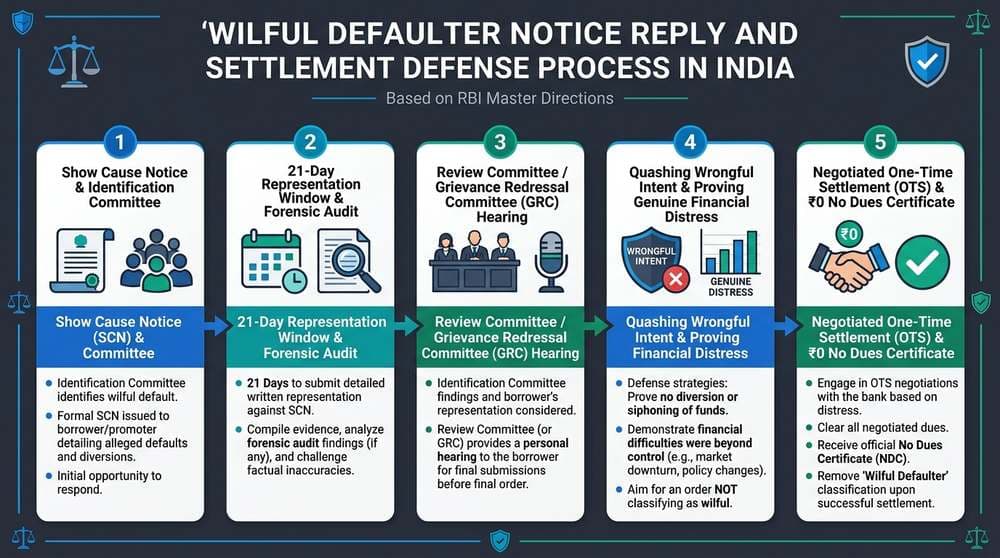
The visual roadmap below shows the full 5-stage legal defense path. It starts when you get the Show Cause Notice. Next, you send a 21-day forensic reply. Then, you appear before the Grievance Redressal Committee (GRC). You disprove bad intent. Finally, you execute an bank compromise OTS with a ₹0 No Dues Certificate.
6. Formulating the Legal Rebuttal
Replying to a Show Cause Notice needs both legal and accounting proof. A simple plea of hard times will fail. You must base your defense on clear ledger data and RBI rules.
Our defense advocates use a proven 4-pillar response:
Pillar 1: Demanding Primary Inspection Records & Forensic Workpapers
Under the Jah Developers ruling, you have a legal right to see all bank evidence. In our first reply, we demand the full Forensic Audit report and committee notes. If the bank refuses to share them, any final order is unlawful.
Pillar 2: Transaction-by-Transaction End-Use Certification
If the lender claims fund diversion, our accountants check every payout. We match loan transfers with vendor bills, purchase orders. And tax files. We issue certified end-use papers under the Bankers&apos. Books Evidence Act to prove funds went to real operations.
Pillar 3: Establishing External Commercial Hardship & Force Majeure
We gather documents showing outside economic events caused the shortfall. These include cancelled state orders, tariff hikes, rising raw material costs, or delayed client dues. Genuine business failure proves there was no deliberate fraud.
Pillar 4: High Court Article 226 Constitutional Writ Remedies
If the bank ignores the 21-day timeline, withholds audit files, or denies a hearing, we act fast. We file a Writ Petition under Article 226 of the Constitution of India in the High Court. High Courts regularly stay bank notices when fair procedure is broken.
By exposing bank procedural errors and showing clean books, we stop harsh actions. This clears the way for a fair settlement.
7. Grievance Redressal Committee (GRC) Personal Hearings
The personal hearing before the Review Committee (or GRC) is the main internal review stage. Under RBI rules, senior bank leaders. This includes the MD or CEO and Independent Directors, lead this committee.
Presenting your case needs sharp focus. Our legal team builds the defense around four key areas:
We show that fund transfers across group accounts were allowed under loan terms or cash-pooling rules approved at sanction.
Under RBI Master Directions, independent and non-executive directors who did not run daily finances cannot be tagged without direct proof of wrongdoing.
We dispute unfair penal interest and compound fees added against RBI Fair Lending rules. This reduces the true claim amount.
We put forward a clear settlement plan to senior bank leaders. We show that quick recovery beats costly, long court cases.
When the Review Committee sees strong legal proof ready for High Court review, it often closes the wilful default tag. The bank then shifts to an amicable OTS.
8. Structuring an Institutional Compromise Settlement (OTS),
Once the wilful defaulter notice is stayed or dropped, you can settle the loan. Under the RBI Framework on Compromise Settlements and Technical Write-offs (2023–2026), lenders have full power to enter into compromise deals with borrowers facing wilful default claims.
To protect your rights, the settlement deal must include four key terms:
- Board-Approved Sanction Letter: The OTS must be approved by the bank Special Committee. It must state court suit numbers and the exact agreed payment.
- Withdrawal of Wilful Defaulter Recommendations: A clear written clause confirming that all wilful default notices and committee claims are fully cancelled.
- Quashing of Criminal actions &. LOCs: A binding term requiring the bank to file joint pleas to close Section 406/420 IPC cases and drop Look Out Circulars.
- Mandatory 30-Day Document Return (RBI/2023-24/60): Release of all original title deeds and issue of a ₹0 No Dues Certificate (NDC) within 30 days. Delays carry a penalty of ₹5,000 per day.
Credit Information Companies (CIC) De-Tagging & CIBIL Bureau Restoration
After you pay the agreed settlement sum, RBI Master Directions require the bank to update all four credit bureaus (TransUnion CIBIL, Experian, Equifax, CRIF High Mark) and CRILC:
- Removal of Wilful Defaulter Flag: The "Wilful Defaulter". and "Suit Filed". marks are fully deleted from your credit profile.
- Status Remark Update to "Settled": The loan status shows "Settled / Post-Write-off Settled". with a current balance of strictly ₹0.
- Rebuilding Commercial Credit Rating: With court cases dismissed and guarantees released, you can rebuild your credit score and access fresh funding over time.
9. Statutory Enforcement Comparative Matrix
Comparing Indian loan recovery laws shows why an early defense against a Wilful Defaulter notice is vital. Acting fast protects your freedom, credit score. And business assets:
| Enforcement Action. | Governing legal Act. | Primary bank Threat. | legal Response Window. | Effective Legal Defense Strategy. |
|---|---|---|---|---|
| Wilful Defaulter SCN. | RBI Master Directions / BR Act Sec 35A. | 5-year credit ban. Section 29A IBC bar. loss of directorships. | Strict 21 Calendar Days. | Forensic ledger audit. GRC hearing. Article 226 Writ plea. |
| SARFAESI Section 13(2)/13(4). | SARFAESI Act, 2002. | Asset seizure and public auction of mortgaged property. | 60 Days (13(2)) / 45 Days (13(4)). | Section 13(3A) reply. Section 17 appeal in DRT for stay. |
| DRT Section 19 OA. | Recovery of Debts and Bankruptcy Act, 1993. | Recovery certificate. bank account attachment. | 30 Days for Written Statement. | Filing written reply. disputing penal fees. compromise OTS. |
| Criminal FIR (Sec 406/420). | IPC / Bharatiya Nyaya Sanhita (BNS). | Arrest risk. Look Out Circulars. travel bans. | Immediate Anticipatory Bail. | Section 482 CrPC plea in High Court. proving civil dispute. |
10. SettleLoans Regulatory Defense
Handling a Wilful Defaulter notice requires skilled advocates and forensic accountants. They know banking law, RBI Master Directions, and High Court writ procedures. SettleLoans provides complete defense support. We draft solid 21-day replies. We secure audit records under the Jah Developers rule. We defend you before Review Committees and GRC hearings. We obtain High Court stays against unlawful tagging. Finally, we negotiate structured settlements backed by a ₹0 No Dues Certificate.

Settle Loan is India's trusted debt relief and loan settlement platform. We help borrowers overcome financial distress by negotiating with banks and NBFCs to legally settle personal loans and credit card debts. With our transparent, performance-based approach, you can achieve debt freedom and regain your financial peace of mind.
COMPUTER
11. FAQs: Wilful Defaulter Notice Reply & Defense
Direct, legally verified answers to essential questions regarding Wilful Defaulter show cause notices, 21-day representation timelines, GRC hearings, and One Time Settlements in India.
What constitutes a 'Wilful Defaulter' under RBI Master Directions?
Under RBI Master Directions, a unit is a wilful defaulter if unpaid debt is ₹25 Lakhs or more. It applies if a borrower avoids paying despite having funds. It also covers diverting loan money, siphoning funds, or selling pledged assets without bank consent.
What is the statutory timeline to submit a Wilful Defaulter notice reply?
Under RBI Master Directions, banks must give borrowers, promoters. And guarantors at least 21 days to reply to a Show Cause Notice (SCN).
How does the two-tier committee mechanism (Identification and Review Committee) function?
The process uses two panels. The first panel checks audit facts and issues the notice. If it finds default, the Review Committee / GRC reviews your reply. It holds a hearing and passes a reasoned order.
What are the legal rights established by the Supreme Court in State Bank of India v. Jah Developers?
In SBI v. Jah Developers (2019), the Supreme Court protected borrower rights. Banks must share all audit records, give 21 days to reply. And pass a clear speaking order.
Can a bank tag a borrower as a wilful defaulter due to genuine business losses or insolvency?
No. RBI rules separate genuine business loss from deliberate default. Losses from market shocks or unpaid bills are not wilful default unless the bank proves intentional fraud.
What are the severe consequences of being officially declared a Wilful Defaulter?
A wilful defaulter tag brings severe fines. You face a 5-year ban on new bank loans. Promoters face a Section 29A IBC bar on bidding for assets. It also causes director disqualification and potential Section 406/420 IPC cases.
Can a borrower settle a loan through a One Time Settlement (OTS) after receiving a Wilful Defaulter notice?
Yes. Under the RBI Compromise Settlement Framework, banks can agree to an OTS with wilful defaulters. The deal needs approval from a special board-level committee.
How can a borrower challenge an arbitrary wilful defaulter order in court?
If a bank breaks fair rules or withholds audit files, you can act. You can file an Article 226 Writ Petition in the High Court. The court can stay and quash the wrongful tag.
What evidence is required to disprove allegations of loan fund diversion?
To disprove fund diversion, show clear accounts. Submit audited balance sheets, vendor bills, bank books, CA end-use certificates. And tax filings showing funds went to real work.
How does a successful settlement remove the Wilful Defaulter tag from CIBIL and CICs?
Once you pay the agreed OTS sum, the bank issues a ₹0 No Dues Certificate. The bank must update CIBIL, Experian, Equifax, CRIF. And the RBI database within 30 days to clear the tag.