- Civil Nature of Market Losses: Defaulting on personal loans due to market crashes or options expiry is strictly a civil breach. It does NOT constitute criminal cheating (BNS Section 318 / Section 420 IPC) when application disclosures were genuine.
- Immediate Debt Spiral Interruption: Borrowers must immediately cease "revenge trading" or taking fresh high-interest app loans to service existing EMIs, freezing all margin trading facilities.
- Audited Hardship Dossier Strategy: Verified broker P&L statements, demat loss ledgers, and crypto trade logs serve as admissible proof of total capital depletion during institutional bank negotiations.
- Substantial OTS Haircuts (40%–60%): Once loans surpass 90–120 days past due, banks face heavy mandatory RBI provisioning burdens, incentivizing credit committees to approve deep principal discounts.
- Extinguishment of Statutory Notices: Compoundable offenses under Section 25 PSSA (NACH bounce) and Section 138 NI Act (cheque bounce) are fully discharged upon execution of an official OTS sanction letter.
1. The Anatomy of Trading Crypto Debt Collapse: Psychological
The democratization of digital retail broking and instant consumer credit in India has birthed an acute socio-financial crisis: retail individuals borrowing heavily through unsecured personal loans and credit lines to speculate in equity derivatives (Futures & Options) or volatile cryptocurrency markets. According to landmark research published by the Securities and Exchange Board of India (SEBI), over 93% of individual retail traders in the equity F&O segment incur net financial losses, with the average loss exceeding ₹1.25 Lakhs per trader excluding transaction friction. When speculative exposure is funded not through discretionary savings, but through high-interest personal loans carrying interest rates between 14% and 28% per annum, the outcome is almost invariably catastrophic financial ruin.
The psychological descent follows an alarmingly consistent operational trajectory. An initial retail trading loss triggers acute cognitive dissonance and panic. Rather than accepting the market loss, the individual experiences "loss aversion bias" and attempts revenge trading, borrowing an initial personal loan from an institutional bank (such as HDFC Bank, ICICI Bank, SBI, or Axis Bank) or instant lending apps (such as KreditBee, Navi, or Bajaj Finserv) to recapitalize their trading margin. When secondary market moves wipe out this borrowed capital, the borrower takes additional personal loans to service the monthly equated monthly installments (EMIs) of the earlier loans. Within six to twelve months, a manageable salary of ₹50,000 to ₹1,00,000 is overwhelmed by aggregate loan liabilities of ₹15 Lakhs to ₹30 Lakhs, with monthly EMI commitments exceeding 150% of net take-home earnings.
This dynamic creates an agonizing state of emotional despair, isolation, and acute clinical anxiety. Retail borrowers frequently conceal the debt collapse from spouses, parents, and employers due to profound social shame and fear of ostracization. However, attempting to resolve an insolvent debt spiral through continued market speculation or tertiary borrowing is mathematically impossible. True recovery begins by breaking the silence, immediately freezing all trading terminals, disconnecting margin credit, and transitioning from panic-driven denial to a disciplined, advocate-led legal resolution under official banking frameworks.
2. Market Losses vs Bank Default: Indian Contract Act Protections & Absence of Fraud
The most pervasive weapon deployed by aggressive third-party recovery agencies against trading-loss defaulters is the psychological threat of criminal prosecution. Recovery agents frequently claim that utilizing personal loan disbursements for stock trading or cryptocurrency speculation constitutes criminal breach of trust, willful diversion of funds, or cheating punishable by immediate imprisonment under Section 318 of the Bharatiya Nyaya Sanhita, 2023 (BNS, formerly Section 420 of the Indian Penal Code). These assertions are legally baseless misrepresentations designed to extort payments through intimidation.
Under Indian jurisprudence, an unsecured personal loan is a multi-purpose financial contract governed strictly by the Indian Contract Act, 1872. When an individual takes an unsecured personal loan, the lender disburses the funds based on credit underwriting, credit scores, and verified income documentation without creating a specific hypothecation or mortgage lien over specific assets. Default in repayment due to market losses represents a civil breach of contractual repayment covenants, not a penal offense.
In landmark rulings, including Vesa Holdings P. Ltd. v. State of Kerala and Hridaya Ranjan Prasad Verma v. State of Bihar, the Supreme Court of India established that to sustain a charge of cheating or fraudulent inducement, the dishonest or fraudulent intention (mens rea) must exist at the very inception of the transaction. If a borrower obtained a loan with genuine intent to repay based on their verified employment or commercial revenue, subsequent financial insolvency caused by investment destruction or trading losses cannot be retrospectively converted into a criminal act. Furthermore, under the RBI Master Circular on Wilful Defaulters (DOR.AML.REC.47/14.01.001/2023-24), a borrower can only be declared a "Willful Defaulter" if they have the demonstrated financial capacity to pay but intentionally refuse, or have siphoned capital into hidden assets. Complete, verifiable capital destruction in SEBI-regulated exchanges or liquid crypto exchanges directly disproves willful default.
Check Your Loan Settlement Options
Answer 2 quick questions to evaluate your settlement eligibility.
1. What type of loan do you want to settle?
3. Delinquency Aging, NPA Provisioning & The Net Present Value (NPV) Recovery Model
To secure an authorized 40% to 60% settlement haircut on a defaulted personal loan, a borrower must understand the institutional accounting mathematics governing commercial banks and Non-Banking Financial Companies (NBFCs). Under the Reserve Bank of India's Prudential Framework on Resolution of Stressed Assets, overdue loans transition through strictly regulated asset classification stages based on Days Past Due (DPD). The loan is categorized as Special Mention Account-0 (SMA-0) for 1 to 30 days overdue, SMA-1 for 31 to 60 days, and SMA-2 for 61 to 90 days.
Once an account breaches the 90-day threshold of continuous non-repayment, the lender is legally required under the RBI Master Circular on Income Recognition, Asset Classification and Provisioning (IRACP) to classify the loan as a Non-Performing Asset (NPA) under the Substandard category. Upon NPA classification, the bank must set aside an immediate 15% capital provision from its operating profits for unsecured debt. If the default extends past 12 months, the account degrades to Doubtful Asset Stage 1 (D1), mandating a 25% to 40% capital provision, which climbs to 100% for Doubtful D2 and Loss Asset categories.
This mandatory capital provisioning creates a powerful financial incentive for the bank's Credit Committee to settle. Capital locked in provisioning cannot be deployed into profitable lending, directly suppressing the bank's Return on Equity (ROE). When presented with a structured One-Time Settlement (OTS) proposal backed by an audited hardship dossier, the bank evaluates the transaction through a mathematical Net Present Value (NPV) recovery analysis.
Where C_t represents estimated recoveries, r is the discount rate, and deductions account for 3–5 years of court friction and capital locked in NPA provisions.
Because an unsecured personal loan carries no underlying physical collateral (unlike a mortgage or gold loan), litigating against an insolvent borrower who has depleted their net worth in trading provides virtually zero probability of secondary recovery. The bank faces substantial litigation expenses, non-refundable court fees (4% to 7% of claim value), and years of administrative delays. Consequently, recovering 40% to 50% of the principal today in liquid cash yields a significantly higher NPV for the financial institution than pursuing an uncollectible civil decree.
| Delinquency Tier | Days Past Due (DPD) | Mandatory RBI Provisioning | Bank Settlement Leverage |
|---|---|---|---|
| SMA-0 / SMA-1 | 1 – 60 Days | 0.4% Standard Provision | Minimal Haircut; Lender Focuses on Regularization |
| SMA-2 | 61 – 90 Days | Pre-NPA Alert Window | Waiver of Overdue Penalties & Late Fees Only |
| Substandard NPA | 91 – 180 Days | 15% Mandatory Capital Lock | 25% – 35% Principal Haircut Window Opens |
| Doubtful D1 NPA | 181 – 365 Days | 25% – 40% Capital Provision | 40% – 55% Principal Haircut Sweet Spot |
| Doubtful D2 / Loss | 365+ Days | 100% Capital Written Off | 55% – 70% Maximum Hardship Haircut |
4. Statutory Legal Notice Escalation: Section 25 PSSA, Section 138 NI Act & Conciliation
As loan defaults mount, financial institutions initiate formal statutory legal escalation. When recurring electronic National Automated Clearing House (e-NACH) mandates bounce due to insufficient balances, the lender issues a statutory demand notice under Section 25 of the Payment and Settlement Systems Act, 2007 (PSSA). Simultaneously, if post-dated security cheques or repayment instruments dishonor, demand notices are served under Section 138 of the Negotiable Instruments Act, 1881 (NI Act).
Receiving these notices often pushes distressed traders into extreme panic. However, understanding their procedural architecture is vital. Both Section 25 PSSA and Section 138 NI Act are quasi-criminal, bailable, and compoundable statutory offenses designed to ensure commercial discipline. The law provides the recipient with a mandatory 30-day statutory window from the date of receipt to respond or satisfy the claim before any formal complaint can be filed before a Judicial Magistrate First Class (JMFC) or Metropolitan Magistrate (MM).
Engaging an experienced debt settlement advocate to draft an authoritative, point-by-point legal response within this 30-day window is essential. Counsel's reply accomplishes three decisive objectives:
1. Rebuttal of Criminal Intent: It establishes that the default stems from genuine financial insolvency resulting from documented market failure rather than deliberate fraud or dishonest evasion.
2. Security Instrument Defense: It places on record that the disputed e-mandate or cheque was obtained as an unliquidated security instrument at loan origination rather than drawn against an undisputed, crystallized ledger sum.
3. Formal Conciliation Offer: It formally invites the lender to submit the dispute to bilateral conciliation or an institutional One-Time Settlement under RBI compromise guidelines.
Under Section 147 of the NI Act and landmark Supreme Court precedents (including M/s Meters and Instruments Pvt. Ltd. v. Kanchan Mehta), all proceedings under Section 138 and Section 25 PSSA are compoundable. Once an OTS agreement is executed and the agreed settlement sum is remitted, all underlying legal complaints are permanently withdrawn with zero criminal record or conviction.
Trading & Crypto Debt Settlement: Resolution Roadmap
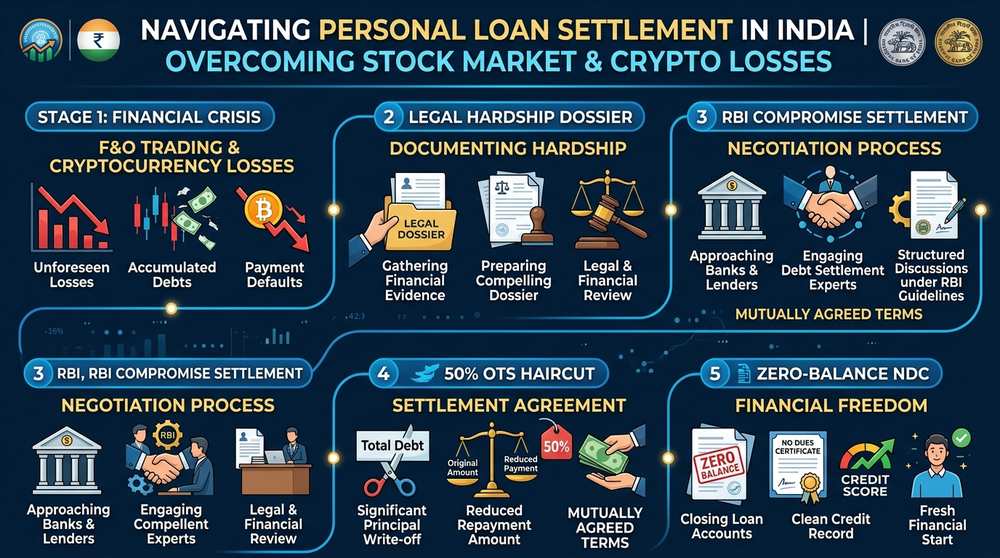
6. Building an Irrefutable Financial Hardship Dossier for Trading & Crypto Losses
The cornerstone of securing deep debt waivers from bank credit committees is converting a trading disaster from an embarrassing secret into a legally documented proof of insolvency. A bank will never grant a 40% to 60% principal write-off based solely on oral pleas; the request must be backed by an airtight, forensic Financial Hardship Dossier.
SettleLoans legal associates assist borrowers in assembling and structuring the following primary evidentiary pillars:
• Certified Broking P&L Statements: Tax P&L reports downloaded directly from registered stockbrokers (e.g., Zerodha, Groww, AngelOne, Upstox, ICICI Direct) detailing real capital depletion across equity options, index futures, and intraday equity trades over the preceding 12 to 24 months.
• Demat Holding Statements: Official demat holding statements demonstrating that the portfolio contains zero marketable securities, shares, mutual funds, or sovereign gold bonds that could be liquidated to repay the loan.
• Cryptocurrency Exchange Trade Logs: Comprehensive transaction histories, deposit records, and loss statements from FIU-registered crypto exchanges (e.g., CoinDCX, WazirX, CoinSwitch) or wallet audit reports confirming unrecoverable capital losses.
• Income Tax Returns (ITR) & Form 26AS: Annual tax filings reflecting declared short-term/long-term capital losses and verified reductions in taxable income.
• Bank Account Statement Audits: Complete 6-month statements for all operative bank accounts proving that loan disbursements were transferred directly to trading margin accounts without diversion into real estate, gold, or third-party beneficiaries, and demonstrating zero hidden liquid reserves.
When presented as a formal legal representation, this dossier proves conclusively that the borrower possesses zero unencumbered assets, dismantling any suspicion of willful diversion and making an OTS the bank's only viable recovery mechanism.
7. Realistic OTS Haircut Formula & Settlement Slabs for Trading Debts
During default, banks and collection agencies inflate personal loan liabilities by compounding exorbitant penal interest (frequently 24% to 36% per annum), automated mandate bounce charges, and administrative recovery overhead. An initial ₹10 Lakh loan balance rapidly swells on the bank ledger to ₹13.5 Lakhs or more.
A legitimate, advocate-negotiated compromise settlement under RBI guidelines is calculated through a structured two-tier haircut formula:
Tier 1: 100% Surcharge & Penalty Waiver. Under RBI Fair Lending Practices circulars, 100% of accrued normal interest, capitalized penal interest, late payment penalties, and e-mandate bounce fees are completely eliminated before evaluating the core debt.
Tier 2: 40% to 60% Principal Debt Haircut. The negotiation focuses exclusively on the core disbursed principal amount. Depending on the vintage of the NPA (120 to 360+ days) and the severity of the documented financial hardship, the credit committee approves a final settlement payable either in a single bullet payment or across 2 to 3 structured monthly tranches.
| Original Disbursed Loan | Inflated Bank Ledger Claim | Negotiated OTS Haircut | Final Settlement Payable | Total Debt Waiver |
|---|---|---|---|---|
| ₹3,00,000 (App Loans / Fintech) | ₹4,20,000 | 50% – 60% Principal Haircut | ₹1,20,000 – ₹1,50,000 | ~65% Total Relief |
| ₹5,00,000 (Single Bank Loan) | ₹6,80,000 | 45% – 55% Principal Haircut | ₹2,25,000 – ₹2,75,000 | ~60% Total Relief |
| ₹10,00,000 (Mid-Tier Exposure) | ₹13,60,000 | 45% – 55% Principal Haircut | ₹4,50,000 – ₹5,50,000 | ~62% Total Relief |
| ₹20,00,000 (Multiple Bank Loans) | ₹27,50,000 | 40% – 50% Principal Haircut | ₹9,00,000 – ₹11,00,000 | ~60% Total Relief |
8. Unilateral Arbitration Defense, DRT Jurisdictional Limits & Civil Court Realities
Borrowers who default on unsecured personal loans must recognize the severe statutory boundaries constraining the bank's recovery apparatus. In India, institutional lenders face three distinct structural barriers when attempting judicial recovery for unsecured loans:
• DRT Barred Below ₹20 Lakhs: Under Section 1(4) of the Recovery of Debts and Bankruptcy Act (RDB Act), 1993, Debt Recovery Tribunals (DRT) possess zero pecuniary jurisdiction over debts below ₹20 Lakhs. A bank cannot file a DRT application for individual personal loans under this limit.
• Invalidity of Unilateral Arbitrator Appointments: Private banks and NBFCs frequently dispatch notices appointing a sole arbitrator unilaterally. In Perkins Eastman Architects DPC v. HSCC (India) Ltd. and TRF Ltd. v. Energo Engineering Projects Ltd., the Supreme Court ruled that a party interested in the dispute outcome cannot unilaterally appoint an arbitrator. An advocate can immediately challenge such proceedings under Section 12(5) of the Arbitration and Conciliation Act, 1996, rendering unilateral awards unenforceable.
• Civil Court Friction: Filing a summary suit under Order XXXVII of the Civil Procedure Code (CPC) requires the bank to pay substantial non-refundable state court fees and endure 4 to 8 years of judicial delays. Even upon securing a money decree, executing it against an insolvent individual with no unencumbered commercial assets yields zero recovery under Order XXI CPC.
| Resolution Channel | Typical Haircut / Discount | Timeframe | Legal Status & Finality | Cash Outflow Mode |
|---|---|---|---|---|
| Bilateral One-Time Settlement (OTS) | 40% – 60% Principal Haircut + 100% Penal Waiver | 45 – 90 Days | Official Sanction Letter + Stamped ₹0 NDC | Lump-sum or 2–3 Monthly Tranches |
| National Lok Adalat Settlement | 35% – 50% Principal Haircut + 100% Penal Waiver | Quarterly Sittings | Final Non-Appealable Civil Court Decree (DLSA) | Immediate Lump-sum on Lok Adalat Award Date |
| Loan Restructuring / Rescheduling | 0% Haircut (Tenure Extended; Interest Capitalized) | 30 – 60 Days | Revised Agreement; Higher Lifetime Interest | Continuing Monthly EMI Outflow |
| Bank Civil Litigation (Order 37) | 0% Discount; 100% Claim + Court Interest & Costs | 4 – 8 Years | Contested Civil Court Judgment & Execution | Ongoing Advocate & Court Appearance Costs |
9. Sanction Letter Forensics, Zero-Balance NDC & Credit Bureau Rebuilding
A compromise settlement is legally incomplete without rigorous verification of the bank's settlement sanction letter. Borrowers must never transfer funds based on oral promises or WhatsApp messages from collection agents. An authentic settlement requires an official letter issued on bank letterhead, bearing a unique reference number, authorized signature, exact loan account details, agreed settlement figures, explicit full-and-final waiver clauses, and a commitment to issue a zero-balance No Dues Certificate (NDC) within 30 days.
Following settlement remittance, the lender is legally required under the Credit Information Companies (Regulation) Act (CICRA), 2005, to update all four credit bureaus (CIBIL, Experian, Equifax, CRIF High Mark). The loan status transitions from 'Default / NPA' to 'Settled' with an outstanding balance of ₹0.
While a 'Settled' status temporarily contracts your credit score by 75 to 150 points, it permanently stops compounding default markers. Borrowers can rebuild their CIBIL score back to 750+ within 18 to 24 months through a disciplined three-step credit rehabilitation strategy:
1. Fixed Deposit-Backed Secured Card: Open a secured credit card (such as IDFC WOW, OneCard, or SBI Unnati) against a fixed deposit of ₹25,000 to ₹50,000.
2. Disciplined 20%–30% Utilization: Restrict monthly credit card usage to under 30% of the allocated credit limit.
3. 100% Punctual Total Repayments: Set up automated debits for the entire statement balance, building a spotless 24-month payment track record that proves restored financial discipline to future institutional lenders.

Settle Loan is India's trusted debt relief and loan settlement platform. We help borrowers overcome financial distress by negotiating with banks and NBFCs to legally settle personal loans and credit card debts. With our transparent, performance-based approach, you can achieve debt freedom and regain your financial peace of mind.
COMPUTER
Frequently Asked Questions: Trading & Crypto Loss Loan Settlement
Can a bank file an FIR or criminal cheating case if I lost personal loan money in trading or crypto?
No. Inability to repay an unsecured personal loan due to catastrophic market losses is strictly a civil breach of contract governed by the Indian Contract Act, 1872. The Supreme Court of India has repeatedly ruled that criminal cheating under Section 318 of Bharatiya Nyaya Sanhita (formerly Section 420 IPC) cannot be sustained unless fraudulent intent existed at the exact time of loan sanction. As long as your initial application documents (KYC, income slips) were genuine, commercial loss in speculative markets does not constitute a criminal offense.
How much haircut can I realistically negotiate on a trading loss personal loan?
Under official RBI compromise settlement frameworks, unsecured personal loans in default past 120 to 180 days typically settle at a 40% to 60% haircut on the core principal balance. In addition, 100% of accrued penal interest, late fees, and automated mandate bounce penalties are completely waived, delivering overall debt relief often exceeding 55% to 70% of the inflated ledger claim.
How should I present stock market or crypto trading losses to the bank settlement committee?
Trading losses must be presented through a structured, advocate-compiled Financial Hardship Dossier. This includes certified broker profit and loss (P&L) statements, demat holding ledgers proving zero residual equity, crypto exchange trade logs, income tax returns (ITRs) showing capital losses, and bank statements showing zero hidden liquidity. This transparently proves total capital depletion and bona fide inability to pay.
What should I do if I receive a Section 25 PSSA or Section 138 NI Act legal notice for bounced loan EMIs?
Never ignore statutory legal notices. You have a mandatory 30-day statutory window to respond. Retain a debt settlement advocate to draft a formal legal reply that documents your genuine financial hardship, establishes the absence of criminal mens rea, and formally invites the lender to resolve the dispute through bilateral conciliation or a compromise One-Time Settlement (OTS).
Will the bank classify me as a 'Willful Defaulter' because I lost loan capital in derivatives or cryptocurrency?
Under the RBI Master Circular on Wilful Defaulters, a willful default requires proof that the borrower has the financial capacity to pay but chooses not to, or has siphoned funds into undisclosed personal assets. Total capital loss in SEBI-regulated exchanges or liquid crypto markets—evidenced by verified loss ledgers and lack of liquid net worth—demonstrates genuine economic insolvency rather than willful non-payment.
Can lending institutions seize my family property or salary account for unsecured trading debt defaults?
No. Unsecured personal loans carry zero mortgage or collateral charge over your residential property, family assets, or gold. Furthermore, under the Recovery of Debts and Bankruptcy Act (RDB Act), 1993, Debt Recovery Tribunals (DRT) have zero jurisdiction over debts below ₹20 Lakhs. Lenders can only exercise a Banker's Right of Set-Off under Section 171 of the Indian Contract Act over deposit accounts held within their own banking institution under the same PAN.
How do I stop third-party recovery agents from harassing my family and workplace?
Under the RBI Master Directions on Recovery Agents (August 2022), collection agents are strictly prohibited from contacting third parties, visiting workplaces to cause public embarrassment, or calling outside 8:00 AM to 7:00 PM. Serving a formal advocate cease-and-desist notice and channeling all communications to legal counsel immediately halts unauthorized contact under threat of RBI Ombudsman escalation.
What is the timeline to settle a trading debt personal loan from the first default?
A standard personal loan settlement takes 3 to 6 months. The account transitions through SMA-0 (1-30 DPD), SMA-1 (31-60 DPD), and SMA-2 (61-90 DPD), turning into a Non-Performing Asset (NPA) at 90 days. The optimum negotiation window for maximum debt haircuts opens between Day 120 and Day 180, when the bank absorbs mandatory capital provisioning hits.
What must be verified in the bank's OTS Sanction Letter before transferring settlement funds?
The sanction letter must be issued on official bank letterhead with an authorized signatory stamp, state your exact loan account number and full name, specify the exact settlement amount and tranche dates, include an unambiguous clause extinguishing all residual balance claims, and guarantee the delivery of a stamped zero-balance No Dues Certificate (NDC) within 30 days.
How does settling a trading-loss personal loan impact my CIBIL score and when can I rebuild it?
Upon settlement, the bank updates your credit report status to 'Settled' with an outstanding balance of ₹0. While this causes a temporary score reduction of 75 to 150 points, it halts compounding monthly default penalties. Borrowers can rebuild their CIBIL score back to 750+ within 18 to 24 months by securing a fixed-deposit-backed credit card, maintaining under 30% utilization, and executing punctual total bill repayments.
- RBI Master Circular – Prudential Framework on Resolution of Stressed Assets & Compromise Settlements
- RBI Master Directions on Recovery Agents & Fair Practices Code (August 2022)
- Section 25 of the Payment and Settlement Systems Act, 2007 (PSSA e-Mandate Bounce Laws)
- Section 138 & Section 147 of the Negotiable Instruments Act, 1881 (Cheque Dishonor & Compounding)
- Legal Services Authorities Act, 1987 – National Lok Adalat Dispute Settlement Provisions