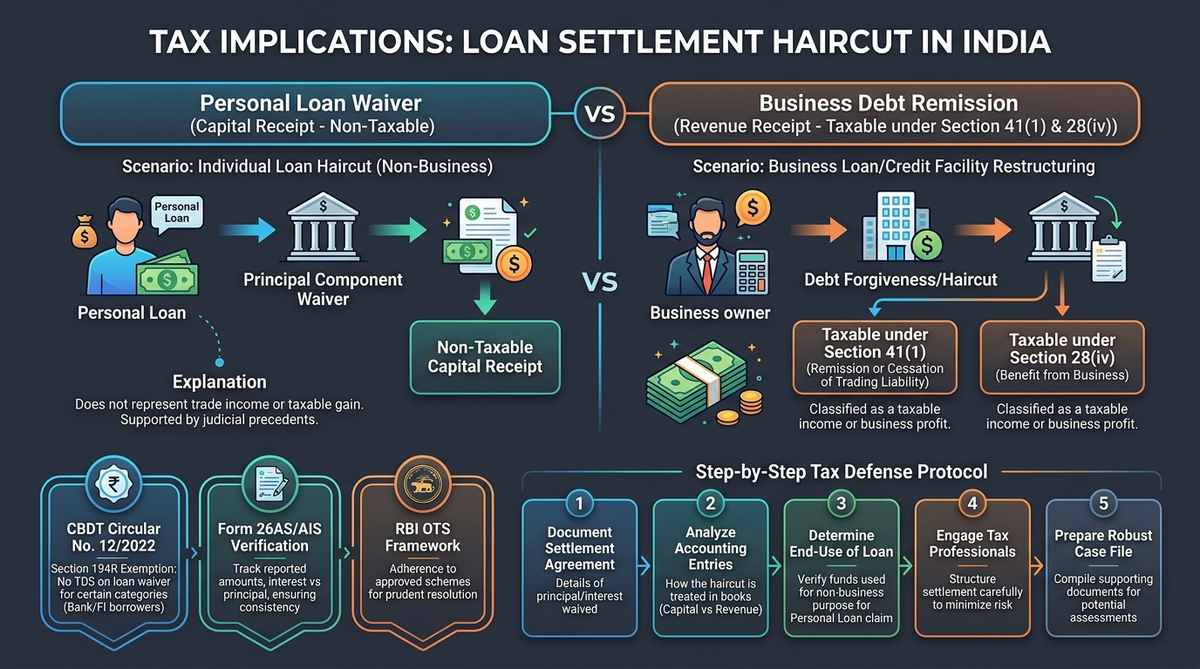
- Personal Loan Waivers are Capital Receipts: For salaried individuals and personal borrowers, a loan haircut is an extinguishment of a capital liability, making it completely non-taxable under the Income Tax Act, 1961.
- CBDT Circular 12/2022 Exempts Bank OTS from TDS: The Central Board of Direct Taxes specifically clarified that Section 194R (10% TDS on business benefits) does not apply to loan waivers granted by commercial banks and regulated NBFCs.
- Supreme Court Precedent (Mahindra & Mahindra): Landmark jurisprudence establishes that a waiver of loan principal utilized for capital purposes cannot be treated as taxable business income under Section 28(iv).
- Section 41(1) Applies Only to Trading Liabilities: Business borrowers are taxed on loan remissions only if the original debt was claimed as a tax-deductible operational expense or revenue expenditure in prior years.
- Form 26AS & AIS Verification: Standard bank One-Time Settlements do not generate TDS entries in Form 26AS, and audit-ready documentation ensures zero tax liability during automated AIS scrutiny.
1. Loan Settlement Haircut & Tax Issues in India
When an individual borrower or commercial enterprise in India defaults on an unsecured credit card, personal loan, or business credit facility due to severe insolvency, medical catastrophe, or economic downturn, commercial banks and Non-Banking Financial Companies (NBFCs) frequently offer a negotiated compromise known as a One-Time Settlement (OTS). In banking parlance, the portion of the outstanding balance forgiven or written off by the lending institution is termed a haircut. For example, if a borrower has an accumulated ledger liability of ₹10 Lakhs—comprising ₹6 Lakhs of principal and ₹4 Lakhs of accrued penal interest and late fees—and the bank agrees to close the loan upon a lump-sum payment of ₹4.5 Lakhs, the borrower receives a total debt remission of ₹5.5 Lakhs.
While achieving a settlement provides immense psychological and financial relief from aggressive recovery mechanisms, distressed borrowers immediately confront a critical legal and financial anxiety: Does the Income Tax Department treat the ₹5.5 Lakhs waived debt as taxable income? Will the Assessing Officer issue a demand notice under Section 148 or impose penalties under Section 270A for under-reporting income?
Under the Indian Income Tax Act, 1961, taxability is strictly governed by the foundational character of the underlying transaction. Income is categorized under five statutory heads: Salaries, Income from House Property, Profits and Gains of Business or Profession, Capital Gains, and Income from Other Sources. A debt waiver does not automatically convert into taxable earnings. To ascertain tax liability, the law draws an uncompromising statutory distinction between capital receipts and revenue receipts, as well as the commercial end-use of the borrowed capital.
2. Personal Loans vs. Business Loans: The Capital vs. Revenue Receipt Doctrine
The determination of whether a loan settlement haircut attracts tax hinges on whether the forgiven liability represents a capital obligation or a revenue trading liability. The judicial doctrine governing debt remission in India has been established through landmark decisions of the Supreme Court of India and various High Courts:
When a salaried employee, homemaker, or professional borrows a personal loan or uses a consumer credit card for family consumption, medical care, home renovation, or debt consolidation, the loan principal represents capital inflow. The borrower never claimed any tax deduction or business expense write-off for this liability against taxable income. Consequently, when the bank waives a portion of the principal under an OTS, it constitutes an extinguishment of a capital liability. Under Section 2(24) of the Income Tax Act, capital receipts are not taxable unless expressly included by statutory mandate.
For commercial enterprises, proprietorships, and corporate entities, the tax treatment depends strictly on fund utilization. If borrowed funds were utilized to acquire capital assets (such as plant, machinery, or factory land), the waiver remains a capital receipt and reduces the actual cost of the asset under Section 43(1) for future depreciation, rather than triggering immediate taxable business profit. However, if the waived debt represents working capital, cash credit, or trade credit used for revenue operational expenses previously claimed in the Profit & Loss account, Section 41(1) applies.
In the authoritative judgment of Commissioner of Income Tax v. Mahindra and Mahindra Ltd. (2018) 404 ITR 1 (SC), the Supreme Court of India held that the waiver of a loan availed for purchasing capital assets cannot be taxed as a business perquisite or profit under Section 28(iv) of the Income Tax Act. The apex court ruled that for Section 28(iv) to apply, the benefit or perquisite must arise directly from the carrying on of a business or profession and must not represent a cash loan waiver of a capital obligation. This precedent was reaffirmed in CIT v. Tosha Machines Ltd. and Logitronics Pvt. Ltd. v. CIT (Delhi HC).
Check Your Loan Settlement Options
Answer 2 quick questions to evaluate your settlement eligibility.
1. What type of loan do you want to settle?
3. Statutory Analysis: Section 28(iv), Section 41(1), Section 56(2)(x) & Section 194R
Navigating the tax implications of loan settlements requires a precise understanding of four primary sections of the Income Tax Act, 1961, and recent amendments introduced under the Finance Acts of 2022 and 2023:
Section 28(iv): Value of Any Benefit or Perquisite from Business
Section 28(iv) taxes the value of any benefit or perquisite arising from business or the exercise of a profession, whether convertible into money or not, or in cash. While tax authorities historically attempted to invoke this section to tax loan haircuts, judicial consensus affirms that a distressed loan settlement is a bilateral debt recovery compromise, not an incentive or perquisite extended by a trade partner in the ordinary course of business.
Section 41(1): Remission or Cessation of Trading Liability
Section 41(1) operates as a statutory recoupment mechanism. If an assessee incurred an allowance or deduction in respect of loss, expenditure, or trading liability in any assessment year, and subsequently obtains a benefit in respect of such trading liability by way of remission or cessation, the amount is deemed to be taxable business profits. Because personal loan borrowers never claimed deductions for their loan principal or interest, Section 41(1) has zero legal applicability to personal settlements.
Section 56(2)(x): Taxation of Deemed Gifts Without Consideration
Under Section 56(2)(x), any sum of money received without consideration exceeding ₹50,000 is taxed under "Income from Other Sources". However, loan settlement is not a gift. In an OTS, the bank exercises commercial prudence to mitigate non-performing asset (NPA) losses under RBI guidelines. Extinguishment of a debt under a legal compromise does not constitute receipt of money without consideration.
Section 194R & CBDT Circular No. 12/2022 (Exemption for Bank OTS)
Introduced in Finance Act 2022, Section 194R mandates 10% TDS on benefits or perquisites provided to a resident arising from business or profession. To eliminate widespread panic regarding loan write-offs, the Central Board of Direct Taxes issued Circular No. 12/2022 (Question 8) and Circular No. 18/2022, explicitly clarifying that one-time loan settlements or waivers granted by Scheduled Commercial Banks, Public Financial Institutions, State Financial Corporations, and regulated NBFCs are exempt from Section 194R TDS.
Where capital waivers on personal loans and capital asset acquisitions remain 100% exempt from income tax, while trading liabilities previously claimed as business expense deductions trigger Section 41(1) recoupment.
4. Bank Accounting, Form 26AS/AIS Scrutiny & Handling Income Tax Notices
To evaluate the risk of tax scrutiny, one must understand how lending institutions account for compromise settlements in their statutory books. When a regulated bank concludes an OTS, the unrecovered ledger balance is booked as an accounting write-off under the prudential provisioning norms of the Reserve Bank of India (RBI). The bank claims this loss as a bad debt deduction under Section 36(1)(vii) of the Income Tax Act against its own corporate income.
Because banks do not deduct TDS on personal loan waivers pursuant to CBDT Circular 12/2022, no entry appears in Form 26AS under Section 194R. However, under the automated compliance architecture of the Income Tax Department, large cash remittances or high-value banking transactions may trigger automated flags in the Annual Information Statement (AIS) or Taxpayer Information Summary (TIS) under Statement of Financial Transactions (SFT) reporting.
If the Income Tax Department issues an automated inquiry notice under Section 133(6) or a reassessment notice under Section 148 asking for the source of funds utilized for the settlement or questioning the waived balance, borrowers must respond through a structured legal submission containing:
5. Infographic: Loan Waiver Tax Decision Matrix & Defense Framework
Visual roadmap illustrating the statutory differences between non-taxable personal capital waivers and business debt remission under the Income Tax Act, 1961.
6. The 4-Stage Legal Protocol for Post-Settlement Tax Immunity
Securing a heavy debt haircut without proper legal structuring can lead to unforeseen tax litigation. Debt defense advocates implement an institutional 4-stage tax immunity protocol to safeguard borrowers before, during, and after settlement execution:
Stage 1: Forensic Loan Classification & Accounting Audit
Prior to initiating settlement talks, advocates scrutinize the borrower's financial records, bank statements, and tax filings to establish whether the debt is purely personal or mixed with commercial overdrafts. For business entities, loans are partitioned into capital asset term lines versus working capital trading facilities.
Stage 2: Sanitization of the OTS Sanction Letter
Advocates ensure that the lender's settlement sanction letter explicitly records the transaction as a "Compromise Settlement / Principal Haircut on NPA Debt Account" rather than any term implying incentive, rebate, commission, or commercial perquisite that could trigger Section 28(iv).
Stage 3: Zero TDS Certification & Form 26AS Reconciliation
Ensuring that the creditor bank does not inadvertently issue a Form 16A or file a TDS return under Section 194R. If an erroneous TDS credit is uploaded by a bank branch, counsel serves a regulatory notice compelling immediate rectification of the quarterly e-TDS return.
Stage 4: Tax Return Disclosure & CASS Defense File Creation
Structuring the taxpayer's annual Income Tax Return (ITR) with appropriate disclosures under the "Exempt Income" schedule where advisable, while maintaining a sealed audit dossier with loan sanction contracts, payment proofs, and RBI-mandated No Dues Certificates for instant response to automated scrutiny notices.
7. Structuring Tax-Safe One-Time Settlement (OTS) Terms with Lenders
Negotiating an institutional debt compromise requires aligning banking recovery frameworks with tax compliance. Under the RBI Master Directions on Compromise Settlements and Non-Cooperative Borrowers (June 8, 2023), commercial banks, cooperative lenders, and NBFCs possess board-approved policies to approve compromise settlements with substantial principal haircuts for non-wilful, distressed borrowers.
To maximize financial savings while eliminating tax exposure, debt resolution specialists follow four negotiation pillars:
Compiling verifiable evidence of financial distress—including salary reduction certificates, medical treatment records, business insolvency filings, or termination letters—proving genuine inability to maintain the original EMI schedule.
Securing 100% waiver of accumulated penal interest, compounding late fees, and recovery expenses, combined with an aggressive 45% to 65% reduction on the principal ledger balance based on NPA vintage.
Disbursing agreed settlement amounts exclusively through traceable banking channels (RTGS/NEFT or crossed Demand Draft) directly into the designated loan account number, strictly avoiding third-party collection agent accounts.
Ensuring the settlement agreement confirms that the lender waives all residual claims, surrenders all negotiable instruments (cheques/NACH mandates), and closes legal proceedings unconditionally.
8. Sanction Forensics, Direct Remittance, RBI ₹0 NDC Mandate & Bureau Trajectory
A critical danger during debt resolution is executing settlements based on unauthorized or forged letters issued by unauthorized third-party recovery telecallers. Borrowers must verify every settlement document through four forensic checkpoints before remitting funds:
- Official Bank Letterhead & Sanction Code: Must be issued on the official letterhead of the bank or NBFC with a verifiable internal sanction reference number and signature of a competent Scale-IV / Zonal Authority.
- Accurate Borrower & PAN Details: Must clearly reflect the borrower's full legal name, PAN card number, and exact 16-digit loan account number.
- Explicit Waiver Terms: Must state the total outstanding amount, the exact agreed compromise figure, payment due dates, and specify that the remaining balance is forgiven as a principal haircut.
- Closure & Litigation Withdrawal Covenant: Must contain an express commitment to withdraw all pending legal proceedings (Section 138 NI Act, Section 25 PASA, or arbitration) and issue an official No Dues Certificate.
Under RBI Circular RBI/2023-24/60, regulated lenders are legally mandated to release all original documents and issue a formal No Dues Certificate (NDC) / Loan Closure Letter within 30 calendar days of receiving the final agreed settlement tranche. Failure to deliver the NDC within 30 days makes the bank liable to pay statutory compensation of ₹5,000 for each day of delay directly to the borrower.
Understanding CIBIL Bureau Reporting & Credit Score Rehabilitation
Following loan settlement, the creditor updates credit information companies (CIBIL, Experian, Equifax, CRIF High Mark) with the status remark "Settled" or "Post-Write-off Settled" with a current outstanding balance of ₹0. While this reporting causes an initial credit score dip of 60 to 110 points, it halts cascading monthly default marks and completely terminates legal exposure. By utilizing a secured fixed-deposit credit card, keeping credit utilization below 30%, and ensuring timely utility payments, settled borrowers systematically rebuild their credit score back above 750 within 18 to 24 months.
9. Comprehensive Tax Matrix Across Loan Categories & Legal Forums
Evaluating the tax implications across various loan categories and dispute resolution mechanisms provides complete operational clarity for borrowers:
| Loan Category / Forum | Taxability Status | Governing Statutory Provision | TDS Applicability (Sec 194R) | Documentation Required |
|---|---|---|---|---|
| Personal Loan / Credit Card OTS | 100% Non-Taxable | Capital Receipt (Sec 2(24) / Mahindra Precedent) | Exempt (CBDT Cir 12/2022) | Bank OTS Letter & ₹0 NDC |
| Business Term Loan (Capital Asset) | Non-Taxable Capital Receipt | Reduces asset cost under Sec 43(1) for depreciation | Exempt (CBDT Cir 12/2022) | Asset Purchase Invoices & OTS Sanction |
| Working Capital / Cash Credit Waiver | Taxable Business Income | Section 41(1) (Remission of Trading Liability) | Exempt from TDS (Taxable in ITR) | Audited P&L Statements & Tax Audit Report |
| Home Loan Shortfall Settlement | Non-Taxable Capital Receipt | Capital Liability Extinguishment | Exempt (CBDT Cir 12/2022) | Sale Certificate & Settlement Sanction |
| Corporate Insolvency (IBC / NCLT Plan) | Exempt under Approved Plan | Section 31 IBC Overrides Income Tax Act | Exempt by Statute | NCLT Approved Resolution Plan Order |
10. SettleLoans Legal Defense & Comprehensive Financial Advisory
Navigating distressed loan settlements while safeguarding your financial freedom and tax standing requires seasoned banking litigation counsel and structured financial advisory. SettleLoans represents borrowers nationwide—serving formal legal notices, shielding families from unlawful recovery agent harassment, negotiating directly with bank zonal committees for 45% to 65% principal haircuts, and structuring audit-proof documentation to guarantee complete immunity from post-settlement tax liabilities and civil claims.

Settle Loan is India's trusted debt relief and loan settlement platform. We help borrowers overcome financial distress by negotiating with banks and NBFCs to legally settle personal loans and credit card debts. With our transparent, performance-based approach, you can achieve debt freedom and regain your financial peace of mind.
COMPUTER
11. Frequently Asked Questions: Loan Haircut Taxability in India
Direct, legally verified answers to critical questions regarding loan settlement haircuts, tax provisions, and post-resolution safety in India.