- Circle SASTRA Escalation: When an unsecured personal loan defaults beyond 90 days, local branch managers lose settlement discretion, transferring the file to specialized Circle SASTRA Centres for compromise evaluation.
- Substantial Haircut Band (40%–65%): Involuntary defaulters with documented financial distress can secure 40% to 65% principal waivers, alongside a 100% complete waiver of unapplied penal interest and bounce penalties.
- Section 171 Banker's Lien Defense: PNB can legally freeze and set off funds across any PNB branch account under the same CIF, making it essential for borrowers to safeguard external banking arrangements.
- Section 138 & Section 25 Defense: Prompt advocate-drafted replies to statutory cheque bounce and NACH return notices halt magistrate court escalation and pivot the bank into compromise conciliation.
- Enforceable 30-Day NDC Mandate: Under RBI Circular RBI/2023-24/60, PNB is legally required to deliver a formal ₹0 No Dues Certificate within 30 days of settlement payment or pay ₹5,000 daily delay compensation.
PNB Retail Portfolio & Recovery Systems
Punjab National Bank (PNB) operates as India's second-largest public sector bank following its historic mega-merger with Oriental Bank of Commerce (OBC) and United Bank of India (UBI). With an expansive retail network exceeding 10,000 domestic branches and a massive presence across Punjab, Haryana, Delhi NCR, Uttar Pradesh, Bihar, Rajasthan, and Madhya Pradesh, PNB commands a vast retail loan book. This includes unsecured personal loans, salaried overdrafts, pensioner credit lines, festive personal credit, and pre-approved digital lending products.
Unlike private commercial lenders that rely strictly on fintech credit models, PNB operates under strict public sector governance, board-approved recovery manuals, and the oversight of the Central Vigilance Commission (CVC) and the Reserve Bank of India (RBI). When an unsecured retail borrower encounters severe financial distress—such as prolonged unemployment, corporate restructuring, business insolvency, or acute medical emergencies—the borrower's cash flow breaks down. The moment scheduled EMIs fail to clear, PNB's Core Banking Solution (CBS) automatically applies penal charges of 2% per month alongside compounding interest, quickly inflating total ledger dues.
Under Indian jurisprudence and the statutory directives of the Reserve Bank of India, loan default arising from genuine, involuntary financial distress is purely a civil contractual dispute governed by the Indian Contract Act, 1872. Indian law and RBI guidelines draw a sharp line between a wilful defaulter who possesses liquid assets but deliberately refuses to pay, and a bona fide distressed borrower whose debt-servicing capacity has been dismantled by legitimate hardship. Involuntary borrowers have the recognized legal right to seek debt resolution under PNB's board-approved compromise settlement policies.
PNB's Delinquency Lifecycle: From SMA-0 to Circle SASTRA Transfer
Successfully settling a personal loan with Punjab National Bank requires understanding the Reserve Bank of India's Prudential Norms on Income Recognition, Asset Classification and Provisioning (IRACP). When a monthly repayment is missed, the loan account moves through standardized regulatory classifications that dictate the bank's provisioning liability and its institutional appetite for granting debt waivers.
During the early delinquency stages (SMA-0 and SMA-1, spanning 1 to 60 days overdue), collections are managed at the branch level through automated SMS alerts and telephonic follow-ups. Once default reaches SMA-2 status (61 to 90 days overdue), the account is flagged for imminent NPA classification. When the default crosses 90 consecutive days, the loan is formally classified as a Non-Performing Asset (NPA). At this crucial stage, local branch managers lose discretionary settlement authority, and the account is transferred to PNB's specialized Circle SASTRA Centre (Stressed Assets Stabilization and Recovery Branch).
| Delinquency Stage | Overdue Duration | PNB Asset Category | Institutional Action & Haircut Viability |
|---|---|---|---|
| SMA-0 | 1 – 30 Days Past Due | Standard Performing Asset | Automated SMS reminders, NACH re-presentment fees, standard branch tele-calling. 0% haircut viability. |
| SMA-1 | 31 – 60 Days Past Due | Standard Monitored Asset | Formal demand letters, initial field visits by branch recovery staff. Standard restructuring without haircut. |
| SMA-2 | 61 – 90 Days Past Due | High-Risk Pre-NPA | Final cure notices, pre-NPA warnings, automated debit holds on linked PNB accounts. Compromise talks initiated. |
| NPA (Substandard) | 91 – 365 Days Past Due | Substandard Asset (15% Provision) | File transferred to Circle SASTRA Centre. Statutory legal demand notices issued. 35%–50% haircut potential. |
| NPA (Doubtful D1–D3) | 1 – 3 Years Past Due | Doubtful Asset (25%–100% Provision) | Assigned to Zonal Settlement Committee / Lok Adalat bench. Maximum haircut potential (50%–65%). |
| Loss Asset | > 3 Years / Written Off | Loss Asset (100% Provisioned) | Account fully provisioned on PNB balance sheet. Deepest compromise discounts sanctioned for cash recovery. |
Check Your Loan Settlement Options
Answer 2 quick questions to evaluate your settlement eligibility.
1. What type of loan do you want to settle?
Banker's General Lien Under Section 171: Protecting Your Financial Lifeline
A critical legal mechanism frequently exercised by Punjab National Bank is the Banker's Right of General Lien and Set-Off under Section 171 of the Indian Contract Act, 1872. Because PNB operates an integrated Core Banking Solution (CBS) across all branches nationwide, the bank's system automatically maps all accounts linked to the borrower's Customer Identification File (CIF) and Permanent Account Number (PAN).
If an unsecured personal loan defaults, PNB's CBS engine can unilaterally place a freeze, debit hold, or auto-sweep funds from any savings account, current account, recurring deposit, or fixed deposit maintained with Punjab National Bank (including accounts originating from legacy OBC or UBI branches). However, PNB's statutory power of lien is strictly limited to accounts maintained within Punjab National Bank itself.
PNB has zero legal power to debit, freeze, or attach funds maintained in external banking institutions (such as State Bank of India, HDFC Bank, ICICI Bank, or Bank of Baroda) without obtaining an explicit attachment order from a competent Civil Court or Debt Recovery Tribunal (DRT). Borrowers facing imminent default must immediately route their active salary, business revenues, and essential family savings to an independent third-party bank account to preserve their essential living liquidity during settlement negotiations.
Defending Section 138 NI Act & Section 25 PSSA Statutory Notices
When an electronic National Automated Clearing House (NACH) auto-debit mandate fails or a post-dated repayment cheque dishonours due to insufficient funds, Punjab National Bank's empanelled law firms issue formal statutory demand notices under Section 25 of the Payment and Settlement Systems Act, 2007 (PSSA) or Section 138 of the Negotiable Instruments Act, 1881.
Receiving a Section 138 or Section 25 notice is not an arrest warrant; it is a mandatory 15-day statutory precursor required before the bank can file a complaint before a Metropolitan Magistrate or Judicial Magistrate First Class (JMFC). Borrowers must never ignore these statutory communications. Serving a comprehensive, advocate-drafted legal reply within the 15-day statutory window establishes genuine financial hardship, challenges unlawful compounding penal interest, and officially proposes a compromise One-Time Settlement, effectively pausing aggressive magistrate court actions and directing the bank toward judicial conciliation.
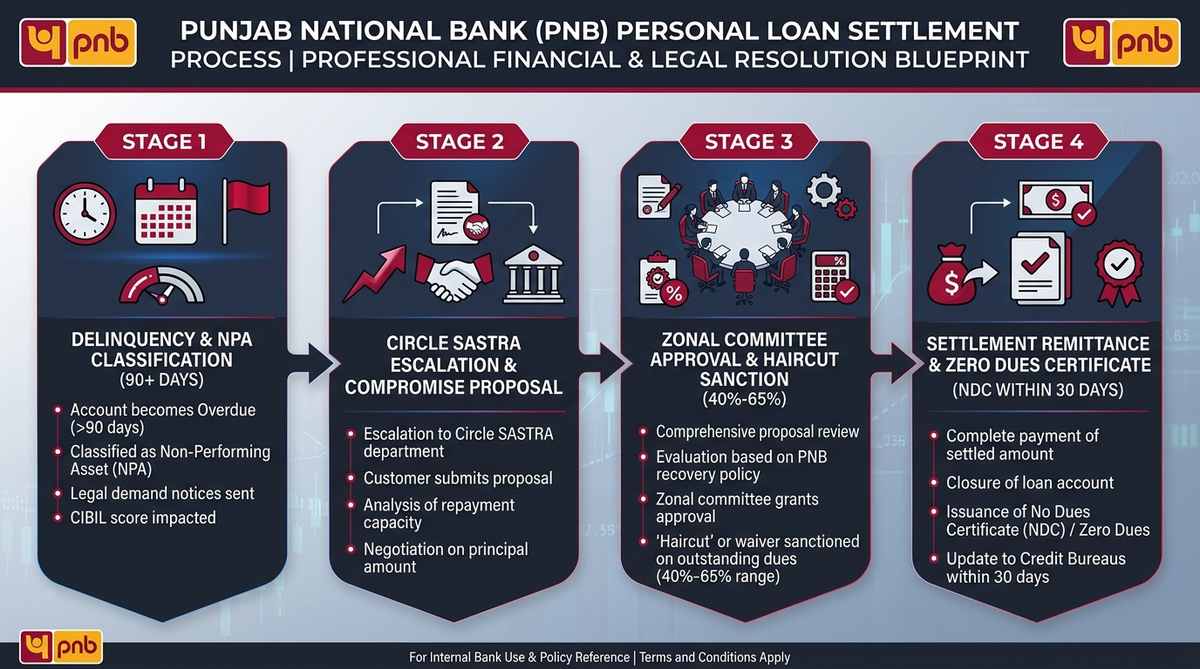
Punjab National Bank Personal Loan Settlement Process Flowchart
The visual blueprint below details the complete 4-stage resolution framework for Punjab National Bank personal loans, illustrating delinquency progression, Circle SASTRA escalation, Zonal Committee compromise valuation, and final ₹0 No Dues Certificate delivery.
PNB Special OTS Schemes, Delegated Powers & Recovery NPV Formula
Punjab National Bank operates under structured Board-approved Compromise Settlement Policies and periodically launches time-bound Special OTS Schemes designed to clean its retail balance sheet of non-performing loans. Under PNB's internal Delegation of Financial Powers (DFP), settlement authority is strictly tiered: local branch managers have limited waiver powers, Circle SASTRA Heads can approve moderate haircuts, while substantial waivers (40% to 65%) on higher balances require sanction by the Zonal Settlement Committee (ZSC) or the Head Office Credit Committee.
When evaluating an OTS petition, PNB does not act on sentiment; it applies a rigorous Net Present Value (NPV) Recovery Benchmark mandated by RBI Master Directions. The bank compares the guaranteed immediate cash recovery of a compromise offer against the discounted net recovery of prolonged litigation in Civil Courts or DRTs over 3 to 7 years.
Where C_t represents estimated recoveries in year t, r is PNB's cost of capital discount rate, and deductions account for multi-year court expenses, advocate retainers, and regulatory capital locked in 100% NPA balance-sheet provisioning.
Because an unsecured personal loan lacks tangible collateral that can be attached under SARFAESI, PNB recognizes that prolonged civil litigation yields low recovery efficiency. When an advocate presents a credible hardship dossier demonstrating that the borrower's insolvency is irreversible, PNB's settlement committee regularly approves substantial principal haircuts (40% to 65%) combined with a total 100% waiver of accrued penal interest.
PNB Recovery Agent Conduct Rules & Statutory Harassment Protections
Across its vast footprint in North and Central India, Punjab National Bank utilizes internal recovery officers for early arrears and assigns empanelled third-party Debt Recovery Agencies (DRAs) and Business Correspondents (BCs) for NPA accounts. However, all recovery personnel are bound by the strict statutory standards of the RBI Master Circular on Recovery Agents and Conduct, as well as landmark Supreme Court directives.
Borrowers possess clear, legally enforceable rights against unlawful recovery practices:
- Strict Permitted Calling Hours: Recovery agents may contact borrowers strictly between 08:00 AM and 07:00 PM. Late-night or early-morning calls are strictly prohibited by RBI guidelines.
- Prohibition of Workplace & Third-Party Contact: Agents are legally barred from visiting workplaces uninvited, creating scenes at office premises, or contacting colleagues, employers, and non-guarantor family members.
- Mandatory Identity & Authorization Credentials: Any visiting recovery executive must produce an official PNB authorization letter with DRA identity credentials and an official bank employee ID upon request.
- Zero Tolerance for Intimidation or Abuse: Verbal abuse, physical intimidation, social shaming, or threatening arrest constitutes an offense under Section 503 and 506 of the Indian Penal Code (or Bharatiya Nyaya Sanhita).
If PNB collection agents violate these statutory protections, borrowers should serve a formal legal cease-and-desist notice to the PNB Circle Head and Principal Nodal Officer, while simultaneously filing an online complaint on the RBI Integrated Ombudsman CMS Portal (cms.rbi.org.in).
The 6-Phase Step-by-Step PNB SASTRA Settlement Roadmap
Executing a legally sound, maximum-haircut One-Time Settlement with Punjab National Bank requires a disciplined, evidence-based legal strategy:
1Comprehensive Financial Audit & Hardship Dossier Compilation
Assemble comprehensive documentary proof evidencing bona fide, non-wilful financial distress. Crucial records include job termination letters, salary reduction slips, audited business balance sheets, hospital discharge summaries, or bank statements showing depleted liquidity. This proves the default is involuntary and qualifies for PSU compromise relief.
2Revoking NACH Mandates & Establishing Written Communication
Submit a formal mandate suspension request to your bank under NPCI rules to stop recurring NACH bounce penalties. Serve a formal written notice to PNB directing all communication to official email channels or through designated legal counsel, establishing a verifiable evidentiary audit trail.
3Submitting Formal Hardship Petition to Circle SASTRA Centre
Submit a formal OTS petition addressed to PNB's Circle SASTRA Head citing PNB's Board-approved Recovery Policy and the RBI Master Direction on Compromise Settlements. Anchor the initial settlement offer at 25% to 35% of principal dues to establish realistic room for structured counter-negotiations.
4Managing Counter-Demands & Structuring Committee Approvals
PNB will initially offer nominal concessions (10%–20%). Experienced banking advocates demonstrate that settlement funds are being pooled from external family assistance or non-banking liquidation, steering the Zonal Settlement Committee toward the target 40% to 65% principal waiver band.
5Rigorous Forensic Audit of the PNB OTS Sanction Letter
Before transferring any settlement funds, conduct a forensic audit of the sanction letter. Ensure it is printed on official PNB branch or SASTRA letterhead, signed by an authorized Chief Manager/Assistant General Manager with P.F. number, and explicitly confirms full debt extinguishment with withdrawal of all legal notices.
6Direct Account Remittance & Enforcing ₹0 NDC Delivery
Deposit the agreed settlement amount directly into your designated PNB loan account number via RTGS, NEFT, or CBS transfer. Under RBI Circular RBI/2023-24/60, PNB is legally required to deliver a formal No Dues Certificate and update credit bureaus within 30 calendar days.
National Lok Adalat Resolution, Sanction Forensics & Mandatory NDC Timeline
Punjab National Bank actively participates in the quarterly National Lok Adalat conducted across India under the Legal Services Authorities Act, 1987. During Lok Adalat sessions, PNB deputes authorized SASTRA officers empowered with special discount mandates (often approving 45% to 60% haircuts). A settlement award passed in Lok Adalat holds the legal status of a non-appealable Civil Court Decree, ensuring absolute finality and permanently terminating all Section 138 NI Act or Section 25 PSSA proceedings.
A grave danger during debt resolution is unauthorized collection agents issuing fabricated settlement letters to pocket partial payments. Borrowers must perform a rigorous 5-point forensic audit of any PNB OTS sanction letter before depositing funds:
- Official PNB Letterhead: Verify the letter is printed on official Punjab National Bank letterhead with branch code, BSR code, and official contact details.
- Authorized Signatory Credentials: Ensure the letter is signed by an authorized officer (Chief Manager, AGM, or Circle SASTRA Head) with employee P.F. number and official bank stamp.
- Unambiguous Debt Extinguishment Clause: Confirm the letter explicitly states that the payment represents full and final settlement, releasing the borrower from all further claims.
- Direct Loan Account Remittance: Payments must be deposited strictly into the borrower's PNB loan account number—never into individual or agency accounts.
- Statutory 30-Day NDC Delivery: Under RBI Circular RBI/2023-24/60, PNB is legally mandated to deliver the formal No Dues Certificate within 30 days or pay ₹5,000 daily compensation.
CIBIL Score Recovery Post-Settlement & Resolution Avenue Comparison
Following full payment of the agreed settlement amount, Punjab National Bank updates all four licensed credit bureaus (TransUnion CIBIL, Experian, Equifax, CRIF High Mark) with the status 'Settled' or 'Post-Write-off Settled' with an outstanding balance of exactly ₹0. While this results in a temporary credit score drop of 75 to 150 points and a mandatory 12-month cooling period before fresh unsecured credit can be accessed, it completely halts active compounding default entries.
Borrowers can systematically restore their credit profile to 750+ within 18 to 24 months by securing a fixed-deposit-backed credit card (FD card), maintaining credit utilization strictly below 25%, and maintaining a flawless repayment track record on all utility bills and surviving credit obligations.
| Resolution Avenue | Principal Haircut Range | Legal Finality | CIBIL Reporting Status | Resolution Timeline |
|---|---|---|---|---|
| Direct Circle SASTRA OTS | 40% – 65% Principal Haircut | Complete (PNB NDC Issued) | 'Settled' / ₹0 Balance | 3 to 6 Weeks |
| National Lok Adalat | 45% – 65% Principal Haircut | Absolute (Civil Court Decree) | 'Settled' / ₹0 Balance | Quarterly Lok Adalat Cycles |
| Standard Restructuring | 0% Haircut (Tenure Extension) | Conditional on Ongoing EMIs | 'Restructured' / Active Debt | 2 to 4 Weeks |
| Civil Court / DRT Litigation | Uncertain (Judicial Discretion) | Subject to Multi-Year Appeal | 'Suit Filed' / Open Default | 3 to 7 Years |
Professional Legal Representation for Punjab National Bank Settlements
Settling a defaulted personal loan with a major public sector lender like Punjab National Bank requires specialized knowledge of PSU banking hierarchies, Circle SASTRA procedures, and RBI Master Directions. SettleLoans provides end-to-end legal and financial representation to protect your family from recovery harassment, reply to statutory Section 138/25 notices, and negotiate directly with PNB Zonal Committees for maximum debt relief.

Settle Loan is India's trusted debt relief and loan settlement platform. We help borrowers overcome financial distress by negotiating with banks and NBFCs to legally settle personal loans and credit card debts. With our transparent, performance-based approach, you can achieve debt freedom and regain your financial peace of mind.
COMPUTER
Frequently Asked Questions About PNB Personal Loan Settlement
What is the Punjab National Bank (PNB) personal loan settlement process and how does it operate?
The Punjab National Bank loan settlement process is a structured debt resolution mechanism governed by PNB's Board-approved Recovery & Compromise Settlement Policy and RBI Master Directions. When an unsecured personal loan defaults beyond 90 days and enters Non-Performing Asset (NPA) status, the file is escalated from the originating branch to PNB's Circle SASTRA Centre (Stressed Assets Stabilization and Recovery Branch). The borrower submits a formal hardship petition supported by verifiable financial distress records. PNB's Competent Settlement Committee evaluates the proposal against Net Present Value (NPV) recovery benchmarks. Upon approval, PNB issues a stamped OTS Sanction Letter, and once the agreed compromised amount is remitted directly into the loan account, the bank delivers a formal ₹0 No Dues Certificate (NDC).
What percentage of debt waiver or haircut does Punjab National Bank offer on personal loans?
Punjab National Bank typically sanctions principal haircuts between 40% and 65% of the total ledger balance on defaulted unsecured personal loans, pension loans, and digital credit lines. The achievable waiver depends on the NPA aging bucket (Substandard, Doubtful D1/D2/D3, or Loss Asset), the level of balance-sheet provisioning already absorbed by PNB (ranging from 15% to 100%), and the verifiability of the borrower's insolvency. Under standard compromise terms, 100% of accumulated penal interest, compounding late fees, and cheque return charges are completely waived.
What are PNB SASTRA Centres and what authority do they have in loan settlements?
SASTRA (Stressed Assets Stabilization and Recovery) Centres are PNB's dedicated specialized branches established at the Circle and Zonal levels to handle, manage, and resolve non-performing retail and commercial loan portfolios. When a personal loan defaults past 90 to 120 days, local branch managers lose discretionary sanctioning powers, and recovery operations transfer entirely to SASTRA. SASTRA committees possess the delegated financial powers to evaluate compromise settlements, sanction substantial principal haircuts, and issue legally binding OTS Sanction Letters.
Can Punjab National Bank freeze or debit my savings account under Section 171 Banker's Lien?
Yes. Under Section 171 of the Indian Contract Act, 1872 (Banker's General Lien and Right of Set-Off), Punjab National Bank has the statutory right to freeze, place a debit hold, or set off funds from any savings, salary, current, or fixed deposit account maintained across any PNB CBS branch under the same Customer Identification File (CIF) or PAN. However, PNB has zero legal authority to unilaterally freeze, debit, or attach bank accounts maintained with other independent banking institutions (such as SBI, HDFC, ICICI, or Bank of Baroda) without a formal attachment order issued by a competent Civil Court or DRT.
How should borrowers handle Section 138 NI Act and Section 25 PSSA legal notices from PNB?
When repayment cheques or automated NACH mandates bounce due to insufficient funds, PNB's empanelled legal counsels issue statutory 15-day demand notices under Section 138 of the Negotiable Instruments Act, 1881, or Section 25 of the Payment and Settlement Systems Act, 2007 (PSSA). Borrowers must never ignore these notices. A formal legal reply drafted by experienced debt defense advocates must be served within 15 days, explaining bona fide financial incapacity, disputing inflated penal calculations, and formally proposing a compromise One-Time Settlement to avert magistrate court complaints.
What are PNB recovery agent conduct rules and how can borrowers stop collection harassment?
PNB recovery agents, business correspondents, and empanelled Debt Recovery Agencies (DRAs) are bound by the RBI Master Directions on Recovery Agents and PNB's Fair Practices Code. Key protections include: (1) Calling is restricted strictly between 08:00 AM and 07:00 PM; (2) Visiting workplaces uninvited or contacting employers, colleagues, and relatives is prohibited; (3) Intimidation, abusive language, and threats are illegal; (4) Visiting agents must show a valid identity card and PNB authorization letter. Violations should be escalated immediately to PNB's Circle Head, Principal Nodal Officer, and the RBI Integrated Ombudsman on CMS portal.
Can PNB personal loans be settled through the National Lok Adalat?
Yes. Punjab National Bank extensively utilizes the quarterly National Lok Adalat organized by the National Legal Services Authority (NALSA) and State Legal Services Authorities across North and Central India. PNB deputes authorized SASTRA officers with pre-approved settlement discount mandates to Lok Adalat benches. A settlement award passed in Lok Adalat holds the legal status of a non-appealable Civil Court Decree under the Legal Services Authorities Act, 1987, ensuring permanent legal finality and extinguishing all pending court proceedings.
What is the timeline for PNB to issue the No Dues Certificate (NDC) under RBI rules?
Under RBI Circular RBI/2023-24/60, Punjab National Bank is legally mandated to deliver a formal No Dues Certificate (NDC) / Loan Closure Letter and update all credit information companies (CIBIL, Experian, Equifax, CRIF High Mark) within 30 calendar days of receiving full settlement payment. If PNB fails to deliver the closure certificate within 30 days without lawful justification, the bank is statutorily liable to pay compensation of ₹5,000 per day of delay directly to the borrower.
How does settling a PNB personal loan impact my CIBIL score and credit profile?
Following settlement payment, PNB updates credit bureaus with the status 'Settled' or 'Post-Write-off Settled' with an outstanding balance of ₹0. While this leads to an initial credit score drop of 75 to 150 points and a mandatory 12-month cooling period under RBI compromise guidelines before fresh unsecured borrowing, it halts active compounding default markers. Borrowers can restore their CIBIL score back to 750+ within 18 to 24 months through disciplined credit rebuilding using secured credit instruments.
What precautions must be taken before paying settlement funds to Punjab National Bank?
Borrowers must follow five vital safeguards: (1) Never pay based on verbal assurances or WhatsApp messages from recovery agents; (2) Insist on an authentic OTS Sanction Letter on official PNB branch/SASTRA letterhead with bank seal and officer signature/P.F. number; (3) Verify that the sanction letter explicitly confirms full debt discharge upon payment; (4) Remit funds strictly into your designated PNB loan account number via RTGS, NEFT, or CBS transfer—never into individual or agency accounts; (5) Obtain an immediate stamped PNB bank receipt upon remittance.