- Statutory Compromise Rights: Unsecured loan default is purely a civil contractual dispute governed by the Indian Contract Act, 1872. Borrowers in Indore and Madhya Pradesh maintain legal rights under RBI Master Directions to seek a structured One-Time Settlement (OTS).
- Harassment Defense: Aggressive debt collection tactics—including workplace visits in Vijay Nagar, market intrusions in Sarafa or Siyaganj, and third-party calling—violate RBI Fair Practices Codes and can be halted through formal cease-and-desist legal notices.
- Realistic 45%–65% Debt Waivers: Once an unsecured personal or business loan crosses 90 to 180 Days Past Due (DPD) and transitions into Non-Performing Asset (NPA) status, banks and NBFCs absorb mandatory provisioning and routinely approve substantial principal haircuts.
- District Court & Lok Adalat Defense: Experienced debt settlement advocates in Indore handle Section 138 NI Act cheque bounce complaints and Section 25 PSSA summons at the District Court Complex and secure binding compromise decrees at DLSA National Lok Adalat sessions.
- Mandatory ₹0 NDC Guarantee: Under RBI Circular RBI/2023-24/60, lenders must issue an official No Dues Certificate and update credit bureaus within 30 days of settlement payment, backed by a statutory ₹5,000 per day penalty for non-compliance.
The Economic Reality of Debt Distress in Indore: Commercial
Indore stands as the unchallenged commercial, financial, and industrial capital of Madhya Pradesh and the broader Malwa region. The city's rapid economic expansion over the past decade has created a vibrant, dual-structured credit ecosystem. On one side lies the traditional commercial trading core centered in historic markets—such as the Sitlamata Cloth Market, the Sarafa bullion exchange, Siyaganj wholesale trade corridors, Marothia, and the transport terminals of Loha Mandi. On the other side sits a modern, fast-growing service and manufacturing economy anchored by IT campuses in Vijay Nagar and the Super Corridor, alongside heavy industrial belts in Pithampur, Sanwer Road, Dewas, and Dhar.
To fuel this rapid commercial growth and consumer lifestyle expansion, commercial banks (such as HDFC Bank, ICICI Bank, Axis Bank, Kotak Mahindra Bank, State Bank of India, and IndusInd Bank) and major Non-Banking Financial Companies (including Bajaj Finance, Aditya Birla Capital, Tata Capital, Poonawalla Fincorp, Piramal Finance, and instant fintech lenders) disbursed tens of thousands of unsecured personal loans, business installment facilities, and revolving credit lines across Indore, Bhopal, and neighboring districts.
However, when external macroeconomic headwinds strike—such as unexpected business cash-flow contractions, wholesale trade payment delays, client insolvencies in manufacturing clusters, tech-sector job restructuring, or catastrophic family medical emergencies—borrowers find themselves trapped in acute financial distress. An initial equated monthly installment (EMI) default quickly triggers automated punitive charges, compounding default interest, and aggressive collection recovery measures.
It is essential for distressed borrowers in Indore to understand that defaulting on an unsecured personal loan, credit card account, or commercial credit line is strictly a civil contractual matter governed by the Indian Contract Act, 1872. Financial default is not a criminal offense. Under the regulatory oversight of the Reserve Bank of India (RBI), borrowers possess enforceable statutory rights to halt third-party collection harassment, challenge predatory penalty levies, and negotiate an authorized compromise One-Time Settlement (OTS) through experienced legal representation.
Delinquency Lifecycle & Bank Provisioning: From SMA-0 to Non-Performing Asset (NPA)
Under the Reserve Bank of India's Prudential Norms on Income Recognition, Asset Classification and Provisioning (IRACP) and Expected Credit Loss (ECL) frameworks under Indian Accounting Standard 109 (Ind AS 109), financial institutions operating in Madhya Pradesh classify delinquent loan facilities into precise Days Past Due (DPD) categories. Understanding how lenders manage these delinquency buckets is crucial for determining the strategic window to execute an optimal debt settlement.
During the initial 1 to 60 days of default (Special Mention Account stages SMA-0 and SMA-1), bank branch managers and call centers focus exclusively on regularizing the overdue installments. However, once an account reaches 90 continuous days of non-payment, the loan is formally classified as a Non-Performing Asset (NPA). At this critical transition, the lender is legally required to freeze interest income accrual and allocate mandatory capital provisions from its balance sheet, shifting the bank's institutional focus from installment collection to loss minimization and capital recovery.
| Delinquency Stage | Overdue Days (DPD) | Lender Recovery Strategy in Indore | Legal Exposure & Court Notices | Settlement Haircut Potential |
|---|---|---|---|---|
| SMA-0 (Early Overdue) | 1 – 30 Days | Automated SMS warnings, IVR tele-calls, multiple electronic NACH presentations. | Zero judicial action; credit bureau DPD counter begins recording default. | Negligible (Bank demands 100% full EMI clearance). |
| SMA-1 (Mid Delinquency) | 31 – 60 Days | Intensive tele-calling, outsourced agency assignment, loan acceleration notices. | Formal loan recall warning letters; sharp decline in CIBIL score. | Low (Tenure extension or EMI restructuring evaluated). |
| SMA-2 (Pre-NPA Escalation) | 61 – 90 Days | Field visits by recovery personnel, intense pressure on co-borrowers or references. | Section 138 NI Act or Section 25 PSSA 15-day statutory demand notices issued. | Moderate (Waiver of late payment fees can be initiated). |
| NPA (Substandard Asset) | 91 – 180 Days | Account transferred to Zonal Stressed Assets Resolution Desk; Ind AS 109 capital provisioning. | JMFC Court summons under Sec 138/25; National Lok Adalat pre-litigation notices. | High (35%–50% Principal Waiver). |
| Doubtful / Written-Off Asset | 181 – 365+ Days | Substantial balance-sheet provisions booked; technical loss write-off executed. | Civil summary recovery suits (Order 37 CPC), private arbitration claims, Lok Adalat awards. | Maximum (50%–65% Principal Waiver). |
When an unsecured personal loan or commercial credit facility in Indore reaches Doubtful Asset classification or undergoes technical write-off, the bank has already recognized the financial loss on its audited financial statements. Consequently, when an experienced loan settlement lawyer presents a structured, lump-sum settlement proposal backed by verifiable hardship proof, it represents an immediate cash write-back to the bank's operating profit, incentivizing Zonal Credit Committees to sanction substantial debt waivers.
Check Your Loan Settlement Options
Answer 2 quick questions to evaluate your settlement eligibility.
1. What type of loan do you want to settle?
Defending Against Aggressive Recovery Tactics & Stopping Unauthorized NACH Bounces in Indore
In regional commercial centers like Indore and Bhopal, third-party Debt Recovery Agencies (DRAs) employed by major private banks and NBFCs frequently deploy aggressive, coercive collection methods. Borrowers across residential localities—such as Vijay Nagar, Palasia, Sudama Nagar, Scheme 54, Scheme 78, Annapurna, and Rau—routinely report unsolicited home visits, aggressive shouting, and unlawful threats of police arrest. In commercial markets like Sarafa, Siyaganj, and Sitlamata Cloth Market, recovery agents often attempt public shaming by visiting retail shops during business hours.
The Reserve Bank of India Master Direction on Recovery Agents and NBFC Fair Practices Code establish strict, non-negotiable legal protections that recovery personnel must follow:
- Strict Calling & Visiting Hours: Recovery agents are legally restricted to contacting or visiting borrowers between 08:00 AM and 07:00 PM only.
- Absolute Prohibition on Third-Party Contact: Reaching out to employers, colleagues, business clients, neighbors, or non-guarantor family members is strictly illegal under RBI consumer protection regulations.
- Prohibition of Intimidation & Abusive Conduct: Using abusive language, making physical threats, creating public scenes at retail shops, or disrupting corporate offices is punishable under civil and criminal law.
- Mandatory Identification: Field recovery personnel must carry official identity cards, formal bank authorization letters, and Indian Institute of Banking & Finance (IIBF) DRA certifications.
Simultaneously, lenders frequently present electronic National Automated Clearing House (NACH) mandates multiple times a month against empty bank accounts. Each failed presentation triggers return penalties from both the borrower's home bank (₹250 to ₹500 plus GST) and the lender (₹500 to ₹1,000 plus GST), draining funds and compounding ledger debt. Under National Payments Corporation of India (NPCI) guidelines, borrowers have the statutory right to instruct their destination bank to cancel or freeze the e-NACH mandate. During legal settlement negotiations, your advocate demands a 100% complete waiver of all accumulated bounce fees and penal charges.
RBI Compromise Settlement Framework & Net Present Value (NPV) Valuation Economics
Under the landmark Reserve Bank of India Master Direction on Compromise Settlements and Technical Write-offs (DOR.STR.REC.20/21.04.048/2023-24), all regulated commercial banks, NBFCs, and housing finance companies are required to maintain a transparent, board-approved compromise settlement policy. Rather than relying on arbitrary discretion, senior credit committees evaluate settlement proposals using an institutional Net Present Value (NPV) recovery methodology.
Because unsecured personal loans, credit card balances, and clean business credit lines have no underlying physical collateral (such as real estate or machinery) that can be seized under the SARFAESI Act, a bank must evaluate whether an immediate lump-sum settlement offer yields a superior economic return compared to initiating prolonged civil court litigation in Indore courts.
Where C_t represents estimated recoveries, r is the discount rate, and deductions account for 3–5 years of court friction and capital locked in NPA provisions.
When legal counsel demonstrates that legal recovery through civil courts would require 3 to 5 years of litigation retainers, judicial court fees, advocate appearance expenses, and ongoing balance-sheet capital lock-in, the bank's internal financial model proves that accepting a 45% to 65% cash settlement immediately delivers higher net present value than pursuing an insolvent borrower.
Realistic Loan Settlement Haircut Slabs for Indore & MP Borrowers
| Debt Category | Delinquency Bucket | Penal & Bounce Waiver | Principal Haircut Range | Optimal Settlement Target |
|---|---|---|---|---|
| Unsecured Personal Loan | 90 – 180 Days (NPA) | 100% Complete Waiver | 35% – 50% Principal Waiver | Pay 45%–55% of Core Principal |
| Unsecured Personal Loan | 180 – 365+ Days (Written Off) | 100% Complete Waiver | 50% – 65% Principal Waiver | Pay 35%–45% of Core Principal |
| Credit Card Outstanding | 90 – 180+ Days (NPA) | 100% Interest & Late Fees | 55% – 70% Total Waiver | Pay 30%–40% of Total Dues |
| MSME Unsecured Business Loan | 90 – 180 Days (NPA) | 100% All Penal Charges | 35% – 50% Principal Waiver | Pay 45%–55% of Disbursed Dues |
| Fintech Instant Loan App | 60 – 180+ Days (Default) | 100% Compound Fees | 50% – 65% Principal Waiver | Pay 35%–45% of Net Principal |
Indore Personal Loan Settlement & Lok Adalat Legal Defense Blueprint
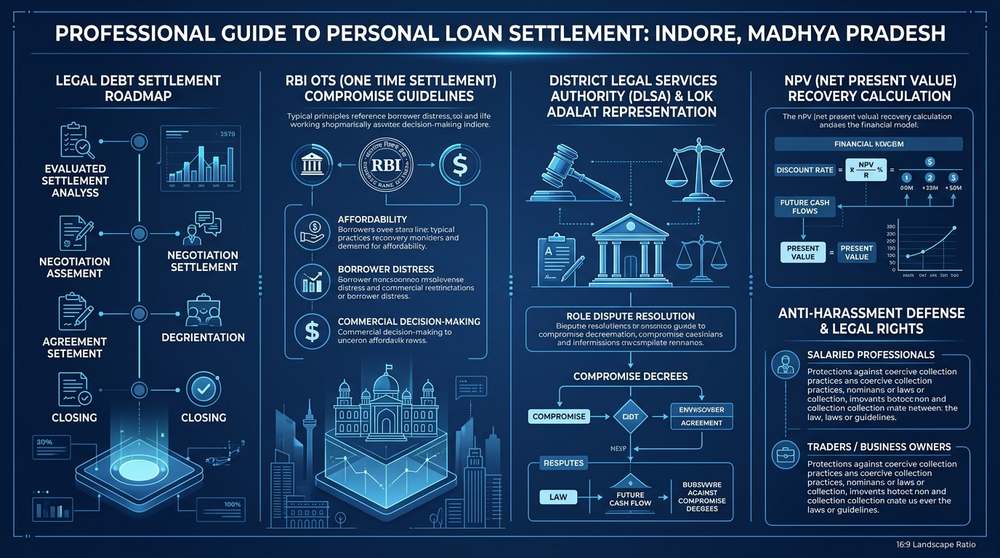
Navigating Section 138 NI Act, Section 25 PSSA & Civil Suits in Indore Courts
When an unsecured personal loan or commercial credit facility enters chronic default, lenders routinely initiate quasi-criminal and civil proceedings across the District & Sessions Court Complex in Indore (located near Kothari Market and M.G. Road) and the Judicial Magistrate First Class (JMFC) courts. The two most common legal mechanisms employed by lenders are:
1. Section 138 of the Negotiable Instruments Act (Cheque Bounce): Lenders present security cheques collected during loan origination. If dishonoured due to insufficient funds, the lender serves a mandatory 15-day statutory demand notice followed by a criminal complaint in the JMFC court.
2. Section 25 of the Payment and Settlement Systems Act (NACH Dishonour): When automated electronic NACH mandates fail, lenders issue 15-day demand notices under Section 25 PSSA, which carries quasi-criminal penalties similar to Section 138.
Receiving a statutory legal notice or court summons is not an arrest warrant. Under the Code of Criminal Procedure, 1973 (CrPC) and the Bharatiya Nagarik Suraksha Sanhita (BNSS), Section 138 and Section 25 offenses are bailable, compoundable offenses. When an experienced loan settlement lawyer in Indore represents the borrower, counsel enters an appearance, secures bail if required, presents bona fide documentary proof of commercial insolvency, and formally requests the court to refer the dispute for compromise conciliation.
Additionally, for lenders attempting to initiate unilateral private arbitration in distant metropolitan venues (such as Mumbai or Delhi), landmark Supreme Court precedents—including Perkins Eastman Architects DVM v. HSCC (India) Ltd. and TRF Ltd. v. Energo Engineering Projects Ltd.—confirm that unilateral arbitrator appointments without mutual written consent are legally invalid. Your advocate can challenge the arbitrator's jurisdiction under Section 12 and Section 14 of the Arbitration and Conciliation Act, 1996, effectively halting biased ex-parte awards.
Resolving Bank Defaults Through District Legal Services Authority (DLSA) Lok Adalat in Indore
One of the most effective, legally binding, and cost-efficient mechanisms for resolving delinquent personal and business loans in Madhya Pradesh is through the quarterly National Lok Adalats organized by the District Legal Services Authority (DLSA) Indore, under the statutory mandate of the Legal Services Authorities Act, 1987.
Held at the District Court Complex on M.G. Road, Indore, Lok Adalat conciliation benches consist of sitting or retired judicial officers, senior advocates, and social legal experts. Prior to the Lok Adalat session, commercial banks and NBFCs provide their designated regional officers with pre-approved settlement mandates featuring substantial debt discount authority (often granting 45% to 65% debt waivers on unsecured portfolios).
Navigating a Lok Adalat settlement with advocate representation delivers immense legal and financial benefits:
- Judicial Status of Civil Court Decree: An award passed by the Lok Adalat holds the identical legal authority of a decree passed by a Principal Civil Court.
- Zero Appealability: Under Section 21 of the Legal Services Authorities Act, 1987, a Lok Adalat award is non-appealable. Once signed, the bank cannot file future claims or reopen the settled balance.
- Instant Case Disposal: All pending Section 138 NI Act, Section 25 PSSA, or recovery suits linked to the loan account are formally disposed of and permanently dismissed.
- Complete Refund of Court Fees: Where a civil suit was previously instituted by the lender, the full court fee is refunded under state legal service rules, reducing the lender's legal overhead and encouraging higher haircuts.
Step-by-Step Roadmap: How to Settle Defaulted Personal & Business Loans in Indore
Achieving a legally watertight One-Time Settlement with substantial debt waivers requires a structured, multi-phase legal and financial strategy:
1Financial Forensic Audit & Hardship Dossier Compilation
Compile comprehensive documentary proof demonstrating genuine, non-wilful financial incapacity. Essential documents include audited business financial statements, GST return filings showing revenue declines, salary termination letters, medical treatment records, or bank statements showing depleted liquidity. This establishes that the default is bona fide and qualifies for compromise relief under RBI rules.
2Mandate Cancellation & Enforcing Communication Channels
Instruct your bank in Indore to suspend or cancel the e-NACH auto-debit mandate to halt recurring return fees. Issue a formal legal notice directing the lender to channel all communications exclusively in writing through designated legal counsel, establishing a verifiable evidentiary trail.
3Submitting Formal Hardship Petition to Stressed Assets Desk
Submit a detailed compromise settlement petition directly to the bank or NBFC's Zonal Stressed Assets Committee in Indore or Bhopal, citing the RBI Master Direction on Compromise Settlements. Anchor the initial opening settlement offer at 25% to 35% of core dues to preserve negotiating leverage.
4Managing Counter-Demands & Credit Committee Approval
Lenders will initially reject low opening bids and propose nominal 10%–15% concessions. Your legal advocate counters by presenting empirical recovery friction data and proving that funds are being pooled from third-party relatives, securing final sanction within the target 45% to 65% debt waiver band.
5Rigorous Forensic Audit of the OTS Sanction Letter
Before making any remittance, your advocate conducts a thorough audit of the OTS Sanction Letter to ensure it is printed on official corporate letterhead, contains valid reference numbers, specifies exact settlement amounts, and explicitly covenants to withdraw all pending legal notices and court complaints.
6Direct Account Remittance & ₹0 NDC Delivery Enforcement
Remit the agreed settlement sum directly into your designated loan account via RTGS/NEFT. Under RBI Circular RBI/2023-24/60, the lender is legally required to deliver a formal No Dues Certificate and update credit bureaus within 30 calendar days.
Forensic Verification of Settlement Sanction Letters & Enforcing the ₹0 NDC Mandate
A major hazard encountered by distressed borrowers in Indore involves unauthorized recovery agents issuing fake or fraudulent settlement letters. Third-party agents under pressure to meet monthly targets frequently produce unverified letters or accept verbal assurances, crediting payments as partial recoveries against late fees while leaving the default active and compounding.
To guarantee legal validity, your loan settlement lawyer performs a comprehensive forensic audit on every OTS sanction letter:
- Official Corporate Letterhead: The document must be printed on authentic letterhead featuring the bank or NBFC's Corporate Identification Number (CIN), registered office address, and official corporate logo.
- Specific Account Identifiers: The letter must explicitly cite the borrower's full name, PAN, unique loan account number, and original outstanding ledger dues.
- Clear Settlement Terms: It must state the exact negotiated settlement figure, the strict payment due date (or installment schedule), and the official bank collection account.
- Complete Debt Discharge Covenant: The sanction letter must unequivocally state that upon receipt of the settlement amount, all outstanding claims are extinguished and all pending legal proceedings (such as Section 138 NI Act or arbitration) will be formally withdrawn.
Under Reserve Bank of India Circular RBI/2023-24/60, all regulated commercial banks and NBFCs are legally mandated to deliver an official No Dues Certificate (NDC) and remove all security liens within 30 calendar days of receiving full settlement payment. If the lender fails to deliver the NDC within 30 days without lawful justification, it is statutorily liable to pay compensation of ₹5,000 per day of delay directly to the borrower.
CIBIL Score Trajectory Post-Settlement & 18-Month Credit Rehabilitation Roadmap
Executing a One-Time Settlement with a bank or NBFC results in the account being reported to all four licensed credit information companies in India (TransUnion CIBIL, Experian, Equifax, and CRIF High Mark) with the status 'Settled' or 'Post-Write-off Settled' with an outstanding balance of exactly ₹0. This reporting causes an initial credit score drop of 75 to 150 points.
Under RBI compromise directives, a mandatory 12-month cooling-off window applies before fresh unsecured credit lines can be approved. However, a 'Settled' status with ₹0 balance is vastly superior to an active, compounding 'Default' status that degrades credit scores every month and invites ongoing litigation in court.
Borrowers in Indore can systematically restore their credit profile to 750+ within 18 to 24 months by following a disciplined rehabilitation plan:
- Secured Credit Card (FD Card): Open a fixed deposit of ₹25,000 to ₹50,000 with a bank and obtain a secured credit card.
- Strict Credit Utilization: Maintain monthly credit utilization strictly between 15% and 25% of the allocated limit.
- Flawless Payment Track Record: Pay 100% of the credit card bill on time before the due date every month without carrying rolling balances.
- Credit Bureau Audits: Periodically pull official CIBIL and Experian reports to verify that the settled loan account reflects an outstanding balance of ₹0.
Why Borrowers in Indore & Madhya Pradesh Choose SettleLoans
Navigating complex banking regulations, high-stakes debt negotiations, and aggressive collection tactics requires experienced legal counsel and seasoned financial strategists. SettleLoans provides end-to-end debt resolution for salaried professionals, wholesale traders, and MSME entrepreneurs across Indore, Bhopal, Ujjain, Dewas, and Jabalpur. We halt recovery harassment, defend Section 138 and Section 25 court notices, represent clients at DLSA Lok Adalat sessions, and negotiate directly with bank credit committees for maximum lawful debt waivers.

Settle Loan is India's trusted debt relief and loan settlement platform. We help borrowers overcome financial distress by negotiating with banks and NBFCs to legally settle personal loans and credit card debts. With our transparent, performance-based approach, you can achieve debt freedom and regain your financial peace of mind.
COMPUTER
Frequently Asked Questions About Personal Loan Settlement in Indore
Why do borrowers in Indore need a specialized loan settlement lawyer rather than dealing with recovery agents?
Third-party collection agents operating in Indore work on aggressive recovery commissions and lack legal authority to sanction debt discounts. A specialized loan settlement lawyer in Indore understands the Reserve Bank of India Master Directions on Compromise Settlements, invokes statutory anti-harassment protections, defends against Section 138 NI Act or Section 25 PSSA notices in Indore District Courts, and negotiates directly with bank Zonal Stressed Asset Committees for authentic 45% to 65% OTS debt waivers.
Can banks or NBFC recovery agents visit my shop in Sarafa, Siyaganj, or office in Vijay Nagar without notice?
No. Under the RBI Master Circular on Recovery Agents and NBFC Fair Practices Code, recovery personnel cannot visit a borrower's workplace, retail shop, or residence without prior written notice, cannot visit outside 08:00 AM to 07:00 PM, cannot use abusive language, and are strictly prohibited from disclosing debt details to customers, co-workers, neighbors, or business partners. Violations entitle borrowers to serve formal legal cease-and-desist notices and escalate complaints to the RBI Integrated Ombudsman (CMS).
What percentage of loan waiver can salaried employees and traders in Indore negotiate in an OTS?
For unsecured personal loans, credit card balances, and unsecured MSME business facilities overdue past 90 to 180 days (classified as Non-Performing Assets), banks and NBFCs in Indore typically sanction principal waivers between 45% and 65%, alongside a 100% complete waiver of all accumulated late fees, penal interest, and NACH bounce penalties. The exact haircut depends on asset aging, balance-sheet provisioning, and documented insolvency.
How does the District Legal Services Authority (DLSA) National Lok Adalat in Indore resolve loan defaults?
The Indore District Legal Services Authority conducts quarterly National Lok Adalats at the District Court Complex on M.G. Road. In Lok Adalat sessions, sitting judges and judicial mediators facilitate pre-litigation compromise conciliation between borrowers and bank representatives. The agreed settlement is recorded as a Lok Adalat Award, which carries the legal force of a binding, non-appealable Civil Court Decree under the Legal Services Authorities Act, 1987.
Can a borrower in Indore be arrested or face police action for personal loan EMI defaults?
No. Defaulting on an unsecured personal loan or commercial credit facility is purely a civil contractual dispute governed by the Indian Contract Act, 1872. Police stations in Indore and Madhya Pradesh have no legal jurisdiction to register FIRs, summon borrowers, or make arrests for genuine financial insolvency. If recovery callers falsely claim police involvement, your advocate can issue criminal intimidation notices under the Bharatiya Nyaya Sanhita (BNS).
How should borrowers in Indore respond to a Section 138 NI Act or Section 25 PSSA court summons?
When a cheque or electronic NACH mandate bounces, lenders may file complaints under Section 138 of the Negotiable Instruments Act or Section 25 of the Payment and Settlement Systems Act in the Judicial Magistrate First Class (JMFC) court in Indore. Borrowers must engage an advocate to enter an appearance, obtain bail where applicable, establish genuine commercial hardship, challenge excessive presentation charges, and convert the dispute into an official OTS compromise settlement.
How do you stop recurring NACH mandate bounce charges across Indore bank branches?
Under National Payments Corporation of India (NPCI) procedural guidelines and RBI consumer directives, a borrower has the statutory right to instruct their home branch in Indore (or via net banking) to cancel or suspend the e-NACH mandate linked to the defaulted loan. Furthermore, during compromise settlement negotiations, your legal counsel demands a 100% full waiver of all compounded bounce fees.
How does personal loan settlement affect CIBIL scores in Indore, and how can credit be restored?
Upon receiving the sanctioned settlement sum, the lender reports the loan status as 'Settled' or 'Post-Write-off Settled' with an outstanding balance of ₹0 to TransUnion CIBIL, Experian, Equifax, and CRIF High Mark. While this results in an initial credit score drop of 75 to 150 points, it halts compounding default records. Borrowers can rebuild their CIBIL score to 750+ within 18 to 24 months through disciplined secured credit cards and prompt utility payments.
What essential forensic checks must be conducted on an Indore bank OTS sanction letter?
Before remitting any settlement payment, your legal counsel must audit the OTS sanction letter to verify that: (1) It is issued on official bank/NBFC corporate letterhead; (2) Contains the correct loan account numbers, borrower name, and CIN; (3) Explicitly states the agreed settlement amount and payment due dates; (4) Confirms that upon payment all legal proceedings will be withdrawn; and (5) Guarantees the issuance of a formal ₹0 No Dues Certificate (NDC) within 30 days under RBI Circular RBI/2023-24/60.
How long does a bank take to deliver the No Dues Certificate (NDC) after settlement in Madhya Pradesh?
Under Reserve Bank of India Circular RBI/2023-24/60, all regulated commercial banks and NBFCs are legally mandated to issue a formal No Dues Certificate and update credit bureau records within 30 calendar days of receiving full settlement payment. If the lender fails to deliver the NDC within 30 days without lawful reason, it is statutorily liable to pay compensation of ₹5,000 per day of delay directly to the borrower.
Official Regulatory References & Statutory Circulars
- Reserve Bank of India (RBI): Master Direction on Compromise Settlements and Technical Write-offs (DOR.STR.REC.20/21.04.048/2023-24)
- RBI Master Circular: Fair Practices Code for Non-Banking Financial Companies (NBFCs) & Commercial Banks
- Reserve Bank - Integrated Ombudsman Scheme, 2021: Online Portal for Complaints on Recovery Harassment & Excessive NACH Charges
- National Legal Services Authority (NALSA): Legal Services Authorities Act, 1987 — National Lok Adalat Conciliation Framework
- High Court of Madhya Pradesh (Indore Bench): Case Law Precedents on Debt Recovery, Order 37 CPC & Section 138 NI Act