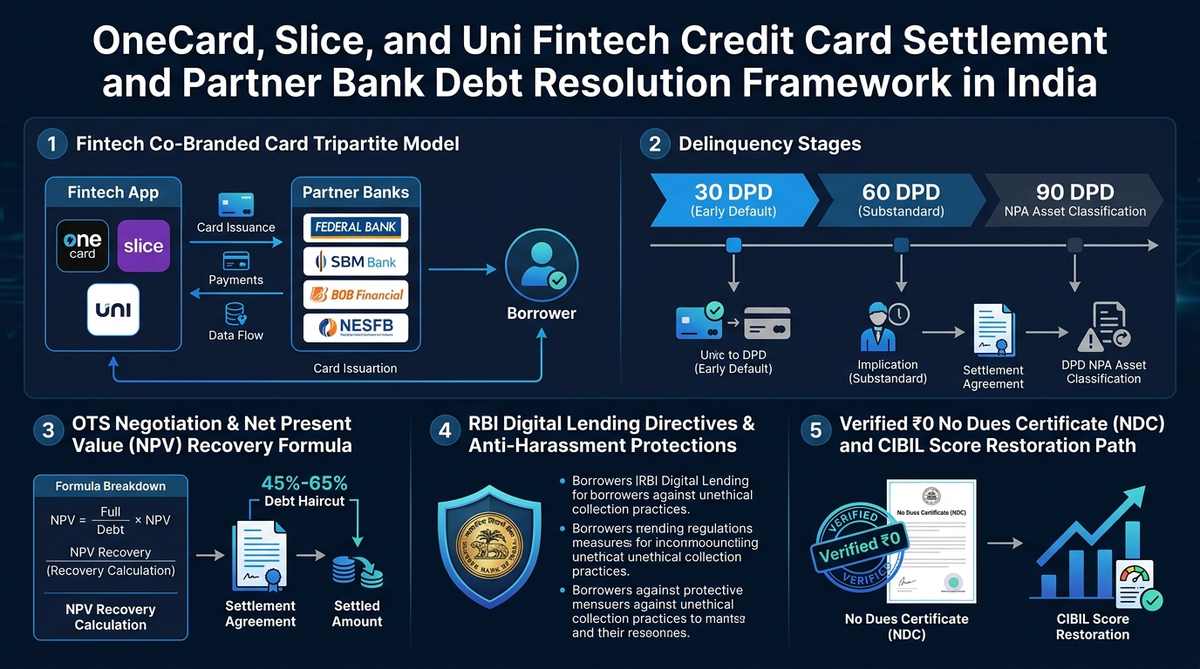
- Partner Bank Reality: Fintech cards are backed by banks like Federal Bank, SBM Bank India, BOB Financial, and NESFB. Settlements must happen with the partner bank.
- Freeze High 36%–48% APR: Annual interest charges, late fees, and 18% GST can be frozen and 100% waived during formal talks.
- Substantial 40%–65% OTS Haircuts: Overdue accounts past 90 days create heavy bank reserves burdens. This opens room for large principal cuts.
- RBI Anti-Harassment Protections: RBI rules stop agents from contacting your phonebook, messaging your workplace, or sending abusive WhatsApp threats.
- Mandatory ₹0 NDC Delivery: Under RBI Circular RBI/2023-24/60, partner banks must issue a formal ₹0 No Dues Certificate within 30 days of payment.
Co-Branded Card Architecture & Risks
Fintech credit cards like OneCard, Slice, and Uni Card are widely used. They offer sleek metal cards and instant app signups. However, they follow RBI rules on Digital Lending and Credit Cards.
Fintech apps work as Digital Lending Apps (DLAs). The actual lenders are partner banks and NBFCs. OneCard partners with Federal Bank, SBM Bank India, and BOB Financial. Slice works with NESFB. Uni Card partners with RBL Bank and PayU Finance.
When you default, your legal debt is owed to the partner bank. The partner bank reports your default to CIBIL and Experian. Therefore, any valid settlement, debt waiver, and ₹0 No Dues Certificate must come directly from the partner bank's Credit Committee.
Anatomy of Fintech Card Default & Charges
Fintech cards offer instant credit limits from ₹50,000 to over ₹5,00,000. Job loss or medical costs can make full payments hard. If you pay only the Minimum Amount Due, the bank removes the interest-free grace period on all purchases.
Interest rates of 36% to 48% APR compound daily. Combined with 18% GST and monthly late fees, card balances rise fast. An initial debt of ₹2,00,000 can grow past ₹3,40,000 in one year.
Fintech Card Ledger Inflation Mechanics (Example: ₹2,00,000 Default)
| Default Timeline. | Core Principal. | Accrued 42% APR + GST. | Late &. Return Fees. | Total Claimed Ledger. |
|---|---|---|---|---|
| Month 1 (Due Date Missed). | ₹2,00,000. | ₹8,260. | ₹1,180. | ₹2,09,440. |
| Month 3 (60 DPD / SMA-2). | ₹2,00,000. | ₹26,180. | ₹3,540. | ₹2,29,720. |
| Month 6 (150 DPD / Substandard). | ₹2,00,000. | ₹58,400. | ₹7,080. | ₹2,65,480. |
| Month 12 (365 DPD / Loss Asset). | ₹2,00,000. | ₹1,28,600. | ₹14,160. | ₹3,42,760. |
Check Your Loan Settlement Options
Answer 2 quick questions to evaluate your settlement eligibility.
1. What type of loan do you want to settle?
Chronology of Default: DPD to NPA
Under RBI IRACP rules, overdue credit card accounts move through clearly defined stages:
SMA-0 to SMA-2 (Days 1 to 90): Automated app alerts turn into collection agency calls. Your credit card limit is blocked. And pre-NPA notices are sent.
NPA status &. reserves (Day 91+): On day 91, the partner bank marks the card as a defaulted Asset (NPA). The bank stops adding interest to income and locks 15% to 25% capital in loss reserves. After 12 months, the account becomes a Doubtful or Loss Asset. This creates the best time to negotiate a One-Time Settlement (OTS).
| default Stage. | DPD Window. | RBI Asset status. | Partner Bank reserves. | OTS Negotiation Feasibility. |
|---|---|---|---|---|
| SMA-0. | 1 – 30 Days. | Standard Performing Asset. | 0.40% Standard Provision. | Low. Restructuring or EMI conversion offered. |
| SMA-1 / SMA-2. | 31 – 90 Days. | Special Mention Account. | 0.40% Standard Provision. | Moderate. Penal interest waivers considered. |
| Substandard NPA. | 91 – 180 Days. | defaulted Asset. | 15% to 25% Capital Provision. | High. 35% to 50% debt haircut possible. |
| Doubtful / Loss. | 181 – 365+ Days. | Doubtful or Written-Off Asset. | 40% to 100% Capital Provision. | Optimal. 50% to 65% principal haircut possible. |
Net Present Value (NPV) Recovery Math
Fintech cards are unsecured debts. Filing civil suits under Order 37 CPC for ₹1 Lakh to ₹5 Lakhs is costly for partner banks. Court cases take 3 to 5 years and bring high lawyer fees. Instead, banks use Net Present Value (NPV) models to evaluate settlement offers.
Here, C_t is the expected recovery and r is the discount rate. Deductions include litigation costs and locked capital reserves.
When you prove financial hardship, the NPV model shows that accepting a 40% to 55% settlement gives the bank higher recovery than waiting years in court. This allows large principal waivers.
OneCard, Slice & Uni Fintech Card Settlement & Legal Resolution Blueprint
Combatting Digital Recovery Harassment
Defaulted borrowers often face aggressive collection tactics. These include continuous phone calls, threatening WhatsApp messages. And contact with employers. Under RBI Digital Lending Guidelines and Credit Card rules, these actions are illegal:
1. Contact Scraping Prohibited: Lenders cannot access your mobile contacts or call your friends and family.
2. Calling Window Mandate: Agents may only call between 08:00 AM and 07:00 PM. Calls outside this time are illegal.
3. Workplace Harassment Ban: Visiting your workplace or revealing your debt to coworkers is strictly prohibited.
4. Fake Legal Notices Barred: Sending fake police notices or arrest threats violates the IT Act and IPC.
Sending a formal legal notice to the bank Principal Nodal Officer stops harassment. You can also file a complaint on the RBI CMS portal.
Defending Sec 25 PSSA & Arbitration
When card accounts pass 90 to 120 days overdue, partner banks may start legal actions:
Section 25 PSSA Notices: Failed e-NACH auto-debits trigger notices under Section 25 of the Payment and Settlement Systems Act, 2007. This is a bailable magistrate court proceeding. A prompt legal reply showing financial hardship resolves the case in Lok Adalat.
one-sided Digital Arbitration (ODR): Under Supreme Court rulings in Perkins Eastman and TRF Ltd., lenders cannot pick sole arbitrators alone. Filing legal objections under Sections 12 and 14 of the Arbitration Act halts unfair digital actions.
National Lok Adalat: Partner banks often refer card disputes to Lok Adalat. This provides a court-backed platform to finalize 40% to 60% debt waivers with a binding decree.
5-Step Strategic Settlement Framework
Follow these five steps to settle your fintech credit card debt safely:
Step 1: Statement Ledger Audit: Remove penalty fees, late charges, and GST surcharges to find your true borrowed balance.
Step 2: Hardship Proof Compilation: Collect job termination letters, bank records, or medical bills to prove financial distress.
Step 3: Direct Partner Bank Escalation: Send your settlement petition directly to the partner bank Stressed Assets team.
Step 4: Structured Haircut Negotiation: Use recovery math to negotiate a binding 40% to 65% debt waiver.
Step 5: Verified Payment Execution: Pay the settlement amount directly into your card account after verifying the official sanction letter.
Sanction Letter Audit & ₹0 NDC Mandate
Never pay money on informal messages or phone calls. A genuine OTS letter must meet six key points:
1. Partner Bank Letterhead: Must be issued on official letterhead of Federal Bank, SBM Bank, or BOB Financial.
2. Account &. PAN Matching: Must display your full name, PAN. And exact 16-digit card account number.
3. Full &. Final Clause: Must state that the payment clears all current and future card liabilities.
4. Clear Waiver Breakdown: Must list the exact waiver on principal, interest. And penalty charges.
5. Payment Deadlines: Must specify clear payment dates and verified bank payment channels.
6. Officer Authorization: Must include the signature, employee code. And official stamp of an authorized Credit Officer.
Under RBI Circular RBI/2023-24/60, partner banks must issue the ₹0 No Dues Certificate within 30 days. Delays require the bank to pay ₹5,000 per day to the borrower.
Fintech Card CIBIL Recovery & Credit Rebuilding
After settlement, the bank reports the card as "Settled". with a balance of ₹0. Your score may drop by 75 to 120 points at first. However, this stops new default marks and ends legal threats. You can rebuild your score to 750+ within 18 to 24 months:
| recovery Phase. | Target Timeline. | Primary Action Item. | Expected CIBIL Trajectory. |
|---|---|---|---|
| Phase 1: Zero Balance Audit. | Month 1 – 2. | Verify ₹0 balance reporting across CIBIL, Experian, and Equifax. | Score stabilizes around 580–620. |
| Phase 2: Secured Credit Inception. | Month 3 – 6. | Open a fixed-deposit (FD) backed secured credit card. | Score climbs to 650–680. |
| Phase 3: Utilization Discipline. | Month 7 – 12. | Maintain credit utilization strictly below 25% of secured limit. | Score crosses 700–720. |
| Phase 4: Prime Credit Restoration. | Month 13 – 24. | Pay all utility bills and secured EMIs on time without missing dates. | Score reaches prime 750–780+. |

Settle Loan is India's trusted debt relief and loan settlement platform. We help borrowers overcome financial distress by negotiating with banks and NBFCs to legally settle personal loans and credit card debts. With our transparent, performance-based approach, you can achieve debt freedom and regain your financial peace of mind.
COMPUTER
OneCard, Slice & Uni Fintech Card Settlement
What is the OneCard, Slice, and Uni credit card settlement process in India?
Who is the actual legal lender behind OneCard, Slice, and Uni cards?
How much debt waiver or haircut can you negotiate on defaulted fintech cards?
Can fintech apps like OneCard or Slice file a criminal police complaint (FIR) for non-payment?
How should cardholders respond to legal notices and Section 25 PSSA summons from fintech partner banks?
Can fintech lenders enforce digital arbitration or Online Dispute Resolution (ODR) awards without mutual consent?
How do you stop aggressive WhatsApp spamming and recovery agent harassment from fintech collection agencies?
Why is paying the fintech app directly risky during an ongoing settlement negotiation?
What must be verified on a partner bank OTS Sanction Letter before paying the settlement amount?
How long does the partner bank take to issue the ₹0 No Dues Certificate (NDC) and update CIBIL?
Official Statutory & Regulatory References
- Reserve Bank of India (RBI): Guidelines on Digital Lending – Regulated Entities, DLAs &. LSPs (2022 / Updated 2026).
- RBI Master Direction: Credit Card and Debit Card – Issuance and Conduct Directions, 2022 (Updated 2026).
- RBI Circular RBI/2023-24/60: Responsible Lending Conduct – Release of Movable/Immovable Property Documents &. ₹0 NDC 30-Day Mandate.
- Reserve Bank - Integrated Ombudsman Scheme, 2021: Online Complaint Management System (CMS) for Recovery Harassment &. Excessive Levies.
- National Legal Services Authority (NALSA): Legal Services Authorities Act, 1987. National Lok Adalat settlement Framework.