- Distinct Risk Assessment Models: Bank credit committees assess salaried borrowers on verifiable payroll cash flows, while self-employed entrepreneurs are evaluated on commercial enterprise viability and asset liquidation value.
- Documentation Divergence: Salaried employees require Form 16, payslips, medical records, or termination letters; business owners require audited balance sheets, ITR loss filings, and GST cancellation certificates.
- Section 60 CPC Statutory Shield: Salaried borrowers are shielded by civil law exemptions that protect the first ₹1,000 plus two-thirds of salary from court attachment, preventing total income garnishment.
- Haircut Differential: Defunct business enterprises typically secure 50% to 70% principal waivers due to low recovery expectations, whereas salaried borrowers generally secure 45% to 60% based on documented hardship.
- Personal Guarantee Vulnerability: Self-employed business owners must ensure settlement agreements explicitly extinguish personal guarantee covenants alongside corporate obligations to prevent lingering liability.
1. Bank Credit Committee Psychology: Salaried Predictability
When a borrower defaults on an unsecured personal loan, credit card portfolio, or business credit line, the account transitions from front-line recovery call centers to the specialized Stressed Asset Resolution Group (SARG) and the Bank Credit Sanction Committee. Institutional lenders—including State Bank of India, HDFC Bank, ICICI Bank, Axis Bank, Kotak Mahindra Bank, and leading non-banking financial companies (NBFCs)—do not evaluate all distressed debtors through a uniform lens. Instead, their valuation algorithms and settlement mandates divide borrowers into two distinct risk classifications: salaried professionals and self-employed business owners.
For salaried individuals, credit committees assume an inherent continuity of earning capacity. Corporate employees receive monthly bank credits traceable through digital banking rails, Employee Provident Fund (EPF) filings, and Tax Deducted at Source (TDS) entries under Form 26AS. Consequently, when a salaried borrower approaches a bank requesting a One-Time Settlement (OTS), the initial institutional posture is skepticism. The bank assumes that the default is temporary or strategic unless the applicant provides unimpeachable forensic evidence proving an involuntary collapse in personal cash flow, such as corporate layoffs, severe pay cuts, or disabling medical crises.
Conversely, the underwriting and recovery framework for self-employed entrepreneurs, partnership firms, and private limited company promoters is anchored in commercial enterprise volatility. Banks recognize that business cash flows are inherently cyclical and exposed to market insolvency, client defaults, regulatory shifts, and supply chain disruptions. When a business enterprise collapses, its balance sheet receivables often become uncollectible. Credit committees evaluate business distress through the lens of terminal asset liquidation: if the commercial enterprise has ceased operations and possess zero unencumbered tangible collateral, the lender faces near-total loss. As a result, credit committees are structurally predisposed to sanction deeper principal haircuts for business owners, provided the debtor proves complete enterprise failure rather than asset siphoning.
2. Statutory Legal Protections: Section 60 CPC Wage Shields vs. Commercial Entity Exposure
A critical strategic divide between salaried professionals and self-employed business owners lies in the statutory recovery protections codified under Indian civil jurisprudence. Salaried borrowers enjoy robust legislative shields enacted to prevent total destitution during debt recovery, whereas commercial entities face aggressive multi-statute recovery mechanisms.
Under Section 60(1)(clause i) of the Code of Civil Procedure, 1908 (CPC), in the execution of any civil court monetary decree, the first ₹1,000 plus two-thirds of the remainder of a debtor's monthly salary is completely exempt from judicial attachment. Furthermore, under Section 60(1)(clause ia), salary attachment decrees cannot remain operative for more than 24 consecutive months against the same debt.
Because private commercial banks cannot exercise greater extra-judicial recovery powers than a sovereign Civil Court executing a formal decree under Order 21 of the CPC, any unilateral attempt by a lender to sweep 100% of an employee's payroll account under an internal Right of Set-Off constitutes an actionable illegality. Furthermore, under Article 21 of the Constitution of India, the Supreme Court has affirmed that the right to livelihood cannot be extinguished by coercive financial recovery.
Protected by Section 60 CPC wage garnishment ceilings, Employee Provident Fund immunity under Section 10 of the EPF Act, and RBI Fair Practices Code against workplace harassment. The lender must pursue civil summary suits (Order 37 CPC) or arbitration, both of which face severe procedural delays.
Exposed to Debt Recovery Tribunals (DRT) for claims exceeding ₹20 Lakhs under the RDB Act, 1993, commercial summary suits, and intense scrutiny under Section 138 of the Negotiable Instruments Act for dishonored business cheques and NACH mandates. Personal guarantors face simultaneous personal asset attachment.
Understanding these differing legal exposures allows debt defense advocates to formulate tailored negotiation strategies: leveraging statutory wage caps to force compromise settlements for salaried employees, while using commercial insolvency and balance sheet depletion to negotiate deep haircuts for business owners.
Check Your Loan Settlement Options
Answer 2 quick questions to evaluate your settlement eligibility.
1. What type of loan do you want to settle?
3. Proving Hardship & Financial Insolvency: Documentation Comparison Matrix
The single most decisive factor determining the success and magnitude of a loan settlement is the quality of the financial hardship dossier presented to the bank's credit committee. Verbal pleas of poverty or generic claims of recession are universally rejected. The borrower must submit documented, third-party verifiable evidence tailored to their employment classification.
| Documentation Parameter | Salaried Professional Requirements | Self-Employed Business Requirements |
|---|---|---|
| Income & Revenue Collapse | Consecutive salary slips (last 6 months), HR salary cut / layoff letter, Form 16 showing reduced taxable income. | Audited Profit & Loss statements (2–3 years), balance sheets showing negative net worth, ITR-3/4 loss returns. |
| Operational Inactivity Proof | Employment relieving letter, corporate restructuring notice, or proof of active job hunting / severance exhaustion. | GST cancellation certificate (Form GST REG-19), trade license surrender, commercial lease termination deeds. |
| Cash Flow & Banking Records | Bank statements showing zero disposable surplus, high EMI-to-income ratio, absence of high-value investments. | Current account statements with bounced debtor cheques, vendor default notices, negative working capital cycle. |
| Medical / Emergency Hardship | Hospital discharge summaries, chemotherapy / surgery bills, chronic disease maintenance invoices. | Key-person medical disability certificates, factory fire / casualty insurance survey reports, litigation freezes. |
| Total Liability Exposure | Consolidated CIBIL report demonstrating multi-lender debt stress and inability to service aggregate EMI load. | Schedule of secured vs. unsecured creditors, statutory tax dues, pending MSME vendor payment claims under Samadhaan. |
When a salaried borrower submits an HR termination notice paired with a depleted bank statement, the credit committee recognizes that pursuing regular EMI collection is futile. Similarly, when a business owner presents a certified GST surrender acknowledgment alongside an audited balance sheet showing depleted inventory and uncollectible receivables, the bank's risk officers verify that the enterprise is commercially non-viable, paving the way for maximum principal waivers.
4. Bank Balance Sheet Accounting, NPA Provisioning & The Net Present Value (NPV) Equation
To master settlement negotiations, one must grasp how banks account for delinquent loans under Reserve Bank of India Master Directions on Prudential Norms on Income Recognition, Asset Classification and Provisioning. When an unsecured loan crosses 90 days of non-payment, it is classified as a Non-Performing Asset (NPA). Overdue aging dictates mandatory capital provisioning that directly erodes the lender's profitability:
Requires 25% unsecured provisioning; bank initiates aggressive recovery calls.
Requires 100% capital provision on unsecured portion; ideal OTS window opens.
100% provisioning locked; credit committee authorizes deep 50%–65% haircuts.
Full ledger write-off; maximum 60%–70% principal waivers sanctioned for closure.
When evaluating an OTS offer from either a salaried employee or a self-employed business owner, the bank credit committee applies a financial benchmarking calculation known as the Net Present Value (NPV) of Recovery:
Where C_t represents estimated recoverable cash flows over time, r is the bank's internal hurdle discount rate, and deductions account for 3–5 years of judicial court friction, advocate retainers, recovery agency commissions, and capital locked in non-yielding NPA provisions.
For a salaried employee, if the bank realizes that pursuing civil litigation will yield only limited garnishable funds under Section 60 CPC wage exemptions while incurring significant advocate costs, the NPV of an upfront 50% cash settlement is far higher than prolonged litigation. For a defunct business enterprise, the NPV of litigation is virtually negative, forcing the credit committee to accept steep 55% to 70% haircuts to recover liquid capital immediately.
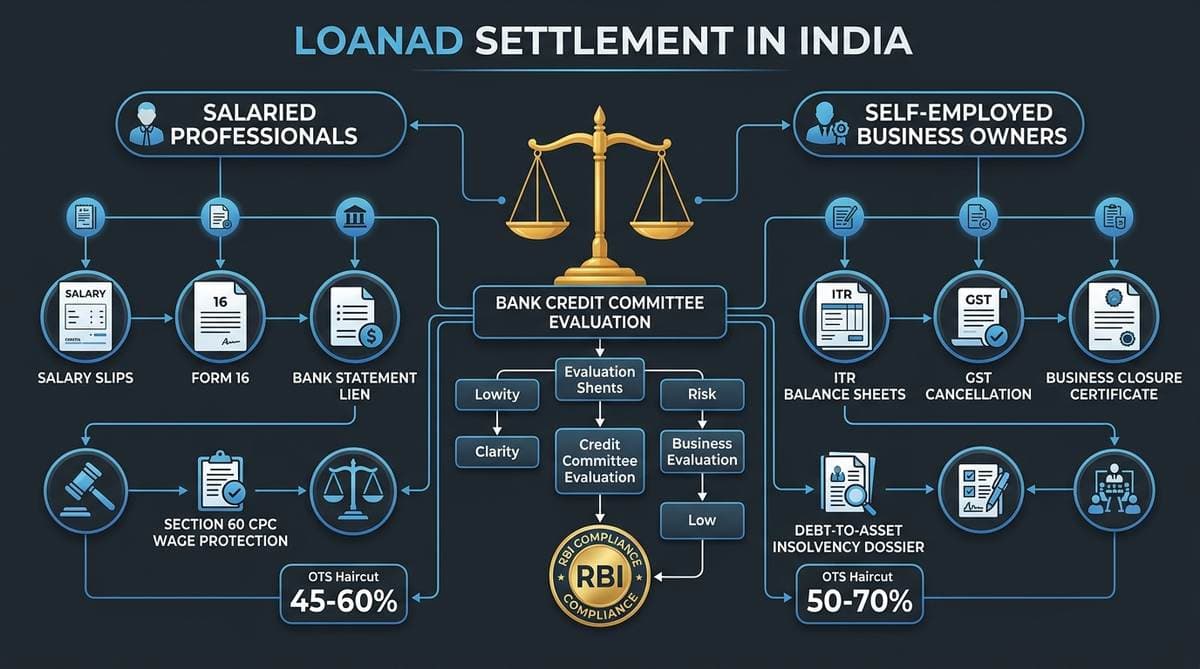
5. Salaried vs. Self-Employed Loan Settlement Visual Architecture
The visual infographic below contrasts the dual-track institutional pathways for debt resolution in India: comparing the salaried track (payslips, Form 16, Section 60 CPC, 45%–60% haircut) against the self-employed track (ITR balance sheets, GST surrender, insolvency dossier, 50%–70% haircut).
6. Negotiation Strategies & Haircut Benchmarks: Maximizing Debt Relief
Securing an optimal settlement requires executing a structured, advocate-led negotiation strategy rather than pleading with local branch recovery officers. The haircut percentage—the portion of the outstanding balance formally waived by the bank—varies significantly based on employment category and negotiation execution.
- 100% Penal Waiver Demand: Insist on total elimination of accumulated late payment fees, penal interest, and recovery agency charges prior to principal discussion.
- Disposable Income Cap: Demonstrate that post-hardship net income barely covers family subsistence, rendering original EMIs mathematically impossible.
- Lump-Sum Tranche Leverage: Offer an immediate single-tranche or 2-tranche disbursement funded by family loans in exchange for an additional 10%–15% principal concession.
- Workplace Harassment Restraint: Serve legal notices if recovery agents contact HR or colleagues, using RBI Fair Practices Code violations as bargaining leverage.
- Terminal Enterprise Dossier: Prove that operating assets are depleted, customer accounts are written off, and the business has zero going-concern value.
- Guarantor Release Condition: Mandate that the compromise settlement simultaneously discharges all personal guarantees and third-party surety bonds.
- Multi-Creditor Pari-Passu Settlement: Present a proportional debt settlement plan across multiple lenders, demonstrating equitable distribution of limited distress capital.
- Litigation Cost Demonstration: Show the bank that pursuing DRT proceedings or insolvency petitions under the IBC will consume years with negligible asset recovery.
By presenting a structured settlement proposal backed by verifiable financial data, borrowers avoid arbitrary recovery harassment and secure legally binding approval from competent credit authorities.
7. Countering Legal Coercion: Salary Account Freezes vs. DRT & Section 138 Actions
When borrowers default, lenders frequently deploy aggressive recovery tactics to pressure debtors into borrowing from informal sources. The nature of these coercive measures differs fundamentally between salaried and self-employed individuals, requiring distinct legal defense countermeasures.
Salaried Defense: Illegal Salary Account Freezes & Workplace Intimidation
Banks hosting a salaried borrower's payroll account frequently place unauthorized debit freezes or balance sweeps. Advocates immediately invoke Section 60 CPC wage exemptions, submit formal branch objections, instruct HR to divert future salary credits to an unaffected institution, and escalate arbitrary set-off violations to the RBI Banking Ombudsman under the Integrated Ombudsman Scheme, 2021.
Self-Employed Defense: Section 138 NI Act & DRT Original Applications
For business defaults, lenders aggressively file criminal complaints under Section 138 of the Negotiable Instruments Act for bounced security cheques and NACH mandate rejections. Advocates appear in the jurisdictional Magistrate Court to secure prompt personal bail, file formal defense replies under Section 139 NI Act challenging the legally enforceable debt quantum, and simultaneously initiate compromise settlement discussions at the National Lok Adalat or High Court mediation centers.
Proactive legal representation neutralizes coercive pressure, halts illegal recovery agent visits, and transitions adversarial litigation into structured settlement negotiations.
8. Sanction Letter Forensics, Direct Remittance, RBI ₹0 NDC Mandate & CIBIL Trajectory
A critical vulnerability during loan settlement is falling prey to fraudulent settlement offers issued by third-party recovery agencies attempting to meet recovery quotas. Disbursing funds against an unverified WhatsApp letter or informal email will result in the payment being credited as a regular overdue adjustment rather than a full debt extinguishment.
- Official Bank Letterhead & Reference: Must be generated on official lender letterhead containing a unique central sanction reference number and signature of a Scale-IV / Zonal Credit Head.
- Specific Account Identifiers: Must clearly state the borrower's legal name, PAN, borrowing entity name, and exact 16-digit loan account numbers.
- Unconditional Debt Discharge Clause: Must explicitly confirm that receipt of the compromised settlement sum constitutes full and final satisfaction of all principal, interest, and legal dues.
- Withdrawal of Legal Proceedings: Must contain an enforceable undertaking by the bank to withdraw all pending Section 138 NI Act complaints, civil suits, arbitration claims, and DRT applications.
Under RBI Master Circular RBI/2023-24/60, all regulated commercial banks and NBFCs are legally mandated to deliver a formal No Dues Certificate (NDC) / Loan Closure Certificate and update all credit information bureaus (CIBIL, Experian, Equifax, CRIF High Mark) to ₹0 outstanding balance within 30 calendar days of receiving the final settlement payment. Any unjustified delay beyond 30 days makes the lender liable to pay statutory compensation of ₹5,000 per day of delay directly to the borrower.
Credit Score Trajectory & Rebuilding Protocols
Post-settlement, the credit bureau status reflects "Settled" or "Post-Write-Off Settled" with a current balance of ₹0. While this causes an immediate credit score contraction of 75 to 120 points, it halts cascading 90+ DPD default accumulation. Salaried borrowers can systematically restore their CIBIL score to 750+ within 18 to 24 months by securing a fixed-deposit-backed credit card, maintaining credit utilization below 30%, and ensuring zero missed payments. Self-employed borrowers can re-establish commercial creditworthiness by maintaining pristine operational banking with an alternate institution.
9. Comprehensive Comparative Matrix: Salaried vs. Self-Employed Settlement Blueprint
The strategic matrix below summarizes the operational, legal, and financial differences between salaried and self-employed debt settlement under Indian banking regulations:
| Strategic Parameter | Salaried Professional Blueprint | Self-Employed Business Blueprint |
|---|---|---|
| Primary Hardship Proof | HR layoff notice, salary cut letter, Form 16, medical expense invoices. | Audited balance sheets, ITR loss returns, GST cancellation acknowledgment. |
| Key Statutory Protection | Section 60(1)(i) CPC (1st ₹1,000 + 2/3rd salary completely exempt from attachment). | Commercial insolvency proof, insolvency defense under IBC / SARFAESI frameworks. |
| Primary Bank Risk Focus | Future re-employment and continuity of verifiable salary inflows. | Asset liquidation value, business failure certainty, uncollectible receivables. |
| Typical Principal Haircut | 45% to 60% waiver on principal ledger balance. | 50% to 70% waiver on principal ledger balance. |
| Primary Legal Exposure | Arbitrary salary account freeze, Order 37 CPC summary civil suit. | Section 138 NI Act criminal complaints, DRT proceedings, personal guarantees. |
| Resolution Timeline | 15 to 45 calendar days via Zonal Credit Sanction Desk. | 30 to 60 calendar days via Stressed Asset Resolution Group (SARG). |
| Post-Settlement Output | ₹0 NDC, release of bank account liens, removal of recovery harassment. | ₹0 NDC, release of personal guarantees, withdrawal of court complaints. |
10. SettleLoans Legal Defense & Institutional Debt Settlement Advisory
Navigating the complexities of bank loan settlement requires specialized legal acumen, thorough documentation forensics, and institutional negotiation experience. SettleLoans provides end-to-end legal representation for both salaried professionals and self-employed business owners across India. Our banking advocates build unassailable hardship dossiers, halt recovery harassment, protect against unlawful salary freezes, represent borrowers in Section 138 NI Act proceedings, and negotiate directly with bank credit committees to secure 45% to 70% principal waivers backed by official, bank-stamped No Dues Certificates.

Settle Loan is India's trusted debt relief and loan settlement platform. We help borrowers overcome financial distress by negotiating with banks and NBFCs to legally settle personal loans and credit card debts. With our transparent, performance-based approach, you can achieve debt freedom and regain your financial peace of mind.
COMPUTER
11. Frequently Asked Questions: Salaried vs. Self-Employed Loan Settlement
Direct, legally verified answers to critical questions regarding loan settlement rules, documentation standards, legal protections, and haircut optimization in India.
Why do banks treat salaried and self-employed borrowers differently during loan settlement?
Bank credit committees evaluate income predictability and recovery friction. Salaried borrowers possess transparent, verifiable cash inflows with predictable future earnings, making banks assume high recovery probability unless severe involuntary hardship is documented. In contrast, self-employed borrowers operate commercial enterprises where business failure, balance sheet erosion, and commercial insolvency make future recovery highly uncertain, often justifying higher principal haircuts.
What specific documents must a salaried individual submit to prove loan settlement hardship?
Salaried borrowers must provide: (1) Official termination letter, retrenchment notice, or compensation cut letter from HR; (2) Consecutive salary slips for the last 6 months showing reduced or zero pay; (3) Form 16 and ITR-1 showing taxable income collapse; (4) Bank statements illustrating high fixed EMI-to-income ratios and zero liquid reserves; and (5) Certified medical expenditure receipts or chronic illness records if health issues caused the default.
What documentation is required for self-employed individuals to prove business insolvency?
Self-employed proprietors and partners must submit: (1) Audited financial statements (Profit & Loss accounts and Balance Sheets) for the last 2 to 3 financial years reflecting operating losses; (2) ITR-3 or ITR-4 filings with computation of income; (3) GST cancellation or surrender acknowledgment certificates (Form GST REG-16/REG-19); (4) Bank statements showing debtor defaults and bounced vendor payments; and (5) Formal business closure certificates, lease termination deeds, or trade license cancellations.
Can a lender attach my salary if I default on an unsecured personal loan?
No bank can unilaterally attach your salary without a formal judicial execution order from a competent Civil Court. Furthermore, under Section 60(1)(i) of the Code of Civil Procedure, 1908 (CPC), the first ₹1,000 plus two-thirds of the remainder of your monthly salary is strictly exempt from court attachment. A private lender cannot seize your salary extra-judicially.
Who typically gets a higher haircut: salaried professionals or business owners?
Self-employed business owners with defunct enterprises or documented commercial insolvency generally secure higher principal waivers (50% to 70%) because the bank's net present value (NPV) recovery outlook is near zero. Salaried employees typically secure 45% to 60% principal haircuts, though severe involuntary hardships such as permanent disability or prolonged job loss can unlock maximum 65% waivers.
How does personal guarantee affect settlement for self-employed borrowers?
Most unsecured business loans and overdraft facilities require the personal guarantee of the proprietor or directors. While the corporate entity or partnership may wind down, personal liability persists. Settlement negotiations must explicitly encompass both the primary borrowing entity and the personal guarantors, ensuring the final sanction letter releases all personal guarantee covenants.
Can a bank freeze my company current account for a personal loan default or vice versa?
Under Indian banking jurisprudence, the Right of Set-Off requires strict mutuality of accounts and identical legal capacity. A bank cannot freeze a separate Private Limited company current account for an individual director's personal loan default. However, in sole proprietorships where the individual and the business entity share the same PAN, banks may attempt cross-account holds unless restrained by legal counsel.
What is the role of Net Present Value (NPV) in bank credit committee approvals?
Bank credit committees use NPV formulas to evaluate whether an immediate lump-sum settlement offer yields more economic value than spending 3 to 5 years pursuing civil litigation, DRT recovery, or SARFAESI actions. The formula discounts future uncertain recoveries against advocate retainers, court fees, and mandatory RBI capital provisioning burdens locked in NPA classifications.
How long after full settlement payment does the bank issue a No Dues Certificate?
Under RBI Circular RBI/2023-24/60, all regulated commercial banks and NBFCs are statutory mandated to deliver a formal No Dues Certificate (NDC) and update credit bureau records to ₹0 balance within 30 calendar days of receiving the final settlement tranche. Any unjustified delay incurs a mandatory compensation penalty of ₹5,000 per day payable to the borrower.
How does settlement impact CIBIL scores differently for salaried versus self-employed individuals?
Both categories see their trade line updated to 'Settled' or 'Post-Write-off Settled' with a ₹0 balance, resulting in a temporary credit score drop of 75 to 120 points. For salaried borrowers, rebuilding credit requires 18 to 24 months of disciplined use with a secured FD credit card. For self-employed individuals, commercial credit bureaus (such as CIBIL Commercial CMR scores) are also impacted, necessitating fresh collateralized working capital lines to re-establish business borrowing eligibility.