- Civil Dispute: MSME business loan default is strictly a civil breach under the Indian Contract Act, 1872. Borrowers possess statutory compromise rights under RBI frameworks.
- Halting Debit Sweeps: Revoking e-NACH mandates through your bank under NPCI rules stops automated presentations and eliminates recurring return fees.
- 40%–55% Haircut: Accounts past 90 to 180 DPD qualify for substantial principal discounts based on Net Present Value (NPV) recovery benchmarks.
- Defending Legal Demands: Section 25 PSSA demand notices and unilateral sole arbitration summons can be defended, dismissed, or resolved via Lok Adalat.
- Guarantee Release & NDC: Stamped settlements guarantee full cancellation of director personal guarantees and delivery of a ₹0 No Dues Certificate.
Lendingkart Digital MSME Lending & Recovery Engine
Lendingkart Finance Limited, an RBI-regulated systemically important NBFC, operates as a prominent digital lender to Indian MSMEs. Utilizing algorithmic models, GST analytics, and banking scrapers, Lendingkart disburses collateral-free working capital loans from ₹2 Lakhs to ₹50 Lakhs. However, these facilities carry steep annualized capital costs between 24% and 36%, bundled with high processing fees and automated auto-debit sweeps.
Lendingkart also co-lends alongside institutional partners such as Bank of Baroda, Tata Capital, and Piramal Finance, functioning as the customer-facing servicer. When enterprise cash flows suffer from delayed buyer payments or supply disruptions, missed installments trigger automated recovery workflows. Defaulting on an unsecured business loan is strictly a civil contractual breach, entitling distressed enterprise promoters to statutory protections under RBI compromise directions.
Lendingkart Delinquency Lifecycle & Provisioning
Under RBI IRACP and Ind AS 109 Expected Credit Loss mandates, Lendingkart categorizes defaulted business facilities into structured DPD aging brackets. During Special Mention Account (SMA) stages, collections focus on installment regularization. Crossing 90 days triggers Non-Performing Asset (NPA) classification. Lendingkart must reverse accrued interest and allocate statutory provisions, shifting its institutional objective toward cash recovery via compromise settlements.
| Delinquency Stage | Overdue Days | Lendingkart Action | Provisioning Impact | Haircut Window |
|---|---|---|---|---|
| SMA-0 (Early Stress) | 1 – 30 Days | Payment alerts, automated e-NACH sweeps. | Standard asset (0.40%). | Negligible discount. |
| SMA-1 (Moderate Stress) | 31 – 60 Days | Agency calling, demand letters. | Elevated credit risk. | Tenure restructuring. |
| SMA-2 (Severe Stress) | 61 – 90 Days | Advocate notices, Sec 25 PSSA warnings. | Pre-NPA reserves. | Bounce fee waivers. |
| Substandard NPA | 91 – 180 Days | Stressed Assets Desk, legal summons. | 10%–15% provisioning. | 35%–45% Haircut. |
| Doubtful / Written Off | 181 – 365+ Days | Balance-sheet write-off, Lok Adalat. | 20%–100% loss absorbed. | 45%–55% Haircut. |
Upon reaching Doubtful status, Lendingkart absorbs the balance-sheet loss. A cash settlement represents an immediate net recovery, enabling Credit Committees to sanction substantial principal haircuts.
Check Your Loan Settlement Options
Answer 2 quick questions to evaluate your settlement eligibility.
1. What type of loan do you want to settle?
Halting NACH Auto-Debits & Compounding Penal Fees
A primary operational drain for defaulting MSMEs is the repeated presentation of electronic National Automated Clearing House (e-NACH) mandates. Lendingkart's payment engines frequently present debit mandates multiple times per month. When current accounts lack funds, destination banks deduct return fees of ₹250 to ₹500 plus GST per bounce, while Lendingkart levies internal penalties of ₹500 to ₹1,000 plus taxes.
Under RBI Fair Lending Practice Directives (2023), lenders are prohibited from compounding penal charges onto the loan principal. Business owners have the statutory right under NPCI guidelines to instruct their bank to cancel or suspend e-NACH debits. Concurrently, legal notice served on Lendingkart halts automated presentations, ensuring that 100% of accumulated bounce penalties and late payment fees are eliminated during One-Time Settlement negotiations.
Under Section 25 of the Payment and Settlement Systems Act, electronic debit failures only trigger statutory liability if an intentional dishonour occurs without underlying commercial justification. Revoking the electronic mandate through formal banker communication asserts commercial dispute status, halting automated fee leakage while preserving cash flows for structured debt settlement.
Lendingkart OTS Haircut Policies & Financial Relief
Under RBI Master Directions (DOR.STR.REC.20/21.04.048/2023-24), Lendingkart evaluates settlement proposals using Net Present Value (NPV) recovery benchmarks. Because MSME credit lines are unsecured, Lendingkart cannot invoke SARFAESI asset repossession. Pursuing recovery through civil suits involves court delays of 3 to 6 years, continuous legal costs, and trapped capital. A lump-sum compromise settlement yields a superior Net Present Value compared to uncertain judicial execution.
Where C_t represents estimated recoveries, r is the discount rate, and deductions account for 3–5 years of court friction and capital locked in NPA provisions.
Realistic Lendingkart Settlement Haircut Slabs by Product & Aging
| Facility Category | Delinquency Aging | Penal Waiver | Principal Haircut | Target Offer |
|---|---|---|---|---|
| MSME Working Capital | 90 – 180 Days (NPA) | 100% Full Waiver | 30% – 40% Haircut | Offer 50%–60% Balance |
| MSME Working Capital | 181 – 365 Days (Doubtful) | 100% Full Waiver | 40% – 50% Haircut | Offer 40%–45% Balance |
| Co-Lending Bank Line | 120 – 270 Days | 100% Full Waiver | 35% – 45% Haircut | Offer 45%–55% Balance |
| Written-Off MSME Debt | 365+ Days (Loss) | 100% Full Waiver | 50% – 55%+ Haircut | Offer 30%–40% Balance |
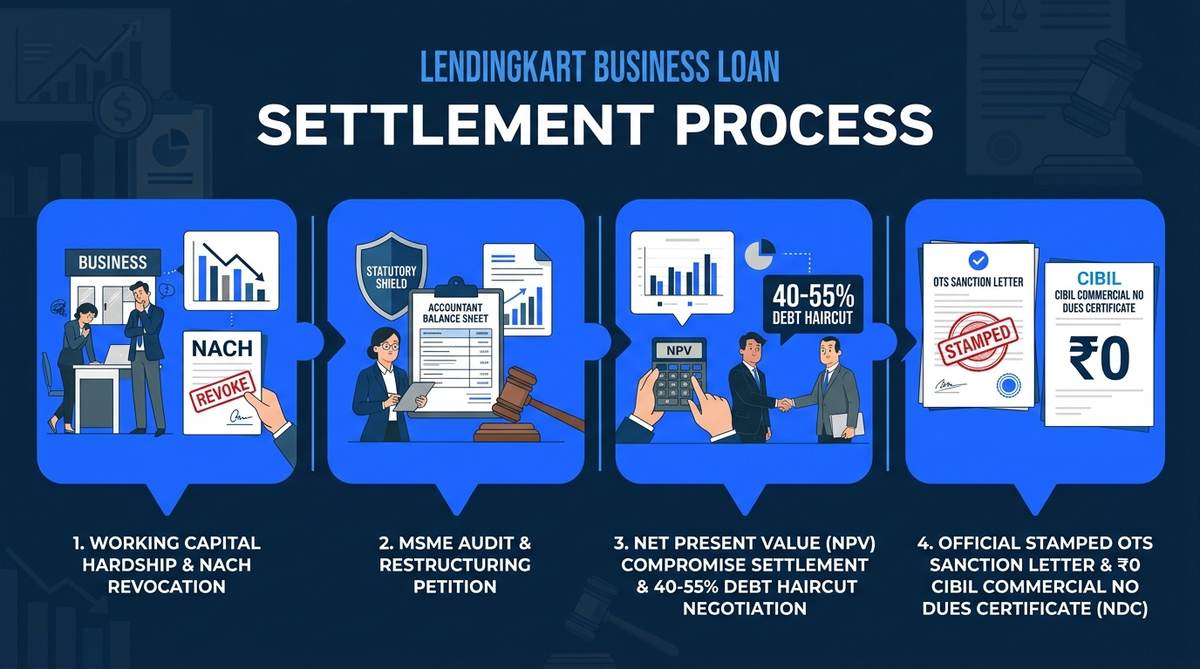
Lendingkart Business Loan Settlement & Legal Resolution Blueprint
Defending Against Aggressive Recovery Tactics
As loan accounts transition into deeper delinquency buckets, Lendingkart frequently reassigns recovery operations to third-party Debt Recovery Agencies (DRAs). Collection agents often resort to high-pressure practices, including repetitive calling during trading hours, contacting commercial suppliers, visiting business premises, and approaching uninvolved family members.
The RBI Master Directions on Recovery Agents and NBFC Fair Practices Codes establish clear legal boundaries: agents may only contact borrowers between 08:00 AM and 07:00 PM; contacting commercial associates, employees, or non-guarantor relatives is illegal; intimidation and workplace disruption are strictly prohibited; and representatives must carry valid ID and IIBF DRA certifications. Documenting violations and serving a formal legal notice to Lendingkart's Principal Nodal Officer halts harassment immediately.
When third-party recovery agencies breach RBI operational guidelines by contacting commercial vendors or making unannounced visits, borrowers should file digital complaints via the RBI CMS portal. Fintech lenders face severe regulatory audits for systemic collection abuses, prompting Credit Committees to swiftly reassign files to internal settlement officers.
Step-by-Step Guide to Lendingkart Debt Settlement
Executing an enforceable One-Time Settlement with Lendingkart requires a disciplined, evidence-based procedure:
1Hardship Dossier Compilation
Assemble GST returns, audited P&L records, debtor payment delays, or cancellation orders verifying non-wilful business distress under RBI guidelines.
2NACH Revocation & Legal Routing
Instruct your bank in writing to cancel electronic auto-debits to stop return charges. Direct Lendingkart to route all correspondence through written legal channels.
3Hardship Petition to Credit Committee
Submit a formal OTS petition to Lendingkart's Stressed Assets division citing RBI compromise directions, proposing an opening settlement at 25% to 35% of core dues.
4Counter-Negotiation & Haircut Structuring
When Lendingkart counters with modest discounts, demonstrate that funds are sourced from third-party family support or asset liquidation, securing the 40% to 55% waiver band.
5Forensic Sanction Letter Verification
Demand an official OTS sanction letter on corporate letterhead detailing the loan account, sanctioned sum, payment schedule, and full release covenants.
6Account Remittance & NDC Delivery
Pay the settlement sum directly into the Lendingkart loan account via RTGS/NEFT. Enforce delivery of the No Dues Certificate within 30 days under RBI mandates.
Section 25 PSSA Notices, Arbitration & Lok Adalat
Between 60 and 90 days of default, Lendingkart issues demand notices under Section 25 of the Payment and Settlement Systems Act, 2007 (PSSA) for dishonoured NACH mandates, along with notices invoking sole arbitration in Ahmedabad or Mumbai.
A Section 25 PSSA notice is a 15-day statutory demand regarding a bounced electronic mandate, not an arrest warrant. Responding through counsel within 15 days documenting bona fide commercial hardship protects legal standing and initiates settlement discussions.
Regarding arbitration notices, landmark Supreme Court rulings in Perkins Eastman and TRF Ltd. confirm that unilateral arbitrator appointments without mutual written consent are legally invalid. Counsel can challenge jurisdiction under Sections 12 and 14 of the Arbitration Act, preventing biased ex-parte awards. Additionally, Lendingkart participates in National Lok Adalats, where settlement awards carry the legal force of a final Civil Court Decree.
Settling an unsecured Lendingkart facility before a National Lok Adalat bench provides unmatched judicial finality. The award passed by the presiding judicial officer operates as a non-appealable civil court decree under Section 21 of the Legal Services Authorities Act, permanently barring future litigation, recovery agency re-assignments, or credit ledger revival.
| Resolution Avenue | Legal Mechanism | Haircut Potential | Typical Timeline | Judicial Finality |
|---|---|---|---|---|
| Direct NBFC OTS | Compromise under RBI Master Directions. | 40% – 55% Haircut | 15 to 30 Days | Binding private contract & NDC. |
| National Lok Adalat | Judicial conciliation before judge. | 45% – 55% Haircut | Single-day session | Civil Court Decree (Final). |
| Arbitration Defense | Contesting unilateral appointment. | Variable (Converts to OTS) | 3 to 9 Months | Section 34 challenge grounds. |
| Section 25 PSSA Defense | Magistrate Court compounding. | 35% – 50% Haircut | 2 to 6 Months | Formal complaint withdrawal. |
Authenticating Settlement Letters & PAN Liabilities
A major risk involves third-party collection callers issuing unverified settlement proposals. Depositing funds against an informal email or verbal promise causes Lendingkart to credit payments against accrued penal fees, leaving the principal balance in active default while continuing legal proceedings.
Borrowers must verify that the OTS sanction letter is issued on official Lendingkart Finance Limited corporate letterhead containing their Corporate Identification Number (CIN), registered office details, loan account numbers, authorized officer signature, and branch seal. The document must explicitly confirm full and final settlement with zero remaining balance upon payment.
For MSME entities, the letter must confirm the unconditional discharge of all personal guarantees. Under RBI Circular RBI/2023-24/60, Lendingkart is mandated to issue the formal No Dues Certificate and update credit bureaus within 30 calendar days, subject to statutory compensation of ₹5,000 per day of delay payable directly to the borrower.
Why MSME Borrowers Trust SettleLoans for Resolution
Resolving an unsecured working capital default with Lendingkart requires strategic financial analysis combined with assertive legal advocacy. SettleLoans shields your enterprise from recovery harassment, cancels unauthorized debit presentations, defends against Section 25 PSSA notices, and negotiates directly with Lendingkart's Credit Committees to secure authorized 40% to 55% debt haircuts and ₹0 No Dues Certificates.

Settle Loan is India's trusted debt relief and loan settlement platform. We help borrowers overcome financial distress by negotiating with banks and NBFCs to legally settle personal loans and credit card debts. With our transparent, performance-based approach, you can achieve debt freedom and regain your financial peace of mind.
COMPUTER
Frequently Asked Questions About Settlement
What is the Lendingkart business loan settlement process and how does an MSME compromise work?
The Lendingkart business loan settlement process is a structured compromise governed by RBI Master Directions. When an unsecured MSME working capital facility defaults past 90 days (NPA), the enterprise submits a formal hardship petition to Lendingkart Finance Limited's Stressed Assets Committee. After evaluating insolvency against Net Present Value (NPV) benchmarks, Lendingkart issues an official stamped OTS sanction letter. Paying the settlement sum directly into the loan account extinguishes all business and guarantor liabilities, yielding a formal No Dues Certificate.
How can small business owners stop Lendingkart daily or monthly NACH auto-debit bounce fees?
Borrowers can halt recurrent NACH bounce fees by submitting a written mandate revocation request to their home bank under NPCI procedural guidelines, instructing the bank to stop honoring debit presentations. Concurrently, legal counsel serves formal notice on Lendingkart demanding an immediate pause on electronic sweeps, ensuring 100% waiver of accrued bounce penalties during OTS negotiations.
What percentage of debt haircut or waiver is achievable when settling an unsecured Lendingkart loan?
On unsecured MSME business loans, Lendingkart Finance typically sanctions debt waivers between 40% and 55% of the total outstanding ledger balance. Substandard NPAs (90 to 180 DPD) generally qualify for 35% to 45% waivers, while accounts overdue beyond 180 days (Doubtful or written-off assets) qualify for 45% to 55% principal haircuts alongside full cancellation of penal fees.
How should MSME borrowers respond to a Section 25 PSSA legal notice issued by Lendingkart?
A Section 25 PSSA notice is a 15-day statutory demand regarding a bounced electronic mandate, not an arrest warrant. Borrowers must never ignore this notice. Experienced legal counsel should serve a detailed reply within 15 days documenting commercial disruption, highlighting multiple mandate sweeps, and formally inviting Lendingkart's legal desk to resolve the dispute through an OTS.
Can Lendingkart file criminal charges, freeze current accounts, or initiate police action for loan default?
No. Defaulting on an unsecured MSME business loan is strictly a civil breach of contract under the Indian Contract Act, 1872. Police authorities have zero jurisdiction to register an FIR or arrest business promoters for commercial insolvency. Furthermore, Lendingkart cannot freeze operating current accounts without obtaining an attachment order from a competent Civil Court under Order 38 Rule 5 CPC.
How should borrowers defend against unilateral sole arbitration notices issued by Lendingkart?
Lendingkart often issues notices appointing a sole arbitrator in Ahmedabad or Mumbai. Under Supreme Court rulings in Perkins Eastman and TRF Ltd., unilateral arbitrator appointments without mutual written consent are legally void. Legal counsel can challenge the arbitrator's jurisdiction under Sections 12 and 14 of the Arbitration Act, halting ex-parte proceedings and directing the dispute into settlement channels.
How does settling a Lendingkart business loan affect the business PAN and personal CIBIL score of proprietors or directors?
Following full OTS payment, Lendingkart reports the account to credit bureaus with the status 'Settled' or 'Post-Write-off Settled' with a ₹0 balance. This reflects on the company's Commercial CIR and the personal CIBIL records of guarantors. While causing a temporary score dip, it permanently stops compounding default remarks, eliminates litigation flags, and allows credit restoration to 750+ within 18 to 24 months.
What critical clauses must be verified in a Lendingkart OTS Sanction Letter before transferring settlement funds?
Borrowers must ensure the sanction letter is on official Lendingkart Finance Limited letterhead containing the Corporate Identification Number (CIN), loan account numbers, exact settlement sum, payment deadlines, and covenants confirming full debt discharge, release of personal guarantees, withdrawal of legal proceedings, and delivery of a No Dues Certificate within 30 days.
Official Regulatory References & Statutory Circulars
- Reserve Bank of India (RBI): Master Direction on Compromise Settlements and Technical Write-offs (DOR.STR.REC.20/21.04.048/2023-24)
- RBI Master Circular: Fair Practices Code for Non-Banking Financial Companies (NBFCs) & Recovery Agent Guidelines
- Lendingkart Finance Limited: Corporate Grievance Redressal Policy & Principal Nodal Officer Escalation Matrix
- Reserve Bank - Integrated Ombudsman Scheme, 2021: Online Portal for Complaints on NBFC Harassment & Excessive Penal Charges
- National Legal Services Authority (NALSA): Legal Services Authorities Act, 1987 — National Lok Adalat Conciliation Framework