- Complete Workplace & HR Protection: Under Reserve Bank of India recovery guidelines, lenders and collection agents are legally barred from contacting tech company employers, emailing corporate addresses, or visiting tech parks in Outer Ring Road, HITEC City, or Hinjawadi.
- Substantial 45%–65% OTS Waivers: When unsecured personal loans and credit cards enter NPA status due to layoff-induced income disruption, banks apply Net Present Value (NPV) recovery modeling, sanctioning massive principal and interest waivers.
- 100% Digital Advocate Representation: Tech professionals can execute full legal representation via digital Vakalatnama. Advocates handle all bank escalations, notice responses, and negotiation sessions without requiring physical court or branch appearances.
- Clean Background Verification (BGV): Unsecured debt settlement is a civil contractual remedy under the Indian Contract Act, 1872. It generates zero criminal records and does not trigger red flags during standard IT employment background screenings.
- Statutory ₹5,000/Day Delay Guarantee: Under RBI Circular RBI/2023-24/60, banks must deliver an authentic stamped No Dues Certificate (NDC) within 30 days of settlement payment or compensate the borrower ₹5,000 per calendar day of delay.
Tech Layoffs & Debt in Bengaluru, Hyderabad & Pune
India's premier technology corridors—spanning Whitefield, Bellandur, and Manyata Tech Park in Bengaluru; HITEC City, Gachibowli, and the Financial District in Hyderabad; and Hinjawadi, Kharadi, and Magarpatta in Pune—have long represented the pinnacle of high-velocity white-collar compensation. Over the past decade, aggressive hiring sprees by multinational software conglomerates, venture-backed unicorns, and Global Capability Centers (GCCs) created a compensation architecture characterized by elevated base salaries, generous joining bonuses, variable performance pay, and substantial Restricted Stock Unit (RSU) vesting schedules.
Commercial retail banks and fintech lenders capitalized aggressively on this corporate liquidity. By targeting software architects, lead full-stack developers, engineering directors, and product managers earning between ₹20 Lakhs and ₹80 Lakhs per annum, financial institutions disbursed multi-layered unsecured personal loans, pre-approved top-up credit lines, and premium lifestyle credit cards with limits exceeding ₹10 Lakhs to ₹25 Lakhs per individual. These credit structures operated smoothly as long as variable quarterly bonuses arrived on schedule and stock prices appreciated.
However, sweeping macroeconomic headwinds—driven by generative AI restructuring, global tech consolidation, venture capital pullback, and corporate downsizing—have drastically reshaped this landscape. Tech professionals suddenly confronted severe involuntary income disruptions: abrupt workforce reductions with 30-day severance cliffs, total cancellation of variable bonuses, cancellation or cliff-drop of unvested RSUs, and prolonged six-to-twelve-month re-employment search horizons in a saturated labor market.
When monthly equated monthly installments (EMIs) totaling ₹1.5 Lakhs to ₹3.5 Lakhs collide with zero active income or drastically diminished consulting compensation, software engineers find themselves trapped in a severe debt spiral. Lenders immediately trigger high-frequency collection calls, initiate automated NACH bounce sweeps that incur compounding bank charges, and threaten professional reputation. In this high-stakes environment, understanding statutory rights under Reserve Bank of India regulations and executing a structured, confidential compromise settlement is the only viable path to total financial liberation.
Anatomy of Tech Debt: RSUs, Variable Pay Claws, and Lifestyle Over-Leveraging
The financial anatomy of debt distress among technology professionals differs fundamentally from traditional retail defaults. In the tech sector, borrowing capacity is routinely calibrated by bank underwriting algorithms against gross CTC (Cost-to-Company) rather than stable, liquid net cash flow. A typical CTC package of ₹45 Lakhs may comprise only ₹24 Lakhs in fixed base salary, with the remainder distributed across performance incentives, employer PF contributions, and unvested stock grants.
When tech workers committed to substantial real estate EMIs, luxury vehicle financing, high-limit credit cards, and multiple instant personal loans from digital NBFCs, their monthly debt servicing obligations frequently consumed 60% to 80% of net monthly income. Upon termination or corporate restructuring, several compounding financial vulnerabilities immediately materialize:
| Debt Instrument | Typical Tech Exposure | Compounding Risk Mechanism | Delinquency Impact | Settlement Haircut Window |
|---|---|---|---|---|
| Unsecured Personal Loans | ₹10 Lakhs – ₹35 Lakhs | Fixed high EMIs with 13%–18% interest; rigid 36–60 month amortizations. | Rapid transition from SMA-0 to NPA within 90 days of missed EMI. | 45% – 60% Principal Haircut |
| Premium Credit Cards | ₹5 Lakhs – ₹20 Lakhs | Revolving finance charges of 42%–48% APR plus 18% GST on all interest. | Minimum Due spirals exponentially, exhausting credit limits in 90 days. | 50% – 65% Ledger Haircut |
| Fintech Instant Credit Lines | ₹3 Lakhs – ₹10 Lakhs | Automated daily/weekly NACH presentations with aggressive digital collection bots. | Multiple bounce charges multiplying across primary salary accounts. | 50% – 70% Total Waiver |
| Joining Bonus Clawbacks | ₹3 Lakhs – ₹8 Lakhs | Company demands immediate pre-tax repayment of sign-on bonus upon early separation. | Direct civil demand note from former employer HR legal division. | Negotiated Bilateral Settlement |
| Pre-Approved Top-Up Loans | ₹5 Lakhs – ₹15 Lakhs | Cross-sold by salary account bank; linked directly to primary banking operations. | Risk of internal bank set-off against incoming severance credits. | 40% – 55% OTS Reduction |
The most acute danger during this phase is the psychological trap of "debt cycling"—using high-interest credit cards or personal loans from new fintech apps to pay the minimum dues on older loans. This practice rapidly depletes liquid severance reserves, triggers multiple CIBIL hard inquiries, and accelerates financial collapse without reducing core principal debt.
Check Your Loan Settlement Options
Answer 2 quick questions to evaluate your settlement eligibility.
1. What type of loan do you want to settle?
Legal Protections: Civil Law, RBI Master Directions & Zero Workplace Exposure
For IT professionals, the single greatest apprehension during a debt default is workplace exposure. In an industry governed by strict reputation metrics, non-disclosure agreements, and client confidentiality protocols, the prospect of recovery agents calling company switchboards, contacting HR managers, or physically visiting corporate tech campuses creates immense psychological paralysis.
The Indian legal and regulatory framework provides stringent statutory shields that explicitly criminalize and prohibit third-party harassment. Under the Reserve Bank of India's Master Circular on Recovery Agents and Fair Practices Code for Regulated Entities, financial institutions are governed by clear, non-negotiable mandates:
- Absolute Ban on Workplace Harassment: Recovery agents are strictly prohibited from visiting a borrower's workplace, calling office landlines, emailing corporate domains (@company.com), or contacting managers, HR personnel, or colleagues regarding personal financial matters.
- Strict Communication Windows: Permissible telephonic contact is strictly restricted between 08:00 AM and 07:00 PM. Calling before 08:00 AM or after 07:00 PM constitutes an actionable regulatory violation punishable by monetary fines on the lending institution.
- Privacy & Data Protection: Disclosing a borrower's debt status, loan figures, or default notices to non-guarantor family members, friends, or third parties violates the Right to Privacy guaranteed under Article 21 of the Constitution of India (reaffirmed by the Supreme Court of India in K.S. Puttaswamy v. Union of India) and the Digital Personal Data Protection (DPDP) Act.
- Prohibition of Coercion & Threats: The use of abusive language, intimidation, false claims of criminal warrants, or simulated police notices is strictly prohibited under the Indian Penal Code / Bharatiya Nyaya Sanhita (BNS) and RBI directives.
When IT professionals engage SettleLoans, our legal team immediately issues formal statutory cease-and-desist notices to the Principal Nodal Officers and Stressed Assets divisions of all creditor banks. By establishing formal advocate representation under the Advocates Act, 1961, all bank communications are legally redirected to our counsel. This creates an impenetrable confidentiality shield around your current or future employers.
Bank Balance Sheet Economics & The Net Present Value (NPV) Recovery Formula
A common misconception among software engineers is that loan settlement relies on bank mercy or arbitrary sympathy. In reality, loan compromise settlements operate strictly on mathematical, regulatory, and institutional accounting principles mandated by the Reserve Bank of India and Indian Accounting Standard 109 (Ind AS 109).
When an unsecured loan defaults past 90 Days Past Due (DPD), it is classified as a Non-Performing Asset (NPA). Under RBI prudential norms, banks must immediately allocate capital provisioning from their quarterly operating profits:
- Substandard Asset (91–365 Days DPD): 15% mandatory provisioning on total unsecured exposure.
- Doubtful Asset 1 (1–2 Years Overdue): 25% to 40% capital provisioning required.
- Doubtful Asset 2 (2–3 Years Overdue): 100% capital provisioning mandated on unsecured assets.
- Loss Asset (3+ Years or Deemed Unrecoverable): 100% full balance-sheet write-off.
Every month an unsecured tech loan lingers as an active NPA, the bank incurs substantial ongoing financial burdens: capital lock-in, negative risk-weighted asset (RWA) scoring, external advocate fees, court litigation expenses, and administrative overhead. To resolve these stressed assets efficiently, bank Credit Committees evaluate settlement proposals through the Net Present Value (NPV) recovery formula:
Where C_t represents estimated future legal recoveries, r is the bank's hurdle discount rate, and deductions account for 3–5 years of court friction, advocate fees across City Civil Courts, and capital locked in mandatory NPA balance-sheet provisioning.
When a borrower's advocate presents a documented, verified hardship dossier demonstrating permanent income reduction or job loss, the bank's algorithmic NPV of litigation drops significantly below 40% of the loan value. Consequently, an immediate lump-sum One-Time Settlement (OTS) paying 35% to 55% of core dues yields a superior economic return for the bank, prompting credit committees to approve substantial debt haircuts.
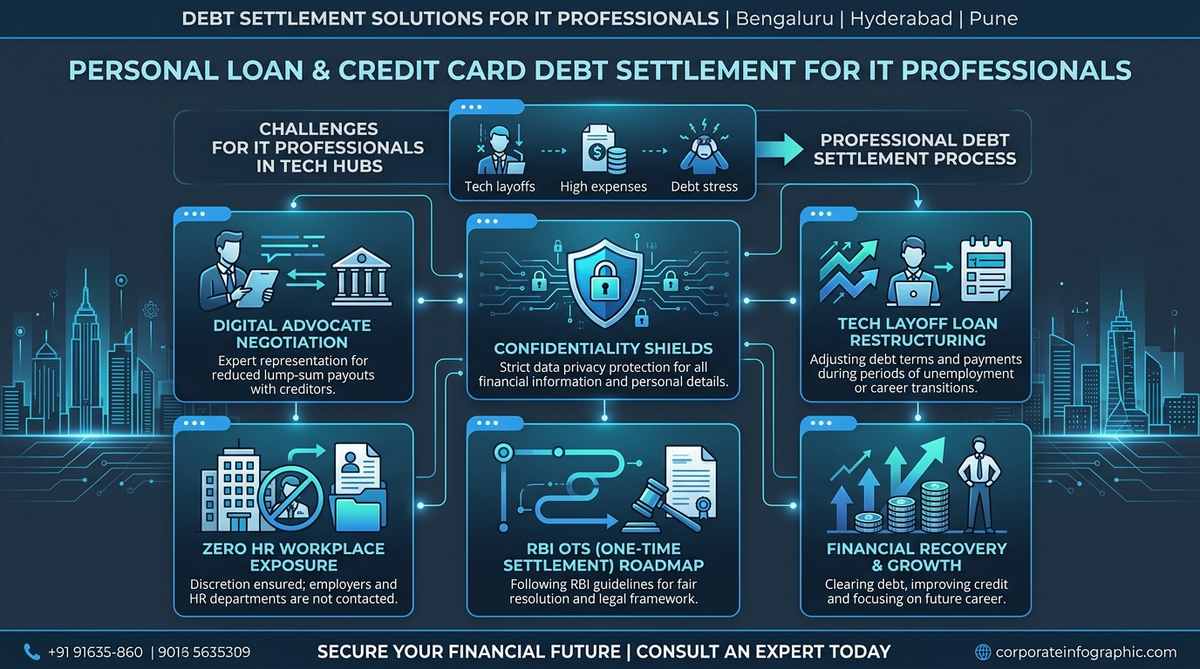
Infographic: Personal Loan & Credit Card Debt Settlement Framework for IT Professionals
The visual blueprint below outlines the complete institutional debt resolution journey for tech workers—from early layoff triage and confidential advocate shield activation to bank zonal committee negotiations, stamped OTS letter issuance, and credit score rehabilitation.
Halting NACH Bounce Sweeps, Section 25 PSSA Notices & Local Court Jurisdictions
When an IT professional misses an EMI, lenders frequently present electronic National Automated Clearing House (e-NACH) mandates multiple times across the billing cycle. Each dishonoured presentation triggers an automated return fee of ₹500 to ₹1,000 debited by the borrower's home bank, accompanied by identical bounce penalties from the lending institution. Over 3 to 6 months, these automated sweeps can siphon ₹30,000 to ₹80,000 in purely predatory fees from remaining cash reserves.
To halt this drain, borrowers have the statutory right under National Payments Corporation of India (NPCI) procedural guidelines and Section 25 of the Payment and Settlement Systems Act (PSSA), 2007, to submit a formal written mandate revocation request to their home branch. Furthermore, our legal team demands a 100% waiver of all accumulated bounce charges and penal interest under the RBI's Fair Lending Practice circulars during settlement proceedings.
Following repeated NACH bounces, banks routinely issue formal statutory demand notices under Section 25 of the PSSA, 2007, or Section 138 of the Negotiable Instruments (NI) Act, 1881. IT professionals frequently mistake these notices for criminal arrest warrants. In reality, these are statutory 15-day pre-litigation notices requiring a formal legal response:
- Bengaluru Judicial Jurisdiction: Matters are filed before the Chief Metropolitan Magistrate (CMM) Court at Mayo Hall, Nrupathunga Road, or local magistrate courts in Koramangala and Electronic City. Legal counsel submits timely hardship appearances, preventing non-bailable warrants.
- Hyderabad & Cyberabad Jurisdiction: Handled across the Metropolitan Magistrate Courts at Kukatpally, Miyapur, and the District & Sessions Court in Rangareddy (L.B. Nagar), where matters are routinely directed to Lok Adalat benches for compromise settlement.
- Pune Judicial Jurisdiction: Proceedings are instituted before the Judicial Magistrate First Class (JMFC) Courts at Shivajinagar or Cantonment Court, where advocate representation facilitates swift compounding of cases upon OTS execution.
When managed by experienced banking advocates, Section 25 and Section 138 matters never lead to police involvement or arrest. Once the One-Time Settlement is executed and payment is deposited, the bank's legal counsel files a formal application for case withdrawal and compounding under Section 147 of the NI Act / Section 25(3) of the PSSA, completely extinguishing the judicial file.
The 100% Digital Advocate Negotiation Roadmap: From Hardship Dossier to 45%–65% OTS
Navigating loan settlement with tier-1 private banks (such as HDFC Bank, ICICI Bank, Axis Bank, Kotak Mahindra Bank) and major NBFCs (such as Bajaj Finance, Aditya Birla Capital, Tata Capital) requires a structured, multi-stage legal methodology. Software professionals must never negotiate directly with third-party tele-callers or collection agency agents, as external tele-callers have zero delegated authority to sanction binding debt discounts.
SettleLoans executes an institutional five-stage debt resolution framework engineered specifically for IT workers:
1Comprehensive Ledger Forensic Audit
Our banking specialists analyze your complete loan account statement, dissecting principal disbursed, total EMIs paid, unamortized interest, and illegitimate penalty charges. We establish the authentic core principal liability and compute target haircut thresholds.
2Digital Representation & Legal Shield Activation
Execution of digital Vakalatnama and Power of Attorney authorizing SettleLoans advocates to represent your case. We immediately serve statutory cease-and-desist notices to bank nodal desks, eliminating third-party calling and shielding your workplace and references.
3Preparation of Institutional Hardship Dossier
Compilation of an unassailable documentary dossier substantiating genuine financial incapacity: corporate termination letters, severance release agreements, salary reduction slips, medical expenditure records, and bank statements establishing zero alternative liquidity.
4Zonal Stressed Assets Committee Negotiation
Advocate-to-advocate negotiations conducted directly with bank Zonal Stress Asset Managers and Credit Approval Committees. By leveraging Ind AS 109 provisioning dynamics and NPV recovery calculations, we negotiate authorized debt waivers ranging between 45% and 65%.
5Forensic Sanction Verification & Direct Bank Settlement
Strict legal verification of the official OTS Sanction Letter issued on bank letterhead with digital signatures and unique settlement reference numbers. The borrower deposits the agreed settlement sum directly into the bank's loan account via RTGS/NEFT.
Forensic Sanction Letter Audit & RBI ₹5,000/Day Delay Penalty on No Dues Certificates
In the debt resolution industry, thousands of distressed borrowers fall prey to unauthorized recovery agent scams—paying funds into personal accounts or relying on fraudulent WhatsApp messages and forged emails. An informal settlement carries zero legal standing; banks can legally re-assign the remaining balance to another collection agency or proceed with court litigation.
An authentic One-Time Settlement Sanction Letter must strictly satisfy four non-negotiable legal criteria:
- Official Corporate Letterhead: Printed on registered bank or NBFC stationary bearing authorized digital signature stamps and employee designation codes.
- Explicit Account & Liability Enumeration: Exact mention of the primary loan account number, total outstanding ledger balance, agreed compromise amount, and payment deadline.
- Full & Final Discharge Clause: Unambiguous contractual language confirming that payment of the settlement amount constitutes total satisfaction of all claims, with no residual liability remaining.
- Direct Payment Routing: Payment instructions must mandate direct deposit into the borrower's specific loan account number through official banking channels (NEFT, RTGS, Net Banking, or direct bank branch cash/cheque counter).
CIBIL Score Trajectory, Background Verification (BGV) Protection & Credit Rebuilding
Software professionals frequently express deep concern regarding how a loan settlement affects credit bureau reports (TransUnion CIBIL, Experian, Equifax, CRIF High Mark) and whether it will jeopardize future employment opportunities during Background Verification (BGV) screenings conducted by tech firms, MNCs, or global consulting enterprises.
It is critical to distinguish between civil credit standing and employment background verification. Standard IT Background Verification (BGV) protocols conducted by screening agencies (such as First Advantage, AuthBridge, HireRight, Matrix) encompass:
- Criminal court record searches across High Courts, District Courts, and police station databases.
- Past employment verification, tenure authentication, and relieving letter validation.
- Educational degree verification with recognized university registrars.
- Identity checks (Aadhaar, PAN, Passport) and address verification.
Unless an IT professional is applying for a specialized Chief Financial Officer (CFO) role or direct banking compliance position, standard tech company BGV audits do not inspect retail CIBIL scores. Because unsecured loan settlement is a lawful civil compromise that extinguishes all legal litigation, it creates zero criminal record and ensures your background verification remains 100% clean.
Regarding CIBIL scores, settling an account marks the status as "Settled" or "Post-Write-off Settled" with a current balance of ₹0. While this leads to an initial credit score dip of 75 to 140 points, it permanently halts compounding default marks (DPD 90+, 180+) and legal flags. Tech professionals can systematically restore their CIBIL score to 750+ within 18 to 24 months by following a structured credit rebuilding roadmap:
Verify ₹0 balance across all credit bureaus. Obtain a secured credit card backed by a small fixed deposit (₹25,000–₹50,000) and utilize under 20% limit.
Maintain 100% on-time automated utility and secured card payments. CIBIL score begins steady upward climb past 680–710.
Qualify for standard unsecured retail credit lines. Healthy credit mix and flawless payment history elevate score back to prime 750+ territory.
Comparative Debt Resolution Pathways for Distressed IT Professionals
When faced with overwhelming unsecured debt following job loss or compensation cuts, IT professionals must carefully evaluate all available resolution pathways to protect their capital, career, and mental well-being.
| Resolution Strategy | Cash Outflow Requirement | Workplace & HR Privacy Risk | Legal Protection Level | Long-Term Financial Recovery |
|---|---|---|---|---|
| Minimum Due Debt Cycling | Severe (Exhausts all savings via 42%+ APR) | Extreme (Inevitable default after savings dry up) | Zero (Full exposure to recovery calls & notices) | Catastrophic (Total financial insolvency) |
| Ignoring Debt & Total Default | Nil initially | High (Harassment calls to references & offices) | Poor (Section 25 / 138 court summons issued) | Prolonged legal friction & damaged credit |
| Bank Tenure Restructuring | Moderate (Continues high full principal repayment) | Protected | Moderate (Conditional on flawless continuous income) | Slow (Higher total lifetime interest paid) |
| SettleLoans Digital Advocate OTS | Optimal (45%–65% Total Debt Reduction) | 100% Confidential (Zero HR/Workplace Exposure) | Complete (Advocate defense in all courts) | Immediate closure, ₹0 NDC & score rebound |
Navigating complex multi-bank debt settlement requires seasoned legal advocacy and institutional negotiation leverage. SettleLoans provides end-to-end confidential representation tailored specifically to India's technology workforce, stopping recovery harassment, eliminating predatory penalty fees, and securing stamped settlement sanction letters directly from bank head offices.

Settle Loan is India's trusted debt relief and loan settlement platform. We help borrowers overcome financial distress by negotiating with banks and NBFCs to legally settle personal loans and credit card debts. With our transparent, performance-based approach, you can achieve debt freedom and regain your financial peace of mind.
COMPUTER
Frequently Asked Questions: IT Professionals Loan Settlement
How does loan settlement work for IT professionals facing layoffs or salary cuts?
Loan settlement for IT professionals is a structured legal process governed by RBI Master Directions on Compromise Settlements. When tech professionals experience involuntary income disruption—such as corporate downsizing, startup closures, severance cliff drops, or loss of variable RSUs—their legal counsel submits a formal hardship petition to bank Zonal Stressed Asset Committees. Upon demonstrating genuine commercial incapacity, lenders agree to waive 45% to 65% of outstanding dues in exchange for a lump-sum One-Time Settlement (OTS), permanently extinguishing all financial and legal liabilities.
Can bank recovery agents visit tech parks or contact my HR department during loan default?
No. Under the Reserve Bank of India Master Circular on Recovery Agents and NBFC Fair Practices Codes, recovery agents are strictly prohibited from visiting a borrower's employer, tech park, or workplace, contacting HR departments, or disclosing financial defaults to colleagues or third parties. Any breach constitutes an actionable regulatory offence. SettleLoans immediately serves formal legal cease-and-desist notices to bank nodal officers, establishing advocate representation and shielding the borrower's professional standing.
Will settling a personal loan or credit card affect my IT background verification (BGV) for future jobs?
Standard IT Background Verification (BGV) conducts criminal record checks, employment history validation, educational degree verification, and identity audits. Unsecured personal loan or credit card debt defaults are strictly civil contractual matters under the Indian Contract Act, 1872, and generate zero criminal record. Furthermore, settling debt through a formal OTS prevents civil court litigation and arrest summons, ensuring standard IT BGV screenings across Tier-1 IT services, product firms, and GCCs remain completely clean.
How should IT professionals handle sudden severance clawbacks, unvested RSUs, and lifestyle debt?
When tech compensation collapses due to unvested stock options (RSUs), variable bonus cancellations, or joining bonus clawbacks, borrowers should immediately segregate unsecured debt from essential living reserves. Instead of depleting provident fund (PF) savings or liquidating distress assets, borrowers should engage specialized legal counsel to present an institutional hardship portfolio to lenders. Banks evaluate this reduced cash flow against recovery litigation costs and sanction substantial compromise waivers.
What percentage of debt waiver can software engineers negotiate on personal loans and credit cards?
On unsecured personal loans and credit cards that have crossed 90 to 180 Days Past Due (entering Non-Performing Asset or Doubtful status), IT professionals typically secure debt waivers between 45% and 65% of total outstanding ledger balances. The final settlement percentage is calculated based on loan vintage, balance-sheet provisioning under Ind AS 109, and the lender's Net Present Value (NPV) recovery analysis.
How do you stop repeated NACH bounce charges from draining tech salary accounts?
Tech professionals can halt destructive automated NACH bounce penalties (ranging from ₹500 to ₹1,000 per sweep) by: (1) Submitting a formal mandate cancellation or stop-payment notice to their home bank under NPCI clearing guidelines; (2) Serving a statutory notice of financial restructuring to the lender's collections department; and (3) Demanding a mandatory 100% waiver of all accumulated bounce fees and penal interest under RBI Fair Lending Practice circulars during OTS negotiations.
What is the legal difference between Section 25 PSSA notices and Section 138 NI Act summons?
Section 25 of the Payment and Settlement Systems Act (PSSA), 2007 applies to bounced electronic NACH/e-mandates, while Section 138 of the Negotiable Instruments (NI) Act, 1881 applies to dishonoured physical paper cheques. Both are compoundable statutory provisions handled before Judicial Magistrate Courts. When represented by experienced banking advocates, these matters are routinely compounded, withdrawn, or resolved through compromise OTS agreements and Lok Adalat decrees without personal court appearances.
Can IT professionals negotiate loan settlements 100% digitally without physical branch visits?
Yes. SettleLoans executes the entire debt resolution workflow 100% digitally. From initial ledger forensic audits and digital Vakalatnama execution to hardship dossier submission and direct liaison with Zonal Stressed Asset Desks, all negotiations occur via encrypted institutional channels. The official stamped OTS Sanction Letter is issued electronically and verified before the borrower executes payment directly into the bank's loan account.
How does an OTS impact CIBIL scores and what is the rehabilitation timeline for tech professionals?
Upon settlement completion, credit bureaus (CIBIL, Experian, Equifax, CRIF) reflect the account as 'Settled' with an outstanding balance of ₹0. While this causes a temporary credit score drop, it permanently terminates compounding delinquency marks (90+ DPD), legal flags, and penalty accumulation. By utilizing secured credit builder cards and maintaining zero delinquencies, tech professionals can restore their credit score back to 750+ within 18 to 24 months.
What statutory protections exist under RBI rules if a bank delays issuing the No Dues Certificate?
Under RBI Circular RBI/2023-24/60, all regulated commercial banks and NBFCs must release all loan documents, issue a formal ₹0 No Dues Certificate (NDC), and update credit bureau records within 30 calendar days of receiving full OTS payment. For every single day of delay beyond 30 days attributable to the lender, the bank is statutorily mandated to pay compensation of ₹5,000 per day directly to the borrower.
Official Regulatory References & Statutory Circulars
- Reserve Bank of India (RBI): Master Direction on Compromise Settlements and Technical Write-offs (DOR.STR.REC.20/21.04.048/2023-24)
- RBI Master Circular on Recovery Agents: Directives Governing Conduct, Timing, Workplace Restrictions & Borrower Privacy Standards
- Reserve Bank - Integrated Ombudsman Scheme, 2021: Online CMS Portal for Harassment Redressal, Predatory Penalties & NDC Delay Penalties
- National Payments Corporation of India (NPCI): NACH / e-Mandate Procedural Guidelines for Cancellation & Electronic Clearing Dispute Resolution
- National Legal Services Authority (NALSA): Legal Services Authorities Act, 1987 — National Lok Adalat Conciliation & Case Compounding Framework