- Collateral Exhaustion Does Not Mean Automatic Liability: The liquidation of pledged gold shifts the lender from a secured creditor to an unsecured claimant, requiring rigorous civil proof to sustain any residual monetary claim.
- Mandatory 14-Day Statutory Notice: RBI Master Directions mandate minimum 14 days prior written notice via registered post before auctioning gold; failure to strictly comply invalidates subsequent shortfall claims.
- Penal Interest Compounding Prohibited: Most residual deficits stem from compounding penal levies of 2%–6% per month, directly violating RBI circulars on fair lending practices and contract law standards.
- Advocate Strategy Achieves ₹0 Resolution: Forensic auditing of auction proceeds and reserve pricing forces institutional lenders like Muthoot, Manappuram, and commercial banks to execute a full ₹0 waiver.
1. Gold Loan Shortfalls: Auction & Residual Debt Rules
For millions of Indian households and MSME proprietors, pledging gold jewellery or coins represents the fastest avenue to bridge immediate liquidity shortfalls. Gold loans are structured under the premise of being fully secured, self-liquidating facilities where the intrinsic value of the pledged 22-karat or 24-karat metal substantially exceeds the sanctioned loan-to-value (LTV) ceiling of 75% prescribed by the Reserve Bank of India. However, when economic distress, business cash-flow contraction, or medical emergencies precipitate payment defaults across multiple monthly cycles, borrowers face a sudden and traumatic institutional transition. Non-Banking Financial Companies (NBFCs) such as Muthoot Finance, Manappuram Finance, and IIFL, alongside commercial scheduled banks like State Bank of India, HDFC Bank, ICICI Bank, and Canara Bank, initiate rapid recovery protocols that culminate in the public auction of the pledged ornaments.
The most severe psychological and financial shock occurs several weeks or months after the borrower assumes the entire ordeal has concluded with the loss of their gold. The borrower receives a stern, formal legal notice from the lender or their retained litigation advocate asserting an outstanding "post-auction shortfall" or "residual deficit." This notice demands immediate remittance of amounts ranging from ₹50,000 to over ₹10 Lakhs under threat of civil litigation, Order 37 CPC summary suits, or asset attachment. Borrowers are left bewildered as to how an asset with an established market value could fail to satisfy the outstanding obligation. The genesis of this artificial deficit lies in aggressive institutional accounting where exorbitant contractual rates, unapproved compounding penal interest, auction handling fees, advertisement costs, and holding charges are loaded onto the ledger, outstripping the net recovery derived from distressed auction pricing.
2. Statutory Protections & The RBI Fair Practices Code for Gold Auctions
Under the Indian legal and regulatory framework, lenders do not enjoy unfettered autonomy to dispose of pledged collateral and subsequently demand unchecked shortfalls. The legal relationship between the borrower (pledgor) and the lending institution (pawnee) is governed by Section 176 of the Indian Contract Act, 1872, read alongside the comprehensive regulatory mandates codified in the RBI Master Direction – Non-Banking Financial Company – Systemically Important Non-Deposit taking Company and Deposit taking Company (Reserve Bank) Directions, 2016, and the Master Circular on Customer Service in Banks.
Section 176 of the Contract Act establishes an unequivocal statutory precondition: the pawnee may only sell the pledged collateral upon giving the pledgor reasonable notice of the sale. The Reserve Bank of India has operationalized this requirement by prescribing exhaustive guidelines that financial institutions must strictly fulfill prior to, during, and subsequent to any auction proceeding:
Mandatory RBI Procedural Protocols for Gold Loan Auctions
When a bank or NBFC breaches any of these mandatory regulatory safeguards—such as auctioning jewellery without verified proof of service of the 14-day notice, failing to publish local vernacular advertisements, or selling pledged items to internal dealer cartels at depressed rates—the entire auction process becomes legally vitiated. Such procedural violations strip the lender of any equitable or legal entitlement to demand residual shortfalls in subsequent civil proceedings.
Check Your Loan Settlement Options
Answer 2 quick questions to evaluate your settlement eligibility.
1. What type of loan do you want to settle?
3. Forensic Examination of NBFC & Bank Auction Irregularities
A meticulous review of post-auction shortfall claims originating from prominent NBFCs (such as Muthoot Finance, Manappuram Finance, Muthoot Fincorp, and Rupeek) as well as retail banks demonstrates that over 85% of claimed deficits are fundamentally the byproduct of systemic operational irregularities. When challenged by skilled debt defense advocates, these irregularities unravel the lender's evidentiary foundation in court.
The most pervasive violation involves the deliberate under-realization of collateral value through internal cartelization. Specialized gold loan NBFCs frequently conduct bulk auctions at regional warehouses where independent retail buyers are effectively excluded due to restrictive deposit thresholds and obscure scheduling. Closed syndicates of wholesale bullion dealers acquire ornamental gold at 15% to 30% discounts below spot market benchmarks. Lenders deduct melting losses, stone-weight deductions exceeding certified sanction appraisals, and exorbitant auctioneer commissions from the gross realization before applying the net balance to the loan ledger.
Furthermore, lenders routinely fail to maintain contemporaneous, auditable records of the bidding process. Under RBI Fair Practices norms, lending institutions must maintain an immutable board-approved register documenting the name, PAN, and KYC of every participating bidder, individual bid sheets, and videographic recordings of the live auction hall. When an advocate serves a formal legal requisition demanding certified copies of these auction registers, assayer purity certificates, and RBI-mandated refund statements for surplus tranches, institutional recovery teams quickly realize that their deficient audit trail cannot withstand judicial scrutiny in a civil court or before the RBI Integrated Ombudsman.
4. Bank NPA Accounting, Penal Charges & The Net Present Value (NPV) Recovery Calculus
Understanding how financial institutions classify defaulted gold loans inside their balance sheets provides crucial strategic leverage during shortfall negotiations. Under RBI Prudential Norms on Income Recognition and Asset Classification (IRAC), a gold loan account is designated as a Non-Performing Asset (NPA) once interest or principal remains overdue beyond 90 days. Once classified as an NPA, the lender is legally prohibited from recognizing accrued interest as income on an accrual basis and must set aside mandatory capital provisions (15% for sub-standard assets, scaling up to 100% for doubtful and loss assets).
To cosmetically inflate their potential balance-sheet recovery prior to write-off, lenders maintain "shadow ledgers" where they compound penal interest at usurious rates of 24% to 36% per annum on top of regular contractual interest. They add administrative penal levies, legal notice charges, asset tracking costs, and physical vault storage fees. Consequently, an original loan of ₹3,00,000 against gold collateral worth ₹4,20,000 may balloon on paper to ₹4,80,000 over eighteen months. When the gold is auctioned for ₹3,80,000, the bank's computer system mechanically generates a "shortfall" notice for ₹1,00,000, despite the lender having already recovered more than the original principal disbursed.
Where C_t represents estimated future cash recovery from civil recovery suits, r is the bank's internal hurdle discount rate, and deductions account for 3–5 years of court friction, advocate fees, court stamp duties (up to 7% of claim), and capital locked in non-earning NPA provisions.
When evaluated through this rigorous financial formula, pursuing an unsecured shortfall of ₹1 Lakh to ₹5 Lakhs in a civil court represents an economically irrational proposition for a bank or NBFC. Filing a recovery suit requires immediate expenditure of court fees, senior advocate retainers, and multiple years of procedural hearings, with a substantial probability that the court will strike down unapproved penal interest under Section 74 of the Indian Contract Act. Consequently, institutional settlement committees are heavily incentivized to write off the artificial residual deficit entirely and execute a ₹0 full and final settlement when confronted with a legally grounded defense.
5. Gold Loan Shortfall Resolution Roadmap
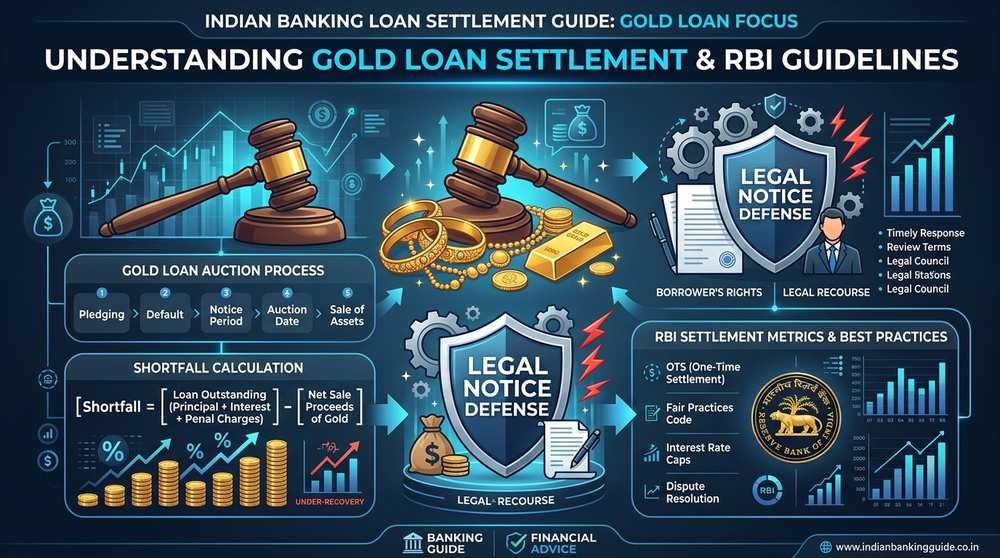
Navigating a post-auction shortfall notice requires a structured, multi-stage legal approach. The infographic below illustrates the institutional workflow from the initial pledge and auction deficit calculation to the forensic audit, advocate rebuttal, and execution of an RBI-compliant zero-rupee settlement.
6. Advocate-Led Legal Defense: Rebutting Deficiencies & Demanding Forensic Audits
When served with a gold loan shortfall demand, the most dangerous response is silence or passive evasion. Ignoring a lawyer's notice allows the lender to establish an unchallenged paper trail, deploy coercive third-party collection agents, or institute an ex-parte civil recovery suit under Order 37 of the Code of Civil Procedure (CPC) in the local City Civil Court or District Court.
A strategic advocate-drafted legal reply immediately shifts the legal burden onto the financial institution. The reply must systematically demand strict documentary compliance under RTI/Banking discovery principles, including:
By presenting these rigorous demands backed by citations to Supreme Court and High Court precedents regarding pledgor rights, the advocate transforms an aggressive collection maneuver into a severe liability exposure for the bank. Faced with the certainty that their documentation will fail judicial scrutiny, the lender's legal committee routinely agrees to compromise the entire residual shortfall.
7. Sanction Letter Forensics & Challenging Illegal Penal Compounding
The contractual bedrock of any gold loan is the original pawn ticket or sanction letter executed at the time of pledge. In their rush to disburse loans, NBFCs and banks frequently employ standard pre-printed adhesion contracts containing microscopic boilerplate clauses that fail Indian contract law standards.
Under Section 74 of the Indian Contract Act, 1872, stipulations for penalty in cases of breach are unenforceable beyond reasonable compensation for actual loss proved. When financial institutions compound default interest monthly—effectively levying interest upon interest and penalty upon penalty—they directly transgress the landmark Supreme Court ruling in Central Bank of India v. Ravindra (2002), which held that penal interest cannot be capitalized or compounded into principal to inflate debt recovery claims.
Furthermore, under the RBI Fair Practices Code (Circular RBI/2023-24/53 on Fair Lending Practice – Penal Charges in Loan Accounts), the Reserve Bank explicitly directed that penal charges for loan defaults must be clearly designated as 'penal charges' and must not be levied in the form of 'penal interest' that is compounded into the rate structure. Any shortfall notice that relies on compounded default interest represents an actionable regulatory violation that can be escalated directly to the RBI Integrated Ombudsman (CMS portal) under the Banking Ombudsman Scheme.
8. Structuring a ₹0 Residual Balance Settlement & Securing an RBI-Compliant NDC
The ultimate objective of legal defense in a post-auction gold loan dispute is the execution of a binding, bilateral Compromise Settlement Agreement that extinguishes all present and future liabilities for ₹0 (Zero Rupees), followed by the issuance of an unconditional No Dues Certificate (NDC).
A properly drafted settlement agreement must incorporate strict legal safeguards to permanently protect the borrower from secondary claims or debt sales:
1. Absolute Extinguishment of Debt: Explicit contractual stipulation confirming that upon realization of the auction proceeds, the loan account stands fully and unconditionally satisfied with zero residual liability payable by the borrower.
2. Prohibition of Secondary Assignment: Formal undertaking that the lender shall not assign, sell, or transfer any purported residual claim or shortfall balance to any Asset Reconstruction Company (ARC) or third-party debt collection agency.
3. Mandatory Bureau Rectification: Mandatory covenant requiring the lender to report the account status as "Settled" or "Closed Post-Auction" to TransUnion CIBIL, Experian, Equifax, and CRIF High Mark within 30 days, reflecting a current balance of ₹0.
4. Delivery of Formal No Dues Certificate: Unconditional issuance of the physical and digitally signed No Dues Certificate / Full Satisfaction Voucher within the statutory 30-day window mandated under RBI Circular RBI/2023-24/60.
Once the No Dues Certificate is secured and bureau records reflect a ₹0 outstanding balance, the borrower can initiate structured credit rehabilitation. While a settled status causes an initial credit score dip of 50 to 120 points, the immediate cessation of compounding overdue cycles allows borrowers to restore their CIBIL score back above 750 within 12 to 24 months through disciplined utilization of secured credit instruments.
9. Comparative Dispute Resolution & Shortfall Settlement Matrix
Borrowers confronted with post-auction shortfall notices have multiple potential paths forward. The comparative matrix below analyzes the strategic trade-offs, procedural timelines, cost implications, and resolution outcomes across different courses of action:
| Resolution Pathway | Procedural Timeline | Financial Cost to Borrower | Legal & CIBIL Risk Exposure | Final Settlement Outcome |
|---|---|---|---|---|
| Uncontested Payment of Demanded Shortfall | 1–7 Days | 100% of Claimed Shortfall (Principal + Inflated Penalties) | High financial loss; validates unfair charges; account marked Closed but credit history reflects severe past default. | Full payment of inflated deficit with zero haircut or penalty relief. |
| Ignoring Notice & Evading Recovery Agents | 6–24 Months | Uncertain (Escalates via Legal Costs & Potential Decree) | Extreme; risk of ex-parte Order 37 CPC decree, bank account freeze, civil warrants, and severe CIBIL destruction. | Ongoing compounding liability and persistent collection harassment. |
| Direct Unrepresented Branch Negotiation | 30–90 Days | 70%–90% of Claimed Shortfall | Moderate; branch managers possess limited discretionary authority to waive non-principal penal charges. | Minor 10%–20% token discount; residual liability remains active on bureau records. |
| Advocate-Led Forensic Defense & ₹0 Settlement | 21–45 Days | Zero Residual Debt + Fixed Advisory Fee | Minimal; legal notice silences recovery agents; statutory flaws force immediate institutional settlement committee review. | 100% Waiver of Shortfall to ₹0 Balance with Official RBI No Dues Certificate. |
As evidenced by the comparative data, an advocate-led defense combining forensic loan ledger audits with RBI regulatory escalation delivers the highest financial protection, completely eliminating the artificial deficit while insulating the borrower from litigation and coercive harassment.
10. SettleLoans Legal Defense & Institutional Settlement Advisory
At SettleLoans, our specialized banking litigation advocates and debt resolution specialists have successfully defended thousands of borrowers across India against aggressive post-auction shortfall claims from NBFCs (including Muthoot Finance, Manappuram Finance, IIFL, Rupeek, and Muthoot Fincorp) and major commercial banks. We provide end-to-end legal representation—from issuing formal legal notice replies and challenging auction procedural lapses to negotiating directly with zonal settlement committees and securing unconditional No Dues Certificates with a ₹0 balance.

Settle Loan is India's trusted debt relief and loan settlement platform. We help borrowers overcome financial distress by negotiating with banks and NBFCs to legally settle personal loans and credit card debts. With our transparent, performance-based approach, you can achieve debt freedom and regain your financial peace of mind.
COMPUTER
11. Frequently Asked Questions (FAQs)
Find clear, authoritative answers to the most critical legal and procedural questions regarding gold loan shortfall notices, auction deficits, and zero-balance debt settlements in India.
What is a gold loan shortfall notice and why did I receive it after the auction?
A gold loan shortfall notice is a formal legal demand sent by a bank or NBFC when the net proceeds from auctioning your pledged gold fail to satisfy the total ledger balance claimed by the lender. This ledger balance typically includes the original principal, regular contractual interest, compounded penal charges, auctioneer fees, advertisement expenses, and administrative overhead. The lender demands that you personally pay this residual deficit out of pocket.
Can a bank or NBFC recover money from me after auctioning my pledged gold?
Under Section 176 of the Indian Contract Act, 1872, a pawnee (lender) retains a theoretical civil right to claim the balance if the sale proceeds are less than the debt. However, to legally enforce this shortfall, the lender must prove in a competent civil court that they strictly adhered to all statutory notice mandates, maintained transparent bidding, obtained fair market value, and did not inflate the balance with usurious or unapproved penal levies.
What are the primary legal grounds to challenge a gold loan shortfall notice?
Primary defenses include: (1) Absence of mandatory 14-day prior registered notice before auction; (2) Auctioning gold in a non-transparent manner or in a distant city rather than the branch district; (3) Selling collateral significantly below the prevailing RBI-prescribed 30-day average market benchmark; (4) Unlawful compounding of penal interest in violation of RBI Fair Practices Codes; and (5) Non-furnishing of the certified auction statement of accounts.
How do lenders inflate the shortfall amount using penal charges?
When a gold loan defaults, lenders often levy monthly penal charges ranging from 2% to 6% per month on top of high contractual interest rates (18% to 26% p.a.). Furthermore, they add steep auction fees, legal handling expenses, and storage overhead. Over 6 to 12 months, these cumulative non-principal levies can expand the book debt by 40% to 70%, artificially generating a shortfall even when the underlying gold possessed substantial market value.
Can Muthoot, Manappuram, or a bank file a criminal case or police complaint for a shortfall?
No. A gold loan default and subsequent auction shortfall are purely civil contractual matters. Unless the borrower pledged fake, counterfeit, or stolen gold (which involves fraud), the police cannot register an FIR or take cognizance of an unpaid shortfall. Any threats by recovery agents claiming imminent arrest or police intervention are unlawful and violate RBI Fair Practices Directives.
How does an advocate negotiate a ₹0 full and final settlement on a gold loan shortfall?
Legal counsel issues a robust response contesting procedural violations, undervaluation during auction, and unconscionable penal charges. Faced with forensic exposure of their regulatory lapses and the prospect of multi-year civil court litigation yielding negligible Net Present Value (NPV), lenders routinely agree to write off the entire residual shortfall and execute a ₹0 full and final settlement.
What happens if I ignore the gold loan shortfall legal notice?
Ignoring the notice allows the lender to mark your credit profile with an active written-off or suit-filed status, deploy third-party recovery agencies for coercive collection, or file a civil recovery suit (such as a Summary Suit under Order 37 CPC). Timely legal rebuttal paralyzes unilateral recovery actions and forces institutional settlement desks to negotiate.
How does settling a gold loan shortfall impact my CIBIL credit score?
Upon executing a zero-rupee or compromised shortfall settlement, the lender updates credit bureaus (CIBIL, Experian, Equifax, CRIF High Mark) with an outstanding balance of ₹0 and status as 'Settled' or 'Post-Auction Closed'. This stops progressive negative compounding and enables structured credit score rehabilitation back above 750 within 12 to 24 months.
When is the lender legally required to issue my No Dues Certificate under RBI rules?
Under RBI Circular RBI/2023-24/60 on Fair Lending Practice, banks and NBFCs are legally obligated to release a comprehensive No Dues Certificate (NDC) and update credit bureau records within 30 days of settlement execution. Unjustified delays make the lender liable to pay statutory compensation of ₹5,000 per day of delay directly to the borrower.