- Intermediary Marketplace Reality: P2P platforms are not balance-sheet lenders. Under Reserve Bank of India (RBI) regulations, platforms cannot offer First-Loss Default Guarantees (FLDG) or absorb credit risk, making person retail lenders highly receptive to realistic compromise settlements.
- Eliminating Predatory Penalties: Revoking electronic NACH mandates under NPCI rules prevents recurring bounce penalties. Formal legal representation demands the complete 100% cancellation of unlawful penal interest and platform administrative fees.
- Realistic 40%–65% Haircut Potential: Because retail investors face prohibitive litigation expenses in local civil courts, the Net Present Value (NPV) recovery calculation strongly supports large debt discounts over protracted legal disputes.
- Statutory Legal Notice Protections: Section 25 PSSA demand notices, Section 138 NI Act notices, and unilateral sole arbitration cases are routinely defended, neutralized, and resolved through formal advocate conciliation.
- Binding ₹0 No Dues Certificate: Under RBI Circular RBI/2023-24/60, P2P platforms must deliver an authentic stamped No Dues Certificate and update credit bureaus within 30 days of receiving the settlement payoff.
The Anatomy of Peer-to-Peer Lending
Peer-to-Peer (P2P) lending in India has expanded rapidly over the past decade. It is driven by platforms like Faircent (Fairassets Technologies India Pvt Ltd), LenDenClub, LiquiLoans, and Finzy. However, distressed borrowers often misinterpret how these platforms function compared to commercial banks or conventional NBFCs. Understanding the statutory design of an NBFC-P2P entity is essential. It is the critical first step in formulating an effective loan settlement strategy.
Under RBI Master Directions on Peer to Peer Lending Platforms (2017) and August 2024 updates, an NBFC-P2P is strictly an intermediary technology platform. The platform is legally prohibited from lending on its own balance sheet or raising public deposits. It cannot provide credit enhancement structures such as First-Loss Default Guarantees (FLDG). When a borrower secures a ₹5 Lakh loan through Faircent, capital is not disbursed from a corporate treasury. Instead, it is syndicated across dozens or hundreds of person retail lenders. These lenders allocate capital in fractional tranches ranging from ₹500 to ₹50,000.
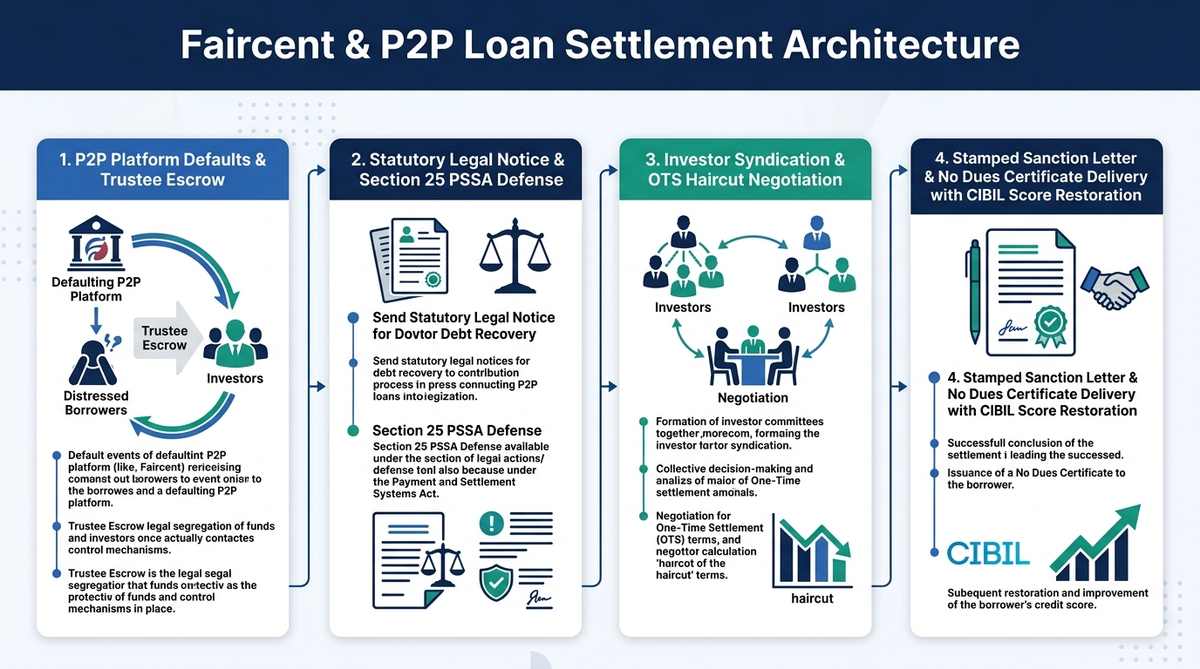
This syndication framework operates entirely through SEBI-regulated, bank-managed Trustee Escrow Accounts. Under RBI directives, all cash flows must route through two distinct escrow mechanisms: the Borrower Escrow Account and the Lender Escrow Account. Both are operated by an independent third-party trustee. When a borrower suffers genuine distress due to job termination, medical catastrophe, or business failure, the default does not impair the platform's equity capital. Instead, the NPA directly impacts the returns of retail investors. This dynamic heavily favors structured compromise settlements.
P2P Delinquency Dynamics: DPD Buckets & Litigation Limits
In traditional commercial banking, defaulted loans trigger rigid provisioning rules mandated under Ind AS 109 and RBI IRAC norms. Banks must lock 15% to 100% of capital reserves as provisioning once an account enters Sub-Standard, Doubtful, or Loss categories. In stark contrast, an NBFC-P2P platform does not carry loan assets on its balance sheet. Therefore, it does not hold statutory capital provisioning against non-performing consumer debt.
Instead, P2P platforms track default trajectories through progressive Days Past Due (DPD) delinquency buckets, categorizing overdue loans into early-stage, mid-stage, and hard-core stressed assets:
| Delinquency Bucket | DPD Range | Platform & Investor Recovery Actions | Optimal Settlement Strategy |
|---|---|---|---|
| Bucket 1 (SMA-0) | 1 – 30 Days | Automated IVR calls, SMS/WhatsApp alerts, initial NACH mandate re-presentation. | Submit formal hardship intimation; request temporary EMI moratorium or restructuring. |
| Bucket 2 (SMA-1) | 31 – 60 Days | Assignment to internal tele-calling agents; accumulation of penal interest and bounce levies. | Revoke banking NACH mandates; request detailed statement audit to freeze penal compounding. |
| Bucket 3 (SMA-2) | 61 – 90 Days | Third-party digital recovery agencies empaneled; issuance of initial advocate demand notices. | Serve anti-harassment legal notice; establish direct notices with Stressed Assets Desk. |
| NPA / Default | 90 – 180 Days | Formal default reporting to credit bureaus; statutory Section 25 PSSA demand notices dispatched. | start formal One-Time Settlement (OTS) talks targeting 40%–50% principal reduction. |
| Hard-Core Stressed | 180+ Days | Unilateral arbitration notices or Lok Adalat referrals; retail lenders seeking loss mitigation. | Finalize maximum OTS haircut (50%–65% debt waiver) with single-tranche payoff via Trustee Escrow. |
The structural challenge for P2P platforms lies in legal enforceability. A ₹5 Lakh loan is fragmented among 50 separate retail investors across different states. so, filing person civil recovery suits under Order 37 CPC in local courts is financially unviable. The legal fees, advocate retainers, court fees, and service expenses rapidly exceed the recoverable principal. Recognizing this legal friction, P2P platforms and lender committees routinely accept large OTS haircuts to recover liquid capital quickly.
Check Your Loan Settlement Options
Answer 2 quick questions to evaluate your settlement eligibility.
1. What type of loan do you want to settle?
Neutralizing Predatory NACH Mandates & Return Fees
One of the most damaging consequences of defaulting on a Faircent, LenDenClub, or LiquiLoans facility is the aggressive, automated presentation of National Automated Clearing House (NACH) electronic debit mandates. Many fintech platforms configure automated clearing bots that trigger mandate sweeps multiple times within a single billing cycle. Each time a debit attempt fails due to insufficient balance, the borrower's commercial bank levies a return charge of ₹250 to ₹500 plus GST. In contrast, the P2P platform adds an internal bounce fee of ₹500 to ₹1,000 alongside penal interest ranging from 24% to 36% per annum.
Within three to four months of initial default, these repetitive debit attempts can drain thousands of rupees from a distressed borrower's bank account, creating secondary overdrafts and inflating the platform ledger with phantom penalty arrears. Borrowers must understand that repetitive mandate presentations when a lender is fully aware of financial hardship violate core fair lending principles established by the Reserve Bank of India.
Under NPCI guidelines and Section 25 of the Payment and Settlement Systems Act, 2007 (PSSA), borrowers possess clear statutory rights. You have the absolute right to revoke or suspend electronic NACH mandates at your bank branch or via mobile banking. Serving a formal written revocation notice legally obligates your bank to reject future automated debits. This halts bank bounce penalties immediately while settlement talks proceed.
RBI Fair Lending Compliance Mandate
Under the RBI Master Directions on Fair Practices Code and the Circular on Fair Lending Practice - Penal Charges in Loan Accounts (RBI/2023-24/53), lenders cannot capitalize penal charges or compound overdue interest into principal dues. In any formal One-Time Settlement, 100% of accumulated bounce fees, late administrative levies, and penal compounding must be completely waived.
Net Present Value (NPV) Recovery Modeling
The core financial mechanism governing all P2P loan compromise settlements is the Net Present Value (NPV) of Recovery equation. Because P2P platforms act as fiduciaries managing recovery operations on behalf of retail lenders, their internal collections committees evaluate default resolution through strict financial discounting models. When a borrower defaults, the platform faces two mutually exclusive paths: pursuing protracted civil and quasi-criminal litigation or accepting a discounted One-Time Settlement.
Litigating an unsecured consumer loan in Indian courts incurs heavy friction: advocate retainers, court process fees, Section 25 PSSA complaint filings, arbitration administrative charges, and execution petition delays spanning 3 to 7 years. also, with inflation eroding monetary value, recovering nominal dues half a decade later yields a severely depressed real economic return.
Where C_t represents estimated recoveries across time t, r is the opportunity discount rate (12%–15%), and deductions account for direct advocate filing fees, process service expenses, and platform administrative drag.
An experienced banking advocate can present a documented hardship brief showing insolvency, job loss, or illness. When presented with this proof, the platform's algorithm recognizes that litigation yields lower net returns than an immediate cash compromise. This economic reality allows distressed borrowers to negotiate legitimate principal haircuts ranging from 40% to 65% of total ledger exposure. The liability is then settled in a single consolidated escrow remittance.
Faircent & P2P Loan Settlement & Legal Defense Architecture
Defending Against Third-Party Recovery Harassment
Because P2P lending platforms operate primarily in the digital realm, their default recovery strategies frequently rely on aggressive tele-calling agencies and third-party recovery vendors. Distressed borrowers frequently report egregious collection tactics: persistent calling outside permitted hours, abusive language, threatening criminal imprisonment, contacting unrelated family members, calling employers or corporate HR departments, and threatening unauthorized home or workplace visits.
Every borrower must understand that such conduct is strictly unlawful under Indian law. The Reserve Bank of India has issued stringent statutory directives governing recovery conduct across all regulated lenders, including NBFC-P2P platforms:
- Statutory Calling Hours: Under RBI Master Directions on Recovery Agents, collection personnel are strictly prohibited from contacting borrowers before 08:00 AM or after 07:00 PM.
- Prohibition of Third-Party Disclosure: Agents cannot disclose loan delinquency details to employers, colleagues, neighbors, or non-guarantor family members. Doing so violates fundamental privacy rights upheld by the Supreme Court of India in K.S. Puttaswamy v. Union of India.
- Digital Lending Guidelines Protection: Under the RBI Guidelines on Digital Lending (2022), platforms and their collection agencies are strictly forbidden from accessing borrower phone contacts, media storage, or social media networks to exert coercive recovery pressure.
- No Criminal Jurisdiction: Recovery agents cannot threaten police FIRs, criminal warrants, or border immigration blocks for unsecured civil loan defaults.
When third-party recovery agencies violate statutory guidelines, borrowers can halt the abuse immediately. An advocate can issue a formal cease-and-desist notice. If the platform fails to discipline the agency within 30 days, the borrower holds the statutory right to escalate the grievance. You can file directly on the RBI Integrated Ombudsman portal (CMS), exposing the P2P platform to severe regulatory penalties.
The 5-Stage P2P Compromise Resolution Protocol
Negotiating an authorized, legally binding One-Time Settlement with Faircent, LenDenClub, or LiquiLoans requires a disciplined, multi-stage protocol. Attempting to negotiate informally with tele-calling recovery agents is ineffective because third-party callers have zero legal authority to sanction debt waivers. Borrowers must follow a formal institutional procedure:
Comprehensive Financial & Ledger Audit
Obtain full loan account statements from the P2P mobile application or web portal. Isolate the exact disbursed principal, total EMIs repaid to date, unapplied interest, accumulated NACH bounce charges, and predatory penal levies. Establish the true outstanding principal baseline.
Statutory Hardship Petition Submission
Draft a formal legal hardship representation addressed to the P2P platform's Stressed Assets Resolution Committee and Principal Nodal Officer. Attach corroborating records—such as job termination letters, medical treatment records, GST sales decline audits, or bank salary slips—proving genuine inability to service contractual EMIs.
Advocate-Led Escrow Haircut talks
Experienced debt settlement counsel engages directly with the platform's legal and credit recovery executives. By showing the prohibitive costs of multi-party civil litigation and leveraging NPV recovery models, counsel negotiates a 40% to 65% debt reduction alongside a 100% waiver of all accumulated penalties.
Sanction Letter Forensic Audit
before authorizing any payment, legal counsel audits the formal OTS Sanction Letter issued on official letterhead. The document must explicitly state the final settlement amount and payment due date. It must also list designated Trustee Escrow Account details. also, it must confirm that all civil claims are extinguished and commit to issuing a ₹0 No Dues Certificate.
Escrow Remittance & No Dues Certificate Delivery
Execute the settlement payment exclusively via traceable banking channels (NEFT/RTGS/IMPS) directly into the platform's designated Trustee Escrow Account. Secure the official payment acknowledgement, stamped No Dues Certificate (NDC), and start credit bureau record updates.
Navigating Legal Notices: Section 25, Section 138 & Lok Adalat
When a P2P loan crosses 90 to 180 DPD without resolution, platforms frequently start formal legal cases to exert pressure on the borrower. Understanding the jurisdictional nature and legal remedies available for each category of notice is essential to avoid panic and protect your statutory rights:
Section 25 PSSA Demand Notices (Dishonoured NACH Mandates)
Under Section 25 of the Payment and Settlement Systems Act, 2007, a bounced electronic mandate carries quasi-criminal liability comparable to a bounced physical cheque under Section 138 of the Negotiable Instruments Act, 1881. However, before any complaint can be filed in a Magistrate Court, the platform must serve a statutory 15-day demand notice. A formal legal reply drafted by experienced counsel showing involuntary financial hardship, highlighting unauthorized repeat presentations, and proposing compromise terms routinely transitions the dispute into settlement discussions.
Unilateral Sole Arbitration cases
Many P2P loan agreements contain arbitration clauses under which platforms attempt to appoint a sole arbitrator unilaterally in Delhi, Mumbai, or Bengaluru. Under binding Supreme Court precedents (Perkins Eastman Architects DVM v. HSCC (India) Ltd. and TRF Ltd. v. Energo Engineering Projects Ltd.), unilateral arbitrator appointments without mutual written consent are legally invalid. Legal counsel can challenge the arbitrator's jurisdiction under Section 12 and Section 14 of the Arbitration and Conciliation Act, 1996, effectively halting ex-parte cases.
National Lok Adalat Amicable Settlement
P2P platforms frequently refer delinquent accounts to National Lok Adalat sessions organized under the Legal Services Authorities Act, 1987. Lok Adalat is an amicable, non-adversarial dispute resolution forum presided over by a retired judicial officer. Lok Adalat awards carry the statutory finality of a civil court decree under Section 21 of the Act, with zero court fees, guaranteed principal waivers, and complete termination of all legal claims.
Authenticating OTS Sanction Letters & Enforcing NDCs
A critical danger in the loan settlement ecosystem involves informal, verbal, or WhatsApp "settlement promises" extended by third-party recovery agency callers. Borrowers who transfer funds based on casual WhatsApp messages frequently discover that the money was credited as a partial installment payment, leaving the remaining loan active and compounding fresh default charges.
To guarantee complete legal immunity, every settlement must be backed by an authentic, stamped One-Time Settlement Sanction Letter. This letter must be issued on the official letterhead of the RBI-registered NBFC-P2P entity (such as Fairassets Technologies India Pvt Ltd or Innofin Solutions Pvt Ltd). The sanction document must explicitly detail:
- Borrower legal name, registered mobile number, and unique P2P Loan Account Number (LAN).
- The agreed compromise settlement amount (inclusive of all applicable taxes) and the strict payment due date.
- The designated SEBI-regulated Trustee Escrow Account number and IFSC code for direct electronic remittance.
- Explicit legal covenants confirming that upon receipt of the settlement sum, all underlying lender claims, Section 25 notices, and arbitration actions are unconditionally withdrawn.
Following full payment, the platform is statutorily bound under RBI Circular RBI/2023-24/60 to issue a formal No Dues Certificate (NDC) within 30 calendar days. If the lender delays issuing the NDC or updating credit bureaus without lawful cause, statutory penalties apply. The borrower is entitled to direct relief of ₹5,000 per day of delay under Reserve Bank of India consumer protection mandates.
CIBIL Score Trajectory: Post-Settlement Credit Rebuilding
A common concern among borrowers settling a Faircent or P2P personal loan is the long-term impact on their credit profile across TransUnion CIBIL, Experian, Equifax, and CRIF High Mark. When a loan is resolved through a compromise settlement, the P2P platform updates the credit bureaus with the status "Settled" or "Post-Write-off Settled" and reflects an outstanding balance of ₹0.
While a "Settled" status triggers a temporary drop of 70 to 120 points on your credit score, it is vastly superior to maintaining an active, compounding default status ("Written Off" or "Suit Filed"). An ongoing default permanently destroys creditworthiness by adding fresh 90+ DPD delinquency marks every 30 days. In contrast, a settled account closes the default cycle, permanently halts penal compounding, and allows your credit profile to enter an active recovery phase.
Borrowers can systematically rehabilitate their credit score back to 750+ within 18 to 24 months by applying disciplined post-settlement steps:
- Credit Bureau Audit (45 Days Post-Settlement): Download updated credit reports to verify that the P2P loan status is updated to "Settled" with a current balance of ₹0 and zero overdue arrears.
- Secured Credit Card Issuance: Obtain a fixed-deposit-backed secured credit card (such as IDFC FIRST WOW or Kotak 811 DreamDifferent) with a modest limit of ₹25,000 to ₹50,000.
- Strict Credit use Ratio (CUR): Maintain credit use strictly below 25% of your available card limit and settle monthly statements in full before the billing due date.
- Eliminate Hard Credit Inquiries: Avoid submitting new unsecured loan or credit card applications for a minimum of 12 months following settlement to show financial stabilization.

Settle Loan is India's trusted debt relief and loan settlement platform. We help borrowers overcome financial distress by negotiating with banks and NBFCs to legally settle personal loans and credit card debts. With our transparent, performance-based approach, you can achieve debt freedom and regain your financial peace of mind.
COMPUTER
Frequently Asked Questions: Faircent & P2P Loan Settlement
Q1.How does the P2P loan settlement process differ from traditional bank settlements?
Unlike scheduled commercial banks that hold loans directly on their balance sheets, Peer-to-Peer (P2P) platforms like Faircent, LenDenClub, and LiquiLoans operate as NBFC-P2P marketplace intermediaries under RBI Master Directions. A single P2P loan is syndicated across dozens of person retail lenders. The platform does not absorb credit risk and cannot provide balance-sheet guarantees. Settlement talks are helped by the platform's stressed asset resolution desk, which executes compromise haircuts (typically 40% to 65%) on behalf of lenders. Funds are routed through a SEBI-regulated Trustee Escrow Account rather than direct bank branch ledgers.
Q2.Can Faircent or P2P lenders file a criminal FIR or arrest a borrower for loan default?
No. Defaulting on an unsecured P2P personal loan is strictly a civil breach of contract under the Indian Contract Act, 1872. Police authorities have no legal jurisdiction to register an FIR, summon borrowers to a police station, or execute an arrest for genuine financial inability to repay. While platforms or person lenders may start quasi-criminal cases under Section 25 of the Payment and Settlement Systems Act (PSSA) or Section 138 of the Negotiable Instruments Act for bounced electronic mandates, these are compoundable matters settled through advocate representation and compromise payoffs.
Q3.What percentage of debt waiver or haircut can you negotiate on a defaulted P2P loan?
Borrowers with authentic financial hardship can negotiate a principal haircut between 40% and 65% of outstanding dues on defaulted P2P loans, alongside a 100% waiver of all accumulated bounce fees, penal charges, and legal administrative costs. Because person P2P investors face high litigation friction and lack the institutional legal machinery of major commercial banks, their Net Present Value (NPV) recovery calculation strongly favors accepting a fast one-time cash settlement over years of uncertain civil litigation.
Q4.How do you stop repeated NACH bounce charges and mandate presentations by P2P platforms?
You can halt recurring NACH bounce penalties by: (1) Submitting a written mandate cancellation or revocation notice to your home bank under National Payments Corporation of India (NPCI) procedural guidelines; (2) Serving a formal legal hardship notice upon Faircent or the P2P platform demanding immediate cessation of automated debit presentations; (3) Insisting on a complete waiver of all penal interest and bounce levies during One-Time Settlement talks under RBI fair lending guidelines.
Q5.What should you do if P2P recovery agents harass your family, friends, or workplace?
Third-party collection harassment is strictly illegal under the RBI Master Directions on Recovery Agents and Digital Lending Guidelines. P2P platforms and their empaneled agencies are prohibited from contacting your relatives, calling employers, accessing your phone contact list, or calling outside the statutory window of 08:00 AM to 07:00 PM. If violated, you should immediately issue a formal legal cease-and-desist notice to the platform's Principal Nodal Officer and file an official complaint on the RBI Integrated Ombudsman portal (CMS).
Q6.How do you handle a Section 25 PSSA or Section 138 legal notice from a P2P lender?
A Section 25 PSSA notice is a statutory 15-day demand notice following a dishonoured automated clearing mandate. It is not an arrest warrant or court judgment. You should engage qualified banking advocates to reply within the 15-day statutory window, documenting bona fide financial hardship, highlighting unauthorized repetitive sweeps, challenging inflated penal fees, and proposing structured One-Time Settlement terms.
Q7.Are unilateral arbitration cases started by P2P platforms legally binding?
Under landmark Supreme Court rulings in Perkins Eastman Architects DVM v. HSCC (India) Ltd. and TRF Ltd. v. Energo Engineering Projects Ltd., unilateral arbitrator appointments made exclusively by a lender without mutual borrower consent are void ab initio and legally unenforceable. Your legal counsel can challenge the arbitrator's jurisdiction under Section 12 and Section 14 of the Arbitration and Conciliation Act, 1996, effectively halting ex-parte orders and compelling the platform to resolve the dispute through compromise talks.
Q8.How does a P2P loan settlement impact your CIBIL score and how can you rebuild it?
Following settlement, the P2P platform reports your account to credit bureaus (CIBIL, Experian, CRIF High Mark) with the status 'Settled' and an outstanding balance of ₹0. While this causes a short-term drop of 70 to 120 points on your credit score, it halts compounding delinquency marks, eliminates 'Written Off' default flags, and ends active legal alerts. You can rebuild your credit score back above 750 within 18 to 24 months using secured credit cards and timely utility bill repayments.
Q9.Who issues the No Dues Certificate (NDC) for a settled P2P loan?
The No Dues Certificate (NDC) or Closure Letter is issued directly by the RBI-registered NBFC-P2P platform (e.g., Faircent / Fairassets Technologies India Pvt Ltd, LenDenClub / Innofin Solutions Pvt Ltd) acting on behalf of the underlying person lender syndicate. Under RBI Circular RBI/2023-24/60, the platform is legally obligated to release the NDC and update credit bureau records within 30 calendar days of receiving the full settlement payoff.
Q10.Can P2P platforms offer First-Loss Default Guarantees (FLDG) to compensate investors?
No. Under the updated RBI Master Directions for NBFC-P2P platforms issued in August 2024, P2P platforms are strictly prohibited from providing any First-Loss Default Guarantee (FLDG), credit enhancement, or assured return schemes to retail lenders. The credit risk resides entirely with the person lenders, which makes them highly pragmatic when evaluating One-Time Settlement compromise offers on non-performing accounts.