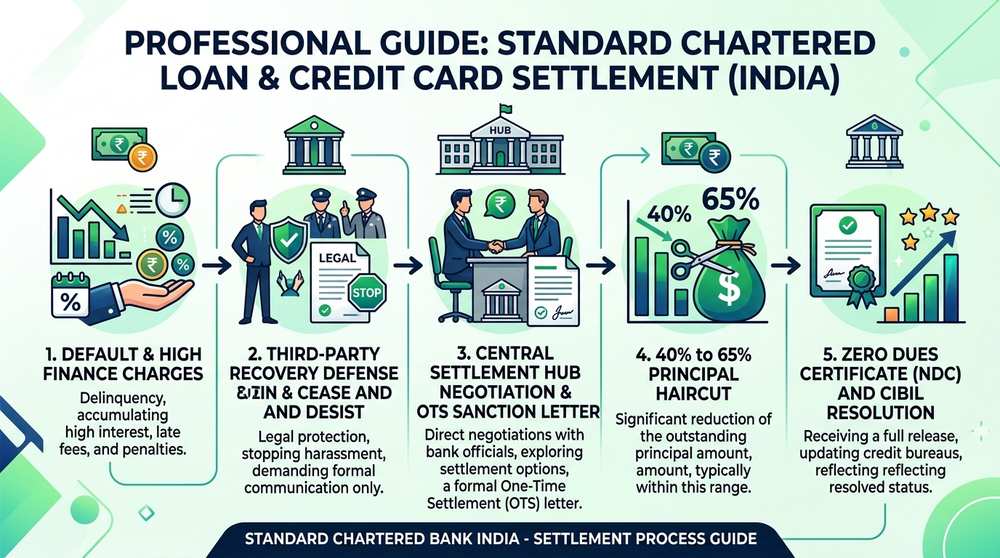
- Central Hub Escalation: Bypassing third-party tele-calling agencies to negotiate directly with Standard Chartered Bank's Central Collections and Stressed Asset Hub in Chennai guarantees authentic One-Time Settlement (OTS) authority.
- Complete Elimination of Finance Charges: High-ticket credit cards (Ultimate, Rewards, Smart, DigiSmart) accumulate up to 52.8% annualized finance charges. RBI compromise guidelines allow complete 100% elimination of all late fees, penal levies, and compounding interest.
- 40% to 65% Principal Haircut: Once an unsecured loan or card debt crosses 90 to 180 days past due and enters Substandard or Doubtful NPA classifications, the bank's internal provisioning model supports substantial principal concessions.
- Section 171 Banker's Lien Shield: Standard Chartered can legally exercise set-off on internal accounts under the same CIF. Distressed borrowers must protect external banking liquidity and challenge Section 25 PSSA notices within the 15-day statutory window.
- Mandatory ₹0 No Dues Certificate: Under RBI Circular RBI/2023-24/60, Standard Chartered must deliver a formal No Dues Certificate (NDC) and update credit bureau records within 30 days of receiving the compromised settlement sum.
Standard Chartered Bank India: Retail Portfolio & OTS
Standard Chartered Bank stands as one of the oldest and most established foreign banking institutions operating in India, catering extensively to affluent professionals, senior corporate executives, high-net-worth individuals, and business owners. The bank's retail lending architecture in India is heavily anchored in premium, high-ticket unsecured credit products, including the Standard Chartered Ultimate Credit Card, EaseMyTrip Credit Card, Smart Credit Card, DigiSmart Credit Card, Platinum Rewards Card, and substantial unsecured Personal Loans extending up to ₹30 Lakhs to ₹50 Lakhs.
Unlike domestic public sector banks whose retail credit underwriting leans heavily on collateralized mortgages or salaried employer tie-ups, Standard Chartered operates a global risk-scoring model. The bank extends generous revolving credit limits and pre-approved personal loans based on internal behavioral scoring and historical income flows. However, when macro-economic disruptions, corporate layoffs, medical emergencies, or severe business cash flow contractions occur, this high-ticket unsecured exposure quickly transforms into a significant financial liability for the borrower.
When a borrower defaults on a Standard Chartered credit card or personal loan, the bank activates an aggressive, highly centralized recovery apparatus. Because foreign banks face stringent capital adequacy norms under Basel III guidelines and RBI oversight, Standard Chartered maintains strict loss-provisioning protocols. Understanding how the bank structures its unsecured credit portfolio, calculates risk-weighted assets, and delegates settlement authority is essential for any borrower seeking a legally enforceable compromise settlement with maximum debt waivers.
The Compounding Debt Trap: How Standard Chartered Finance Charges Inflate Overdue Balances
The primary driver of distress for Standard Chartered credit cardholders is the exponential acceleration of monthly finance charges once the minimum amount due is missed. Standard Chartered credit cards apply monthly finance charges ranging between 3.75% and 3.99%, which translates into an effective Annual Percentage Rate (APR) of 45.0% to 52.8%. When combined with mandatory 18% Goods and Services Tax (GST) levied on all interest charges, late payment fees scaling up to ₹1,200 per billing cycle, over-limit charges, and automated transaction bounce penalties, an overdue card balance escalates rapidly.
Consider a scenario where a cardholder possesses an active revolving balance of ₹6,00,000 on a Standard Chartered Ultimate Card. If the cardholder defaults due to sudden job loss, the monthly interest and finance charges exceed ₹24,00, plus ₹4,320 in GST and ₹1,200 in late fees. Within six months of non-payment, the nominal ledger balance swells beyond ₹7,80,000 without any new purchases being executed. Within twelve months, the total claimed dues frequently surpass ₹9,50,000 to ₹10,20,000, representing a 60% to 70% inflation over the actual transacted principal.
For unsecured personal loans, the bank levies penal interest typically calculated at 24% per annum on the overdue installment amounts, alongside recurring NACH return penalties ranging from ₹450 to ₹590 per presentation attempt. When borrowers attempt to negotiate on their own, collection agencies demand payment against this inflated ledger sum. However, under the Reserve Bank of India Master Direction on Compromise Settlements and Technical Write-offs, banks are legally empowered to strip away 100% of accumulated finance charges, penal interest, late fees, and bounce penalties, restructuring the settlement exclusively around the core underlying principal balance.
During One-Time Settlement (OTS) negotiations with Standard Chartered Bank, professional advocates isolate the transacted principal from compounding finance charges, GST levies, and administrative penal fees. Under RBI compromise settlement frameworks, all non-principal components are categorized as uncollected interest and are completely waived during formal credit committee approvals.
Check Your Loan Settlement Options
Answer 2 quick questions to evaluate your settlement eligibility.
1. What type of loan do you want to settle?
Delinquency Stages, Asset Classification, and Escalation to Central Collections Hub
The resolution trajectory of a defaulted Standard Chartered personal loan or credit card follows a rigid regulatory progression established by the RBI's Prudential Norms on Income Recognition, Asset Classification, and Provisioning pertaining to Advances (IRAC Norms). Understanding these exact chronological stages enables borrowers to time their settlement petitions for maximum institutional receptivity.
During the early delinquency cycle (Days Past Due or DPD 1 to 90), accounts are categorized under Special Mention Account classifications: SMA-0 (1 to 30 DPD), SMA-1 (31 to 60 DPD), and SMA-2 (61 to 90 DPD). At this stage, Standard Chartered relies on automated SMS alerts, robotic Interactive Voice Response (IVR) calls, and early-stage internal tele-calling units. Frontline branch staff and early tele-callers possess zero discretion to offer discounts; their sole mandate is to coerce immediate payment of the full minimum amount due.
Once the delinquency crosses the critical 90-day threshold, the account is formally classified as a Non-Performing Asset (NPA). Under RBI provisioning rules, Standard Chartered is mandated to lock away 15% of the outstanding loan value as a balance-sheet provision under the Substandard Asset category. If the default continues past 12 months, the account transitions to Doubtful Asset status (D1 with 25%–40% provision, D2 with 40%–100% provision, and eventually Loss Asset with 100% provision).
At the NPA inflection point, the file is stripped from retail branch custody and transferred to Standard Chartered Bank's Central Collections and Stressed Asset Resolution Hub (primarily operating out of Chennai and major zonal operational hubs in Mumbai, Delhi-NCR, Bengaluru, and Kolkata). It is at this central tier that specialized Stressed Asset Officers and Regional Credit Committees hold the delegated financial powers to approve substantial principal haircuts, evaluate Net Present Value recovery formulas, and execute legally binding One-Time Settlement (OTS) sanction letters.
Banker's Right of Lien (Section 171) and Defending Statutory Legal Notices
A critical legal dimension that borrowers must navigate when dealing with Standard Chartered Bank is the statutory doctrine of the Banker's Right of General Lien and Set-Off, codified under Section 171 of the Indian Contract Act, 1872. If a borrower defaults on a Standard Chartered credit card or personal loan while simultaneously maintaining a Savings Account, Priority Banking Account, Salary Account, Current Account, or Fixed Deposit with Standard Chartered Bank, the bank will unilaterally freeze and sweep those deposited funds to adjust against the overdue loan ledger under the same Customer Information File (CIF) or PAN.
However, this right of general lien is strictly confined to accounts held internally within Standard Chartered Bank. The bank possesses no statutory power to unilaterally attach, freeze, or sweep balances held in external commercial banks (such as State Bank of India, HDFC Bank, ICICI Bank, or Axis Bank) without obtaining an explicit attachment order from a competent Civil Court or Debt Recovery Tribunal (DRT). Borrowers facing imminent default must proactively redirect their primary salary credits and operational living liquidity to external banking institutions to preserve their essential financial solvency.
Simultaneously, when automated NACH mandates or repayment cheques dishonour due to insufficient funds, Standard Chartered's empanelled legal firms issue statutory demand notices under Section 25 of the Payment and Settlement Systems Act, 2007 (PSSA) or Section 138 of the Negotiable Instruments Act, 1881. Borrowers often mistake these demand notices for immediate criminal arrest warrants or court decrees. In reality, a Section 25 PSSA notice is a statutory 15-day demand notice.
Serving a structured, advocate-drafted legal reply within the mandatory 15-day window accomplishes three vital objectives: (1) It prevents the bank from establishing unrefuted dishonest intention or willful default; (2) It places the borrower's genuine financial hardship, job loss, or medical emergency firmly on the legal record; and (3) It formally challenges the exorbitant computation of compounding finance charges while opening direct institutional conciliation channels with the bank's Central Stressed Asset Committee.
Standard Chartered Bank India: Strategic Debt Resolution Blueprint
One-Time Settlement (OTS) Haircut Mechanics and the Net Present Value Recovery Formula
A common misconception among defaulting cardholders is that Standard Chartered Bank agrees to debt settlements out of charitable sympathy. In commercial reality, every compromise settlement sanctioned by Standard Chartered is an analytical financial decision driven by risk management algorithms and balance-sheet recovery modeling known as the Net Present Value (NPV) Recovery Assessment.
When an unsecured credit card or personal loan defaults, Standard Chartered evaluates two competing paths: pursuing protracted civil litigation (filing summary suits under Order 37 CPC or Section 25 PSSA complaints in Magistrate Courts) versus accepting an immediate lump-sum cash compromise. Civil litigation in Indian judicial forums entails extensive legal retainers, court fee disbursements, process service delays, and an average resolution timeline of 3 to 7 years. During this prolonged period, the bank must maintain 100% provisioning on the non-performing asset, locking up valuable regulatory capital.
Where C_t represents estimated future judicial recoveries across time t, r is the bank's weighted average cost of capital, and deductions account for direct legal advocate fees, court expenses, and the commercial cost of capital locked under 100% NPA balance-sheet provisioning.
Because unsecured credit lines lack underlying mortgage collateral, the bank's realistic probability of recovering 100% of the ledger balance through civil execution is extremely low. When a distressed borrower presents a credible, advocate-backed One-Time Settlement proposal offering immediate cash remittance (typically between 35% and 60% of the total ledger balance, or 50% to 70% of core principal), the discounted cash flow of the OTS significantly exceeds the Net Present Value of uncertain long-term litigation. Consequently, the bank's Stressed Asset Committee sanctions substantial principal haircuts while recording the remainder as an authorized compromise write-off.
Defending Against Aggressive Recovery Agencies Under RBI Master Directions
Standard Chartered Bank outsources the field recovery of delinquent retail accounts to external third-party Debt Recovery Agencies (DRAs) across major Indian metros. Because these outsourced collection agencies operate on high recovery commission slabs (often earning 10% to 25% of any collected amount), their collection tele-callers and field personnel frequently resort to unlawful, coercive tactics designed to induce panic.
Common violations include placing continuous abusive calls from personal mobile numbers, threatening immediate police arrest or criminal FIRs, contacting non-guarantor relatives, friends, and corporate HR departments whose contact information was mined from credit applications, and dispatching unverified recovery personnel to residential societies or office premises.
The Reserve Bank of India Master Directions on Recovery Agents and the Banking Codes and Standards Board of India (BCSBI) establish rigorous, non-negotiable statutory protections for borrowers:
- Calling Hour Restrictions: Recovery personnel are legally restricted to contacting borrowers strictly between 08:00 AM and 07:00 PM. Calls placed before 8 AM or after 7 PM violate RBI circulars.
- Third-Party Contact Prohibition: Reaching out to employers, colleagues, neighbors, or non-guarantor family members is strictly illegal under RBI privacy guidelines and judicial rulings.
- Mandatory Identification: Any visiting field agent must carry an official Standard Chartered authorization letter, Indian Institute of Banking & Finance (IIBF) DRA certification, and valid government photo ID.
- Civil Decorum & Workplace Protection: Coercion, shouting, public shaming at residential gates, or workplace disruptions constitute actionable civil harassment and criminal intimidation under Section 351/352 of Bharatiya Nyaya Sanhita (BNS).
When borrowers face persistent recovery harassment, engaging specialized debt defense counsel immediately shifts the operational dynamics. Serving a formal legal cease-and-desist notice directly to Standard Chartered Bank's Principal Nodal Officer (PNO) and escalating documented violations to the RBI Integrated Ombudsman portal (CMS) immediately halts third-party calling and forces the bank to conduct all future interactions through formal, professional channels.
Step-by-Step Roadmap: Negotiating Directly with Standard Chartered Central Collections Hub
Executing a legally airtight, financially optimized One-Time Settlement with Standard Chartered Bank requires a structured, multi-phase methodology:
1Comprehensive Financial Audit & Hardship Dossier Compilation
Compile irrefutable documentary evidence establishing bona fide, involuntary financial incapacity. Critical documents include salary reduction or termination letters, audited business balance sheets, hospital bills and discharge summaries, or bank account statements evidencing depleted liquidity. This conclusively proves that default is non-wilful and qualifies under RBI compromise guidelines.
2Revoking Mandates & Establishing Exclusive Legal Channels
Instruct your operational bank to suspend active e-NACH mandates to prevent recurring bounce charges. Issue a formal communication to Standard Chartered Bank directing that all future communications must be conducted via official email or through designated legal counsel, stopping third-party tele-calling.
3Submitting Formal Hardship Petition to Central Collections Hub
Submit a detailed One-Time Settlement petition addressed directly to Standard Chartered Bank's Central Collections and Stressed Asset Hub in Chennai and Regional Zonal Desks. Anchor the initial settlement offer at 25% to 35% of total ledger dues, citing RBI compromise settlement directives.
4Structured Counter-Negotiation with Credit Committees
The bank's recovery team will initially propose modest concessions (10%–20%). Experienced legal counsel counters by demonstrating that settlement funds are being pooled from third-party family loans or non-operational asset liquidation, steering the Credit Committee toward the optimal 40% to 65% principal haircut band.
5Rigorous Forensic Audit of the OTS Sanction Letter
Before authorizing any funds, conduct a forensic audit of the settlement letter. Verify that it is printed on official Standard Chartered Bank India letterhead, contains the exact card/loan account numbers, sanctioned compromise amount, clear payment tranches, and explicit covenants confirming complete debt extinguishment.
6Direct Account Remittance & Enforcing ₹0 NDC Delivery
Remit the agreed settlement amount strictly into your designated Standard Chartered loan/card account via NEFT/RTGS or account payee cheque. Under RBI Circular RBI/2023-24/60, the bank must issue a formal No Dues Certificate (NDC) and update credit bureau records within 30 calendar days.
Sanction Letter Forensics: Verifying Authentic Letters and Enforcing the ₹0 NDC Mandate
The single most perilous hazard in credit card and personal loan settlement is the prevalence of fake or unauthorized settlement letters generated by rogue third-party collection agents. Under high monthly collection targets, unscrupulous agency callers fabricate PDF settlement letters or send informal WhatsApp approvals promising account closure upon partial payment. If a borrower deposits money against an unverified letter, Standard Chartered treats the deposit as a routine partial recovery against accrued finance charges, leaving the default active and compounding.
To guarantee complete legal validity, every settlement letter must undergo a strict forensic verification checklist:
- Official Bank Letterhead: The document must be printed on official Standard Chartered Bank India letterhead, displaying the registered branch address, official bank logo, and unique settlement reference identifier.
- Explicit Account Identification: The letter must explicitly cite the borrower's full legal name, masked 16-digit credit card number or personal loan account number, and permanent PAN.
- Unambiguous Debt Extinguishment Covenant: The sanction letter must state in unequivocal terms that upon receipt of the specified compromise amount by the stipulated date, all outstanding claims, finance charges, and penal levies stand fully extinguished with zero residual liability.
- Authorized Signatory & Official Stamp: The letter must bear the physical or verified digital signature and employee code of an authorized Manager / Stressed Asset Officer of Standard Chartered Bank.
Following full remittance, the borrower is legally entitled to receive a formal No Dues Certificate (NDC) or Loan Closure Certificate. Under Reserve Bank of India Directive RBI/2023-24/60, all scheduled commercial banks are mandated to deliver the NDC and release all encumbrances within 30 calendar days of settlement receipt. Failure to comply without valid justification makes the bank statutorily liable to pay compensation of ₹5,000 per day of delay directly to the borrower.
CIBIL Score Trajectory Post-Settlement, Credit Rehabilitation & Comparative Matrix
Upon successful execution of a One-Time Settlement, Standard Chartered Bank transmits updated records to all four licensed credit information bureaus in India: TransUnion CIBIL, Experian, Equifax, and CRIF High Mark. In compliance with credit reporting guidelines, the bureau status transitions from 'Overdue/Default' to 'Settled' or 'Post-Write-off Settled', with the outstanding dues balance updated to exactly ₹0.
A 'Settled' status results in an immediate credit score dip of approximately 75 to 150 points and triggers an institutional cooling period of 12 months under RBI lending norms before fresh unsecured credit lines can be approved. However, a 'Settled' remark with ₹0 dues is vastly superior to an active, compounding default. An unresolved default continually degrades credit scores month after month, invites aggressive legal notices, and blocks all future commercial credit.
Borrowers can systematically rebuild their credit score back to 750+ within 18 to 24 months by following a disciplined credit rehabilitation roadmap: (1) Procure a secured credit card backed by a Fixed Deposit (FD card) with a modest limit of ₹30,000 to ₹50,000; (2) Maintain credit utilization strictly below 25% of the card limit; (3) Ensure 100% on-time full statement payments every month; and (4) Avoid making repetitive hard inquiries for unsecured loans during the 12-month recovery window.
| Resolution Avenue | Legal Mechanism | Haircut Potential | Typical Timeline | Judicial Finality |
|---|---|---|---|---|
| Central Hub Direct OTS | Compromise agreement under RBI Master Directions. | 40% – 65% Debt Haircut | 15 to 30 Days | Binding private contract with ₹0 NDC. |
| National Lok Adalat | Judicial conciliation before sitting judge and bench. | 45% – 60% Debt Haircut | Single-day session | Civil Court Decree (Zero appeal). |
| Section 25 / 138 Defense | Magistrate court compoundable defense & mediation. | 35% – 50% Debt Haircut | 2 to 5 Months | Formal case withdrawal and disposal. |
| Civil Suit (Order 37 CPC) | Leave to defend filing on unverified finance charges. | Variable (Converts to OTS) | 6 to 18 Months | Decree or mutual settlement compromise. |
Why Distressed Standard Chartered Borrowers Choose SettleLoans
Navigating a high-ticket debt settlement with an international foreign bank requires sophisticated financial acumen, deep understanding of banking regulations, and robust legal advocacy. SettleLoans provides complete end-to-end protection for Standard Chartered credit cardholders and personal loan borrowers: we halt third-party recovery harassment through immediate cease-and-desist notices, draft statutory replies to Section 25 PSSA and Section 138 notices, and negotiate directly with Standard Chartered Bank's Central Collections and Stressed Asset Hub to secure maximum lawful debt haircuts and authentic ₹0 No Dues Certificates.

Settle Loan is India's trusted debt relief and loan settlement platform. We help borrowers overcome financial distress by negotiating with banks and NBFCs to legally settle personal loans and credit card debts. With our transparent, performance-based approach, you can achieve debt freedom and regain your financial peace of mind.
COMPUTER
Frequently Asked Questions About Standard Chartered Bank Settlement
What is the Standard Chartered loan and credit card settlement process and how does it work?
The Standard Chartered loan and credit card settlement process is a formal compromise resolution mechanism governed by RBI Master Directions on Compromise Settlements. When an unsecured personal loan or credit card defaults beyond 90 days and transitions into Non-Performing Asset (NPA) status, the file moves from branch recovery tele-callers to Standard Chartered Bank's Central Collections and Stressed Asset Hub. The borrower or their legal representative submits a comprehensive hardship petition supported by verifiable insolvency documents. Standard Chartered's Credit Committee evaluates the proposal against Net Present Value (NPV) recovery benchmarks. Upon approval, an official stamped OTS Sanction Letter is issued on bank letterhead, and upon direct remittance into the loan or card account, all remaining liabilities are extinguished and a ₹0 No Dues Certificate is delivered.
How does Standard Chartered Bank calculate credit card finance charges and can they be waived during settlement?
Standard Chartered credit cards levy monthly finance charges between 3.75% and 3.99% (compounding to an Annual Percentage Rate of 45% to 52.8%), along with 18% GST on interest, cash withdrawal fees from day one, over-limit charges, and late payment penalties. During active default, these charges cause the ledger balance to double within 12 to 18 months. In any RBI-compliant compromise settlement negotiated directly with the Central Collections Hub, 100% of accumulated finance charges, penal interest, late fees, and bounce charges are completely waived, allowing the settlement to be anchored strictly around a discounted core principal amount.
What percentage of debt haircut can borrowers negotiate on Standard Chartered personal loans and credit cards?
Borrowers can realistically negotiate debt waivers ranging from 40% to 65% of the total ledger balance on unsecured Standard Chartered credit cards and personal loans. The exact haircut percentage depends on the NPA aging bucket (Substandard, Doubtful D1/D2, or Loss Asset), the bank's internal balance-sheet provisioning level (25% to 100%), and the documented strength of the borrower's financial hardship. Accounts aged beyond 180 to 365 days qualify for the deepest principal waivers when negotiated directly with central credit authorities.
Why should borrowers negotiate with the Central Collections Hub instead of third-party recovery agencies?
Third-party Debt Recovery Agencies (DRAs) and outsourced tele-callers operate on commission incentives and possess zero delegated financial authority under Standard Chartered's internal governance to approve principal haircuts or issue binding settlement letters. Paying money based on recovery agent verbal promises or informal links results in funds being credited against accumulated finance charges without resolving the default. Legitimate One-Time Settlements must be negotiated directly with Standard Chartered Bank's Central Collections & Stressed Asset Hub, which alone has the legal power to execute binding OTS agreements.
Can Standard Chartered Bank debit money from my savings or priority account for an overdue credit card?
Yes. Under Section 171 of the Indian Contract Act, 1872 (Banker's Right of General Lien and Set-Off), Standard Chartered Bank has the statutory right to freeze or debit balances from any savings account, priority banking account, current account, or fixed deposit maintained with Standard Chartered under the same Customer Information File (CIF) or PAN. However, Standard Chartered has no legal authority to attach or freeze bank accounts maintained with other independent banking institutions (such as HDFC, ICICI, or SBI) without a specific attachment order from a competent Civil Court or DRT.
How should borrowers handle Section 25 PSSA or Section 138 legal notices from Standard Chartered Bank?
When an automated NACH mandate or repayment cheque dishonours due to insufficient funds, Standard Chartered's empanelled law firms issue statutory 15-day demand notices under Section 25 of the Payment and Settlement Systems Act, 2007 (PSSA) or Section 138 of the Negotiable Instruments Act, 1881. Borrowers must never ignore these notices. A formal legal reply drafted by experienced banking advocates must be served within the 15-day window, setting out bona fide financial distress, disputing usurious finance charges, and opening structured compromise settlement negotiations to avert Magistrate Court litigation.
What protections exist against aggressive Standard Chartered recovery agents under RBI guidelines?
Under the RBI Master Directions on Recovery Agents and the Fair Practices Code, borrowers have clear statutory protections: (1) Agents are strictly restricted to contacting borrowers between 08:00 AM and 07:00 PM; (2) Reaching out to employers, colleagues, neighbors, or non-guarantor family members is strictly illegal; (3) Intimidation, abusive language, or unauthorized workplace visits are prohibited; (4) Visiting agents must carry an official bank authorization letter and IIBF DRA identity card. Documented violations can be formally reported to Standard Chartered's Principal Nodal Officer and escalated to the RBI Integrated Ombudsman portal (CMS).
Can Standard Chartered credit card and personal loan dues be settled in National Lok Adalat?
Yes. Standard Chartered Bank regularly refers delinquent credit card and unsecured personal loan portfolios to the quarterly National Lok Adalat organized by the National Legal Services Authority (NALSA) and State Legal Services Authorities. In Lok Adalat conciliation benches, bank officers attend with pre-approved settlement mandates offering significant haircuts (typically 45% to 60%). A settlement award passed by a Lok Adalat bench has the legal status of a non-appealable Civil Court Decree under Section 21 of the Legal Services Authorities Act, 1987, ensuring permanent resolution and dismissal of all pending claims.
What is the timeline for Standard Chartered Bank to deliver the No Dues Certificate (NDC) under RBI directives?
Under RBI Circular RBI/2023-24/60, all regulated lenders including Standard Chartered Bank are mandated to issue a formal No Dues Certificate (NDC) / Loan Closure Letter and update credit bureau records within 30 calendar days of receiving full settlement payment. If the bank fails to issue the closure document within 30 days without lawful justification, it is statutorily liable to pay compensation of ₹5,000 per day of delay directly to the borrower.
Official Regulatory References & Statutory Circulars
- Reserve Bank of India (RBI): Master Direction on Compromise Settlements and Technical Write-offs (DOR.STR.REC.20/21.04.048/2023-24)
- RBI Master Circular: Prudential Norms on Income Recognition, Asset Classification and Provisioning pertaining to Advances (IRAC Norms)
- Standard Chartered Bank India: Code of Commitment to Customers, Grievance Redressal Policy & Principal Nodal Officer Matrix
- Reserve Bank - Integrated Ombudsman Scheme, 2021: Online Portal for Complaints on Recovery Harassment, Excessive Charges & NDC Delays
- National Legal Services Authority (NALSA): Legal Services Authorities Act, 1987 — National Lok Adalat Dispute Settlement Framework