- Statutory Compromise Framework: Defaulting on an HSBC personal loan or Premier credit card is strictly a civil breach of contract under the Indian Contract Act, 1872. Borrowers possess clear statutory rights under RBI Master Directions to petition for a structured One-Time Settlement (OTS).
- Workplace Privacy & Anti-Harassment: Calling corporate office receptionists, emailing official enterprise mailboxes, or contacting human resources violates the RBI Master Direction on Recovery Agents and constitutional privacy protections. Advocate cease-and-desist notices immediately halt workplace outreach.
- Substantial 45%–60% Principal Haircuts: Because international IFRS 9 / Ind AS 109 norms mandate heavy balance-sheet provisioning against aging unsecured non-performing loans, HSBC India commercially favors lump-sum compromise settlements over protracted litigation.
- Judicial Notice Defense: Section 25 PSSA summons, Section 138 NI Act notices, and unilateral sole arbitration proceedings can be effectively defended, transferred, and settled through formal legal conciliation and Lok Adalat benches.
- Mandatory ₹0 No Dues Certificate: Under RBI Circular RBI/2023-24/60, HSBC India is legally obligated to deliver an authentic No Dues Certificate and update credit bureaus within 30 calendar days of settlement receipt, backed by statutory delay penalties.
The Corporate Default Dilemma: HSBC Retail Credit
The Hongkong and Shanghai Banking Corporation Limited (HSBC India), operating as a premier foreign scheduled commercial bank licensed by the Reserve Bank of India, occupies a distinct niche in India's retail banking ecosystem. Rather than catering to mass-market micro-borrowers, HSBC India specializes in underwriting high-ticket unsecured credit lines, structured personal loans, and Premier World Elite credit cards tailored almost exclusively for affluent salaried professionals, multinational enterprise executives, technology leads, management consultants, and commercial corporate leaders.
During economic upswings, corporate professionals with monthly salaries exceeding ₹2 Lakhs to ₹10 Lakhs are aggressively onboarded with pre-approved personal loans scaling up to ₹30 Lakhs to ₹50 Lakhs and premium credit card limits reaching ₹10 Lakhs to ₹25 Lakhs. These unsecured financial instruments carry standard nominal annual percentage rates (APR) of 10.5% to 15% on personal loans, while credit card revolvers carry annualized finance charges ranging from 42% to 49.5%, augmented by hefty annual membership fees and Goods and Services Tax (GST).
However, when severe macro-economic dislocations strike—such as multinational corporate restructuring, tech sector layoffs, startup equity collapse, sudden business failure, or catastrophic family medical emergencies—high-income earners experience immediate liquidity shocks. Unlike secured home or automobile loans backed by physical collateral, unsecured HSBC credit facilities transform into overwhelming financial liabilities within a matter of months. As automated monthly installments fail, automated penalty levies, late payment charges, and compound finance charges rapidly inflate ledger balances to unmanageable levels.
For corporate executives, financial distress carries a dual vulnerability: the quantitative debt burden and the qualitative risk to corporate reputation and professional standing. Defaulting on an unsecured personal loan or credit card in India is strictly a civil breach of contract under the Indian Contract Act, 1872, rather than a criminal offense. Under the statutory regulatory architecture established by the Reserve Bank of India, distressed corporate borrowers possess absolute legal rights to protect their workplace privacy, demand an audit of inflated penalty levies, and negotiate a binding compromise One-Time Settlement (OTS) directly with HSBC India's Stressed Assets Recovery division.
HSBC India Delinquency Progression: From DPD 1-30 to NPA & Write-Off Accounting
Under the Reserve Bank of India's Prudential Norms on Income Recognition, Asset Classification and Provisioning (IRACP) pertaining to Advances, combined with global Expected Credit Loss (ECL) accounting standards under IFRS 9 / Ind AS 109, HSBC India systematically classifies defaulting credit card and personal loan accounts across precise Days Past Due (DPD) aging buckets. Mastering these institutional milestones is vital for timing settlement negotiations when bank provisioning is at its peak.
During the initial Special Mention Account stages (SMA-0 and SMA-1), HSBC's internal collections desks focus primarily on regularizing delinquent installments through automated digital notifications, outbound tele-calling, and electronic mandate re-presentations. However, once an account breaches the 90-day non-payment barrier, the credit facility is formally classified as a Non-Performing Asset (NPA). At this critical juncture, HSBC India is mandated by banking law to freeze interest income recognition and allocate significant balance-sheet capital reserves to cover potential losses.
| Delinquency Stage | Overdue Range (DPD) | HSBC Internal Recovery Actions | Legal & Statutory Exposure | Settlement Haircut Potential |
|---|---|---|---|---|
| SMA-0 (Early Delinquency) | 1 – 30 Days | Automated SMS/Email reminders, automated IVR calls, daily e-NACH mandate presentation. | Zero legal exposure; initial bureau DPD tracking recorded. | Negligible (Bank demands 100% clearance of overdue installments). |
| SMA-1 (Mid Delinquency) | 31 – 60 Days | Direct tele-calling from central collections hub, credit line block, loan acceleration alerts. | Pre-legal warning letters; credit score drops 40–80 points. | Low (Waiver of late payment fees or tenure restructuring considered). |
| SMA-2 (Pre-NPA Escalation) | 61 – 90 Days | Outsourced agency assignment, field verification warnings, formal loan recall notice. | Section 25 PSSA / Section 138 NI Act statutory legal demand notices. | Moderate (Discussions for waiver of accumulated penal interest can begin). |
| NPA (Substandard Asset) | 91 – 180 Days | Transferred to HSBC Stressed Assets Recovery Branch; 25% balance-sheet provisioning. | Magistrate Court filings under Sec 25 PSSA; pre-litigation conciliation. | High (35%–50% Principal Haircut achievable). |
| Doubtful / Loss Asset | 181 – 365+ Days | 100% Provisioning allocated; account subjected to internal technical write-off. | Summary civil suits (Order 37 CPC), sole arbitration claims, Lok Adalat referrals. | Maximum (50%–60% Haircut on Ledger Dues). |
When an HSBC personal loan or Premier credit card reaches the Doubtful Asset stage (overdue past 180 days) or undergoes technical write-off, the bank has already absorbed the loss on its quarterly profit and loss statement. At this advanced delinquency stage, an upfront lump-sum compromise settlement represents an immediate, risk-free net recovery that directly boosts HSBC's operating cash flow and improves its Net NPA ratios, providing senior credit committees with strong commercial justification to grant substantial debt haircuts.
Check Your Loan Settlement Options
Answer 2 quick questions to evaluate your settlement eligibility.
1. What type of loan do you want to settle?
Workplace Privacy Protection: Halting HR Outreach, Reception Calls & Collection Harassment
The most acute vulnerability experienced by salaried corporate executives during financial default is the unlawful breach of workplace confidentiality by third-party recovery agencies engaged by lending institutions. Aggressive collection agents frequently utilize invasive tactics—such as dialing corporate switchboards, calling human resources departments, contacting reporting managers or colleagues, sending harassing communications to official enterprise email addresses, or threatening unauthorized visits to office premises.
Such intrusive practices are strictly unlawful and violate multiple statutory frameworks established by the Reserve Bank of India, Indian civil jurisprudence, and constitutional law:
1. RBI Master Direction on Recovery Agents & Fair Practices Code: Under explicit directives issued by the Reserve Bank of India, banks and their outsourced recovery agents are strictly prohibited from contacting a borrower before 08:00 AM or after 07:00 PM. Crucially, agents are legally barred from contacting friends, employers, co-workers, or relatives who are not co-borrowers or legal guarantors to the credit facility. Calling official workplace phone numbers or visiting a borrower's place of employment without prior consent constitutes a gross violation of RBI operational guidelines.
2. Fundamental Right to Privacy & Defamation Protections: In the landmark constitutional judgment Justice K.S. Puttaswamy (Retd.) v. Union of India (2017), the Supreme Court of India established privacy as an intrinsic fundamental right under Article 21. Divulging personal financial debt information to a borrower's corporate employer or colleagues constitutes criminal defamation under Section 499 of the Indian Penal Code (IPC) / Bharatiya Nyaya Sanhita (BNS) and gives rise to civil tort claims for damages against both the agency and the principal lending bank.
3. Criminal Intimidation & Extortion Prohibitions: Threatening a borrower with professional termination, public humiliation, or fabricated police complaints constitutes criminal intimidation under Section 503 and Section 506 of the Indian Penal Code. The Supreme Court in ICICI Bank v. Shanti Devi Sharma (2008) categorically ruled that banks cannot employ strong-arm tactics or muscle power for recovery and are vicariously liable for the illegal conduct of their recovery contractors.
Distressed corporate borrowers can immediately neutralize workplace harassment by having legal counsel issue a formal Advocate Cease-and-Desist Notice addressed directly to HSBC India's Principal Nodal Officer, Head of Retail Collections, and outsourced agency heads. This legal instrument explicitly revokes permission for workplace contact, provides a designated advocate communication channel, and warns of immediate escalations to the RBI Integrated Ombudsman and jurisdictional High Courts in the event of further privacy violations.
The Financial Mathematics of HSBC OTS: NPV Recovery Formula & Haircut Slabs
Under the Reserve Bank of India Master Direction on Compromise Settlements and Technical Write-offs (DOR.STR.REC.20/21.04.048/2023-24), HSBC India operates a structured, board-approved compromise settlement matrix. Rather than relying on subjective officer discretion, HSBC's Stressed Assets Recovery Branch evaluates settlement proposals using an actuarial Net Present Value (NPV) recovery methodology.
Because unsecured personal loans and Premier credit cards possess zero underlying physical collateral or real estate mortgages, HSBC's credit risk analysts must mathematically weigh an immediate lump-sum settlement offer against the heavily discounted probability of multi-year litigation in crowded civil courts, factoring in substantial advocate retainers, court stamp duties, and mandatory balance-sheet provisioning costs.
Where C_t represents estimated recoveries, r is the discount rate, and deductions account for 3–5 years of court friction and capital locked in NPA provisions.
Realistic HSBC Settlement Haircut Slabs by Product & Aging
| HSBC Credit Facility | Delinquency Aging | Penal & Fee Waiver | Principal Haircut Range | Target Settlement Offer |
|---|---|---|---|---|
| HSBC Premier World Elite Credit Card | 90 – 180 Days (NPA) | 100% Full Waiver | 35% – 45% Principal Waiver | Offer 45%–55% of Statement Dues |
| HSBC Premier World Elite Credit Card | 181 – 365+ Days (Written Off) | 100% All Penal Interest | 50% – 60% Principal Waiver | Offer 35%–40% of Core Principal |
| HSBC Unsecured Personal Loan | 90 – 180 Days (NPA) | 100% Full Waiver | 30% – 45% Principal Waiver | Offer 45%–55% of Book Principal |
| HSBC Unsecured Personal Loan | 181 – 365+ Days (Doubtful) | 100% All Bounce Fees | 45% – 60% Principal Waiver | Offer 35%–45% of Book Principal |
| HSBC Smart Mortgage / Overdraft | 180+ Days (Stressed Line) | 100% Interest Surcharges | 25% – 40% Facility Haircut | Offer 55%–65% of Total Dues |
In standard compromise settlements sanctioned by HSBC India, the bank agrees to a complete 100% waiver of all accumulated penal interest, monthly late payment charges, finance charges, and annual card maintenance fees. The negotiated debt reduction percentage is calculated strictly against the core principal balance, ensuring substantial financial relief for the distressed executive.
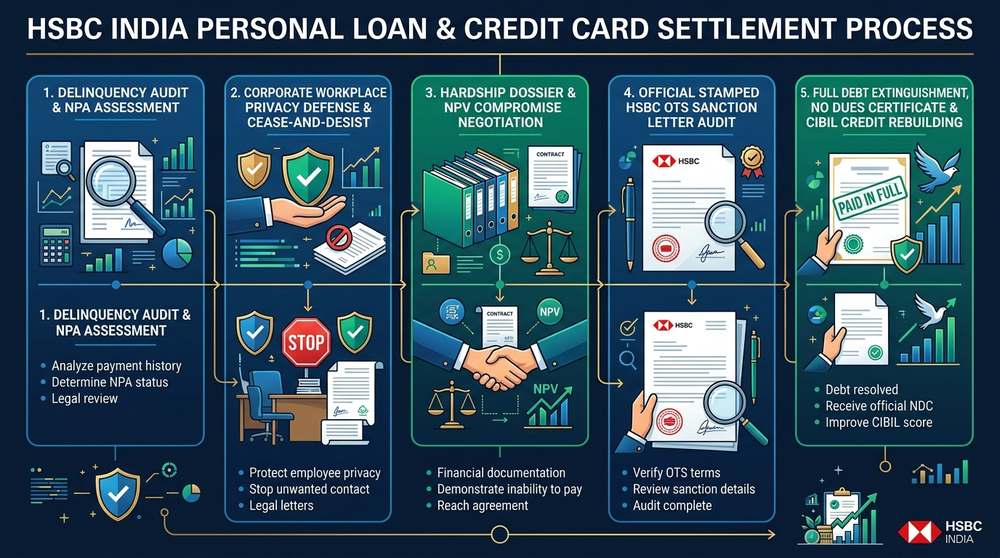
HSBC Personal Loan & Credit Card Settlement & Legal Defense Blueprint
Legal Notice Forensics: Section 25 PSSA, Summary Suits & Unilateral Arbitration
During advanced delinquency, HSBC India's legal panel advocates initiate formal statutory steps designed to compel borrower engagement. Understanding the specific legal mechanics and appropriate procedural responses prevents unnecessary panic and protects borrower rights:
1. Section 25 PSSA & Section 138 NI Act Notices: When automated e-NACH auto-debit mandates or repayment cheques bounce due to insufficient funds, HSBC's legal panel issues a statutory demand notice giving 15 calendar days to clear the overdue amount. If unpaid, the bank can file a complaint under Section 25 of the Payment and Settlement Systems Act, 2007, or Section 138 of the Negotiable Instruments Act, 1881, in the Metropolitan Magistrate Court. These proceedings are bailable and compoundable quasi-criminal actions. An advocate-drafted reply highlighting bona fide financial incapacity and proposing an OTS effectively halts punitive steps and paves the way for formal conciliation.
2. Summary Civil Suits (Order 37 CPC): For high-ticket personal loans exceeding ₹10 Lakhs to ₹20 Lakhs, HSBC India may file a summary suit under Order 37 of the Code of Civil Procedure, 1908, in the jurisdictional City Civil Court or High Court. In an Order 37 suit, the borrower must apply for 'Leave to Defend' within 10 days of receiving summons. Legal counsel presents substantial triable issues—such as excessive penal capitalization and genuine commercial distress—compelling the bank into compromise discussions.
3. Unilateral Sole Arbitration Proceedings: HSBC loan and credit card agreements often contain arbitration clauses appointing a sole arbitrator based in Mumbai, New Delhi, or Bengaluru. Under landmark Supreme Court rulings—including Perkins Eastman Architects DVM v. HSCC (India) Ltd. (2019) and TRF Ltd. v. Energo Engineering Projects Ltd. (2017)—unilateral appointment of a sole arbitrator by a lender without the borrower's express post-dispute consent is null and void ab initio. Legal counsel can challenge the arbitrator's jurisdiction under Section 12 and Section 14 of the Arbitration and Conciliation Act, 1996, halting ex-parte proceedings.
4. National Lok Adalat Resolution: HSBC India frequently refers stressed retail accounts to the quarterly National Lok Adalat organized under the auspices of the National Legal Services Authority (NALSA). Lok Adalat conciliation benches offer a neutral, cost-effective forum where pre-approved settlement mandates are executed with full judicial finality, extinguishing all active civil and statutory litigation without appeal.
The 5-Stage Institutional Protocol for HSBC Loan & Premier Card Settlement
Executing an optimal compromise settlement with a major multinational banking entity like HSBC requires a disciplined, legally backed 5-stage institutional workflow:
Stage 1: Portfolio Delinquency Audit & Legal Protection
Comprehensive audit of outstanding HSBC personal loans, Premier credit cards, and credit lines. Evaluation of delinquency aging, DPD bucket, and total accumulated penal interest. Immediate service of formal legal cease-and-desist notices to HSBC's Principal Nodal Officer to halt workplace calling and third-party recovery outreach.
Stage 2: Comprehensive Hardship Dossier Formulation
Drafting an authoritative legal hardship petition substantiating genuine insolvency or liquidity crisis. The dossier compiles certified income tax returns, salary reduction or termination letters, bank statements, and medical records to establish bona fide financial distress under RBI Master Directions.
Stage 3: High-Level NPV Hardship Negotiation
Direct representation before HSBC India's Zonal Stressed Assets Recovery Branch (SARB) and Retail Credit Committee in Mumbai. Bypassing external collection agencies, legal counsel presents an actuarial Net Present Value recovery argument to negotiate a 45% to 60% principal debt haircut with a complete 100% waiver of ancillary charges.
Stage 4: Multi-Point Sanction Letter Forensic Audit
Rigorous forensic examination of the official stamped HSBC OTS Sanction Letter. Legal audit confirms corporate letterhead authenticity, unique settlement reference numbers, explicit debt extinguishment clauses, and payment schedules before authorizing borrower funds remittance.
Stage 5: Direct Remittance, ₹0 NDC & Court Withdrawal
Borrower remits the negotiated settlement sum strictly into their designated HSBC loan/card account via direct RTGS/NEFT. Legal counsel monitors delivery of the formal No Dues Certificate within 30 days under RBI directives and oversees the formal withdrawal of all pending Section 25 PSSA or civil court proceedings.
HSBC OTS Sanction Letter Forensics: Eliminating Payment Traps & Securing ₹0 NDC
A critical danger encountered by borrowers during loan settlement is the prevalence of unauthorized or fraudulent settlement letters issued by rogue collection agency personnel. Third-party tele-callers frequently present fabricated settlement emails or unauthorized concessions to extract partial payments that are subsequently booked as standard overdue installments, leaving the borrower with active debt and ongoing litigation.
Before remitting a single rupee, borrowers and their legal advisors must perform a thorough forensic audit of the settlement document against five mandatory institutional standards:
1. Authentic Corporate Letterhead & Bank Seal: The OTS sanction letter must be issued on official HSBC India corporate letterhead, bearing the bank's registered address, official branch stamp, and the employee identification code and digital signature of an authorized Chief Manager or Vice President in Stressed Asset Recovery.
2. Explicit Full & Final Satisfaction Clause: The letter must contain unambiguous legal phrasing declaring that payment of the agreed settlement sum constitutes full and final satisfaction of all outstanding claims, releasing the borrower from all past, present, and future financial obligations under the credit facility.
3. Unconditional Waiver of Penal & Ancillary Charges: The sanction letter must explicitly record the complete cancellation and write-off of all accrued penal interest, late payment penalties, annual membership fees, and legal administrative expenses.
4. Strict Direct Account Remittance: Payment must be routed exclusively to the borrower's designated HSBC loan account number or credit card account via secure RTGS, NEFT, or account payee cheque. Remitting funds into personal bank accounts, third-party agency escrows, or cash handovers is strictly prohibited and legally invalid.
5. Statutory 30-Day NDC Mandate: Under Reserve Bank of India Circular RBI/2023-24/60 on the Release of Movable/Immovable Property Documents and Loan Closure, HSBC India is legally obligated to issue a formal No Dues Certificate (NDC) / Loan Closure Certificate and update credit bureau records within 30 calendar days of receiving full settlement funds. If the bank delays delivery of the closure certificate beyond 30 days without lawful cause, it is statutorily liable to pay compensation of ₹5,000 per day of delay directly to the borrower.
CIBIL Score Trajectory Post-Settlement & Strategic 18-Month Credit Recovery Plan
Executing a One-Time Settlement with HSBC India results in the account being formally reported to all four licensed credit information companies in India—TransUnion CIBIL, Experian, Equifax, and CRIF High Mark—with the account status updated to 'Settled' or 'Post-Write-off Settled' with an outstanding balance of exactly ₹0.
While this reporting reflects that a compromise haircut was granted, resulting in a temporary credit score dip of 75 to 150 points, it provides an immediate, decisive benefit: it permanently freezes compounding monthly default marks (30, 60, 90, 120+ DPD), extinguishes active debt liability, and removes active litigation flags from commercial databases.
Under RBI compromise directives, a mandatory 12-month cooling-off window applies before fresh unsecured credit lines can be approved. However, corporate professionals can systematically restore their credit score back to 750+ within 18 to 24 months through a disciplined credit rehabilitation roadmap:
Step 1 (Months 1–3): Secure the formal stamped No Dues Certificate from HSBC India and verify that all four credit bureau reports reflect ₹0 outstanding balance with zero active default compounding. File online bureau disputes if any reporting discrepancy persists.
Step 2 (Months 4–6): Open a fixed-deposit-backed credit card (FD card) with a major scheduled bank with a deposit of ₹50,000 to ₹1,00,000. Utilize the card exclusively for minor recurring utility expenses.
Step 3 (Months 7–18): Maintain credit utilization strictly below 20% to 25% of the card limit, ensuring 100% on-time payment before monthly statement due dates. As positive repayment history accumulates, credit scoring algorithms recalibrate, restoring prime creditworthiness and opening doors to future commercial credit.
Why Salaried Corporate Professionals & Executives Choose SettleLoans
Settling high-value unsecured debt with a premier multinational institution like HSBC India requires a sophisticated blend of corporate privacy defense, financial accounting expertise, and institutional legal advocacy. SettleLoans represents salaried executives and corporate leaders with complete confidentiality, halting third-party collection harassment through formal advocate notices, defending against statutory legal summons, and negotiating directly with HSBC Stressed Assets Recovery Desks to secure maximum lawful debt waivers and authentic stamped No Dues Certificates.

Settle Loan is India's trusted debt relief and loan settlement platform. We help borrowers overcome financial distress by negotiating with banks and NBFCs to legally settle personal loans and credit card debts. With our transparent, performance-based approach, you can achieve debt freedom and regain your financial peace of mind.
COMPUTER
Frequently Asked Questions About HSBC Personal Loan & Credit Card Settlement
What is the HSBC loan settlement process in India and how does an OTS work for personal loans and credit cards?
The HSBC loan settlement process is an institutional debt compromise framework governed by Reserve Bank of India (RBI) Master Directions on Compromise Settlements and Technical Write-offs. When an unsecured personal loan or Premier credit card reaches 90+ days of delinquency and is classified as a Non-Performing Asset (NPA), the borrower or their authorized legal counsel submits a formal financial hardship dossier to HSBC India's Stressed Assets Recovery Branch (SARB) or Retail Credit Committee. Upon evaluating the borrower's genuine financial incapacity against the Net Present Value (NPV) of recovery, HSBC issues a formal stamped OTS Sanction Letter. Remitting the agreed settlement amount directly into the loan account extinguishes all outstanding liabilities and entitles the borrower to a formal No Dues Certificate (NDC).
Can HSBC recovery agents contact my employer, HR department, or call my corporate office desk?
No. Under the Reserve Bank of India Master Direction on Recovery Agents, the Fair Practices Code, and constitutional privacy protections affirmed by the Supreme Court of India, recovery agents are strictly prohibited from contacting a borrower's employer, human resources department, colleagues, or administrative reception. Furthermore, calling official corporate phone numbers or sending collection notices to workplace email addresses constitutes a severe violation of privacy and unlawful harassment. Distressed borrowers can immediately serve a legal cease-and-desist notice to HSBC India's Principal Nodal Officer and escalate privacy breaches to the RBI Integrated Ombudsman.
What percentage of debt haircut or waiver can you negotiate with HSBC India?
On unsecured personal loans and Premier credit cards, HSBC India typically sanctions debt waivers between 45% and 60% of total ledger dues for accounts classified as Doubtful Assets or written-off non-performing loans (overdue beyond 180 to 365 days). In approved compromise settlements, 100% of accumulated late payment fees, annual membership charges, finance charges, and penal interest are fully waived, with the negotiated discount applied directly against the core outstanding principal.
What legal notices can HSBC India issue during loan or credit card default?
During prolonged default, HSBC India's legal advocates may issue three categories of statutory notices: (1) Loan Recall and Demand Notice accelerating the entire balance; (2) Section 25 notice under the Payment and Settlement Systems Act (PSSA), 2007, or Section 138 of the Negotiable Instruments Act, 1881, if automated NACH/e-mandates or cheques dishonour due to insufficient funds; and (3) Summary Civil Suit notices under Order 37 of the Code of Civil Procedure (CPC) or arbitration referral notices. All such notices require prompt legal replies establishing bona fide financial hardship and initiating formal OTS conciliation.
How do foreign bank provisioning rules influence HSBC India's willingness to settle defaulted debts?
Under RBI Income Recognition, Asset Classification and Provisioning (IRACP) norms and international IFRS 9 / Ind AS 109 Expected Credit Loss standards, HSBC India must allocate up to 100% capital provisioning against unsecured loans and credit cards that remain non-performing past 180 to 365 days. Because non-performing loans lock up valuable regulatory capital and degrade balance-sheet metrics, HSBC's retail risk committee is commercially incentivized to accept an upfront lump-sum compromise settlement, which delivers an immediate cash write-back to its operating profit.
Can HSBC India initiate criminal proceedings or have a defaulting borrower arrested?
No. Unsecured personal loan and credit card default is strictly a civil breach of contract under the Indian Contract Act, 1872. Police authorities have zero jurisdiction to register an FIR or make an arrest for bona fide financial inability to repay debt. While Section 25 PSSA or Section 138 NI Act proceedings for mandate dishonour are quasi-criminal statutory actions handled in Magistrate Courts, they are compoundable civil-offense matters that are routinely resolved and formally withdrawn upon executing an approved One-Time Settlement.
How does an HSBC loan or credit card settlement affect your CIBIL score and credit history?
Upon receiving the agreed settlement amount, HSBC India reports the account status to credit information companies (TransUnion CIBIL, Experian, Equifax, CRIF High Mark) as 'Settled' or 'Post-Write-off Settled' with an outstanding balance of ₹0. This immediately halts negative monthly DPD compounding and legal status markers. While the borrower's credit score experiences an initial drop of 75 to 150 points and a temporary 12-month cooling period, creditworthiness can be restored to 750+ within 18 to 24 months through disciplined credit rebuilding with secured credit instruments.
What safety precautions are essential before remitting settlement funds to HSBC India?
Borrowers must adhere to four mandatory safety rules: (1) Never remit funds based on verbal promises or WhatsApp messages from recovery agents; (2) Insist on receiving a formal, stamped OTS Sanction Letter printed on authentic HSBC corporate letterhead containing unique reference numbers and authorized signatory signatures; (3) Verify that the letter explicitly declares the settlement as full and final satisfaction of all claims with complete debt extinguishment; and (4) Pay strictly into your designated HSBC loan or credit card account via RTGS, NEFT, or account payee cheque—never to third-party agency bank accounts.
What is the statutory timeline for HSBC India to issue the No Dues Certificate under RBI rules?
Under Reserve Bank of India Circular RBI/2023-24/60, all regulated commercial banks including HSBC India are legally mandated to issue a formal No Dues Certificate (NDC) / Loan Closure Certificate and update credit bureau records within 30 calendar days of receiving full settlement funds. If the bank fails to issue the certificate within 30 days without lawful justification, it is statutorily liable to pay compensation of ₹5,000 per day of delay directly to the borrower.
Who within HSBC India possesses the legal authority to sanction an OTS haircut?
Under HSBC India's internal Delegation of Financial Powers and Retail Credit Risk Policy, external tele-calling agents and outsourced field agencies possess zero legal authority to grant debt waivers. Substantial debt haircuts (45% to 60%) must be reviewed and approved by HSBC's Zonal Stressed Assets Recovery Branch (SARB), Retail Risk Collections Head, or Country Credit Committee, documented via a verifiable corporate sanction letter.
Official Regulatory References & Statutory Circulars
- Reserve Bank of India (RBI): Master Direction on Compromise Settlements and Technical Write-offs (DOR.STR.REC.20/21.04.048/2023-24)
- RBI Master Circular: Fair Practices Code for Commercial Banks & Guidelines on Recovery Agents (RBI/2022-23/108)
- HSBC India: Customer Grievance Redressal Policy, Fair Practices Code & Principal Nodal Officer Matrix
- Reserve Bank - Integrated Ombudsman Scheme, 2021: Online Portal for Banking Grievances, Privacy Breaches & NDC Delay Penalties
- National Legal Services Authority (NALSA): Legal Services Authorities Act, 1987 — National Lok Adalat Conciliation Framework