- Credit Bureau Distinction: Foreclosure and prepayment mark your loan as "Closed". This boosts your credit score. Settlement marks it as "Settled". This can lower your CIBIL score by 75 to 120 points.
- Zero Foreclosure fines Under RBI: Under RBI Master Directions, banks cannot charge foreclosure fees on floating-rate personal, home, or education loans for people.
- Financial Economics &. Haircuts: Prepayment cuts future interest costs. Settlement waives 40% to 70% of current dues based on Net Present Value (NPV) recovery rules.
- Tax Treatment (Section 194R): Personal loan waivers are non-taxable capital receipts. Business loan waivers require review under Section 41(1) and Section 194R.
- Mandatory 30-Day Document Release: Under RBI circular RBI/2023-24/60, banks must return property papers within 30 days of closure. Lenders pay ₹5,000 per day for delays.
1. Definitional Foundations
Borrowers in India have three main ways to exit a loan: Loan Foreclosure, Part-Prepayment, and Loan Settlement. Many people confuse these terms. But each option works differently. Each option affects your credit score in distinct ways and carries different costs.
Loan Foreclosure (Full Pre-Closure): Foreclosure means paying off your full loan balance in one single payment before the loan ends. This clears the loan under Section 37 of the Indian Contract Act, 1872. It stops all future EMIs. It releases your pledged security and marks the account as "Closed". in credit records.
Part-Prepayment (Partial Principal Injection): Part-prepayment means paying an extra lump sum towards your principal while keeping the loan active. This payment reduces your principal right away. You can then choose to reduce your EMI amount or shorten your loan tenure.
Loan Settlement (One-Time Settlement / OTS): Loan settlement is a hardship compromise between a borrower and a bank. If you face job loss, illness, or business loss, you can seek an OTS. Under Section 63 of the Indian Contract Act, the bank accepts a reduced lump sum (often 30% to 60% of total dues). The bank writes off the remaining balance.
2. RBI Foreclosure Rules & Fair Practices
The Reserve Bank of India (RBI) sets clear rules for early loan closure and debt resolution. Knowing these rules helps you protect your rights against illegal bank fees and unfair recovery tactics.
Key legal rules include:
Under RBI Circular DBOD.No.Dir.BC.107/13.03.00/2013-14 and Master Direction DNBR.PD.008/03.10.119/2016-17, banks and NBFCs cannot charge foreclosure fees on floating-rate retail loans given to people. Any penalty clause on floating-rate home or personal loans is void.
Under the RBI Prudential Framework (June 7, 2019 Circular), lenders can create Board-approved One-Time Settlement (OTS) policies. These policies let banks resolve defaulted assets (NPAs) through compromises without long court battles.
Floating-rate retail loans carry zero prepayment fees. In contrast, fixed-rate loans and business loans may carry prepayment charges. These typically range from 2% to 4% plus GST if stated in the agreement.
Check Your Loan Settlement Options
Answer 2 quick questions to evaluate your settlement eligibility.
1. What type of loan do you want to settle?
3. CIBIL Forensics: Settled vs Written Off
Under the Credit Information Companies (Regulation) Act, 2005 (CICRA), banks must send monthly repayment records to CIBIL, Experian, Equifax, and CRIF High Mark. Your chosen closure method determines your credit score for years.
| Reporting Parameter. | Full Foreclosure. | Part-Prepayment. | Distressed Settlement (OTS). |
|---|---|---|---|
| Credit Bureau Account Status. | "Closed" | "Active / Standard" | "Settled". / "Post-Write-Off Settled" |
| Payment History Grid (DPD). | 000 (Zero Days Past Due). | 000 (Current / Regular). | Shows past 30 to 180+ day default flags. |
| Principal &. Interest Recovery. | 100% Full Recovery. | Fast 100% Recovery. | Waiver written off as loss by bank. |
| Immediate Score Impact. | +25 to +50 points gain. | +10 to +30 points gain. | -75 to -120 points drop. |
| Bureau Retention Period. | Saved as positive history. | Active positive credit history. | Flagged for up to 7 years. |
| Subsequent Unsecured Credit Access. | Fast prime loan approval. | Fast prime loan approval. | High rejection risk for 2 to 3 years. |
Many borrowers think a No Dues Certificate automatically changes their CIBIL tag to "Closed". That is not true. An NDC protects you from legal action. But banks must report the written-off amount to credit bureaus. Only paying the full loan balance or clearing the settlement waiver difference will remove the "Settled". tag.
4. Financial Economics & NPV Formulas
The choice to foreclose, prepay, or settle depends on recovery math. Banks review settlement offers using the Net Present Value of Legal Recovery formula:
Here, C_t is the estimated future recovery over time t. And r is the discount rate. Banks deduct 3 to 7 years of court delays, advocate fees. And locked capital under RBI NPA reserves rules (15% to 100%).
If your lump-sum settlement offer is higher than net court recovery, the bank committee will accept the deal.
Income Tax Implications: Retail vs. Commercial Borrowers (Section 194R & Section 41(1))
Under the Income Tax Act, 1961, the tax impact of a waived loan depends on your loan type:
Under Supreme Court rulings (like CIT vs. Mahindra and Mahindra Ltd.), personal loan waivers are capital receipts. Individual borrowers do not pay income tax on the waived loan amount.
If a business claimed tax deductions on loan interest, a debt waiver may count as taxable income under Section 41(1). Under CBDT Circular No. 12/2022, Section 194R TDS does not apply to bank loan settlements.
5. Loan Exit Mechanisms Strategic Visual Roadmap
This chart compares Foreclosure, Part-Prepayment, and Loan Settlement in India. It highlights how each route works, affects your CIBIL score. And saves interest:
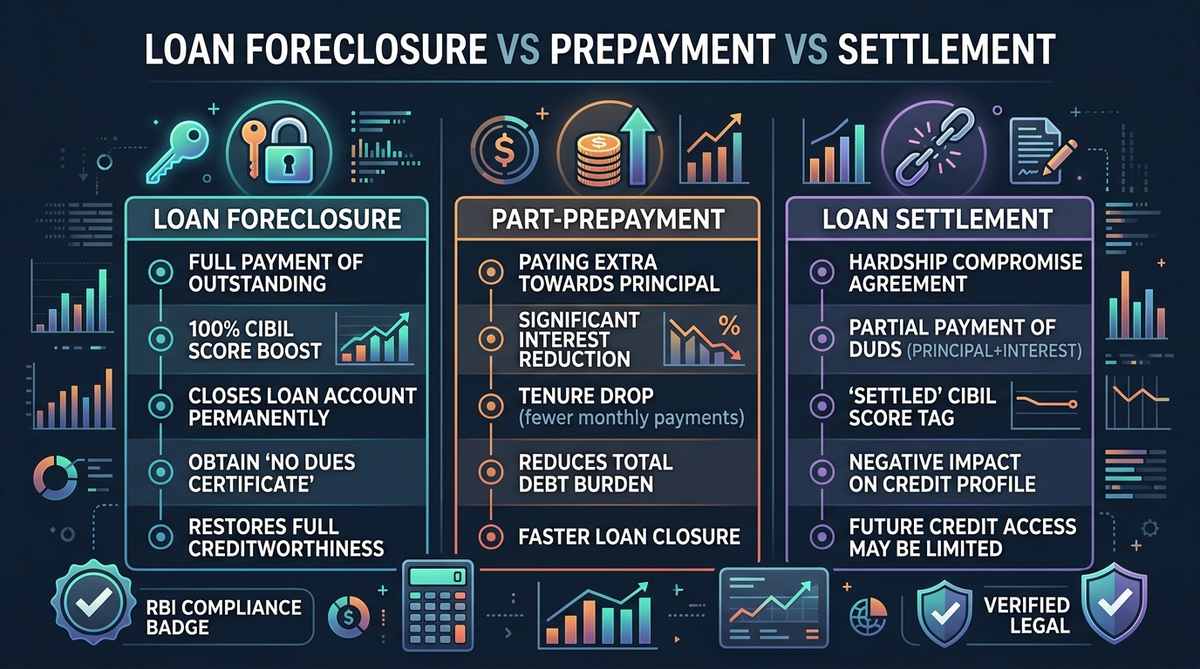
Pay full loan balance. Zero fee on floating rate. Perfect "Closed". credit status. Immediate return of property papers.
Pay extra toward principal. Save on compound interest. Choose lower EMI or shorter tenure. Account remains standard.
Settle dues under hardship. Get 40% to 70% debt waiver. Close pending legal cases. Credit file shows "Settled".
6. Step-by-Step Execution Protocols
Follow standard banking steps to close your loan without surprise charges or active auto-debit issues:
1. Request an official Foreclosure Statement &. Outstanding Dues Certificate valid for 15 to 30 days.
2. Check that the bank applied zero prepayment penalty on floating-rate retail loans.
3. Pay the exact balance via RTGS or NEFT to your loan account and get a stamped receipt.
4. Cancel active NACH and e-mandates so your bank stops auto-debiting EMIs.
1. Log in to your bank portal or visit your branch.
2. Mark the payment clearly as a Principal Prepayment, not advance EMI.
3. Choose Tenure Reduction to save maximum interest, or EMI Reduction for lower monthly payments.
4. Download the new repayment schedule showing your reduced principal balance.
1. Prepare hardship proofs, like medical records or job loss letters.
2. Send a written OTS proposal to the bank recovery department.
3. Negotiate an affordable settlement based on net recovery math.
4. Get an official Settlement Sanction Letter signed by an authorized bank officer before paying.
5. Pay the agreed settlement amount within the approved deadline.
7. Sanction Letter & Agreement Audit
Never settle a loan based on verbal talks from recovery agents. Agents may take your money as overdue interest instead of closing the debt.
Check these key terms in your settlement sanction letter before paying:
The letter must be on official bank letterhead with a reference number, officer name, employee code. And bank stamp. Third-party emails have no legal value.
The letter must state that the bank will withdraw all pending court cases, DRT claims, Section 138 NI Act cheque bounce cases, and Section 25 PSSA complaints.
Check payment due dates for each installment. If you miss a deadline, the bank may cancel the OTS and demand the full original balance.
The letter must confirm that payment clears your debt under Section 63 of the Indian Contract Act. The bank must promise to issue an NDC within 30 days.
8. Post-Exit NDC & CIBIL Rebuilding
Closing a loan requires getting your discharge papers, releasing property deeds. And fixing your credit score.
RBI 30-Day Mandatory Collateral Release Rule (Circular RBI/2023-24/60)
Under RBI directives on the Release of Movable/Immovable Property Documents on Repayment/Settlement of Personal Loans, all banks and NBFCs are required to:
- Return all original title deeds and property papers within 30 days of full payment.
- Remove security charges registered with CERSAI within the same 30-day window.
- Pay you ₹5,000 per day for any delay in releasing your property papers beyond 30 days.
Systematic Credit Rebuilding Roadmap Post-Settlement
If you settled your loan, your CIBIL file will show a "Settled". tag. Follow these 4 steps to rebuild your credit score:
Download credit reports from CIBIL, Experian, Equifax, and CRIF 45 days after payment. Check that your outstanding balance shows ₹0.
Get a secured credit card backed by a Fixed Deposit (FD). Keep credit usage below 30% of your limit. Pay bills on time every month.
Making regular on-time payments adds positive records to your file. This improves your credit score over 18 to 24 months.
Once you have extra funds, you can pay the waived balance to the lender. The bank will then update your tag from "Settled". to "Closed".
9. Comprehensive 3-Way Comparative Decision Matrix Table
The comparative matrix below outlines every legal, financial, legal. And operational parameter across all three exit options:
| Decision Parameter. | Loan Foreclosure. | Part-Prepayment. | Loan Settlement (OTS). |
|---|---|---|---|
| Core Strategic Objective. | Pay off full debt early. | Cut interest and tenure. | Emergency debt relief. |
| Principal Repayment Obligation. | 100% of outstanding principal. | Lump-sum partial principal. | 30% to 60% negotiated lump sum. |
| Accrued Interest &. fines. | Full payment of accrued interest. | Standard ongoing billing. | Substantial waiver of interest &. penal fees. |
| RBI Foreclosure Fee Protection. | 0% penalty on floating retail loans. | 0% fee on floating retail loans. | Not applicable (distress compromise). |
| Credit Bureau Status Tag. | "Closed". (Positive). | "Standard / Active". (Positive). | "Settled". (Adverse Flag). |
| Impact on CIBIL Score. | Immediate increase (+30 to +50). | Steady incremental boost. | Immediate reduction (-75 to -120). |
| Future Loan Eligibility. | Unrestricted prime eligibility. | Unrestricted prime eligibility. | Restricted for 2 to 3 years. |
| Tax Liability (Retail Borrowers). | Zero tax liability. | Zero tax liability. | Non-taxable capital receipt. |
| Collateral / Property Release. | Within 30 days under RBI rules. | Retained until final closure. | Within 30 days of settlement payment. |
| Legal Case Dismissal Mandate. | Automatic upon closure. | Not applicable (no litigation). | Mandatory withdrawal of Sec 138 / DRT. |
10. SettleLoans Strategic Debt Resolution & Legal Advisory
Choosing between foreclosure, prepayment. And settlement depends on your budget and goals. SettleLoans helps you check bank fees under RBI rules. We build prepayment plans and negotiate One-Time Settlements (OTS) with major banks to secure maximum debt relief.

Settle Loan is India's trusted debt relief and loan settlement platform. We help borrowers overcome financial distress by negotiating with banks and NBFCs to legally settle personal loans and credit card debts. With our transparent, performance-based approach, you can achieve debt freedom and regain your financial peace of mind.
COMPUTER
11. FAQs: Foreclosure vs. Prepayment vs. Settlement
Find clear answers below on RBI foreclosure rules, CIBIL credit tags. And debt settlement in India.
What is the primary difference between loan foreclosure, part-prepayment, and loan settlement?
Foreclosure means paying off your full loan balance early in one payment. This marks the loan as 'Closed' on your credit report. Part-prepayment means paying extra money toward the principal balance. This lowers your monthly EMI or shortens your loan tenure. Loan settlement is different. It is an agreement where the bank accepts a lower amount (often 40% to 60% of dues) due to financial hardship. A settlement closes the loan but adds a 'Settled' tag to your credit report.
Does the Reserve Bank of India (RBI) allow banks to charge foreclosure or prepayment penalties?
Under RBI Master Directions, banks and NBFCs cannot charge foreclosure or prepayment fees on floating-rate term loans for people. This applies to personal, home. And education loans. But lenders can charge fees on fixed-rate loans or loans given to companies. Any prepayment fees must be clearly stated in the loan agreement.
How does a 'Settled' loan tag differ from a 'Closed' loan tag on CIBIL and Experian reports?
A 'Closed' tag shows you paid the full loan amount as agreed. This boosts your CIBIL score. A 'Settled' tag means the bank wrote off part of the loan as a loss. This tag stays on your credit report for up to 7 years. It lowers your credit score and makes it harder to get new loans or credit cards.
Can a borrower convert a 'Settled' credit status to a 'Closed' status later?
Yes. You can contact your lender and ask to pay the waived balance amount. Once you pay this remaining balance, the lender must update your status with credit bureaus (CIBIL, Experian, Equifax, CRIF High Mark). They will change the tag from 'Settled' to 'Closed' and issue a full No Dues Certificate.
What are the tax implications of loan waiver under a settlement agreement under Section 194R?
For retail borrowers (home, personal, or car loans), a loan waiver under a hardship settlement is treated as a capital receipt. It is generally not taxable. For businesses, a loan waiver may be treated as taxable income under Section 41(1) of the Income Tax Act. Section 194R TDS rules do not apply to loan waivers granted by scheduled banks.
How does part-prepayment save more interest: reducing EMI or shortening the loan tenure?
Keeping your EMI the same and shortening your tenure saves much more interest. Reducing your loan term cuts down compound interest over time. This saves you significant money over the life of the loan.
What is the 30-day RBI rule regarding the return of original property documents after loan closure?
Under RBI circular RBI/2023-24/60, lenders must return all original property papers within 30 days of full loan repayment or settlement. They must also remove any CERSAI charges. If the lender delays beyond 30 days, they must pay you ₹5,000 for each day of delay.
Why do banks agree to loan settlements and accept a substantial financial haircut?
Banks agree to One-Time Settlements based on Net Present Value (NPV) recovery rules. When a loan defaults, banks must lock away capital under RBI reserves rules (15% to 100%). Legal battles in DRT or civil court can take years. Accepting a quick cash settlement frees up bank funds and avoids legal costs.
Can a lender initiate legal proceedings under Section 138 of the NI Act after a settlement agreement is executed?
No. Once you pay the agreed settlement amount under Section 63 of the Indian Contract Act, 1872, the debt is cleared. The lender must withdraw all court cases, including Section 138 NI Act cheque bounce cases and Section 25 PSSA complaints.
What essential documents must a borrower obtain after executing a loan foreclosure or settlement?
You must collect four key items: (1) An official No Dues Certificate (NDC) on bank letterhead. (2) A zero-balance loan account statement. (3) All unused cheques and NACH mandate cancel confirmation. and (4) Original property papers with a CERSAI satisfaction receipt for secured loans.