- Conversion to Unsecured Debt: Once the bank sells your property under SARFAESI, the mortgage is gone. Any remaining shortfall becomes a simple unsecured money claim.
- Strict 3-Year Limitation Deadline: Under Articles 55 and 113 of the Limitation Act, 1963, the bank must sue in DRT or court within 3 years of the auction. After 3 years, the claim is time-barred.
- Loss of SARFAESI Powers: The bank cannot use Section 13(4) notices or take other property for the shortfall without winning a court case first.
- 100% NPA reserves Pressure: RBI rules treat post-auction shortfalls as unsecured loss assets. This pushes banks to accept low One-Time Settlements (OTS) or ₹0 waivers.
- Challenging Flawed Auctions: If the bank skipped the 30-day notice under Rule 8(6) or sold below circle rates, you can challenge the shortfall in the DRT.
1. The Post-Mortgage Crisis
Defaulting on a Loan Against Property (LAP) can be overwhelming. Borrowers pledge their homes, offices, or factories to get these large loans. When business drops or emergencies strike, missing three EMIs triggers recovery under the SARFAESI Act, 2002.
The bank sends a 60-day notice under Section 13(2), followed by taking possession under Section 13(4) with magistrate help under Section 14. Losing your property is hard. But the biggest shock often comes after the auction. Many borrowers assume the auction clears all debt.
In reality, banks often sell properties at distress prices 30% to 50% below market value. If a ₹1 Crore property sells for ₹65 Lakhs against a ₹95 Lakhs loan, a ₹30 Lakh deficit remains. The bank then demands this post-auction residual shortfall from the borrower.
2. Statutory Conversion
To defend against a shortfall demand, you must understand how the debt changes under Indian law. Under the Transfer of Property Act, 1882, a mortgage ties debt to specific property. When the bank sells the asset under SARFAESI and issues a Sale Certificate under Rule 9(6), the buyer gets full ownership.
The moment the sale is complete, the mortgage is legally cleared. The bank holds no more security over the property. The remaining shortfall becomes a simple unsecured personal claim against the borrower and guarantors.
This change limits the bank's powers. The lender can no longer use SARFAESI rules. To collect ₹20 Lakhs or more, the bank must file an Original Application (OA) in the Debt Recovery Tribunal (DRT). For claims under ₹20 Lakhs, the bank must file a civil suit under Order 37 CPC in civil court. Both routes take years.
Check Your Loan Settlement Options
Answer 2 quick questions to evaluate your settlement eligibility.
1. What type of loan do you want to settle?
3. The Law of Limitation
The Limitation Act, 1963 is your strongest defense against an auction shortfall claim. Banks often wait years before taking legal action. But Indian law gives lenders a strict time limit to recover shortfall balances.
Article 62 gives 12 years only to sell the mortgaged property. Once the property is sold, personal recovery of the shortfall falls under Article 55 (breach of contract) or Article 113 (residual suits) of the Limitation Act, 1963.
The High Court ruled that the right to claim a post-sale shortfall begins on the auction adjustment date. The bank has exactly 3 years to file a case under Order 34 Rule 6 CPC or the RDBFI Act.
The court confirmed that the limitation deadline for a personal shortfall claim is 3 years from the auction date. Any case filed after 3 years is barred by limitation.
If the bank fails to file in the DRT within 36 months of the auction, the claim becomes time-barred. Advocates file objections under Section 3 of the Limitation Act. This forces courts to dismiss the claim.
4. Rigged Distress Auctions, Rule 8(6)
Shortfalls usually happen because lenders fail to run fair, open auctions. Under the SARFAESI Act, banks must protect the borrower's asset value. In Mathew Varghese v. M. Amritha Kumar (2014) and J. Rajiv Subramaniyan v. Pandiyas (2014), the Supreme Court ruled that banks cannot sell mortgaged assets below market value.
Banks often commit serious legal mistakes during property auctions:
Breach of Mandatory 30-Day Individual Sale Notice (Rule 8(6))
The bank must give you 30 days of individual notice before advertising the sale. The Supreme Court ruled that skipping this 30-day window makes the entire auction invalid.
Arbitrary Reserve Price Fixing & Lack of IBBI Valuer Assessment
Under Rule 8(5), banks must get a valuation from an approved IBBI valuer before fixing reserve prices. Lenders often rely on low estimates that undervalue properties.
Defective Auction Publication in Obscure Newspapers (Rule 9(1))
The law requires auction ads in two major local newspapers. Banks sometimes pick obscure papers. This prevents genuine buyers from bidding.
Filing an application under Section 17 of the SARFAESI Act puts heavy pressure on the bank. Facing legal risks, the bank often agrees to waive the shortfall.
5. LAP Post-Auction Shortfall Settlement Process
This roadmap shows the step-by-step path from auction shortfall to a full ₹0 settlement:
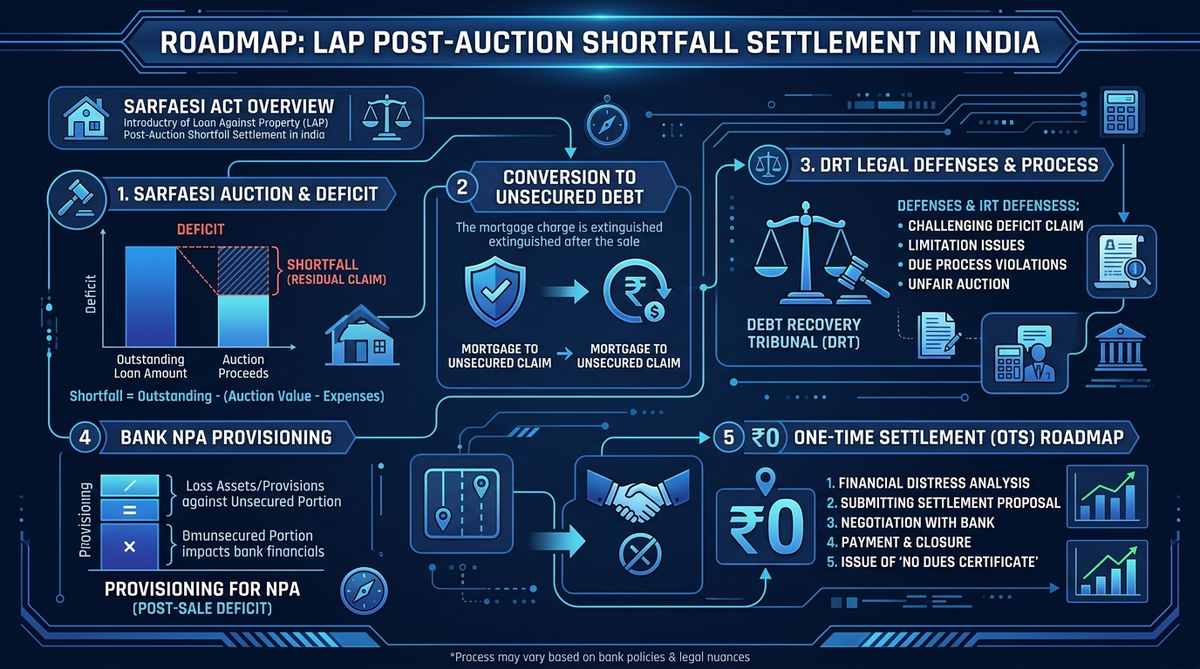
6. Bank NPA Accounting, Loss Asset Provisioning
Banks agree to settle LAP shortfalls because of RBI rules under the IRACP Norms.
While a loan has property collateral, the bank keeps low risk reserves. But after the auction, the remaining shortfall becomes an unsecured loss asset. Under RBI rules, banks must set aside 100% reserves from their profits for this loss.
Keeping a ₹40 Lakh shortfall means locking ₹40 Lakhs of cash. Fighting a DRT case costs heavy court fees and advocate retainers over 3 to 6 years, with no guarantee of recovery.
Here, C_t is estimated recovery. And r is the discount rate. Banks deduct DRT court fees, advocate costs. And the 100% locked reserves burden.
Since fighting in court yields a net negative return, the bank's settlement committee prefers an immediate OTS waiver.
7. Strategic Legal Defenses
If you receive a shortfall legal notice, you have strong legal remedies. Experienced banking advocates use these defenses to secure ₹0 full compromise settlements:
Advocates check the auction date against the court filing date. If 3 years have passed under Article 55 or 113 without debt acknowledgment, lawyers get the plaint dismissed under Order 7 Rule 11 CPC.
Under RBI Circular RBI/2023-24/53 and Central Bank of India v. Ravindra (2002), banks cannot compound penal interest. Removing illegal penalty fees often wipes out the shortfall balance.
Under Section 19(8) of the RDBFI Act, borrowers can file counterclaims against banks for selling below market price. This risk forces banks to offer a mutual settlement waiver.
Under Section 12(5) of the Arbitration Act and the Supreme Court Perkins Eastman (2020) ruling, one-sided arbitrator appointments are void. Advocates quash these actions quickly.
8. LAP Shortfall Sanction Letter Forensics & NDC
Always get a formal One-Time Settlement (OTS) Sanction Letter on bank letterhead before paying any funds.
Mandatory Clauses in a LAP Shortfall Settlement Sanction Letter
- Full and Final Debt Discharge: The letter must confirm that all residual debt, interest. And shortfall balances are fully closed.
- Simultaneous Release of Guarantors &. Co-Borrowers: All co-borrowers and personal guarantors must be freed under Section 128 of the Indian Contract Act.
- Mandatory Withdrawal of All Judicial actions: The bank must promise to withdraw all DRT cases, civil suits, and Section 138 NI Act cheque bounce complaints within 30 days.
- Return of Residual Title Documents: The bank must agree to return any leftover property papers and link deeds within 30 days.
Under RBI Circular RBI/2023-24/60, lenders must return all property papers and issue an NDC within 30 days. Any delay beyond 30 days requires the bank to pay ₹5,000 per day in payout.
The bank will also update credit bureaus to show a ₹0 balance. This stops default flags. This allows you to rebuild your CIBIL score back to 750+ over 18 to 24 months.
9. LAP Default Resolution Matrix
Evaluating the strategic trade-offs across different resolution pathways highlights the profound advantage of advocate-led compromise talks:
| Resolution Pathway. | Legal Basis / legal Standing. | Shortfall Financial Liability. | Resolution Timeline. | Guarantor &. Asset Protection. |
|---|---|---|---|---|
| Passive Inaction (Ignoring Notices). | Bank files DRT case. | 100% debt plus 18% interest. | 3 to 6 Years. | Guarantors face asset seizure. |
| Uncontested Civil / DRT Litigation. | Borrower fights without expert counsel. | High legal fees and court costs. | 4 to 7 Years. | Ongoing credit damage. |
| Advocate-Led ₹0 / Discounted OTS. | Limitation and auction flaws leveraged. | ₹0 to small nominal sum. | 45 to 90 Days. | Complete discharge and NDC. |
| DRT Section 17 &. Counterclaim. | Challenging low auction price. | Bank faces liability for damages. | 18 to 36 Months. | Court protection and orders. |
10. SettleLoans LAP Shortfall Legal Defense
Resolving post-auction shortfall demands requires expert knowledge of the SARFAESI Act, the RDBFI Act. And the Limitation Act, 1963. SettleLoans provides complete defense across India. We audit auction records, challenge flaws in the DRT, stop recovery calls. And negotiate ₹0 or low shortfall settlements with official No Dues Certificates.

Settle Loan is India's trusted debt relief and loan settlement platform. We help borrowers overcome financial distress by negotiating with banks and NBFCs to legally settle personal loans and credit card debts. With our transparent, performance-based approach, you can achieve debt freedom and regain your financial peace of mind.
COMPUTER
11. FAQs: Loan Against Property (LAP) Shortfall Settlement
Clear, legally verified answers to critical questions regarding SARFAESI property auctions, post-mortgage unsecured debt conversion, DRT limitation periods. And residual shortfall debt settlement in India.
What is a Loan Against Property (LAP) shortfall balance after a bank auction?
A LAP shortfall occurs when a bank auctions your mortgaged property under the SARFAESI Act. But the sale money does not cover your full loan. The remaining unpaid balance is treated as an unsecured shortfall debt.
Can the bank still use the SARFAESI Act against me after auctioning my mortgaged property?
No. Once the bank sells the property and issues a sale certificate under Rule 9(6), the mortgage ends. The bank cannot use SARFAESI powers or Section 13(4) notices for the shortfall. The debt becomes a simple unsecured claim.
What is the legal limitation period for a bank to claim an auction shortfall balance?
Under Articles 55 and 113 of the Limitation Act, 1963, the bank has exactly 3 years from the auction date to file a recovery case in court or DRT. If the bank misses this 3-year deadline, the shortfall debt becomes time-barred and cannot be collected.
Where does the bank file a recovery case for a post-auction LAP shortfall?
If the shortfall is ₹20 Lakhs or more, the bank must file an Original Application (OA) before the Debt Recovery Tribunal (DRT). If the claim is under ₹20 Lakhs, the bank must file a suit in a regular civil court.
Can I challenge the bank's auction if the property was sold below market value?
Yes. Under Section 17 of the SARFAESI Act, you can challenge the auction before the DRT. You can act if the bank set a low reserve price or broke Rule 8(6) by skipping the mandatory 30-day notice. This gives you strong leverage to wipe out the shortfall.
Is it possible to settle a LAP auction shortfall for ₹0 or a heavily discounted OTS?
Yes. Once the property is sold, the shortfall becomes an unsecured 'Loss Asset' on the bank's books. Under RBI rules, banks must set aside 100% reserves for it. Lawyers use auction errors and DRT costs to negotiate ₹0 or low OTS settlements.
Are personal guarantors and co-borrowers liable for the post-auction shortfall?
Under Section 128 of the Indian Contract Act, 1872, guarantors share debt liability. But guarantors have the same legal defenses, like the 3-year limitation and auction flaws. An advocate-led settlement frees both the borrower and all guarantors.
Can the bank attach my other personal bank accounts or unencumbered assets for the shortfall?
No. The bank cannot freeze other accounts or seize assets without a formal court decree or DRT order. Getting a court decree takes years, giving you ample time to settle the debt peacefully.
What must be included in a formal LAP Shortfall Settlement Sanction Letter?
A valid OTS letter must state: (1) Full closure of all shortfall debt. (2) Release of the borrower and all guarantors. (3) Withdrawal of all DRT and Section 138 NI Act court cases. and (4) Return of title papers with a No Dues Certificate.
How does settling a LAP auction shortfall impact my CIBIL credit score?
Your credit report will show a 'Settled' status with a ₹0 balance. This stops ongoing default marks and clears legal tags. You can rebuild your score back to 750+ within 18 to 24 months using secured credit cards.