1. The ₹4.2 Lakh Crisis: Borrower Profile, Minimum Amount Due
In January 2024, Rajesh Verma, a 34-year-old IT consultant residing in Bengaluru, experienced an acute cash-flow dislocation when his independent consulting contract was abruptly terminated amidst industry-wide software budget contractions. Facing simultaneous relocation expenses and emergency medical treatment for his mother, Rajesh utilized his Kotak Mahindra Bank League Platinum Credit Card, possessing an approved credit line of ₹2,00,000, incurring cumulative living and medical charges totaling ₹1,55,000.
Confident that new enterprise projects would materialize within a quarter, Rajesh adopted what appeared to be a manageable holding strategy: paying the monthly Minimum Amount Due (MAD) of roughly 5% of the statement balance. Over the course of fourteen consecutive billing cycles, Rajesh diligently remitted approximately ₹7,500 to ₹9,500 every month, transferring more than ₹1,10,000 in hard-earned liquidity directly into Kotak Mahindra Bank's card accounts.
Despite these continuous remittances, Rajesh received an alarming statement in May 2025 indicating that his total outstanding liability had surged from ₹1,55,000 to an astronomical ₹4,20,000. Unbeknownst to him, annualized finance charges of 45%, monthly late payment penalties of ₹1,200 per cycle, over-limit surcharges, and mandatory 18% Goods and Services Tax (GST) had compounded continuously. His monthly MAD payments had serviced solely the interest and tax layers, leaving the core principal untouched. When income ceased altogether and defaults crossed 90 days past due (DPD), Kotak classified the card account as a Non-Performing Asset (NPA).
Under standard credit card agreements, paying the Minimum Amount Due is engineered to keep default reporting at bay while maximizing unearned interest capitalization. In an annualized 45% APR regime, over 92% of every rupee paid satisfies finance charges and statutory taxes, guaranteeing that the original principal remains intact while compounding interest accumulates exponentially.
2. The Mathematics of Ruin: 45% APR, Monthly Capitalization & 18% GST Cascades
To understand how an initial principal of ₹1.55 Lakhs mutated into a crushing ₹4.2 Lakh demand, one must analyze the statutory compounding framework governing unsecured retail revolving credit in India. Unlike conventional personal loans where interest diminishes on an amortization schedule, credit cards apply monthly financing charges ranging from 3.50% to 3.75% per month (equivalent to 42% to 45% APR).
The instant a cardholder fails to settle the full statement balance by the due date, the interest-free grace period is voided retroactively from the date of purchase. Daily finance charges are computed under the following banking accounting formula:
Unserviced monthly finance charges are capitalized directly into the principal ledger, causing subsequent interest to be charged upon prior interest, while an 18% GST surcharge is levied across every financial fee.
The progressive inflation of Rajesh's card ledger over eighteen months highlights the compounding trap:
| Timeline Milestone | Principal Base | Compounded Interest (45% APR) | Penalties, GST & Total Claim |
|---|---|---|---|
| Month 1 (Initial Utilization) | ₹1,55,000 | ₹0 (Grace Window) | ₹1,55,000 |
| Month 6 (MAD Servicing Phase) | ₹1,51,000 | ₹39,800 | ₹2,02,800 |
| Month 12 (Revolving Peak) | ₹1,49,000 | ₹1,06,500 | ₹2,98,500 |
| Month 18 (NPA Default Claim) | ₹1,55,000 | ₹1,78,000 | ₹4,20,000 |
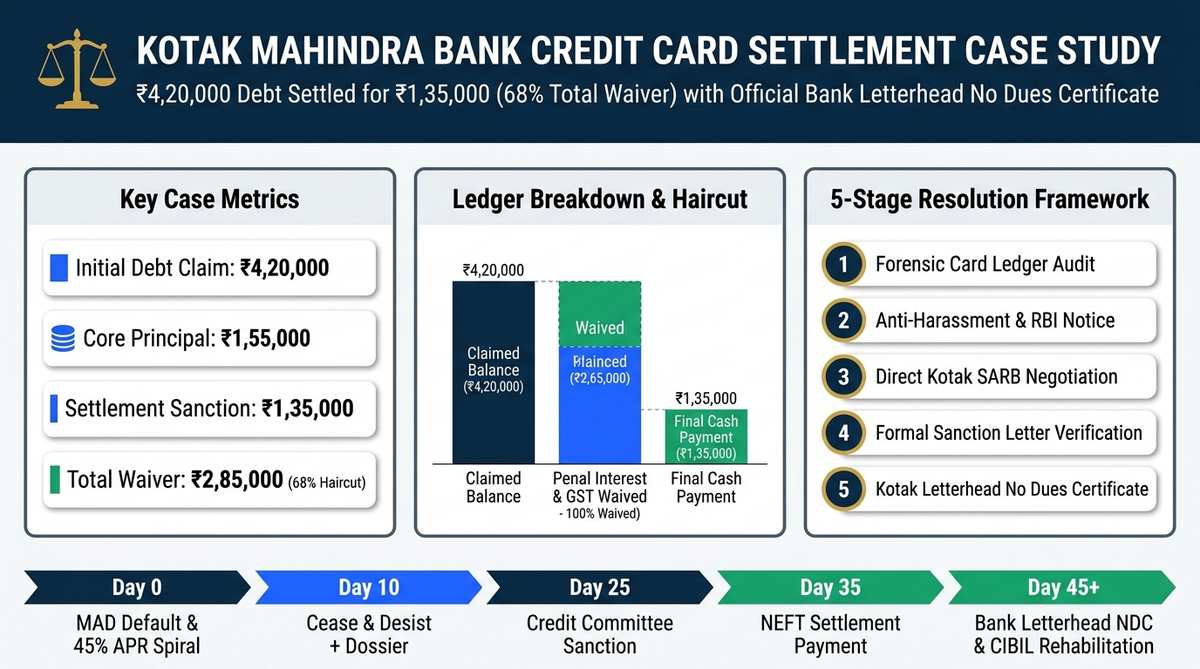
Forensic accounting confirmed that out of Kotak Mahindra Bank's ₹4,20,000 aggregate claim, ₹2,65,000 (over 63% of the total amount) consisted purely of capitalized interest, penal charges, and tax levies. Demonstrating this structural inflation established the baseline for negotiating an institutional haircut.
Check Your Loan Settlement Options
Answer 2 quick questions to evaluate your settlement eligibility.
1. What type of loan do you want to settle?
3. Behind Kotak Mahindra Bank's Retail Book: NPA Provisioning & Balance Sheet Dynamics
Achieving a binding compromise settlement requires leveraging the internal regulatory imperatives of the lender. Under the Reserve Bank of India (Prudential Norms on Income Recognition, Asset Classification and Provisioning) Directions, commercial banks cannot treat delinquent credit card accounts as permanent interest-bearing assets.
Credit card debt is completely unsecured. Kotak Mahindra Bank holds no underlying tangible collateral, mortgaged real estate, or pledged assets capable of summary attachment under the SARFAESI Act, 2002. As an account slips through delinquency buckets past 90 days, the bank is legally mandated to immobilize operating capital to create specific default provisions:
| Classification Category | Days Past Due (DPD) | Accounting Status | Mandatory RBI Provision |
|---|---|---|---|
| SMA-0 to SMA-2 | 1 – 89 Days | Standard / Stressed | 0.40% – 5.00% General Provision |
| NPA Substandard | 90 – 365 Days | Substandard Unsecured | 25.00% Specific Provision |
| NPA Doubtful (D1/D2) | 12 – 36 Months | Doubtful Unsecured | 100.00% Provisioning |
| Technical Write-Off (AUCA) | 24+ Months | Written-off Pool | 100.00% Fully Expensed |
When Rajesh's account crossed 140 DPD, Kotak Mahindra Bank had already ceased recognizing uncollected finance charges as real revenue under RBI income recognition norms. For Kotak's Stressed Assets Resolution Branch (SARB), accepting an immediate cash recovery of ₹1.35 Lakhs unlocked frozen provisioning, resulting in an immediate positive impact on the bank's quarterly net earnings.
4. The Hardship Resolution Dossier & Kotak Net Present Value (NPV) Valuation Model
Commercial banks do not approve substantial debt waivers based on emotional appeals. Under Kotak Mahindra Bank's Board-approved Compromise Settlement Policy, debt haircuts are sanctioned strictly upon objective proof of involuntary insolvency rather than willful non-compliance.
SettleLoans conducted an exhaustive forensic audit of Rajesh's financial profile and assembled an airtight Hardship Resolution Dossier grounded in five verifiable documentation pillars:
First, certified consulting contract termination notices and corresponding bank account statements confirming the abrupt cessation of professional cash inflows. Second, verified medical records, diagnostic invoices, and pharmacy receipts establishing emergency dependent healthcare expenditures. Third, an audited household cash-flow statement demonstrating that current income barely serviced essential sustenance. Fourth, comprehensive credit bureau pull reports verifying that no fresh unsecured credit lines had been procured during default. Fifth, an affidavit confirming the non-existence of unencumbered liquid assets or attachable real properties.
Using this evidentiary dossier, SettleLoans framed the settlement proposition using Kotak Mahindra Bank's internal Net Present Value (NPV) Recovery Benchmark:
Pursuing civil litigation against an individual lacking attachable assets yields an estimated recovery NPV under ₹95,000 after factoring in 3–5 years of court friction, advocate retainers, and execution delays.
Our advocates demonstrated to Kotak's Zonal Credit Committee that an immediate, guaranteed One-Time Settlement of ₹1,35,000 provided superior financial value to the bank compared to years of costly, uncertain court proceedings.
Kotak Mahindra Bank Credit Card Settlement: ₹4.2L to ₹1.35L Case Study
6. Cease-and-Desist Defense: Neutralizing Kotak Collection Harassment & Section 25 PSSA Notices
Prior to retaining legal representation, Rajesh endured intense psychological pressure from third-party recovery agencies engaged by Kotak Mahindra Bank. Recovery callers subjected him to incessant calls outside statutory hours, contacted his former professional colleagues, and threatened physical home visits. Concurrently, Kotak's legal panel served a formal demand notice under Section 25 of the Payment and Settlement Systems Act, 2007 (PSSA) regarding an automated NACH mandate dishonour, alongside a notice under Section 138 of the Negotiable Instruments Act, 1881.
SettleLoans activated a comprehensive two-stage legal defense strategy:
First, our legal team served a formal Cease-and-Desist Notice upon Kotak Mahindra Bank's Principal Nodal Officer (PNO) and Head of Retail Collections, citing explicit violations under the RBI Master Direction on Recovery Agents and Fair Practices Code (2022). The notice documented unauthorized communication hours, verbal harassment, and third-party disclosure of confidential financial data. Within 48 hours of service, third-party recovery contact terminated completely, and the file was routed to Kotak's internal legal conciliation team.
Second, our advocates issued a robust legal reply to the Section 25 PSSA and Section 138 NI Act notices within the statutory 15-day window. The reply established the absence of fraudulent intent, substantiated involuntary medical hardship, and formally recorded the borrower's willingness to enter structured compromise negotiations under RBI guidelines.
7. The Settlement Table: Negotiating the ₹1.35 Lakhs (68% Haircut) with Kotak SARB
Securing a genuine institutional debt settlement requires engaging exclusively with authorized decision-makers. Tele-callers and outsourced collection executives operate on recovery commissions and possess zero authority under Kotak Mahindra Bank's Delegation of Financial Powers (DoFP) framework to waive core principal or compound finance charges.
SettleLoans submitted the formal compromise petition directly to the Stressed Assets Resolution Branch (SARB) and the Zonal Credit Committee of Kotak Mahindra Bank. The negotiation proceeded across three structured conciliation rounds:
In Round 1, Kotak SARB proposed a minor waiver of late charges, demanding ₹3,30,000 while maintaining the bulk of capitalized interest. In Round 2, SettleLoans presented the forensic audit isolating the original ₹1,55,000 principal, backed by medical records and a definitive settlement offer of ₹1,20,000 gathered via family assistance. In Round 3, following risk committee evaluation of the NPV model, Kotak issued a final compromise sanction of ₹1,35,000, delivering an overall 67.9% (68%) total debt waiver.
| Financial Ledger Component | Claimed Bank Dues | Approved Settlement Amount | Total Waiver / Haircut |
|---|---|---|---|
| Core Principal Balance | ₹1,55,000 | ₹1,35,000 | ₹20,000 (12.9% Haircut) |
| Compounded Finance Charges (45% APR) | ₹1,78,000 | ₹0 | ₹1,78,000 (100% Waived) |
| Late Payment & Over-limit Penalties | ₹49,000 | ₹0 | ₹49,000 (100% Waived) |
| 18% GST Surcharges & Legal Charges | ₹38,000 | ₹0 | ₹38,000 (100% Waived) |
| Total Outstanding Debt Claim | ₹4,20,000 | ₹1,35,000 Payable | ₹2,85,000 Total Relief (67.9%) |
8. Kotak Sanction Letter Forensics: 5 Mandatory Verification Checkpoints
Prior to disbursing any funds, SettleLoans conducted a stringent verification of the compromise sanction document issued by Kotak Mahindra Bank. Transferring funds based on unofficial emails or verbal assurances from collection agencies represents the leading cause of failed debt settlements in India.
Our legal team audited five essential institutional criteria:
First, the document was issued on official Kotak Mahindra Bank Limited letterhead, bearing the registered corporate logo, branch stamp, and authorized officer signature with employee designation code. Second, the letter explicitly specified Rajesh's 16-digit credit card number and confirmed ₹1,35,000 as the full, final, and absolute settlement of all claims. Third, it incorporated an explicit debt extinguishment clause stating that upon receipt of ₹1,35,000, all residual claims of ₹2,85,000 would be 100% written off. Fourth, the letter committed Kotak to withdraw all pending legal notices under Section 25 PSSA and Section 138 NI Act within 30 days. Fifth, it established a 15-day settlement window without default penalty clauses.
Settlement funds were remitted via direct NEFT directly into Rajesh's official Kotak Credit Card Account number, guaranteeing complete auditability and eliminating intermediary risk.
9. The Official Kotak Bank Letterhead No Dues Certificate & 24-Month CIBIL Reconstruction
Under RBI Circular RBI/2023-24/60 (Release of Movable/Immovable Property Documents and Issue of No Dues Certificate on Repayment/Settlement of Personal Loans), commercial banks are legally obligated to issue a formal No Dues Certificate (NDC) on bank letterhead and update credit bureau records within 30 calendar days of settlement receipt.
On Day 22 following the NEFT transfer, Kotak Mahindra Bank issued the official stamped No Dues Certificate on bank letterhead, confirming that the credit card account was permanently closed with a total outstanding balance of ₹0.00.
Pursuant to statutory credit reporting regulations, Kotak updated TransUnion CIBIL, Experian, and CRIF High Mark with a 'Settled' status and a ₹0 overdue balance. Rajesh's CIBIL score, which had plummeted to 568 during delinquency, stabilized at 615 upon official closure.
SettleLoans designed a structured 24-month credit rehabilitation roadmap for Rajesh:
First, procuring a secured credit card backed by a ₹35,000 fixed deposit, maintaining monthly credit utilization strictly under 20%. Second, establishing automated recurring debits for recurring utility bills to generate an uninterrupted record of on-time payments. Third, avoiding new unsecured loan applications during the mandatory 12-month cooling period. Within 18 months, Rajesh successfully rebuilt his CIBIL score to 758, completely restoring his institutional creditworthiness.
10. Comparative Resolution Matrix: Direct OTS vs. Restructuring vs. MAD Servicing
When confronting credit card debt distress, borrowers must evaluate the mathematical and legal outcomes of all available resolution pathways in India:
| Resolution Pathway | Total Cash Outflow | Waiver / Haircut Scope | Legal Closure | Time to Debt Freedom |
|---|---|---|---|---|
| Direct SARB One-Time Settlement (OTS) | ₹1,35,000 (Lump Sum) | 68% Total Waiver | Permanent ₹0 Bank NDC | 30 – 45 Days |
| Card EMI Restructuring / Conversion | ₹2,40,000 – ₹2,80,000 | 0% Principal Waiver | Active EMI Obligation | 24 – 36 Months |
| Paying Minimum Amount Due (MAD) | ₹5,50,000+ (Endless) | 0% (Compounding Loss) | No Closure (Debt Spiral) | 15 – 25 Years |
| Contested Court Litigation | Unpredictable + Legal Fees | Subject to Judicial Decree | Subject to Appeals | 3 – 5 Years |
As demonstrated in Rajesh's case study, executing an authentic One-Time Settlement directly with Kotak Mahindra Bank's Stressed Assets Resolution Branch halts the compound interest cycle and achieves complete financial freedom at a fraction of the claimed liability.

Settle Loan is India's trusted debt relief and loan settlement platform. We help borrowers overcome financial distress by negotiating with banks and NBFCs to legally settle personal loans and credit card debts. With our transparent, performance-based approach, you can achieve debt freedom and regain your financial peace of mind.
COMPUTER
Everything You Need to Know About Kotak Card Settlements
Clear, authoritative legal answers regarding Kotak Mahindra Bank credit card settlements, compound interest waivers, recovery defense, and credit rehabilitation.
The cardholder's ₹4,20,000 claimed balance comprised an original principal swipe of ₹1,55,000 and ₹2,65,000 in accumulated monthly finance charges (45% APR), late payment penalties, and 18% GST surcharges. SettleLoans constructed an evidence-backed Hardship Resolution Dossier, performed a forensic audit to isolate unearned interest, and negotiated directly with Kotak Mahindra Bank's Stressed Assets Resolution Branch (SARB) to secure an official One-Time Settlement (OTS) of ₹1,35,000—delivering an overall 68% debt reduction.
Kotak credit cards carry finance charges of 3.50% to 3.75% per month (42% to 45% annual percentage rate or APR). When cardholders miss payments or pay only the Minimum Amount Due (MAD), interest-free grace periods are revoked retroactively, late payment fees (up to ₹1,200 per cycle) are levied, and 18% GST is added to all finance fees. Unpaid charges are capitalized monthly into the balance, generating exponential compound interest.
No. The Minimum Amount Due is generally calculated as 5% of the total statement balance plus fees and taxes. In a 45% APR environment, virtually the entire MAD payment services monthly interest and GST, leaving the core principal untouched and trapping the borrower in decades of revolving debt.
Kotak Mahindra Bank's Credit Committee evaluates settlement proposals using a Net Present Value (NPV) recovery formula. Because credit card debt is 100% unsecured with zero collateral to auction under the SARFAESI Act, once an account enters NPA status (90+ DPD) and regulatory provisioning is locked, the bank prefers immediate lump-sum cash recovery over 3 to 5 years of costly and uncertain civil litigation.
No. Credit card default is purely a civil breach of contract under the Indian Contract Act, 1872. The police cannot arrest borrowers or register FIRs for genuine inability to pay. However, if automated NACH/e-mandates bounce, the bank may issue statutory notices under Section 25 of the Payment and Settlement Systems Act, 2007, or Section 138 of the Negotiable Instruments Act, 1881, which must be addressed through formal legal counsel.
Under the RBI Master Directions on Recovery Agents (2022) and the Fair Practices Code, recovery agents are strictly prohibited from calling before 8:00 AM or after 7:00 PM, contacting friends, relatives, or employers, using abusive language, or threatening borrowers. Borrowers can issue a formal legal cease-and-desist notice to Kotak Bank's Principal Nodal Officer (PNO) and escalate violations to the RBI Integrated Ombudsman portal (cms.rbi.org.in).
Borrowers must ensure: (1) The letter is on official Kotak Mahindra Bank letterhead with an authorized officer's signature, designation, and employee ID; (2) It explicitly states the credit card number and the exact negotiated settlement figure as full and final discharge; (3) It includes a clause confirming 100% waiver of residual balance, interest, and penalties; (4) It commits to issuing a No Dues Certificate (NDC) on bank letterhead and withdrawing legal notices; (5) Payment is remitted directly to the official credit card account number.
Following settlement, Kotak Bank updates credit bureaus with a 'Settled' remark and an outstanding balance of ₹0. While the score experiences an initial drop of 70 to 110 points, the compounding default accumulation stops permanently. Borrowers can rebuild their CIBIL score back to 750+ within 18 to 24 months by using a secured fixed-deposit credit card, keeping credit utilization below 25%, and maintaining a flawless repayment track record.
Under RBI Circular RBI/2023-24/60, all regulated commercial banks including Kotak Mahindra Bank must issue the formal No Dues Certificate (NDC) / Loan Closure Certificate on bank letterhead and update credit bureau records within 30 calendar days of receiving full settlement funds. Lenders failing to comply within this statutory timeframe are liable to pay compensation of ₹5,000 per day of delay to the borrower.
Official Statutory Authorities & Regulatory Frameworks
- Reserve Bank of India (RBI): Master Direction on Credit Card and Debit Card Issuance and Conduct Directions
- RBI Master Direction: Guidelines on Fair Practices Code and Outsourcing of Financial Services / Recovery Agents
- Kotak Mahindra Bank Limited: Customer Grievance Redressal Policy & Principal Nodal Officer (PNO) Framework
- Reserve Bank - Integrated Ombudsman Scheme, 2021: Dispute Redressal Portal for Unfair Recovery & Card Billing Disputes
- National Legal Services Authority (NALSA): Legal Services Authorities Act, 1987 — National Lok Adalat Settlement Mechanism