- The 42% APR Compounding Reality: Defaulting on credit cards triggers monthly finance charges of 3.5% to 3.75% (42%–48% annualized) plus 18% GST, causing the outstanding balance to double within 20 to 24 months if unaddressed.
- The Minimum Amount Due Trap: Paying only 5% Minimum Amount Due (MAD) primarily services accumulated interest and taxes while amortizing almost zero principal, transforming manageable credit into an endless debt spiral.
- Zero Criminal Liability: Unsecured credit card default is governed purely under civil contract law (Indian Contract Act, 1872). Police authorities cannot register an FIR, summon you, or make an arrest for genuine inability to pay.
- Statutory Anti-Harassment Rights: RBI Master Directions prohibit recovery agents from calling outside 8:00 AM to 7:00 PM, contacting employers or relatives, and engaging in verbal intimidation or public shaming.
- Realistic 60%–70% OTS Waivers: Once defaulted credit card accounts cross 90 to 180 days (NPA status), banks utilize RBI compromise settlement policies to waive 100% of penal surcharges and discount principal by 60% to 70%.
Credit Card Bill Na Bharne Par Kya Hota Hai: Understanding
Facing an unmanageable credit card balance in India often triggers acute psychological distress, commonly characterized as debt trap panic. When income disruptions occur due to job loss, business insolvency, or catastrophic family medical emergencies, borrowers suddenly find themselves incapable of paying their monthly statement dues. The fundamental question millions ask during this crisis is: credit card bill na bharne par kya hota hai? Understanding the operational, accounting, and legal reality of credit card default is essential to dismantling fear and executing an effective financial recovery strategy.
In the Indian banking ecosystem, credit cards represent revolving unsecured retail credit facilities regulated under the Reserve Bank of India (RBI) Master Direction on Credit Card and Debit Card Issuance and Conduct Directions, 2022 (RBI/2022-23/92). Unlike home loans or auto loans, credit card debts possess no underlying tangible collateral or mortgage lien. Because lending institutions hold zero asset security, their underwriting models offset structural default risks by levying exorbitant finance charges, compounding interest rates, and multi-tiered punitive penalties whenever an installment deadline lapses.
When a cardholder stops paying their monthly bill, a structured institutional escalation sequence is triggered across four parallel dimensions: exponential interest compounding, systemic credit bureau downgrades, aggressive collection agency deployment, and the dispatch of statutory legal demand notices. However, the pervasive fear that non-payment leads to immediate criminal prosecution or imprisonment is entirely unfounded. Credit card defaults are strictly civil contractual disputes governed by the Indian Contract Act, 1872, providing distressed cardholders with substantial legal safeguards and statutory rights to negotiate compromise settlements.
Under established judicial precedents from the Hon'ble Supreme Court of India, genuine inability to repay an unsecured financial debt does not constitute criminal breach of trust (Section 405/406 IPC) or cheating (Section 415/420 IPC). In the absence of established fraudulent intent at the inception of credit facility issuance, non-payment of credit card bills remains exclusively an actionable civil claim for recovery.
The 42% APR Compounding Engine & Instant Loss of Interest-Free Grace Periods
To understand why credit card debt accelerates out of control so rapidly, one must examine the mathematical formulas banks use to calculate finance charges. Indian commercial banks—including HDFC Bank, SBI Cards, ICICI Bank, Axis Bank, and Kotak Mahindra Bank—apply monthly interest rates ranging from 3.50% to 3.75%. When converted into the Annualized Percentage Rate (APR), this translates to an effective rate of 42.0% to 49.36% per annum. Furthermore, under Indian tax regulations, every single rupee charged as interest or penalty attracts an additional 18% Goods and Services Tax (GST).
The compounding engine is governed by the Daily Periodic Rate (DPR) calculation. The bank calculates finance charges on a daily average balance using the statutory formula:
Where Annual APR averages 42% (DPR = 0.11506% per day). If any portion of the statement balance remains unpaid past the payment due date, the interest-free grace period (typically 20 to 50 days) is entirely revoked retroactively to the original transaction date for all past and new purchases.
The instant you fail to clear the total statement balance in full, the bank revokes the interest-free credit window across your entire account. From that exact moment forward, interest begins compounding daily from the exact date each purchase was swiped. If you make cash withdrawals from an ATM using your credit card, interest compounds from Day 1 alongside cash advance transaction fees of 2.5% to 3.0%. Added to this are tiered Late Payment Charges (ranging from ₹500 to ₹1,300 per billing cycle) and Overlimit Charges if accumulated interest pushes the ledger beyond your sanctioned credit limit.
Check Your Loan Settlement Options
Answer 2 quick questions to evaluate your settlement eligibility.
1. What type of loan do you want to settle?
The Minimum Amount Due (MAD) Trap: How Banks Keep You Trapped for Decades
Many distressed cardholders mistakenly believe that paying the Minimum Amount Due (MAD) protects them from debt accumulation. This is one of the most destructive financial misconceptions in consumer banking. The Minimum Amount Due is systematically engineered to protect the bank's cash flow while ensuring the borrower remains indefinitely indebted. MAD is generally calculated as 5% of the outstanding statement balance (or 100% of accrued finance charges, GST, and late fees plus 1% to 2% of the principal balance).
When a borrower pays only the MAD, approximately 75% to 90% of that payment is immediately absorbed by accrued finance interest, GST, and administrative charges. Less than 10% to 25% of the payment touches the actual principal debt. Meanwhile, the remaining 95% of the core balance continues to compound daily at 42% APR. Actuarial calculations reveal that an individual with an outstanding balance of ₹2,00,000 who pays only the mandatory minimum dues each month will take over 18 to 23 years to clear the liability, ultimately paying more than ₹7,50,000 in cumulative interest and taxes for a ₹2 Lakh principal.
| Repayment Strategy | Effective Monthly Cost | Total Outflow (₹2L Debt) | Time to Debt Freedom | CIBIL & Legal Outcome |
|---|---|---|---|---|
| Paying Minimum Due (5%) | ₹10,000/mo (Diminishing) | ₹7,40,000+ (Extreme Drain) | 18 to 22 Years | Maintains 750+ score, but creates permanent financial drain |
| Unmanaged Total Default | ₹0/mo | Ledger inflates to ₹4.5L+ | Indefinite (Compounding) | Score drops <600, severe harassment, civil court summons |
| One-Time Settlement (OTS) | One-time / Structured | ₹60,000 – ₹80,000 (60–70% Cut) | 3 to 6 Months | Marked 'Settled', ₹0 balance, full legal closure & ₹0 NDC |
The Credit Card Default Timeline: From First Missed Due Date to 90-Day NPA Classification
When you fail to make payments on a credit card, the account moves through rigidly defined regulatory stages established by the Reserve Bank of India's Prudential Norms on Income Recognition, Asset Classification and Provisioning (IRACP). Understanding this institutional chronology enables borrowers to anticipate bank actions and identify the exact tactical window for negotiating deep debt haircuts:
Days 1 to 30: SMA-0 (Special Mention Account 0) & Soft Collections
The cardholder misses the payment due date. The bank immediately applies late payment fees, revokes the grace period, and computes daily 42% APR interest plus GST. Automated IVR reminders, SMS warnings, and soft telephonic follow-ups begin. Credit bureaus (CIBIL, Experian, CRIF High Mark) record 30+ Days Past Due (DPD).
Days 31 to 60: SMA-1 & Digital Card Block
Two consecutive statements remain unpaid. The bank temporarily or permanently suspends credit card charging privileges across domestic and international payment gateways. The internal collections desk intensifies phone calls, and automated demand letters are dispatched via registered email and courier.
Days 61 to 90: SMA-2 & Third-Party Agency Allocation
Three billing cycles elapse without payment. The lending institution transfers the portfolio file to external Direct Recovery Agencies (DRA). External recovery tele-callers commence high-frequency calling. The bank issues a formal loan recall notice terminating the credit card agreement under contractual terms.
Days 91+: Non-Performing Asset (NPA) & Balance Sheet Provisioning
Under RBI Master Directions, the credit card account is officially declared a Non-Performing Asset (NPA). The bank is legally mandated to set aside capital reserves (15% to 100% provisioning under Ind AS 109). It is during this NPA window (Days 90 to 180+) that banks become institutionally motivated to approve deep compromise settlements.
| Aging Bracket (DPD) | RBI Asset Classification | Bank Capital Provisioning | Achievable Settlement Haircut |
|---|---|---|---|
| 1 – 30 Days | Standard Asset (SMA-0) | 0.40% (Standard Provision) | 0% – 10% (Late fee waiver only) |
| 31 – 60 Days | Standard Asset (SMA-1) | 0.40% | 10% – 20% (Partial interest waiver) |
| 61 – 90 Days | Standard Asset (SMA-2) | 0.40% | 20% – 35% (Pre-NPA restructuring) |
| 91 – 180 Days | Sub-Standard NPA | 25% (Unsecured Provision) | 40% – 55% Principal Haircut |
| 180+ Days (Written Off) | Doubtful / Loss Asset | 100% Capital Written Off | 60% – 70% Maximum Haircut |
Strategic Roadmap: Navigating Credit Card Non-Payment to 60–70% OTS Compromise
The detailed infographic below outlines the dual reality of credit card default in India: the compounding financial traps on the left and the advocate-led statutory settlement pathway on the right.
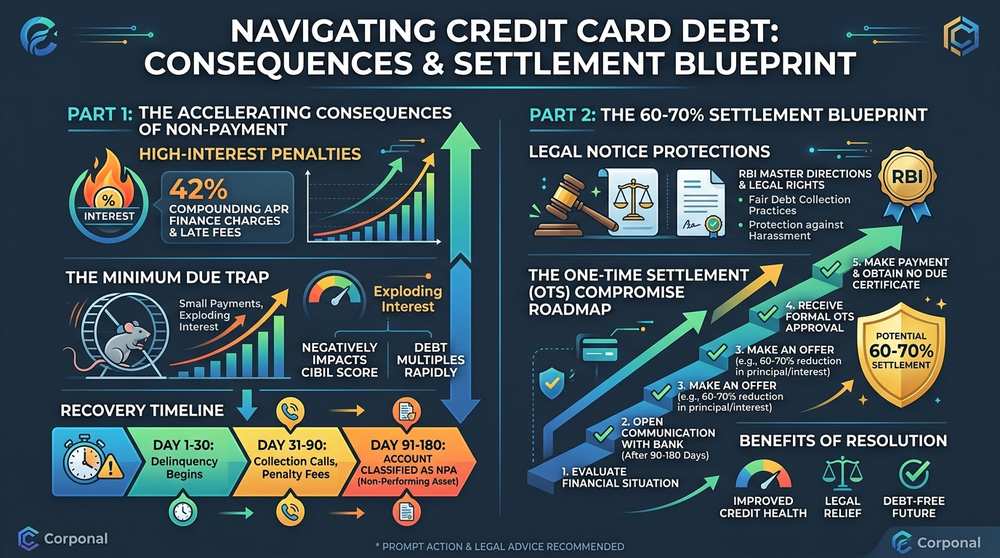
Figure 1.1: Complete structural breakdown of credit card delinquency mechanics, statutory borrower protections under RBI Master Directions, and the 5-step One-Time Settlement compromise process.
Recovery Agent Harassment Defense: Your Legal Rights Under RBI Master Directions
When credit card accounts enter 60+ days of delinquency, banks frequently outsource collections to third-party Direct Recovery Agencies (DRA). Driven by lucrative recovery commissions (ranging from 10% to 25% of recovered amounts), recovery agents often resort to unlawful aggressive tactics: continuous calling, abusive language, threatening home or workplace visits, contacting relatives or employer HR departments, and sending fake legal notices or fabricated police arrest warrants over WhatsApp.
Borrowers must understand that the Reserve Bank of India has enacted stringent statutory regulations under the RBI Master Circular on Recovery Agents & Fair Practices Code to eliminate these predatory practices. Under RBI guidelines:
Recovery agents are strictly prohibited from calling or visiting borrowers before 08:00 AM or after 07:00 PM. Calls during late nights or early mornings constitute an immediate statutory regulatory violation.
Agents cannot disclose your debt, call, or visit your employers, colleagues, friends, neighbours, or non-guarantor family members under strict privacy mandates and IT Act provisions.
Any agent visiting in person must carry a certified Bank Identity Card, a formal Bank Authorization Letter with the cardholder's name, and a valid DRA accreditation from the Indian Institute of Banking and Finance (IIBF).
Threats of police arrest, confiscation of household assets, character defamation, or physical intimidation carry severe civil penalties and criminal liabilities for both the agent and the lending bank.
If recovery agents violate these statutory directives, borrowers can initiate immediate legal recourse: (1) Serving a formal legal Cease-and-Desist Notice drafted by banking advocates to the bank's Managing Director and Principal Nodal Officer; (2) Filing an official grievance on the RBI Integrated Ombudsman portal (cms.rbi.org.in); and (3) Filing an administrative complaint under Section 503/506 IPC if criminal intimidation occurs.
Legal Notice Forensics: Section 25 PSSA, Section 138, Summary Suits & Arbitration
As credit card defaults progress past 90 to 120 days, banks frequently issue formal legal demand notices authored by empaneled collection advocates. Distressed cardholders must recognize the distinct legal instruments lenders employ and understand the civil court protections available:
Advocate Legal Demand Notice (Contractual Recall)
A standard 15-day or 30-day demand notice demanding repayment of total card dues plus compounded interest. It is a pre-litigation communication, not a court order. Responding through specialized legal counsel highlighting genuine financial hardship establishes documentary evidence for future compromise negotiations.
Section 25 PSSA Notices (Auto-Debit / NACH Dishonour)
If you set up an electronic NACH auto-debit for your credit card bill that bounced due to insufficient funds, banks may issue a notice under Section 25 of the Payment and Settlement Systems Act (PSSA), 2007. This is a quasi-criminal bailable proceeding handled in Metropolitan Magistrate Courts that is routinely compounded and dismissed through compromise settlement.
Order 37 CPC Summary Suits & DRT Pecuniary Limits
Under the Recovery of Debts and Bankruptcy Act (RDB Act), 1993, banks cannot approach the Debt Recovery Tribunal (DRT) for debts below ₹20 Lakhs. Because virtually all individual credit card balances fall below ₹20 Lakhs, banks are restricted to local Civil Courts under Order 37 of the Code of Civil Procedure (CPC), where court fees (typically 5% to 8% ad-valorem) and 4 to 7 years of judicial delays make litigation economically unviable for the bank.
Cardholders must be aware of the Right of Set-Off. If you hold a savings, salary, or fixed deposit account with the exact same bank that issued your defaulted credit card under the same PAN/CIF, the bank can legally appropriate deposited funds to adjust credit card arrears. To protect essential household living expenses, borrowers in default should immediately redirect active salary credits and emergency liquidity to an independent, non-lender banking institution.
How One-Time Settlement (OTS) Works: Unlocking 60%–70% Debt Haircuts Under RBI Frameworks
A One-Time Settlement (OTS) is a legally binding compromise resolution executed under the Reserve Bank of India's Framework for Compromise Settlements and Technical Write-offs (RBI/2023-24/40). When a credit card balance transitions into a Doubtful Asset or Technical Write-off on the bank's balance sheet, the bank's internal Credit Risk Committee evaluates the asset through a Net Present Value (NPV) recovery lens.
Lenders understand that pursuing civil litigation against an unsecured debtor involves substantial legal retainer costs, court stamp duties, external agency commissions, and 5 to 7 years of court delays with zero guarantee of asset realization. Consequently, banks prefer recovering a guaranteed lump-sum or structured payment immediately rather than carrying dead assets on their books.
Where C_t represents estimated recoveries, r is the bank discount rate, and deductions account for 3–5 years of court friction, advocate fees, and capital locked in 100% NPA provisions.
During an advocate-led OTS negotiation:
- 100% Elimination of Penal Surcharges: All accumulated 42% APR finance charges, compounding interest, late payment fees, overlimit penalties, and associated GST are stripped from the ledger.
- 60% to 70% Principal Debt Discount: The core utilized principal is negotiated down based on verified documentation of bona fide financial hardship (medical records, job termination letters, business P&L decline).
- Structured Installment Flexibility: Borrowers can negotiate the settlement amount to be paid either as a single bullet payment or across 2 to 4 structured monthly installments.
Sanction Letter Forensics: Essential Checkpoints & Guaranteed ₹0 NDC Delivery
Thousands of borrowers fall victim to collection agency scams where recovery tele-callers make verbal settlement promises, accept partial payments, and credit the money as regular interest payments without closing the account. To ensure complete legal closure, every settlement must satisfy rigorous forensic standards:
Official Bank Letterhead & Stamp
The OTS Sanction Letter must be printed on official bank stationery featuring the bank's corporate logo, branch address, authorized signatory signature, employee ID, and official branch seal. Never accept agreements via plain text emails or WhatsApp messages.
Account Number & Installment Dates
The letter must explicitly cite your 16-digit credit card number or 10-digit loan account reference, the exact negotiated settlement figure in words and figures, and strict payment due dates.
Full & Final Waiver Clause
The document must contain an express contractual clause affirming that upon receipt of the agreed settlement sum, all balance ledger dues stand irrevocably waived, and the bank will initiate no future legal or collection claims.
30-Day Mandatory NDC Delivery
Under RBI Circular RBI/2023-24/60, the bank is statutorily bound to deliver a formal No Dues Certificate (NDC) within 30 calendar days of payment, subject to a ₹5,000 per day compensation penalty for non-compliance.
CIBIL Score Impact & Credit Rehabilitation: Rebuilding to 750+ After Settlement
Executing a credit card settlement results in your credit report status updating to 'Settled' or 'Post-Write-Off Settled' with an outstanding ledger balance of ₹0. While this causes a temporary credit score drop of 75 to 120 points and creates a cooling-off window for unsecured loan applications, it immediately terminates compounding default flags, monthly DPD escalation, and legal collection proceedings.
Borrowers can systematically rehabilitate their credit score back to 750+ within 18 to 24 months by following an advocate-tested credit restoration protocol:
Verify ₹0 Balance Reporting: Within 45 days of settlement, pull fresh credit reports from CIBIL, Experian, Equifax, and CRIF High Mark to confirm the account status is updated to 'Settled' and outstanding dues reflect strictly as ₹0.
Acquire a Fixed-Deposit Secured Credit Card: Open a fixed deposit of ₹25,000 to ₹50,000 with a retail bank (such as IDFC FIRST Bank or Kotak Mahindra Bank) and obtain a secured credit card issued against 80% to 90% of the FD value without income verification.
Maintain a <30% Credit Utilization Ratio: Utilize the secured card exclusively for routine household purchases (groceries, utility bills), keeping utilization strictly under 30% of the credit limit.
100% On-Time Full Bill Payments: Set up automated payments to clear 100% of the monthly statement balance on the secured card before the due date, building a flawless 12 to 18-month on-time repayment track record.

Settle Loan is India's trusted debt relief and loan settlement platform. We help borrowers overcome financial distress by negotiating with banks and NBFCs to legally settle personal loans and credit card debts. With our transparent, performance-based approach, you can achieve debt freedom and regain your financial peace of mind.
COMPUTER
Frequently Asked Questions: Credit Card Default & Debt Settlement
Credit card bill na bharne par bank sabse pehle 42% se 48% annual finance charges (3.5%–4% monthly) aur late payment fees lagata hai, jismein 18% GST judti hai. 30 din baad CIBIL score girna shuru hota hai, 60 din par card permanently block hota hai, aur 90 din default hone par account Non-Performing Asset (NPA) ban jata hai. Iske baad bank third-party recovery agencies assign karta hai aur legal demand notices bhejta hai. Lekin genuine default ek purely civil matter hai, jismein criminal arrest nahi ho sakti.
Nahi, credit card default par bilkul bhi police arrest ya jail nahi ho sakti. Credit card debt ek purely unsecured civil liability hai jo Indian Contract Act, 1872 ke antargat aati hai. Police ke paas credit card default par FIR darj karne ya arrest karne ka koi legal adhikar nahi hai. Recovery agents dwara jail ya police ki dhamki dena RBI guidelines ke tehat gair-kanooni hai.
Minimum Amount Due aamtaur par total balance ka kewal 5% hota hai. Is 5% mein se lagbhag 3.5% finance charges, GST aur fees mein chala jata hai, aur kewal 1% se 1.5% actual principal ko kam karta hai. Baki bache 95% balance par daily compounding 42% APR lagta rehta hai aur interest-free grace period khatam ho jata hai. Is wajah se ₹1 Lakh ka balance kewal minimum dues bharne par chukane mein 15 se 22 saal lag jate hain.
Credit card default jab 90 se 180 din cross karke NPA (Non-Performing Asset) ya Doubtful Asset category mein pahunchta hai, tab bank RBI compromise settlement guidelines ke tehat 60% se 70% tak ka haircut (waiver) sanction karte hain. Is settlement mein 100% penal charges, late fees aur finance interest poori tarah waive ho jate hain aur kewal discounted principal amount par account close hota hai.
RBI Master Directions ke tehat recovery agents kewal subah 8:00 baje se shaam 7:00 baje ke beech hi call ya visit kar sakte hain. Unhe dhar-pakad, gali-galoch, relatives ya office colleagues ko call karna, bina ID card visit karna, ya social media par defame karna strictly banned hai. Harassment hone par borrower bank ke Principal Nodal Officer aur RBI Integrated Ombudsman Portal (cms.rbi.org.in) par formal complaint darj kar sakte hain.
Legal notice ko ignore na karein. Ek banking advocate ke madhyam se 15 se 30 din ke andar formal reply draft karwayein. Reply mein financial hardship (jaise job loss ya medical emergency) ko document karein, bank ke compounding interest aur illegal charges ko challenge karein, aur bank ko Lok Adalat ya formal One-Time Settlement (OTS) negotiation ke liye invite karein.
Bank kewal usi bank mein sthit savings ya deposit account par 'Right of Set-off' (Section 171, Indian Contract Act) use kar sakta hai jahan credit card chal raha hai. Dusre independent banks mein sthit aapke salary ya savings accounts ko bank bina civil court order ke na to touch kar sakta hai aur na hi freeze kar sakta hai.
Settlement ke baad credit report par status 'Settled' update hota hai aur score mein 75 se 120 points ka temporary dip aata hai. Lekin compounding overdue aur legal flags hamesha ke liye band ho jate hain. Fixed Deposit (FD) ke against secured credit card lekar aur timely payment karke 18 se 24 mahine mein CIBIL score ko dobara 750+ tak rehabilitate kiya ja sakta hai.
RBI Circular RBI/2023-24/60 ke anusar, full settlement payment jama hone ke 30 calendar days ke andar bank ko formal No Dues Certificate (NDC) issue karna aur credit bureaus ko update karna anivarya hai. Yadi bank 30 din mein NDC deliver nahi karta, toh borrower ko per day ₹5,000 ka statutory compensation claim karne ka adhikar hai.
Official Statutory & Regulatory References
- Reserve Bank of India: Master Direction – Credit Card and Debit Card – Issuance and Conduct Directions, 2022 (RBI/2022-23/92)
- RBI Master Circular: Framework for Compromise Settlements and Technical Write-offs (RBI/2023-24/40)
- Reserve Bank - Integrated Ombudsman Scheme, 2021: Official Portal for Filing Recovery Agent Harassment Complaints
- Legislative Department, Ministry of Law and Justice: The Indian Contract Act, 1872 & Payment and Settlement Systems Act, 2007 (Section 25)
- National Legal Services Authority (NALSA): Pre-Litigation Dispute Conciliation & National Lok Adalat Settlement Guidelines